
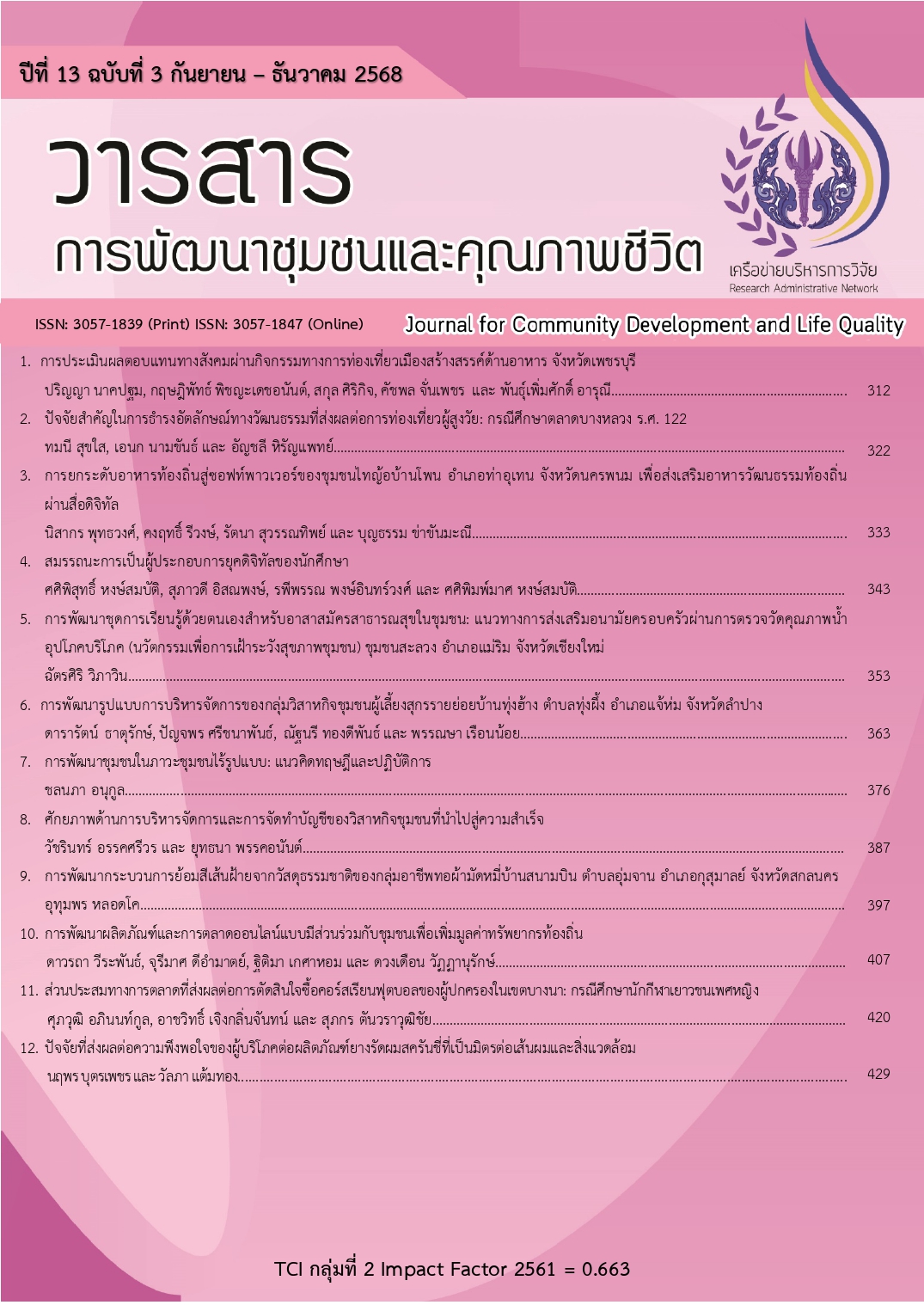
สมรรถนะการเป็นผู้ประกอบการยุคดิจิทัลของนักศึกษา
Article Sidebar
Main Article Content
บทคัดย่อ
การวิจัยนี้มีวัตถุประสงค์เพื่อ 1) วิเคราะห์องค์ประกอบสมรรถนะการเป็นผู้ประกอบการยุคดิจิทัลของนักศึกษา 2) ตรวจสอบความกลมกลืนขององค์ประกอบสมรรถนะการเป็นผู้ประกอบการยุคดิจิทัลของนักศึกษา
เป็นการวิจัยแบบผสานวิธี เก็บข้อมูล 2 รูปแบบ การวิจัยเชิงคุณภาพใช้แบบสัมภาษณ์ กลุ่มเป้าหมาย ได้แก่ ผู้แทนจากชุมชน 2 คน ผู้ทรงคุณวุฒิ 5 คน ประกอบด้วย ผู้ประกอบการ นักวิชาการด้านการบริหารธุรกิจ นักวิชาการด้านบริหารการศึกษา นักวิชาการด้านการตลาด นักวิชาการด้านการเงิน และการวิจัยเชิงปริมาณ ใช้แบบสอบถามมาตราส่วนประมาณค่า 5 ระดับ กับนักศึกษาวิทยาลัยชุมชน จำนวน 521 คน โดยการสุ่มแบบชั้นภูมิ วิเคราะห์ข้อมูลโดยใช้โปรแกรม LISREL ผลการวิจัย พบว่า 1) องค์ประกอบสมรรถนะการเป็นผู้ประกอบการยุคดิจิทัลของนักศึกษามี 4 องค์ประกอบ ได้แก่ (1) ชุดทักษะของผู้ประกอบการ (2) ชุดความรู้ของผู้ประกอบการ (3) กรอบความคิดของผู้ประกอบการ และ (4) การปฏิบัติของผู้ประกอบการ 2) โมเดลองค์ประกอบสมรรถนะการเป็นผู้ประกอบการยุคดิจิทัลของนักศึกษา มีความสอดคล้องกับข้อมูลเชิงประจักษ์ ดัชนีทุกตัวผ่านเกณฑ์การประเมินความสอดคล้องในระดับดี ผลการตรวจสอบดัชนีความสอดคล้องพิจารณาค่า p-value = 0.00 Chi-square/df = 1.689 GFI = 0.967 AGFI = 0.954 SRMR = 0.043 และ RMSEA = 0.036
Article Details

อนุญาตภายใต้เงื่อนไข Creative Commons Attribution-NonCommercial-NoDerivatives 4.0 International License.
กองบรรณาธิการขอสงวนสิทธิ์ในการตรวจและแก้ไขบทความที่เสนอเพื่อตีพิมพ์ในวารสารการพัฒนาชุมชนและคุณภาพชีวิต
บทความหรือข้อความคิดเห็นใด ๆ ที่ปรากฏในวารสารการพัฒนาชุมชนและคุณภาพชีวิต เป็นวรรณกรรมของผู้เขียนโดยเฉพาะคณะผู้จัดทำไม่จำเป็นต้องเห็นด้วย และไม่ใช่ความรับผิดชอบของมหาวิทยาลัยและคณะผู้จัดทำ / บรรณาธิการ
เอกสารอ้างอิง
Carlo, G. and B.A. Randall. 2002. The development of a measure of prosocial behaviors for late adolescents. Journal of Youth and Adolescence 31(1): 31-44.
Chankan, C., C. Chatruprachewin and S. Chaowachai. 2024. Model for developing entrepreneurial competency of students in educational institutions under Office of the Vocational Education Commission. Journal of MCU Peace Studies 12(2): 567-581. (in Thai)
Chatchawan, N. and K. Vaisopha. 2023. The factors analysis of digital competency for education management administrators under the Loei Primary Education Area 1. Ratanabuth Journal 5(1): 169-182. (in Thai)
Cohen, J., P. Cohen, S. G. West and L. S. Aiken. 2003. Applied Multiple Regression/
Correlation Analysis for the Behavioral Sciences. 3rd ed. Lawrence Erlbaum Associates Publishers, Mahwah, New Jersey. 703 p.
Gunawan, A. F. 2024. The impact of entrepreneurial characteristics and competencies on business performance in the creative industry in Indonesia. Asian Pacific Journal of Innovation and Entrepreneurship 18(3): 300-317.
Hair, J.F., W.C. Black., B.J. Babin and R.E. Anderson. 2019. Multivariate Data Analysis. 8th ed. Cengage Learning, Hampshire. 813 p.
Hussain, B.M., U. Baig, V. Davidaviciene and I. Meidute-Kavaliauskiene. 2021. A thoughtful insight on women entrepreneur’s investment attitude. Economies 9(4): 187, doi : org/10.3390/economies9040187
Korte, R., K. A. Smith and C.Q. Li. 2018. The role of empathy in entrepreneurship: A core competency of the entrepreneurial mindset. Advances in Engineering Education7(1).https://file.eric.ed.gov/fulltext/ EJ1199603.pdf
Le Dinh, T., M.C. Vu and A. Ayayi. 2018. Towards a living lab for promoting the digital entrepreneurship process. International Journal of Entrepreneurship 22(1): 1–17.
Markow, W., D. Hughes and A. Bundy. 2018. The New Foundational Skills of the Digital Economy. Burning Glass Technologies, Boston. 63 p.
Morched, S and A. Jarboui. 2025. Synergy between project management and entrepreneurship. IntechOpen. doi:10.5772/intechopen.1008296.
Naklungka, K., K. Khumprasert, K. Photimanee and P. Akrarat. 2025. Strategy for developing short-term curriculum to promote modern entrepreneurial skills. Thai Interdisciplinary and Sustainability Review 14(1): Article 23, doi: 10.14456/tisn.2025.23. (in Thai)
Nakruang, D., K. Donkwa and A. Suvittawat. 2021. Effect of entrepreneurial orientation on corporate sustainability performance: Mediating role of differentiation and the knowledge integration capability of community enterprises in three southern border provinces. Journal of Community Development and Life Quality 9(1): 39-50. (in Thai)
Niyawanont, N. and S. Wanarat. 2021. Structural equation modelling of digital entrepreneurship, logistics innovation, and digital transformation influence on logistics performance of logistics entrepreneurs in Thailand. ABAC Journal 41(4): 147-174.
Office of the Education Council. 2018. Entrepreneurship Education. Prikwhan Graphic, Bangkok. 237 p. (in Thai)
Pantang, P., T. Thamee and D. Buntam. 2024. Development of participatory business model canvas to increase business capability of Ban Siao processed fruit community enterprise. Modern Management Journal 22(1): 41-58. (in Thai)
Phungphol, W., V. Jadesadalug and J. Sansook. 2020. The development of business intellectual competency for modern Thai SMEs towards business performance in Thailand 4.0 era. Dusit Thani College Journal 14(2): 341-360. (in Thai)
Sanchez-Vera, M. del M, and P. Lopez-Vicent. 2024. The competence of digital entrepreneurship in education: Analysis of the perception of university students. Intangible Capital 20(2): 376-392.
Santos, E. A. dos and A. L. V. Torkomian. 2021. Characteristics of the digital entrepreneur: a multicase study in startups. International Journal of Innovation 9(2): 219-238.
Thongeiam, S and W. Sapsanguanboon. 2022. The study of skills development methodology for entrepreneurin digital era. Journal of Accountancy and Management 14(1): 32-42. (in Thai)
Yamane, T. 1973. Statistics: An Introductory Analysis. 3rd ed. Harper and Row, New York. 1130 p.
