
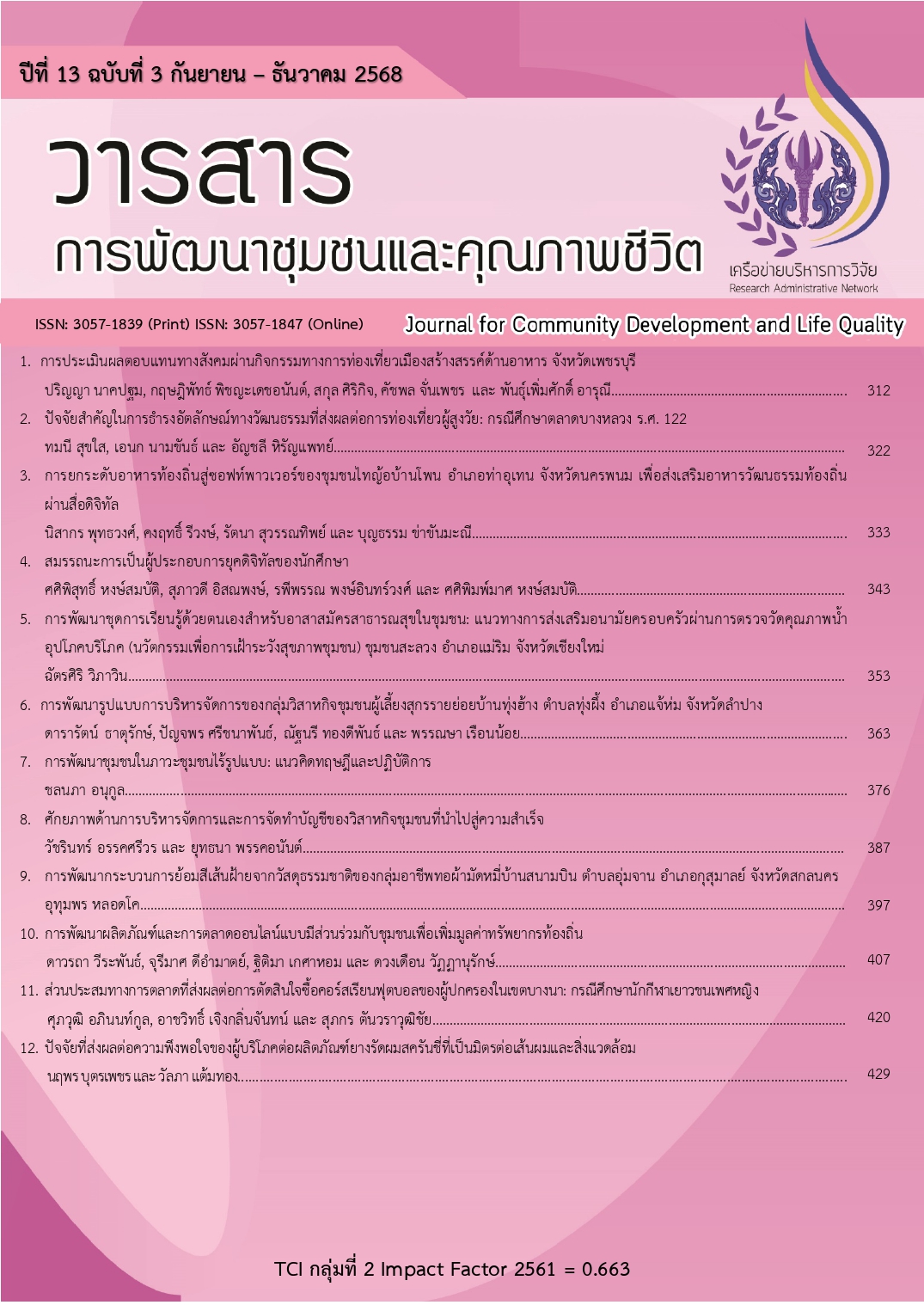
การพัฒนาชุมชนในภาวะชุมชนไร้รูปแบบ: แนวคิดทฤษฎีและปฏิบัติการ
Article Sidebar
Main Article Content
บทคัดย่อ
การเกิดขึ้นของชุมชนไร้รูปแบบ อันประกอบไปด้วย ชุมชนที่ปราศจากความสัมพันธ์ใกล้ชิด และชุมชนที่ไม่ได้ยึดโยงผ่านสถานที่ทำให้ต้องกลับไปทบทวนแนวคิดทฤษฎีก่อนหน้า การขยับขยายนิยามของชุมชนทำให้ปฏิบัติการผ่านชุมชนไร้รูปแบบปรากฏตัวได้มากขึ้น บทความนี้มุ่งสำรวจชุมชนไร้รูปแบบที่หลากหลาย โดยเฉพาะชุมชนที่มีรูปแบบและโครงสร้างต่างไปจากชุมชนดั้งเดิม และแม้ว่านิยามการพัฒนาชุมชนจะยังขาดความชัดเจน แต่การบรรลุความเป็นน้ำหนึ่งใจเดียวกันก็ยังคงเป็นเป้าหมายของงานพัฒนาชุมชน แนวคิดผู้ประกอบการพลเมืองจึงถูกนำเสนอในฐานะแนวทางการพัฒนาชุมชนแบบใหม่ที่จะบรรลุความเป็นน้ำหนึ่งใจเดียวกันของชุมชนไร้รูปแบบ กรณีศึกษา 3 เรื่องในบริบทสังคมไทยใช้อธิบายการทำงานของผู้ประกอบการพลเมืองในการทำงานกับชุมชนที่ปราศจากความสัมพันธ์ใกล้ชิด และชุมชนที่ไม่ได้ยึดโยงผ่านสถานที่
Article Details

อนุญาตภายใต้เงื่อนไข Creative Commons Attribution-NonCommercial-NoDerivatives 4.0 International License.
กองบรรณาธิการขอสงวนสิทธิ์ในการตรวจและแก้ไขบทความที่เสนอเพื่อตีพิมพ์ในวารสารการพัฒนาชุมชนและคุณภาพชีวิต
บทความหรือข้อความคิดเห็นใด ๆ ที่ปรากฏในวารสารการพัฒนาชุมชนและคุณภาพชีวิต เป็นวรรณกรรมของผู้เขียนโดยเฉพาะคณะผู้จัดทำไม่จำเป็นต้องเห็นด้วย และไม่ใช่ความรับผิดชอบของมหาวิทยาลัยและคณะผู้จัดทำ / บรรณาธิการ
เอกสารอ้างอิง
Bhattacharyya, J. 2004. Theorizing community development. Journal of the Community Development Society 34(2): 5-34.
Biddle, W. W. 1966. The “fuzziness” of definition of community development. Community Development Journal 1(2): 5-12.
Blakely, E. J. and M. G. Snyder. 1997. Fortress America: Gated Communities in the United States. Brookings Institution Press, Washington D.C. 208 p.
Bradshaw, T. K. 1992. In the Shadow of Urban Growth: Bifurcation in Rural California Communities. Institute of Urban and Regional Development, University of California, Berkeley. 32 p.
Bradshaw, T. K. 2008. The post-place community: Contributions to the debate about the definition of community. Community Development 39(1): 5-16.
Chiengthong, J. 2000. Evolution of civil society in Thailand. Research Report. Thailand Development Research Institute, Bangkok. 60P. (in Thai)
UNTERM. 1995. Community development. (Online). Available: https://web.archive.org/web
/20140714225617/http://unterm.un.org/DGAACS/unterm.nsf/8fa942046ff7601c85256983007ca4d8/526c2eaba978f007852569fd00036819?OpenDocument (18 October 2024).
Ganjanapan, A. 2001. Community Aspect: Local Thought on Rights, Power, and Resource Management. Thailand Research Fund, Bangkok. 319 p. (in Thai)
Garreau, J. 2011. Edge City: Life on the New Frontier. Knopf Doubleday Publishing Group, New York. 576 p.
Giddens, A. 1984. The Constitution of Society: Outline of the Theory of Structuration. University of California Press, Berkeley. 402 p.
Gilchrist, A. and M. Taylor. 2011. The Short Guide to Community Development. Policy Press, Bristol. 216 p.
Granovetter, M. and R. Swedberg. 2018. The Sociology of Economic Life. Routledge, New York. 594 p.
Henton, D., J. Melville and K. Walesh. 1997. The age of the civic entrepreneur: Restoring civil society and building economic community. National Civic Review 86(2): 149-156.
Hutacharoen, S. (ed.). 1967. Articles on Community Development: Book one. Local Printing House, Phra Nakhon. 206 p. (in Thai)
Kaewthep, K. 1995. Development of Cultural Community: Human Centric Approach. Catholic Council of Thailand for Development, Bangkok, 190 p. (in Thai)
Kenny, S. 2011. Towards unsettling community development. Community Development Journal 46 (Suppl. 1): i7-i19.
Kenny, S. 2019. Framing community development†. Community Development Journal 54(1): 152-157.
Luna, E. M. 1999. Rethinking community development in the Philippines: Indigenizing and regaining grounds.
The Philippine Social Sciences in the Life of the Nation 1: 315–343.
Naksing, P., K. Chawathanakun, C.ฺ Bundhuwong and A. Hongkananukraw 2017. Rural transformation and livelihood adaptations: A case study of villagers in an “agricultural community” in Nakhon Pathom Thailand. Journal of Social Research and Review 40(2): 77-106.
(in Thai)
Nakmanoch, N. 2018. Entering for job of Karen construction workers to Keepmoo community, Klong Sarmwa, Bangkok, M.P.A. Thesis, Burapha University. 87 p. (in Thai)
Nartsupha, C. 2005. Community Economic: Theoretical Proposal for Different Social Contexts. 2nd ed. Sangsan Publishing House, Bangkok. 214 p. (in Thai)
Pintoptang, P. 2015. Political and economic change in rural communities and peasants’ adaptation. Journal of Social Development and Management Strategy 17(1): 29-63. (in Thai)
Pongpit, S. 2002. Community network and civic society: Idea experience examples. Public Health System Research Institute. Bangkok. (in Thai)
Putnam, R. D. 2001. Bowling Alone: The Collapse and Revival of American Community. Simon & Schuster, New York. 541 p.
Rheingold, H. 1993. The Virtual Community: Homesteading on the Electronic Frontier. Addison-Wesley, Reading.
Rigg, J., S. Veeravongs, L. Veeravongs and P. Rohitarachoon, 2008. Reconfiguring rural spaces and remaking rural lives in central Thailand. Journal of Southeast Asian Studies 39(3): 355-381.
Salamon, S. 2003. From hometown to nontown: Rural community effects of suburbanization. Rural Sociology 68(1): 1–24. https://doi.org/10.1111/j.1549-0831.2003.tb00126.x
Sassen, S. 2004. The global city: Introducing a concept. The Brown Journal of World Affairs 11(2): 27-43.
Sattayanurak, A. 2016. Better Live: From Peasant to Enterpreneur. Matichon Public Company Limited, Bangkok. 160 p.
(in Thai)
Puchthonglang P., A. Namwongprom. 2018. Creative economic development model of Lanna Lantern Manufacturers at Muang Sart Community in Muang District, Chiang Mai Province. Journal for Quality Development and Life Quality 1(3): 129-139. (in Thai).
Tonnies, F. and C. P. Loomis. 2002. Community and Society. Dover Publications Inc., Mineola, New York.
Vidich, A. J. and J. Bensman. 1968. Small Town in Mass Society: Class, Power, and Religion in a Rural Community. University of Illinois Press, Urbana. 521 p.
Webber, M. M. 2011. Order in diversity: Community without propinquity. pp.23-56. In: L. Wingo, Jr. (ed.). City and Space: The Future Use of Urban Land. REF Press, New York.
Wellman, B. 2001. Networks in the global village: Life in contemporary communities. Contemporary Sociology 30(5): 268-269.
Wirth, L. 1938. Urbanism as a way of life. American Journal of Sociology 44(1): 1-24.
