
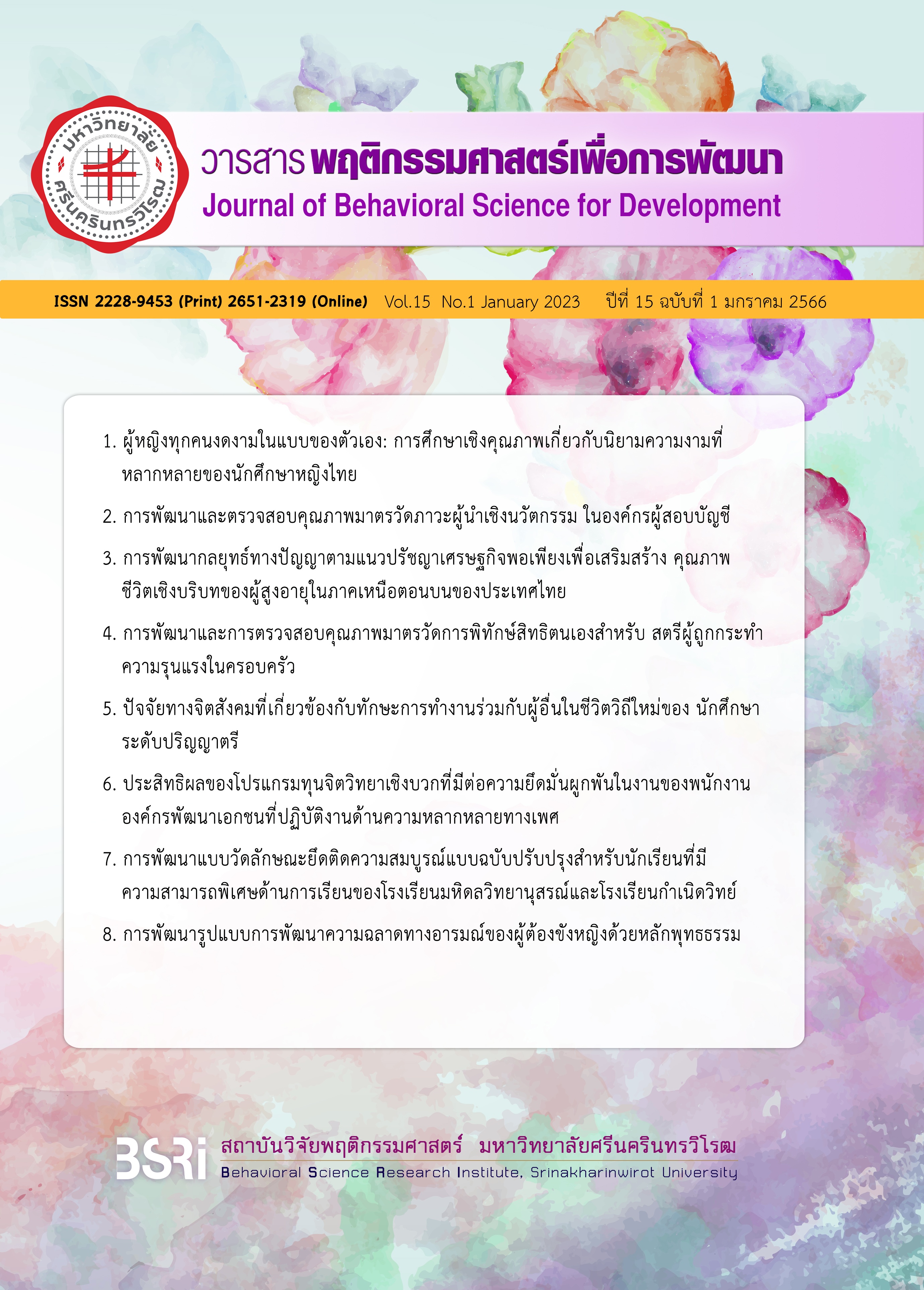
The Development and Validation of Innovative Leadership Scale in Auditory Company
Keywords:
Scale development, Innovative leadership, Psychometric properties, Exploratory factor analysis, AuditorAbstract
Due to digital disruption, the auditing firms and the auditors have greatly been impacted as being the key people who provide the auditing opinions to the business. The objectives of this study were 1. To explore definition, attributes, and factors of innovative leadership in auditory firms; 2. To develop and validate innovative leadership in auditory firms and; 3. To examine the structural factor of innovative leadership in auditory firms. This study was divided into two phases: qualitative and quantitative research methods. The qualitative consisted of the interviews to the four key informants and the second phase was conducted to the 450 auditors in Thailand. For the definition of innovative leadership, referring to the in-depth interview at the first phase of research, it has been found that the innovative leadership in auditing firms can be categorized into five dimensions 1 Team Working; 2. Embracing to Change; 3. Self-development and Team Development; 4. Goal Setting; and 5. Networking. Therefore, the researcher collected the first key findings to define the meaning of innovative leadership as the ability to influence team management to achieve goals, embrace change, assess and take risk of taking the initiative or improving process in own's or team's responsibilities, have perseverance, embracing diversity and inclusion in the team, assign tasks based on individual capability, motivate team and build collaboration, inquiring for information from both inside and outside organization in order to gain the new approach or body of knowledge which the innovative leader significantly supports in bringing the innovation into practice to serve customer's context or needs. The exploratory was applied in order to extract the factors. According to the research findings, there were 34 items of innovative leadership in the auditory firms which could be categorized into five factors: change management, team development, being ambitious, self-development, and building and networking. The psychometric measurement was controlled by the reliability and validity, item-total correlation, and reliability. This study also demonstrated the meaning of Innovative leadership and factors in auditors in Thailand. The psychometric properties can also be used as the tools for developing innovative leadership for auditors in Thailand.
References
Ailin, M., & Lindgren, P. (2008, September). Innovation leadership in danish smes. In 2008 4th IEEE International Conference on Management of Innovation and Technology (pp. 98-103). IEEE.
Alavi, M., Visentin, D. C., Thapa, D. K., Hunt, G. E., Watson, R., & Cleary, M. L. (2020). Chi-square for model fit in confirmatory factor analysis. Journal of Advanced Nursing, 76(9), 2209-2211.
Buachu, T., & Wivatvanit, S. (2017). Innovation leadership of head nurse, government university hospita. Journal of Nursing Science Chulalongkorn University, 29(1), 141-153. [in Thai]
Cardoso, A. A. (2018). A Mixed Method Study of Transformational, Transactional, Innovative Leadership Styles in Large Accounting Firms. University of Phoenix.
Chomphuphan, K. (2021). Development approach for innovative leadership in digital age businesses. Journal of Educational Innovation and Research, 5(1), 148-155. [in Thai]
Comrey, A. L., & Lee, H. B. (2013). A first course in factor analysis. Psychology press.
Costello, A. B., & Osborne, J. (2005). Best practices in exploratory factor analysis: Four recommendations for getting the most from your analysis. Practical assessment, research, and evaluation, 10(1), 7.
Davis, M. W. (2019). Innovative leadership. Journal of Leadership, Accountability & Ethics, 16(4).
Dhammasudho, P. A., & Khantisopano, P. P. (2016). Innovation leadership roles for the Sangha Administration Ministry in the next decade. Journal of MCU Peace Studies. 4(2), 313-325. [in Thai]
Eltweri, A. (2021). The Blockchain Impact on the Current Auditing Standards. Information Technology innovations in Economics, Finance, Accounting, and Law, 2(3), 7-12.
Fabrigar, L. R., Wegener, D. T., MacCallum, R. C., & Strahan, E. J. (1999). Evaluating the use of exploratory factor analysis in psychological research. Psychological methods, 4(3), 272.
Federation of Accounting Professions (n.d.). Auditing Standards (Revised) Communication with those charged with governance. https://www.google.com/url?sa=t&rct=j&q=&esrc=s&source=web&cd=&cad=rja&uact=8&ved=2ahUKEwiM4v6t54b5AhWNjWMGHbAlAdsQFnoECAYQAQ&url=https%3A%2F%2Fwww.tfac.or.th%2Fupload%2F9414%2FfxYPyfxTEX.pdf&usg=AOvVaw2uAETNjLYRBVIWB0yGbWvG
Gliddon, D. G. (2006). Forecasting a competency model for innovation leaders using a modified Delphi technique. (Doctoral dissertation). University Park: Pennsylvania State University.
Gliddon, D. G., & Rothwell, W. J. (2018). Innovation leadership. Routledge.
Griffin, P. A., & Wright, A. M. (2015). Commentaries on big data's importance for accounting and auditing. Accounting Horizons, 29(2), 377-379.
Hinkin, T. R. (1998). A brief tutorial on the development of measures for use in survey questionnaires. Organizational research methods, 1(1), 104-121.
Horth, D. M., & Vehar, J. (2012). Becoming a leader who fosters innovation. Center for Creative Leadership.
Janpla, J. (2016). Enhancement of innovative leadership of entrepreneurs in processed food business. Journal of southern technology, 9(1), 53-60. [in Thai]
Johannessen, J. A., & Stokvik, H. (2018). Evidence-based innovation leadership: creating entrepreneurship and innovation in organizations. Emerald Group Publishing.
Khalili, A. (2017). Creative and innovative leadership: Measurement development and validation. Management Research Review, 40(10), 1117-1138.
Kaiser, H. F. (1960). The application of electronic computers to factor analysis. Educational and psychological measurement, 20(1), 141-151.
Kunthin, P., Manokarn, M., & Thongngok, T. (2017). Innovative leadership of civil-state school administrators in Chiang Mai primary educational service area 5. Veridian E-Journal, Silpakorn University (Humanities, Social Sciences and arts), 10(3), 1833-1848. [in Thai]
Lohsrisupuchai, R. (2019). Development of innovative leadership measure among managers in the sme enterprises. Sripatum Chonburi Journal, 15(4), 219-228. [in Thai]
McGuirk, P. M., & O'Neill, P. (2016). Using questionnaires in qualitative human geography. In I. Hay (Eds.), Qualitative Research Methods in Human Geography (pp. 246-273). Oxford University.
McNeilly, M. (2008). George Washington's innovative leadership: Lessons executives can learn from America's first commander-in-chief. Strategy & Leadership.
Peat, J., & Barton, B. (2008). Medical statistics: A guide to data analysis and critical appraisal. John Wiley & Sons.
O'Grady, T., & Malloch, K. (2010). Quantum leadership. Jones & Bartlett Publishers.
Sen, A., & Eren, E. (2012). Innovative leadership for the twenty-first century. Procedia-Social and Behavioral Sciences, 41, 1-14.
Soonthornchai, N., Preuksatewed, C., & Chusorn, P. (2018). Guidelines for innovative leadership development of private school administrators in Kalasin province. Journal of Research and Development Institute Rajabhat Maha Sarakham University, 5(1), 67-76. [in Thai]
Stonehouse, G. H., & Konina, N. Y. (2020, February). Management challenges in the age of digital Disruption. Proceedings of the 1st International Conference on Emerging Trends and Challenges in the Management Theory and Practice (ETCMTP 2019).
Sultana, N., & Rahman, M. A. (2012). Innovative leadership (people). The Jahangirnagar Journal of Business Studies, 2(1), 37-51.
Szczypiorski, K. (2022). Cybersecurity and Data Science. Electronics, 11(15), 2309.
Tonak, K., Chaemchoy, S., & Konpuang, A. (2014). A Factor Analysis of innovation leadership for basic educational administrators. Journal of education Naresuan University, 16(4), 131-140. [in Thai]
Vanichvasin, P. (2016). The development of the learning activity packages to develop innovative leadership competencies for undergraduate students. Journal of Industrial Education, 15(3), 21-28. [in Thai]
World Economic Forum. (2020). The Future of Jobs Report 2020. World Economic Forum. https://www.weforum.org/reports/the-future-of-jobs-report-2020/.
Yasingthong, W., & Somprach, K. (2017). Innovative leadership affecting teachers learning under the secondary education service area office25. Journal of Education Khon Kaen University (Graduate Studies Research), 11(3), 234-244. [in Thai]
Zhichao, C., & Cui, L. (2012). Impact of mean LMX on team innovation: An empirical study of the mediating effect of team cooperation and the moderating effect of LMX differentiation in China. African Journal of Business Management, 6(35), 9833-9840.
Downloads
Published
How to Cite
Issue
Section
License
Copyright (c) 2023 Journal of Behavioral Science for Development

This work is licensed under a Creative Commons Attribution-NonCommercial-NoDerivatives 4.0 International License.


