
Developing Competency in Thai as a Second Language Instruction Through Active Learning Approach for Pre - Service Thai Language Teachers at Lampang Rajabhat University
Keywords:
Learning management competency, Active Learning, Thai as a Second LanguageAbstract
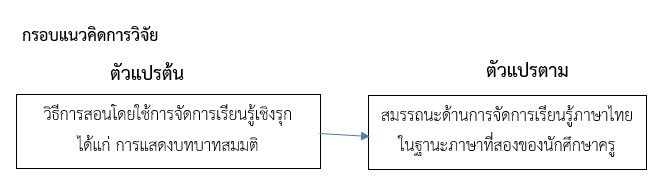
This research aimed to investigate the instructional competencies in teaching Thai as a second language based on an active learning approach among pre-service Thai language teachers at Lampang Rajabhat University. The target group consisted of 26 fourth-year students (Group 2) from the Thai Language Program, Faculty of Education, enrolled in the first semester of the 2025 academic year. The research instruments included four active-learning-based lesson plans. Data were analyzed using mean (M)and standard deviation.
The results revealed that the overall competency of the students in teaching Thai as a second language was at the highest level (M= 4.66, SD = 0.20). Specifically, Competency 1, the integration of pedagogical knowledge and active learning instructional design, was at the highest level (M= 4.58, SD= 0.31). Competency 2, the design of participatory learning activities through role play and group discussion, was at the highest level ( M= 4.66, SD = 0.36). Competency 3, creating a learning environment that promotes participation and cultural diversity, was also at the highest level (M= 4.67, SD = 0.31). Competency 4, the development of innovation and the application of digital technology for Thai language learning as a second language, was at the highest level (M= 4.73, SD = 0.29). Finally, Competency 5, the design of competency-based assessment aligned with the active learning approach, was at the highest level ( M= 4.69, SD = 0.47)
References
พิมพ์พันธ์ เดชะคุปต์, พเยาว์ ยินดีสุข, และพรเทพ จันทราอุกฤษฏ์. (2566). การเรียนรู้เชิงรุกเสริมสร้างสมรรถนะ. สำนักพิมพ์จุฬาลงกรณ์มหาวิทยาลัย.
วรัทยา แซมเพชร, ศศิวรรณ สุวรรณกิตติ, และนันท์นภัส นิยมทรัพย์. (2564). การพัฒนkผลสัมฤทธิ์ทางการเรียนและความสามารถในการคิดแก้ปัญหาของนักเรียนชั้นมัธยมศึกษา ปีที่ 1 โดยการจัดการเรียนรู้ที่ใช้ปัญหาเป็นฐานร่วมกับเทคนิคการอภิปรายกลุ่มย่อย. วารสารสังคมศาสตร์วิจัย, 12(1), 129-148. http://dept.npru.ac.th/jssr/data/files/12.1jssr8%281%29.pdf
วารินท์พร ฟันเฟื่องฟู. (2563). สมรรถนะการจัดการเรียนรู้เชิงรุกของนักศึกษาวิชาชีพครู. วารสารวไลยอลงกรณ์ปริทัศน์, 10(3), 193-202. https://so06.tci-thaijo.org/index.php/var/article/view/244173
สุภาลัย สายคำภา, และธีระภาพ เพชรมาลัยกุล. (2565). การจัดการเรียนรู้ฐานสมรรถนะเชิงรุกที่ส่งผลต่อสมรรถนะของผู้เรียน ในสังกัดสำนักงานเขตพื้นที่การศึกษามัธยมศึกษา กรุงเทพมหานคร เขต 2. วารสารบริหารการศึกษา มศว, 19(37), 22-34. https://ejournals.swu.ac.th/index.php/EAJ/article/view/15405
อาภาพร สิงหราช. (2557). การจัดการเรียนรู้เชิงรุกเพื่อพัฒนาทักษะการคิดขั้นสูง. สมมติ.
Bonwell, C. C., & Eison, J. A. (1991). Active learning: Creating excitement in the classroom. The George Washington University.
Downloads
Published
How to Cite
Issue
Section
License
Copyright (c) 2026 Faculty of Humanities and Social sciences, Pibulsongkram Rajabhat University

This work is licensed under a Creative Commons Attribution-NonCommercial-NoDerivatives 4.0 International License.
บทความที่ได้รับการตีพิมพ์เป็นลิขสิทธิ์ของคณะมนุษยศาสตร์และสังคมศาสตร์ มหาวิทยาลัยราชภัฏพิบูลสงคราม
บทความหรือข้อคิดใด ๆ ที่ปรากฏในวารสารอักษราพิบูลที่เป็นวรรณกรรมของผู้เขียน บรรณาธิการ หรือ มหาวิทยาลัยราชภัฏพิบูลสงคราม ไม่จำเป็นต้องเห็นด้วย



