
The Instructional Management and the Approach to Using the Concept of Intertextuality Theory with Plsek's Creative Process to Enhance Undergraduate Students’ Competence of Story Writing
Keywords:
Learning management model, the intertextuality theory, Plsek's creative thinking process, writing creative children's storiesAbstract
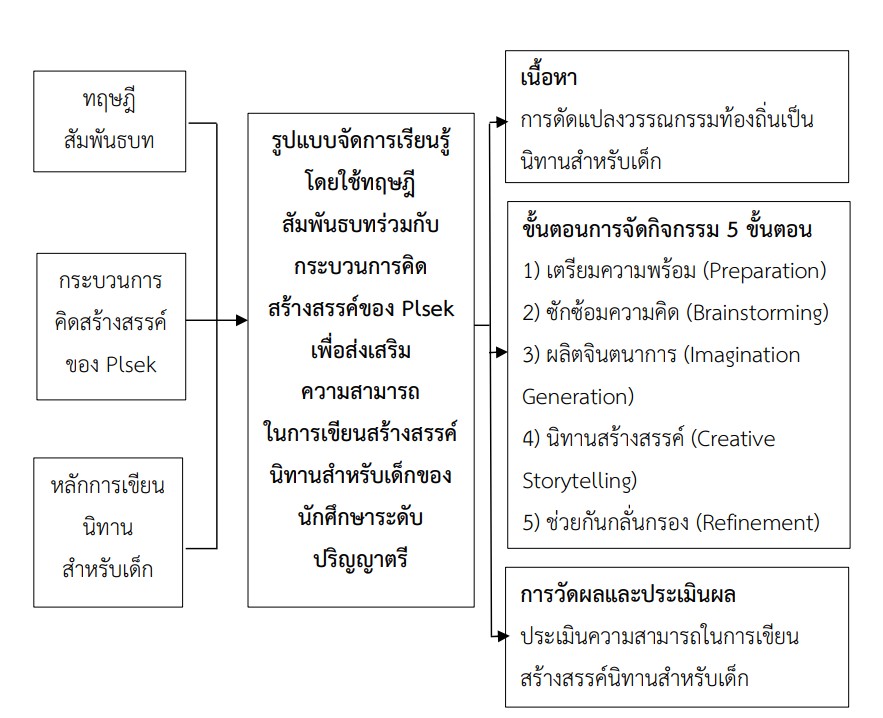
This research aims to study 1) the state of instructional management in story writing for children on undergraduate students, and 2) the approach to using the concept of intertextuality theory together with Plsek's creative thinking process. This is a qualitative research study, and collecting data through in-depth interviews with a purposive sampling method. The qualifications are defined into three groups: 1) eight lecturers in the Bachelor of Arts in Thai Language program from four Rajabhat Universities in lower northern Thailand; 2) twenty students in the Bachelor of Arts in Thai Language program from four Rajabhat Universities in lower northern Thailand; and 3) five experts in theoretical concepts. The research instruments used included: 1) an interview questionnaire on the state of instructional management for lecturers and students, and 2) an interview questionnaire on the approach to using the theoretical concepts. The research results were presented by using content analysis. The research findings revealed that: 1. A study of the instructional management in story writing for children on undergraduate students was categorized into four aspects: 1) Content: instructors selected content based on three approaches including adhering to the scope of the course description, considering student interests, and selecting high-quality children's literature.
Two problems were identified: the theoretical content is extensive, requiring it to be concise to meet deadlines, and students are more interested in literature than theory, and students were more interested in literature than theory; 2) Teaching and learning activities: three types of activities were conducted; lectures, literature analysis, and writing practices. Three problems were identified: students lacked reading and literature analysis skills, lacked creativity in writing, and submitted assignments late; 3) Teaching materials: two types of teaching materials were found; printed and electronic medias. Two problems were identified: instructors needed to constantly update the materials to keep them current, and students disliked reading long literary works; 4) Assessment methods: instructors used both formative and summative assessments. Two problems were identified: some students did not submit assignments on time, and could not complete subjective or essay tests on time. 2. Study the approach to using the concept of intertextuality theory together with Plsek's creative thinking process to enhance competence in creative story writing for children on undergraduate students. Four key aspects were considered: 1) Theoretical concepts could be applied to teaching and learning; 2) The theoretical concepts used could foster creativity; 3) Local literature could be adapted into children's stories; and 4) The evaluation must assess the elements of the story and evaluate its creativity.
References
กมลพัทธ์ โพธิ์ทอง. (2557). การพัฒนารูปแบบการเรียนการสอนอ่านและเขียนเชิงสร้างสรรค์ตามทฤษฎีสัมพันธบทเพื่อส่งเสริมความสามารถในการอ่านและเขียนเชิงสร้างสรรค์ของ นักศึกษาระดับปริญญาบัณฑิต. (วิทยานิพนธ์ปริญญาดุษฎีบัณฑิต, สาขาวิชาหลักสูตรและการสอน, มหาวิทยาลัยศิลปากร).
กิ่งกาญจน์ บูรณสินวัฒนกูล. (2559). การพัฒนารูปแบบการเรียนรู้โดยใช้กระบวนการคิดสร้างสรรค์ของ Plsek ร่วมกับทฤษฎีเชาว์ปัญญาสามองค์ประกอบของ Sternberg เพื่อ เสริมสร้างความสามารถในการเขียนเล่าเรื่องเชิงสร้างสรรค์ของนักศึกษาระดับปริญญาบัณฑิต. (วิทยานิพนธ์ปริญญาดุษฎีบัณฑิต, สาวิชาหลักสูตรและการสอน, มหาวิทยาลัยศิลปากร).
เกศินี จุฑาวิจิตร. (2557). การเขียนสร้างสรรค์ทางสื่อสิงพิมพ์: Idea ดีๆ ไม่มีวันหมด (พิมพ์ครั้งที่ 2). มหาวิทยาลัยราชภัฏนครปฐม. สืบค้นจาก https://e-book.npru.ac.th/?act=MDEwMF9ib29rX2RldGFpbC5waHA=&bid=238.
ชลธิชา หอมฟุ้ง. (2563). การพัฒนากิจกรรมการเรียนรู้เชิงสร้างสรรค์โดยประยุกต์ใช้อนุภาคเพื่อส่งเสริมมโนทัศน์เรื่องอนุภาคในนิทานพื้นบ้านความสามารถด้านการเขียนเชิงสร้างสรรค์และพัฒนาความสามารถของผู้เรียนในศตวรรษที่ 21. คณะศึกษาศาสตร์ มหาวิทยาลัยศิลปากร.
นิตยา วรรณกิตร์. (2559). วรรณกรรมสำหรับเด็ก. อินทนิล.
ปราณี สุรสิทธิ์. (2549). การเขียนสร้างสรรค์เชิงวารศาสตร์. แสงดาว.
พงษ์พัชรินทร์ พุธวัฒนะ. (2564). การจัดการเรียนรูเพื่อพัฒนาผูเรียนในยุคดิจิทัล. วารสารนวัตกรรมการเรียนรูและเทคโนโลยี, 1(2), 1-11. สืบค้นจาก https://so06.tci-thaijo.org/index.php/JLIT/article/view/253671.
ภัทรขวัญ ทองเถาว์, นิศานาจ โสภาผล และปิยาภรณ์ พิชญาภิรัตน์. (2568). การพัฒนารูปแบบการเรียนการสอนเพื่อเสริมสร้างความสามารถในการเขียนสร้างสรรค์วรรณกรรมสำหรับเด็กของนักศึกษาระดับปริญญาตรี. วารสารสันติศึกษาปริทัศน์, 13(2), 566-580. สืบค้นจาก https://so03.tci-thaijo.org/index.php/journal-peace/article/view/285664.
สหวรัชญ์ พลหาญ. (2563). ทักษะแห่งอนาคตสำหรับคนรุ่นใหม่: การทบทวนวรรณกรรมแบบกำหนดขอบเขต. วารสารศึกษาศาสตร์ มหาวิทยาลัยขอนแก่น, 41(1), 56-75. สืบค้นจากhttps://so02.tci-thaijo.org/index.php/EDKKUJ/article/view/259846.
อธิมาส มากจุ้ย. (2553). การพัฒนารูปแบบการสอนตามทฤษฎีสหบทเพื่อเสริมสร้างความสามารถในการเขียนภาษาไทยเชิงสร้างสรรค์ของนักศึกษาระดับปริญญาบัณฑิต. (วิทยานิพนธ์ปริญญาดุษฎีบัณฑิต, สาขาวิชาหลักสูตรและการสอน, จุฬาลงกรณ์มหาวิทยาลัย).
Downloads
Published
How to Cite
Issue
Section
License
Copyright (c) 2026 Faculty of Humanities and Social sciences, Pibulsongkram Rajabhat University

This work is licensed under a Creative Commons Attribution-NonCommercial-NoDerivatives 4.0 International License.
บทความที่ได้รับการตีพิมพ์เป็นลิขสิทธิ์ของคณะมนุษยศาสตร์และสังคมศาสตร์ มหาวิทยาลัยราชภัฏพิบูลสงคราม
บทความหรือข้อคิดใด ๆ ที่ปรากฏในวารสารอักษราพิบูลที่เป็นวรรณกรรมของผู้เขียน บรรณาธิการ หรือ มหาวิทยาลัยราชภัฏพิบูลสงคราม ไม่จำเป็นต้องเห็นด้วย



