A A Structural Equation Model of Causal Factors Influencing Brand Loyalty toward Functional Beverages among Generation Z Consumers in Bangkok
คำสำคัญ:
Functional beverages, Electronic word of mouth, Brand experience, Brand trust, Brand loyaltyบทคัดย่อ
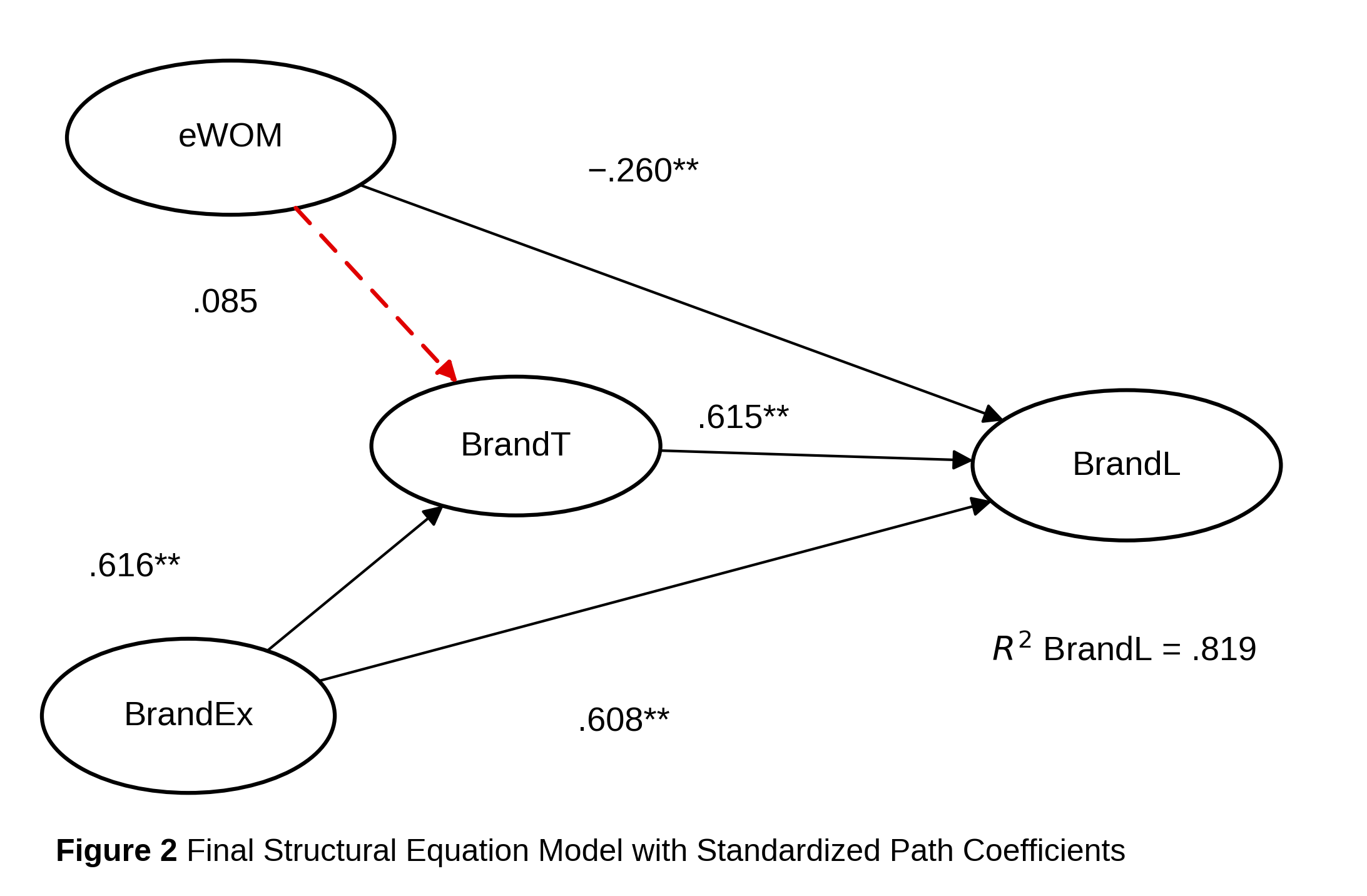
This study develops and empirically tests a structural equation model (SEM) to examine the causal factors influencing brand loyalty toward functional beverages among Generation Z consumers in Bangkok. Drawing on relationship marketing and experiential marketing theories, the proposed model investigates the effects of electronic word-of-mouth (eWOM) and brand experience on brand trust and brand loyalty, while exploring the mediating role of brand trust. Data were collected from 300 Generation Z consumers in Bangkok who had consumed functional beverages within the past six months using a multi-stage sampling technique. Structural Equation Modeling was employed to analyze the hypothesized relationships.
The findings indicate that brand experience plays a central role in driving brand loyalty, both directly and indirectly through brand trust. This suggests that experiential interactions influence both immediate responses and long-term commitment through trust. In contrast, eWOM demonstrates a limited and inconsistent role; it does not significantly influence brand trust and exhibits a significant negative effect on brand loyalty, suggesting that exposure to online information may encourage comparison rather than reinforce commitment.
These results highlight the importance of distinguishing between experiential and informational mechanisms in understanding consumer behavior. In the context of functional beverages, where perceived risk is higher, consumers appear to rely more on experiential validation than on externally generated information. The study contributes by clarifying the differential roles of these mechanisms and by showing that brand trust functions as an effective mediator primarily in experience-driven pathways. The findings also suggest that firms should prioritize authentic and consistent brand experiences to build sustainable brand loyalty among Generation Z consumers in Bangkok
Downloads
เอกสารอ้างอิง
Azis, A., Syarifah, I., & Lisdiantini, N. (2023). Experiential marketing and e-WOM create brand loyalty through brand trust. Journal Multidisiplin Madani (Mudima), 3(7), 1506-1513. https://doi.org/10.55927/mudima.v3i7.4308.
Bae, B. R., & Kim, S. E. (2023). Effect of brand experiences on brand loyalty mediated by brand love: The moderated mediation role of brand trust. Asia Pacific Journal of Marketing and Logistics, 35(10), 2412–2430. https://doi.org/10.1108/APJML-03-2022-0203.
Chaudhuri, A., & Holbrook, M. B. (2001). The chain of effects from brand trust and brand affect to brand performance: The role of brand loyalty. Journal of Marketing, 65(2), 81–93. https://doi.org/10.1509/jmkg.65.2.81.18255.
Chen, Y.-L., Chang, C.-L., & Sung, A.-Q. (2021). Predicting eWOM’s influence on purchase intention based on helpfulness, credibility, information quality, and professionalism. Sustainability, 13(13), 7486. https://doi.org/10.3390/su13137486.
Dianingtyas, H. P., Suharno, & Abidin, Z. (2021). Effect of experiential marketing and e-WOM on brand trust and brand loyalty. International Journal of Business and Management Invention, 10(11), 8–13. https://doi.org/10.35629/8028-1011020813.
Doan, C. (2019). eWOM, brand trust, brand loyalty: A study on Shopee in the e-commerce business sector in Vietnam. KAMK University of Applied Sciences, 1-67. https://www.theseus.fi/handle/10024/161245.
Euromonitor International. (2025). Innovation and functionality drive global soft drinks market to USD1.1 trillion. https://www.euromonitor.com/newsroom/press-releases/june-2025/innovation-and-functionality-drive-global-soft-drinks-market-to-usd1.1-trillion.
Fornell, C., & Larcker, D. F. (1981). Structural Equation Models with unobservable variables and measurement error: Algebra and statistics. Journal of Marketing Research, 18, 382-388. https://doi.org/10.2307/3150980.
Fromm, J., & Read, A. (2018). Marketing to Gen Z: The rules for reaching this vast—and very different—generation of influencers. Amacom.
Gunawan, P. I. W. A., & Wayan, E. N. (2022). Role of brand image and brand trust in mediating e-WOM on repurchase intention of Chatime drink in Denpasar. Russian Journal of Agricultural and Socio-Economic Sciences, 7(127), 41–49. https://doi.org/10.18551/rjoas.2022-07.05
Gupta, A., Sanwal, N., Bareen, M. A., Barua, S., Sharma, N., Olatunji, O. J., Nirmal, N. P., & Sahu, J. K. (2023). Trends in functional beverages: Functional ingredients, processing technologies, stability, health benefits, and consumer perspective. Food Research International, 170, 113046. https://doi.org/10.1016/j.foodres.2023.113046.
Hair, J. F., Babin, B. J., Anderson, R. E., & Black, W. C. (2019). Multivariate Data Analysis (8th ed.). England: Pearson.
Innova Market Insights. (2025). Gen Z, Gen X, Millennials and Boomers trends in the US and Canada. https://www.innovamarketinsights.com/trends/gen-z-gen-x-millennials-and-boomers-trends/
Ismagilova, E., Slade, E. L., Rana, N. P., & Dwivedi, Y. K. (2020). The effect of electronic word of mouth communications on intention to buy: A meta-analysis. Information Systems Frontiers, 22(7), 1203–1226. https://doi.org/10.1007/s10796-019-09924-y.
Jantharapraphaporn, S., & Wanarat, S. (2020). Structural equation modeling of the impacts of Brand experience and brand trust on brand loyalty: Real estate agent in secondhand real estate market in Bangkok Metropolitan Region. Journal of Humanities and Social Sciences, University of the Thai Chamber of Commerce, 40(4), 1–1. https://so06.tci-thaijo.org/index.php/utccjournalhs/article/view/244342.
Kasikorn Research Center. (2024). The Thai non-alcoholic beverage market is expected to continue growing in both domestic and international markets in 2025. https://www.kasikornresearch.com/th/analysis/k-social-media/Pages/Non-Alcoholic-Drinks-IAO109-FB-2024-12-02.aspx.
Kline, R. B. (2023). Principles and practice of structural equation modeling (5th ed.). The Guilford Press.
Kotler, P., Kartajaya, H., & Setiawan, I. (2021). Marketing 5.0: Technology for humanity. John Wiley & Sons.
Likert, R. (1961). New patterns of management. McGraw-Hill.
McKinsey & Company. (2025). The $2 trillion global wellness market gets a millennial and Gen Z glow-up. https://www.mckinsey.com/industries/consumer-packaged-goods/our-insights/future-of-wellness-trends.
Mendoza-Moreira, M., Moliner-Velazquez, B., Berenguer-Contri, G., & Gil-Saura, I. (2025). Antecedents of electronic word of mouth (eWOM) adoption: The role of social influence and perceived eWOM credibility. Journal of Theoretical and Applied Electronic Commerce Research. 20(2), 88. https://doi.org/10.3390/jtaer20020088.
Na, M., Rong, L., Ali, M. H., Alam, S. S., Masukujjaman, M., & Ali, K. A. M. (2023). The mediating role of brand trust and brand love between brand experience and loyalty: A study on smartphones in China. Behavioral Sciences, 13(6), 502. https://doi.org/10.3390/bs13060502.
Puteri, A. S., Suhud, U., & Krissanya, N. (2025). The role of e-WOM, brand image, brand experience, and brand trust in shaping repurchase intention on healthy instant noodle products. International Journal of Education Social Studies and Management (IJESSM), 5(1), 98–112. https://doi.org/10.52121/ijessm.v5i1.598
Sang, V.M., & Cuong, M.C. (2025). The influence of brand experience on brand loyalty in the electronic commerce sector: the mediating effect of brand association and brand trust. Cogent Business & Management, 12(1), 1-23. https://doi.org/10.1080/23311975.2024.2440629.
Siregar, A. I., Mappadeceng, R., & Albetris. (2021). The influence of brand image, trust, electronic word of mouth on consumer loyalty of Jambi typical souvenirs (Outlet Temphoyac). Journal of Economics and Business, 5(2), 512–518. https://doi.org/10.33087/ekonomis.v5i2.407.
Sumarmi, S., & Wijayanti, H. (2023). Brand Experience and brand loyalty: Mediated by brand trust. Journal Ilmiah Manajemen dan Bisnis, 9(3), 384–392. https://doi.org/10.22441/jimb.v9i3.16060.
Tafesse, W. (2016). Conceptualization of brand experience in an event marketing context. Journal of Promotion Management, 22(1), 34–48. https://doi.org/10.1080/10496491.2015.1107007.
Utami, G. R., & Saputri, M. E. (2020). Pengaruh eWOM social media marketing terhadap customer engagement dan loyalitas merek pada akun Instagram Tokopedia. Jurnal Riset Manajemen Dan Bisnis, 5(2), 185–198. http://jrmb.ejournal-feuniat.net/index.php/JRMB/article/view/388.
Villagra, N., Monfort, A., & Sánchez Herrera, J. (2021). The mediating role of brand trust in the relationship between brand personality and brand loyalty. Journal of Consumer Behaviour, 20(5), 1–11. https://doi.org/10.1002/cb.1922.
Widnyasari, N. W. D., & Darma, G. S. (2025). Brand experience, brand satisfaction, e-WOM, brand trust and brand loyalty. EKOMBIS REVIEW: Jurnal Ilmiah Ekonomi Dan Bisnis, 13(1), 153–166. https://doi.org/10.37676/ekombis.v13i1.
Yadav, M., & Rahman, Z. (2018). The influence of eWOM activities on customer loyalty: A study of the e-commerce industry. Benchmarking: An International Journal, 25(9), 3882–3905. https://doi.org/10.1108/BIJ-05-2017-0092.
Yang, B., Liu, Y., Liang, Y., & Tang, M. (2019). Exploiting user experience from online customer reviews for product design. International Journal of Information Management, 46, 173–186. https://doi.org/10.1016/j.ijinfomgt.2018.12.006.
ไฟล์ประกอบ
เผยแพร่แล้ว
รูปแบบการอ้างอิง
ฉบับ
ประเภทบทความ
สัญญาอนุญาต
ลิขสิทธิ์ (c) 2026 วารสารการบัญชีและการจัดการ

อนุญาตภายใต้เงื่อนไข Creative Commons Attribution-NonCommercial-NoDerivatives 4.0 International License.
บทความที่ได้รับการตีพิมพ์เป็นลิขสิทธิ์ของวารสารการบัญชีและการจัดการ
ข้อความที่ปรากฏในบทความแต่ละเรื่องในวารสารวิชาการเล่มนี้เป็นความคิดเห็นส่วนตัวของผู้เขียนแต่ละท่านไม่เกี่ยวข้องกับมหาวิทยาลัยมหาสารคาม และคณาจารย์ท่านอื่นๆในมหาวิทยาลัยฯ แต่อย่างใด ความรับผิดชอบองค์ประกอบทั้งหมดของบทความแต่ละเรื่องเป็นของผู้เขียนแต่ละท่าน หากมีความผิดพลาดใดๆ ผู้เขียนแต่ละท่านจะรับผิดชอบบทความของตนเองแต่ผู้เดียว