Developing a Sustainability Model for Community Enterprises in Eastern Thailand: An Integration of Sufficiency Economy Philosophy, Innovation Management, Social Capital
คำสำคัญ:
Sufficiency Economy Philosophy, Innovation Management, Social Capital, Community Enterprise Sustainabilityบทคัดย่อ
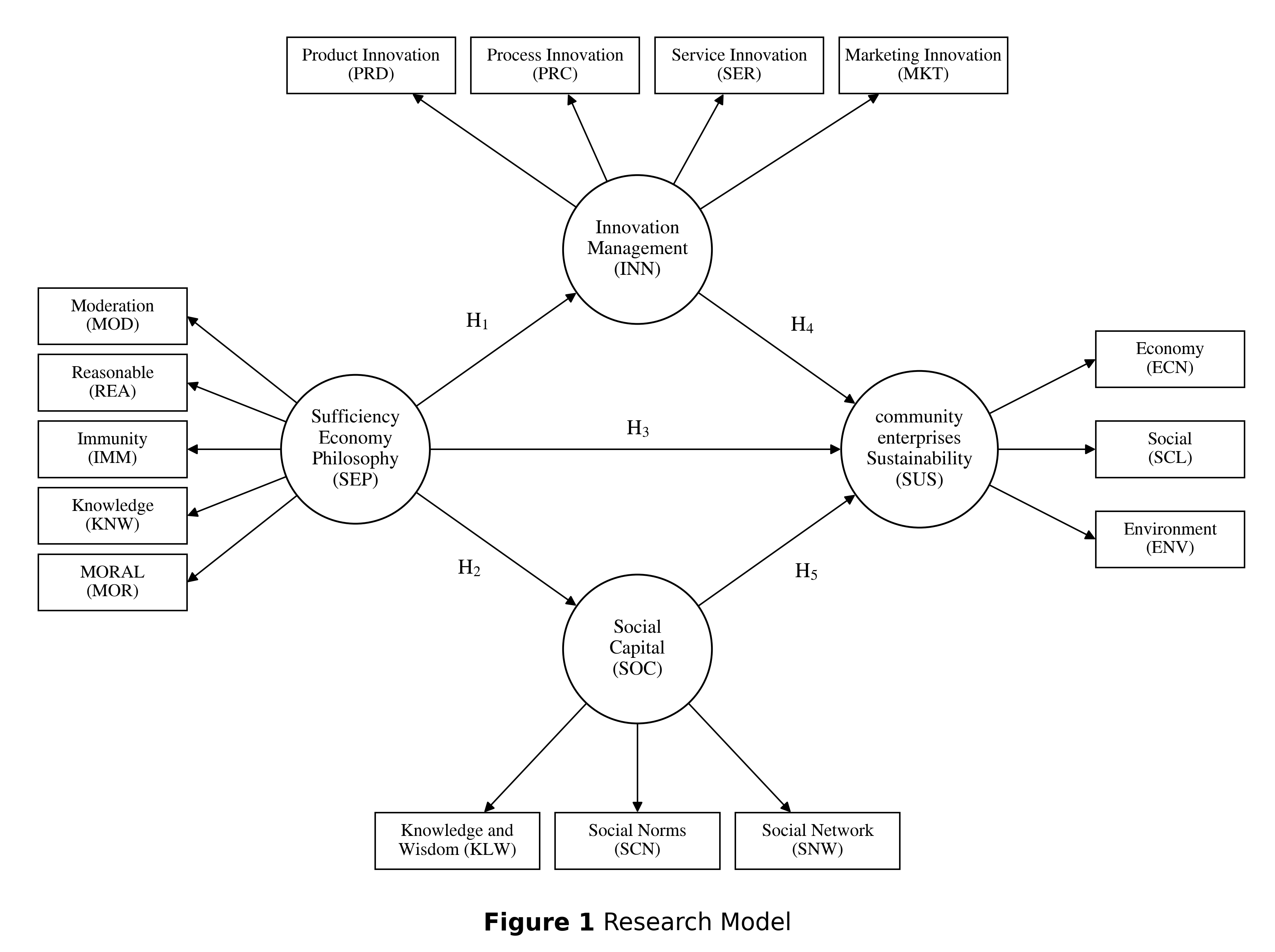
This study investigates the structural relationship and influence pathways among sufficiency economy philosophy, innovation management, social capital, and sustainability of community enterprises in Eastern Thailand. Using a stratified random sampling approach, data were collected through online questionnaires and emails from community enterprise representatives, resulting in 486 valid responses. Structural equation modeling (SEM), integrating confirmatory factor analysis (CFA) and path analysis, was employed to examine the proposed relationships. The study reveals that the proposed structural model demonstrates a good fit with the empirical data. Sufficiency economy philosophy exerted significant direct effects on innovation management and social capital and also influenced sustainability both directly and indirectly through these mediating variables. The findings further demonstrate that innovation management and social capital play critical roles in enhancing the sustainability and governance capacity of community enterprises. Moreover, sufficiency economy philosophy, innovation management, and social capital jointly explained 63% of the variance in sustainability, indicating the model’s strong predictive power. From a policy and practical perspective, the results provide valuable guidance for policymakers and development agencies in designing community enterprise support programs that integrate sufficiency economy principles with innovation capacity building and social capital strengthening, thereby fostering sustainable regional development in Eastern Thailand.
Downloads
เอกสารอ้างอิง
Aksorntap, A., Baedcharoen, I., & Jatuprayoon, C. (2023). Management Model for Enhancing the Level of Community Enterprise Management in Golden Longan Processing, Ban Thi Sub-District, Ban Thi District, Lamphun Province, Suthiparithat Journal, 37(3), 127-141.
Amasiri, T., Niyomyaht, S., Kalyanamitra, K., & Lakkhanapichoncht, T. (2025). The Factors Affecting The Operational Success Of Social Enterprises, Don Phut District, Saraburi Province. Journal of MCU Phetchaburi Review, 8(1), 124-134.
Anusonphat, N., & Leenawrat, I. (2021). Development of Self-Sufficiency Community Economy on Basis of Community Democracy. Journal of MCU Nakhondhat, 8(12), 204-217.
Barisri, J., Murikanon, P., Paladech, J., Sukperm, K., & Sinthudet, T. (2024). Innovation the Wisdom of the Sufficiency Economy to Enhance the Sustainable Competitiveness of Outstanding Community Enterprises. Product Processing Group, Roi Et Province. Ratanabuth Journal, 6(3), 1-16.
Belsley,D. (1991). Conditional diagnostics: collinearity and weak data in regression. Wiley Series in Probability. Jonh Wiley, New York.
Bollen, K.A. (1989). Structural Equations with Latent Variables. Wliey. New York.
Boonnam, J., & Nawakitphaitoon, N. (2022). Innovation of cultural knowledge and local wisdom management for community development in Nakhon Si Thammarat province. Journal of Buddhistic Sociology, 7(2), 103-114.
Boonpeng, N., & Photibat, P. (2023). Model Adaptation to develop economic of Community Enterprise Producing indigo dye, Ban Non SaBang, Kantharawichai district, Mahasarakham Province in during the spread of Coronavirus Disease 2019 (COVID-19). (Doctoral dissertation, Mahasarakham University).
Boonyarat, P., Ramanust, S., & Boonyoo, T. (2023). Organizational Innovation and Knowledge Creation Process as Mediator Linking Transformational Leadership to Corporate Performance of Community Enterprise Network in Community Enterprise in Lower Northern part 1 of Thailand. Rajapark Journal, 17(51), 461-479.
Byrne, B.M. (2010). Structural Equation Modeling With AMOS: Basic Concepts, Applications, and Programming, Second Edition. (2nd ed.). Routledge.
Carmines, E.G. & Zeller, R.A. (1980). Reliability & Validity Assessment. London: SAGE Publications.
Chaithada, P., & Juntarakote, B. (2025). People Participation in Creating a Resource Management Mechanism for the Ban Sai Nuea Community, Na Luang Sen Subdistrict, Thung Song District, Nakhon Si Thammarat Province. Journal of Humanities and Social Sciences Nakhon Phanom University, 15(1), 246-260.
Changprachak, S. (2025). Digital Transformation of Thai Community Enterprises: Research Synthesis. Journal of MCU Social Science Review, 14(2), 201-213.
Chanthanet, W. (2022). The organizational social capital: strategic management of the new normal era. Journal of Graduate Studies Valaya Alongkorn Rajabhat University, 16(2), 288-302.
Chanusit, N., Tonphuban, C., Khumyarach, C. Bunthauaon, N., Suksaart, S., Pitakkul, P., Sangkrit, S., & Norrabut, N. (2024). Innovation system and process for sustainable development in a rapidly changing world. Journal of Administration Management and Sustainable Development, 2(3), 646-656.
Chanyam, T., Mola, A., & Wongwatthanaphong, K. (2023). Sustainable Community Enterprise Development Policy to Strengthen the Local Economy. Interdisciplinary Academic and Research Journal, 3(4), 575-586.
Charoenkasikorn, B., Srisorn, W., & Chayanon, S. (2024). The Strength Development Model of OTOP INNO-Life Community with Creative Participation Process: A Case Study Suphanburi Province. Suan Dusit Graduate School Academic Journal, 20(3), 27-44.
Chaunrakthum, P., Papattha, C., Somsiri, W., & Niamsakul, S. (2024). Digital Marketing Management for Local Coffee Identity and Ready-to-Drink Coffee Blossom of Nam Nao Arabica Community Enterprise Phetchabun. RMUTP Journal of Business and Innovation Management, 3(2), 66-81.
Chimplee, K., Manorat, T.K., Watcharakiettisak, T., & Chairod, J. (2022). Development of Knowledge in Innovation for the Sufficiency Economy Model: Case study Ban Sai Or, Village 1, Sai Or Subdistrict, Non Thai District, Nakhon Ratchasima Province. Journal of Local Research and Innovation, 17(1), 99-110.
Chinnasri, W. (2025). Guidelines for Strengthening Collaborative Networks in Local Governance. Local Administration Journal, 18(1), 45-64
Chuennirun, S., Silarat, P., & Kantha, P. (2024). Model of enhancing social movement and social capital networks for democratization in Mahasarakham province. Academic Journal of Mahamakut Buddhist University Roi Et Campus, 13(2), 113-126
Chukong, S., Sanakulchai, P. T., Kittiwichayakul, B., Dessimma, K., & Sittivongsa, B. (2024). Guidelines for Applying Innovation to Improve People's Quality of Life According to the Sufficiency Economy Philosophy in the Upper Northeastern Region. Academic Journal of Mahamakut Buddhist University Roi Et Campus, 13(1). 544-555.
Comrey, A. (1973). A First Course on Factor Analysis. London: Academic Press.
Curran, P.J., West, S.G., & Finch, J. (1996). The robustness of test statistics to non-normality and specification error in confirmatory factor analysis. Psychological Methods, 1, 16-29.
Department of Agricultural Extension. (2025). Summary of the number of community enterprises and community enterprises networks that have already approved the registration. http://www.sceb.doae.go.th/Documents/STC/310368.pdf
Dhammasaccakarn, W. (2022). Community capital and self-management potential for the sustainable development of local communities. Nakkhabut Paritat Journal, 14(1), 22-32.
Dhirabhaddo, P., Phoowachanathipong, K., Vi, P., Prapassornpitaya, M., & Sarisee, N. (2024). Development of A Collaboration Network for Promoting Creative Spaces with Social Cultural Capital through Three Generations. Buddhist Psychology Journal. 9(4), 659-676.
Diamantopoulos, A., & Siguaw, A.D. (2000). Introducing LISREL: A guide for the uninitiated. Sage Publications, London.
Fornell, C., & Larcker, D.F. (1981). Evaluating structural equation models with unobservable variables & measurement error. Journal of Marketing Research, 8(1), 39–50.
Foxall, G.R., & Yani-de-Soriano, M.M. (2005). Situational influences on consumers, attitudes and behavior. Journal of Business research, 58, 518-525.
Hair, J. F., Anderson, R. E., Tatham, R. L., & Black, W. C. (1998). Multivariate Data Analysis. (5th ed). New Jersey: Prentice.
Hair, J.F., Jr., Black, W.C., Babin, B.J., & Anderson, R.E. (2014). Multivariate data analysis.(7th ed). Harlow: Pearson Education.
Hemnil, S. (2021). Social Capital and Community Enterprise Construction: A Case Study of Don Kaew Fishery Group, Kumphawapi District, Udon Thani Province. Journal of Social Development. 23(1), 118-142.
Hokkhunthod, T. & Saeoung, K. (2023). Lessons learned from the community-based tourism network in Banprok subdistrict of the Mueang district in Samutsongkhram province. Journal of Interdisciplinary Innovation Review, 6(6), 99-112.
Hooper, D., Coughlan, J., & Mullen, M.R. (2008). Structural equation modelling: Guidelines for determining model fit. Journal of Business Research Methods, 6(1), 53–60
Jeerat, P., Kruekum, P., Sakkatat, P., Rungkawat, N., & Fongmul, S. (2022). Developing a model for building farmers’ beliefs in the sufficiency economy philosophy to accommodate sustainable agricultural practices in the highlands of Chiang Mai Province, Thailand. Sustainability, 15(1), 511.
Jintana, S. & Puripanik, T. (2023). A Problem, Limitations and Approaches for Strengthening of Community-Based Enterprises in Thailand. Journal of Politics, Administration and Law, 12(3), 179-194.
Kanchanawasi, S. (2002). Evaluation theory. 3rd ed. Bangkok: Chulalongkorn University Press.
Katkaew, P., Paksa, T., & Kosayodom, P. (2024). Developing the Potential of Community Enterprises to Build Community Strength A Case Study of a Coffee Producing Community Enterprise in Chumphon Province. Journal of Arts Management, 8(3), 98-110.
Khamsuwan, C., Prapan, K., & Promjuk, W. (2022). Model of special agricultural economic zones to a self-reliant community. Journal of Political Science Mahamakut Buddhist University, 2( 6), 37-48.
Khatasombun, H. (2022). Knowledge application of local wisdom in community self-management according to the sufficiency economy philosophy. Journal of MCU Nakhondhat, 9(9), 296-313.
Kim, J.O., and Mueller, C.W. (1978). Factor Analysis: Statistical Methods and Practical Issues. Beverley Hills: Sage Publications.
Klaythanee, S., Wasinworakit, P., Wichotsikkhakit, P., & Uthaikitcharak, P. (2024). Thabua Village, Thabua Subdistrict, Phothrale District, Phichit Province: Model Village Promoting A Good Quality of Life Based on the Principles of Sufficiency Economy. Journal of MCU Social Science Review, 13(6), 477-485.
Kline, R. B. (2010). Principles and Practice of Structural Equation Modeling (3rd ed). New York, NY: The Guilford Press.
Kongkaew, C. (2024). Development of a Construction Model and Utilization of Biodiversity Wisdom in Temples and Communities in Prachin Buri Province. Journal of MCU Peace Studies, 12(6), 2552-2563.
Kuljittree, S., & Mathuros, S. (2023). Innovation for Promoting Occupation Skills to Sustainably Elevate The rassroots Economy. Rajapark Journal, 17(55), 453-466.
Makboriboon, T., & Chantharat, N. (2024). Causal Factors Influencing Entrepreneurial Self-Efficacy and Performance of Processed Agricultural SMCEs in Thailand. 44(2), 85-102.
Makboriboon, T., & Chantharat, N. (2024). Causal Factors Influencing Entrepreneurial Self-Efficacy and Performance of Processed Agricultural SMCEs in Thailand. Executive Journal, 44(2), 85-102.
Moonnanut, P., Sangthongluan, C., & Punoiam, K. (2024). Strategy Innovation Management to Farm Women Group Lower central region of Thailand. Journal of Academic for Public and Private Management, 6(3), 191-206.
Nakudom, S., Yordudom, T., & Siphasead, P. (2020). Social Capital: Competitive Advantage of Community Enterprise. Executive Journal. 40(1), 115-124.
Ngamcharoen, P. (2024). Social Capital and Strengthening the Community’s Foundation Economy. Journal of MCU Peace Studies, 12(2), 473-484.
Nopchalermroj, C. (2024). The Application of King Bhumibol's 9th Working Principle: Simplicity. Institute of Sufficiency Journal, 1(9), 54-68.
Nua-amnat, R., Brahmakappa, A., Pumturian, S., & Soonthondachar, J. (2021). The Development of Knowledge and Community Components of “Smart Community” for Community in Thai Society. Journal of Arts Management, 5(3), 559-573.
Panna, U., Saorom, V., & Singmat, T. (2021). Learning Organization of Management and Innovation Model to Create for Sustainability Community Enterprise: Herbal Group in the Northeast Region. Journal of Social Science and Buddhistic Anthropology, 6(10), 148-164.
Phetcharot, L. & Chamniprasat, A. (2002). Research methods. Bangkok: Phimdee Printing.
Phuengpa, N. (2020). Innovational Management of The Community-based Enterprises in the Area of Thailand Eastern Economic (Research report). Burapha University.
Pimonrattnakan, S. (2021). The Increasing Potential Competition, Value-Added and Innovation Management of Agricultural Products, Mangoes for Export in Chachoengsao Province. Southeast Bangkok Journal, 7(1), 41-54.
Pongsapang, S. (2018). Strong Community Development Based on Sufficiency Economy Philosophy and Socilal Capital of Klong Arang Village, Bankaeng Subdistrict, Muang Sakaeo District, Sakaeo Province. (Independent Study of Master of Business Administration, Burapha University.
Pounpunwong. W. (2023). Sufficiency Economy, the Concept of Ethnic Community Development of Thai State: Study of Changes, Ways of Life, Economic Activities as well as Social and Community Contexts of Tribes in the Area of the Nong Hoi Royal Project Development Center, Chiang Mai Province. Journal of Social Sciences, 53(1), 101-130.
Praphaiphet, S., Praphaiphet, S., Sanglao, W., Sukkhamduang, S., & Plarin, K. (2022). The Sufficiency Economy Philosophy Model. Journal of Intellect Education, 1(1), 68-79.
Pratumsuwan, K., Phansiri, P., & Areerob, A. (2023). The participataory development of community innovation based on the sufficiency economy philosophy, Nakhon Pathom. Journal of Liberal Art of Rajamangala University of Technology Suvarnabhumi, 5(2), 257-270.
Prayukvong, W., Moopayak, K., Tiengnoi, P., Tiengnoi, T., & Preechasilp, T. (2023). Sufficiency Economy Philosophy (SEP) Innovation for Local Development. Journal of Scholar Community, 1(1), 56-71.
Promjuk, W., & Tanintayangkul, N. (2023). Social Capital and Development Dimension. Journal for Developing the Social and Community, 10(2), 485-494.
Rujichai, S., Duongjun, W., Sriwattananusart, K., Sawang, K., Meechaiand, R., & Sanpang, W. (2025). Designing and Developing Commercial Fine Art Handicraft Products with Local Identity to Raise the Economic Potential of Udon-Thani Province. Western University Research Journal of Humanities and Social Science, 11(1), 205-220.
Saengkeaw,S., Kitthitinan, P., & Seedapeng, K.(2025). Influence of Adaptation, Innovation, and Characteristics of Entrepreneurs on the Success of Small and Medium Enterprises in Chiang Mai Province. Journal of Management Science Pibulsongkram Rajabhat University, 7(1), 130-146
Saewang, O. (2020). Social Capital and Economic Strength of Chinatown Community. Journal of Social Development and Management Strategy, 22(2), 91-105.
Sangkanjanavanich, W. & Suwanbundit, A. (2024). Righteousness of Philosophy of Sufficiency: the fundamental philosophy of development of the nation, Journal of Dhammasuksa Research, 7(2), 1-11.
Sangnin, K., Pooripakdee, S. & Siriwong, P. (2021). Creating Shared Values for Sustainability of Community Enterprises: The Grounded Theory Approach. KASEM BUNDIT JOURNAL, 22(2), 83-96.
Sangpud, W., Chirinang, P., Chandarasorn, V., & Katekao, V. (2024). Guidelines for adding value to local Thai community products. Journal of Modern Learning Development, 9(6), 439-448.
Sangwongdee, P.P. (2024). Social capital: factors that promote community finance organizations to succeed. Journal of MCU Social Development, 9(2), 108-117.
Schumacher, R. E., & Lomax, R. G. (2010). A Beginners Guide to Structural Equation Modeling: SEM. New Jersey: Lawrence Erlbaum Associates.
Simaprasert, V., Chimhad, P., Nitithambundhit, P., Wuttisakorntham, P., & Tipwong, P. T. (2025). The Role of Community Financial Institutions in Strengthening Grassroots Economic Stability. Journal of Social Science and Cultural, 9(4), 267-281.
Sittisutakorn, P. (2024). The Develoment of Agricultural Occupation Groups to Raise Income for the Local Economy in Songkhla Province. Journal of Social Science and Cultural, 8(10), 76-86.
Songsawat, T., Meechaisue, P., & Chinuntdej, N. (2025). The Effects of Innovation Management and its Antecedents on Perceived Performance of the Revenue Department in Thailand. Humanities and Social Science Research Promotion Network Journal, 8(1), 90-113.
Srichaiwong, P. (2025). An Analytical Study of the Sufficiency Economy Philosophy within the Framework of Sustainable Development. Journal of Social Sciences Perspectives, 1(1), 15-28.
Supakitpaisan, K. (2023). Ideal Paradigm of Community Welfare Management Under the Social Capital Concept. Journal of Social Work and Social Administration, 31(1), 1-46.
Suwannasri, P. (2025). A Study of the Social Capital of Sao Lao Sub-District Community Nong Kung Si District Kalasin Province. Journal of Academic and Research in Social Sciences, 1(2), 1-10.
Talumphai, S., Inounchot, I., & Rachjun, P. (2024). Increase in Potential of Innovation Development and Revitalize the Local Economy on Market Activities by Creating Jobs Generate Income to Occur in the Local Community in Tambon Sri Wilai, Selaphum District, Roi Et Province. Journal of Management Science Research, Surindra Rajabhat University, 8(2), 395-409.
Tanintayangkul, N., & Thiangdah, W. (2025). Strengthening the Grassroots Economics for Sustainable Development. Journal of Roi Et Rajabhat University, 19(1), 124-133.
Tanratanakul, S. & Seedapang, K. (2023). Community Development Based on Sufficiency Economy to Create Sustainable Jobs and Community Income. Journal of Management Science and Communication, 2(1), 105-128.
Tantra, T., & Pharcharuen, W. (2025). The Analysis of Factors Supporting the Grassroots Economy towards Strength, Stability, and Sustainability: A Case Study of Nong Han Subdistrict, San Sai District, Chiang Mai Province, to Enhance the Quality of Life of the People. Ratanabuth Journal, 7(1), 362-374.
Tantra, T., & Pharcharuen, W. (2025). The Analysis of Factors Supporting the Grassroots Economy towards Strength, Stability, and Sustainability: A Case Study of Nong Han Subdistrict, San Sai District, Chiang Mai Province, to Enhance the Quality of Life of the People. Ratanabuth Journal, 7(1), 362-374.
Thangthong, P., Khunto, S., Panich, J., Udompong, N., Joompafad, J., & Rojanatrakul, T. (2024). Social Capital as a Driving Process for Thai Community Enterprises. Journal of Roi Et Rajabhat University, 18(3), 214-226.
Tipyan, C., Petchkaew, C., Jinayat, S., & Sukhararom, T. (2021). Chaiya Community Self-Innovation management for Economic Stability Based on Community Culture. Journal of Social Science and Cultural, 5(1), 47-60.
Tongdaeng, W., Kiattibutra, R., Mungpattanasunthon, T., Jandaeng, P., Passayawan, S., Sinthunava, N.,…& Wongwilat, P. (2024). The Process Innovation to Upgrade the Mae Ing Shibori Tie-Dye Fabric Product Through the Process of Developing Community Innovators Based on Design Thinking. Journal of MCU Buddhapanya Review. 9(6), 83-99.
Tosuwan, N. (2024). The Role of Community Leaders in Promoting Sufficiency Economy Village: Case Study, Ban Den Ma Kham, Taluk Klang Thung Sub-district, Muang Tak District, Tak Province. Rajapark Journal, 18(56), 249-263.
Totumand, B. & Dokduang, K. (2022). The Development of Social Capital for Being a Source of Learning and Promoting Tourism in Secondary City by using GIS for Mekong Particle Management, Ubon Ratchatani. Journal of MCU Ubon Review, 7(2), 2313-2330.
Trade Policy and Strategy Office, Ministry of Commerce. (2023). Developing the potential of community enterprises to enhance the grassroots economy, Retreieved April 20, 2025, from https://uploads.tpso.go.th/การพัฒนาศักยภาพวิสาหกิจชุมชน.pdf
Von Feigenblatt, O. F., Cooper, M., & Pardo, P. (2022). Sufficiency economy philosophy (SEP): Thailand’s emic approach to governance and development as evidence of an Asian value-oriented inclusive leadership management philosophy. Strategic Analysis, 46(4), 430-440.
Wachiravudho, P. S., & Phinyarak, K. (2025). The Concept of the Sufficiency Economy Philosophy to Promote Strong Social Capital. Journal of Multidisciplinary Research and Social lnnovation, 1(1), 56-63.
Wanthum, P., Thoatachan, H., Jirawuttho, P. J., Phusrisom, S., & Nawaseree, K. (2024). Sufficiency Economy of His Majesty the King: Dimension of Application. Journal of Buddhist Education and Research (JBER), 10(4), 510-521.
Watthapron, S., ArunSutalangkarn, P., & Chimhad, P. (2024). Grassroots Economy: Community Enterprise Development. Journal of MCU Nakhondhat, 11(9), 222 – 231.
Wingwon, B., Hou, S., Wingworn, N., Sukapun, D., Charoenphakinrattana, N., Pompimon, W., & U-pong, N. (2022). Product Innovation Development through Participatory Local Wisdom of Community Enterprises of Ethnic Group at Ban Mae Chaem, Mueang Pan District, Lampang Province. Journal of Social Academic, 15(1), 99-115.
Yaisumlee, T., Kanjina, S., Suanpang, P., & Jainan, A. (2025). Communicating The Identity Of Khao Soi As A Lanna Multicultural Culinary Wisdomto Promote Thai Food Soft Power. Thai Interdisciplinary and Sustainability Review, 14(1), 1-12.
ดาวน์โหลด
เผยแพร่แล้ว
รูปแบบการอ้างอิง
ฉบับ
ประเภทบทความ
สัญญาอนุญาต
ลิขสิทธิ์ (c) 2026 วารสารการบัญชีและการจัดการ

อนุญาตภายใต้เงื่อนไข Creative Commons Attribution-NonCommercial-NoDerivatives 4.0 International License.
บทความที่ได้รับการตีพิมพ์เป็นลิขสิทธิ์ของวารสารการบัญชีและการจัดการ
ข้อความที่ปรากฏในบทความแต่ละเรื่องในวารสารวิชาการเล่มนี้เป็นความคิดเห็นส่วนตัวของผู้เขียนแต่ละท่านไม่เกี่ยวข้องกับมหาวิทยาลัยมหาสารคาม และคณาจารย์ท่านอื่นๆในมหาวิทยาลัยฯ แต่อย่างใด ความรับผิดชอบองค์ประกอบทั้งหมดของบทความแต่ละเรื่องเป็นของผู้เขียนแต่ละท่าน หากมีความผิดพลาดใดๆ ผู้เขียนแต่ละท่านจะรับผิดชอบบทความของตนเองแต่ผู้เดียว