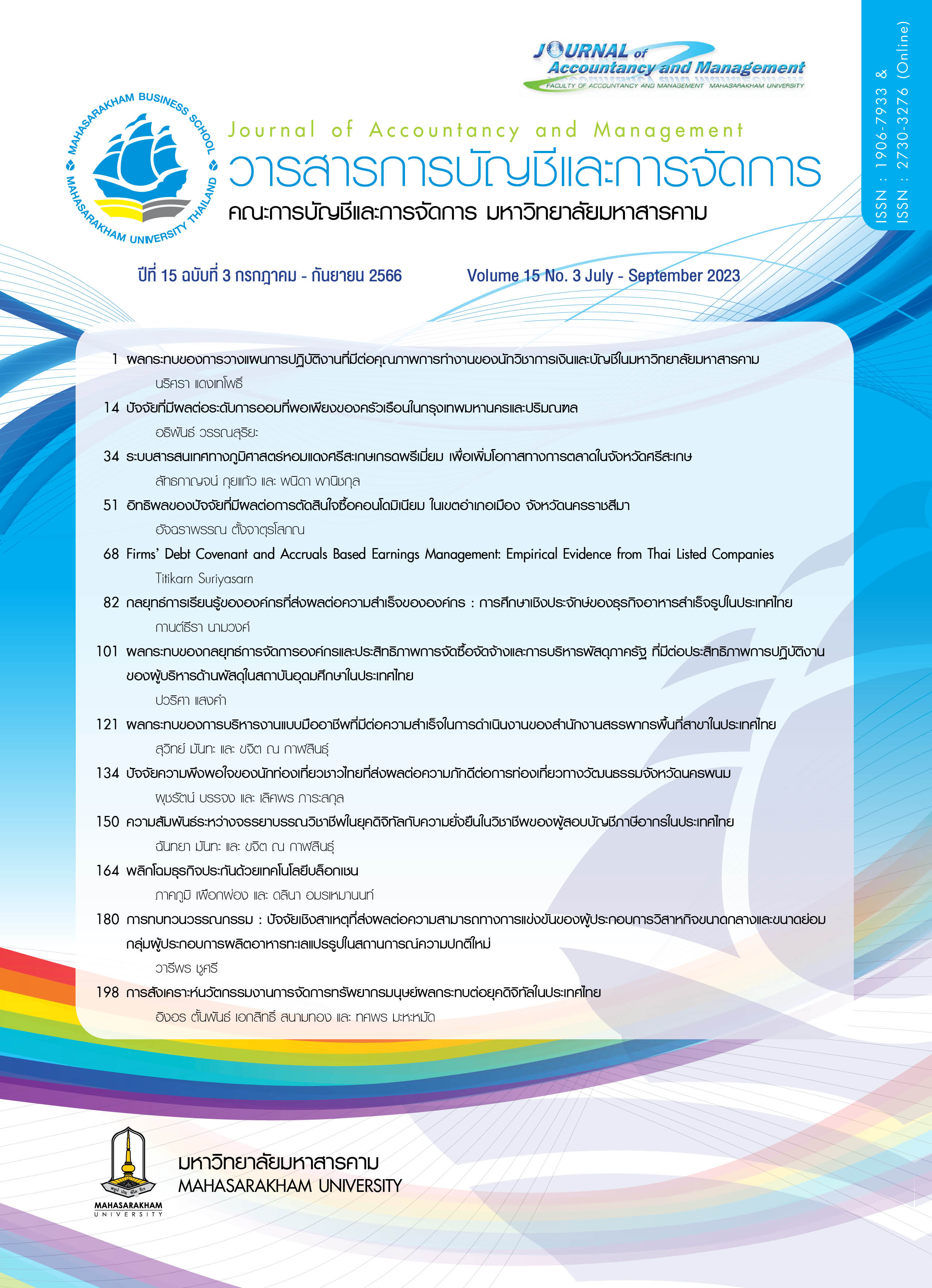
กลยุทธ์การเรียนรู้ขององค์กรที่ส่งผลต่อความสำเร็จขององค์กร : การศึกษาเชิงประจักษ์ของธุรกิจอาหารสำเร็จรูปในประเทศไทย
คำสำคัญ:
กลยุทธ์การเรียนรู้ขององค์กร , การเรียนรู้ขององค์กร , กลยุทธ์การเรียนรู้ขององค์กร การเรียนรู้ขององค์กร ความคิดสร้างสรรค์ขององค์กร ความยืดหยุ่นขององค์กร นวัตกรรมองค์กร ความสำเร็จขององค์กร, ความยืดหยุ่นขององค์กร , นวัตกรรมองค์กร , ความสำเร็จขององค์กรบทคัดย่อ
การศึกษาครั้งนี้มีวัตถุประสงค์เพื่อศึกษากลยุทธ์การเรียนรู้ขององค์กรที่มีอิทธิพลต่อความสำเร็จขององค์กร โดยอาศัยปัจจัยต่าง ๆ ได้แก่ ความคิดสร้างสรรค์ขององค์กร ความยืดหยุ่นขององค์กร และนวัตกรรมองค์กร เพื่อให้เกิดความสำเร็จขององค์กร เก็บรวมรวมข้อมูลโดยแบบสอบถาม และใช้ OLS Regression ในการวิเคราะห์ความสัมพันธ์ระหว่างตัวแปรเหล่านี้ โดยใช้ข้อมูลจากธุรกิจอาหารสำเร็จรูปในประเทศไทย จำนวน 220 บริษัท ผลการศึกษา พบว่า สองในห้ามิติของกลยุทธ์การเรียนรู้ขององค์กร คือ การมุ่งเน้นการใช้ความรู้ร่วมกันเชิงพลวัต และการให้ความสำคัญในการปรับมุมมองระบบ จะมีอิทธิพลเชิงบวกอย่างมีนัยสำคัญทางสถิติกับผลการดำเนินงาน ได้แก่ ความคิดสร้างสรรค์ขององค์กร ความยืดหยุ่นขององค์กร นวัตกรรมองค์กร และความสำเร็จขององค์กร
Downloads
เอกสารอ้างอิง
กรมส่งเสริมอุตสาหกรรม กระทรวงอุตสาหกรรม. (2564). ธุรกิจอาหารในประเทศไทย. ค้นเมื่อ 20 ตุลาคม 2564, จาก https://www.dip.go.th
ฐานเศรษฐกิจ. (2564). อาหารไทยสำเร็จรูปในตลาดโลกยังมีอนาคตไกล. ค้นเมื่อ 20 ตุลาคม 2564, จาก http://www.thansettakij.comj
วันนา ยงพิสานบุตร. (2564). แนวโน้มธุรกิจ/อุตสาหกรรม ปี 2564 – 2566: อุตสาหกรรมอาหารสำเร็จรูป. ค้นเมื่อ 20 ตุลาคม 2564, จาก https://www.krungsri.com
สถาบันอาหาร. (2564). ศูนย์อัจฉริยะเพื่ออุตสาหกรรมอาหาร. ค้นเมื่อ 20 ตุลาคม 2564, จาก https://www.fic.nfi.or.th
Aaker, D. A., Kumar, V., & Day, G. S. (2001). Marketing research. 7th ed. New York : John Wiley and Sons.
Alves, M. F. R., Galina, S. V. R., & Dobelin, S. (2018). Literature on Organizational Innovation: Past and Future. Innovation & Management Review, 15(1), 2-19.
Anning-Dorson, T. (2021). Organizational Culture and Leadership as Antecedents to Organizational Flexibility: Implications for SMEs Competitiveness. Journal of Entrepreneurship in Emerging Economics, 13(5), 112-120.
Appelbaum, S. H., Profka, E., Depta, A. M., & Petrynski, B. (2018). Impact of Business Model Change on Organizational Success. Industrial and Commercial Training, 50(2), 41-54.
Armstrong, J. S., & Overton, T. S. (1979). Estimating nonresponse bias in mail surveys. Journal of Marketing Research, 14(3), 396-402.
Bocken, N., Weissbrod, I., & Antikainen, M. (2021). Business Experimentation for Sustainability: Emerging Perspectives. Journal of Cleaner Production, 12, 1-14.
Bonafe-Pontes, A., Couto, C., Kakinohana, R., Travain, M., Schimidt, L., & Pilati, R. (2021). COVID-19 as Infodemic: The Impact of Political Orientation and Open-mindedness on the Discernment Making, Cambridge University Press, 16(6), 1575-1596.
Chiu, S. S., Pathak, S., Hoskisson, R. E., & Johnson, R. A. (2022). Managerial Commitment to the Status Quo and Corporate Divestiture: Can Power Motivate Openness to Change? The Leadership Quarterly, 33(3).
Chun, E., & Evans, A. (2018). Leading a Diversity Culture Shift in Higher Education: Comprehensive Organizational Learning Strategies. New York: Education Social Sciences. 250.
Crossan, M., Vera, D., & Pathak, S. (2021). Organizational Learning. Strategic Management Journal, 467 – 477.
Darvishmotevali, M., Altinay, L., & Koseoglu, M. A. (2020). The Link between Environmental Uncertainty, Organizational Agility, and Organizational Creativity in the Hotel Industry. International Journal of Hospitality Management, 87, 151-159.
Englert, B., & Helmig, B. (2018). Volunteer Performance in the Light of Organizational Success: A Systematic Literature Review. International Journal of Voluntary and Nonprofit Organization, 29, 1-28.
Ganguly, A., Talukdar, A., & Chatteriec, D. (2019). Evaluating the Role of Social Capital, Tacit Knowledge Sharing, Knowledge Quality and Reciprocity in Determining Innovation Capability or an Organization. Journal of Knowledge Management, 23(6), 1105-1135.
Hair, Jr. J. F., Babin, B. J., & Anderson, R. E. (2010). Multivariate data analysis : A global perspective (7th Ed). New Jersey : Pearson Prentice Hall.
Harvey, J. F., Johnson, K., & Edmondson, A. C. (2019). From Orientation to Behavior: The Interplay between Learning Orientation, Open-mindedness, and Psychological Safety in Team Learning. Academy of Management Review, 39(4), 423-438.
Hasan, M. M., Lobo, G. J., & Qiu, B. (2021). Organizational Capital, Corporate Tax Avoidance, and Firm Value. Journal of Corporate Finance, 70, 89-99.
Kaufman, H. (2017). The Limits of Organizational Change. (2nd ed.). New York : Routledge.
Kocyigit, Y., & Akkaya, B. (2020). The Role of Organizational Flexibility in Organizational Agility: A Research on SMEs. Business Management and Strategy, 11(1), 1-15.
Mikalef, P., & Gupta, M. (2021). Artificial Intelligence Capability: Conceptualization, Measurement Calibration, and Empirical Study on Its Impact on Organizational Creativity and Firm Performance. Information & Management, 58(3), 108-116.
Nunnally, J. C., & Bernstein, I. H. (1994). Psychometric Theory. (3th ed). New York : McGraw-Hill.
Palabud, K. (2019). Risk Management Strategy Influencing on Organizational Survival: An Empirical Study of Community Enterprises in Loei province. Journal of Accountancy and Management, 11(4), 61–80.
Palabud, K. (2020). Strategic Innovation Capability Influencing on Organizational Sustainability: An Empirical Study of Automobile Businesses in Thailand. Journal of Accountancy and Management, 12(3), 109-125.
Park, S., & Doo, M. Y. (2020). The Effect of Organizational Culture and HR Practices on Female Managers’ Commitment and Job Satisfaction. European Journal of Training and Development, 44(2/3), 105-120.
Sariol, A. M., & Abebe, M. A. (2017). The Influence of CEO Power on Explorative and Exploitative Organizational Innovation. Journal of Business Research, 73, 38-45.
Wang, X., & Dass, M. (2017). Building Innovation Capability: The Role of Top Management Innovativeness and Relative-exploration Orientation. Journal of Business Research, 76, 127-135.
ดาวน์โหลด
เผยแพร่แล้ว
รูปแบบการอ้างอิง
ฉบับ
ประเภทบทความ
สัญญาอนุญาต
ลิขสิทธิ์ (c) 2023 วารสารการบัญชีและการจัดการ

อนุญาตภายใต้เงื่อนไข Creative Commons Attribution-NonCommercial-NoDerivatives 4.0 International License.
บทความที่ได้รับการตีพิมพ์เป็นลิขสิทธิ์ของวารสารการบัญชีและการจัดการ
ข้อความที่ปรากฏในบทความแต่ละเรื่องในวารสารวิชาการเล่มนี้เป็นความคิดเห็นส่วนตัวของผู้เขียนแต่ละท่านไม่เกี่ยวข้องกับมหาวิทยาลัยมหาสารคาม และคณาจารย์ท่านอื่นๆในมหาวิทยาลัยฯ แต่อย่างใด ความรับผิดชอบองค์ประกอบทั้งหมดของบทความแต่ละเรื่องเป็นของผู้เขียนแต่ละท่าน หากมีความผิดพลาดใดๆ ผู้เขียนแต่ละท่านจะรับผิดชอบบทความของตนเองแต่ผู้เดียว