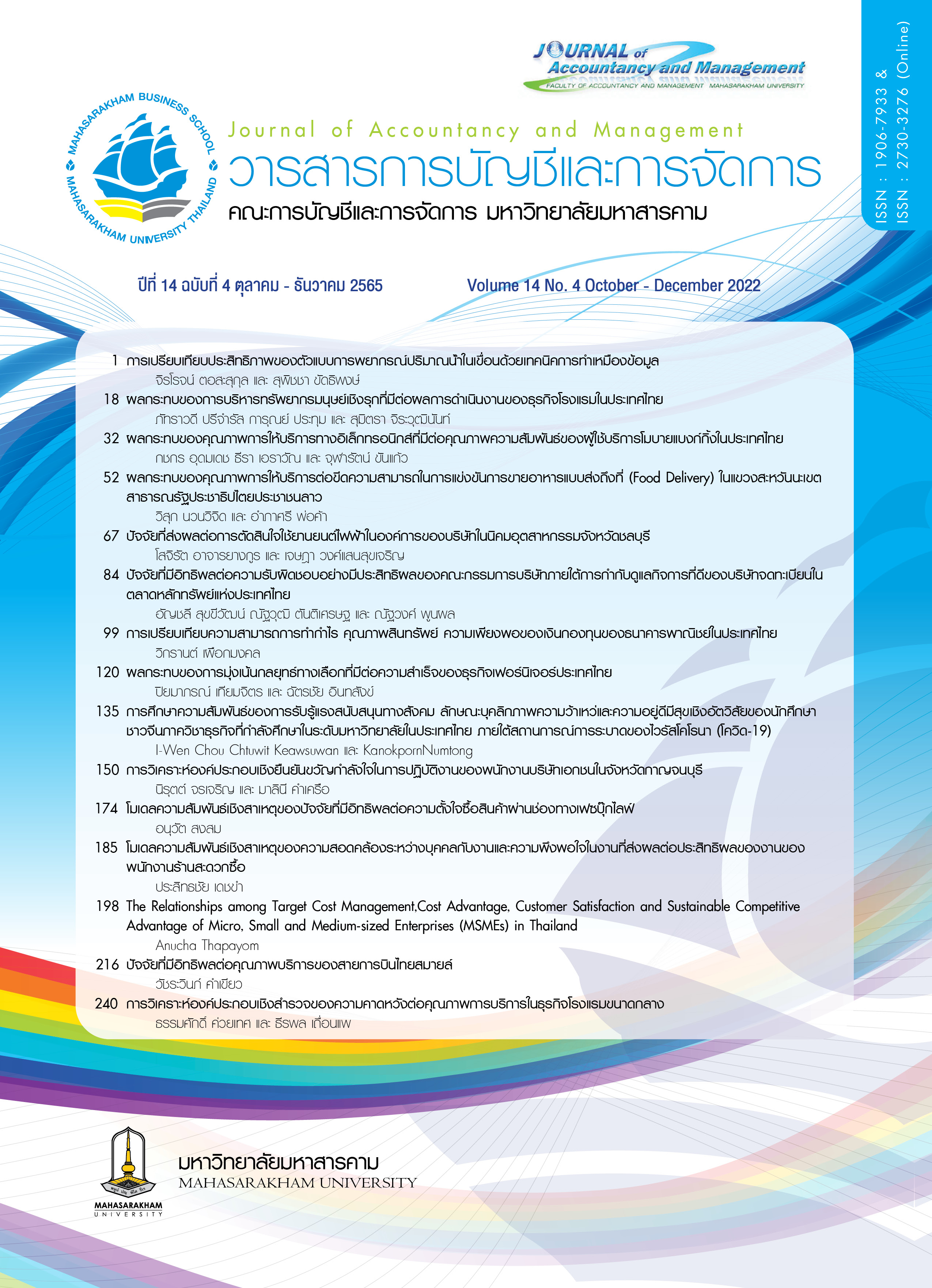
ผลกระทบของการมุ่งเน้นกลยุทธ์ทางเลือกที่มีต่อความสำเร็จของธุรกิจเฟอร์นิเจอร์ ประเทศไทย
คำสำคัญ:
การมุ่งเน้นกลยุทธ์ทางเลือก, ความได้เปรียบทางการตลาด, ความสำเร็จของธุรกิจบทคัดย่อ
การศึกษาครั้งนี้มีวัตถุประสงค์ เพื่อทดสอบความสัมพันธ์และผลกระทบของการมุ่งเน้นกลยุทธ์ที่มีต่อผลความสำเร็จของธุรกิจเฟอร์นิเจอร์ ในประเทศไทย กลุ่มตัวอย่าง คือ ผู้บริหารการตลาดของธุรกิจเฟอร์นิเจอร์ ประเทศไทย จำนวน 109 ตัวอย่าง โดยใช้เครื่องมือในการวิจัยเป็นแบบสอบถาม ซึ่งผ่านการตรวจสอบคุณภาพของเครื่องมือด้วยการทดสอบความเที่ยงตรงเชิงเนื้อหาด้วยผู้เชี่ยวชาญและการทดสอบทางสถิติด้วยค่าอำนาจจำแนก มีค่าระหว่าง 0.714 - 0.902 และความเชื่อมั่นด้วยการทดสอบค่าสัมประสิทธิ์แอลฟาของครอนบาค มีค่าระหว่าง 0.705 - 0.878 การวิเคราะห์ข้อมูล โดยใช้สถิติพรรณนาและทดสอบสมมุติฐานโดยการวิเคราะห์ถดถอยแบบพหุคูณ ผลการทดสอบสมมติฐานการวิจัย พบว่า การมุ่งเน้นกลยุทธ์ (การมุ่งเน้นลูกค้า การมุ่งเน้นคู่แข่งขัน การมุ่งเน้นเทคโนโลยี และการมุ่งเน้นการเรียนรู้) มีอิทธิพลสำคัญและส่งผลกระทบเชิงบวกต่อความได้เปรียบทางการตลาด ในทำนองเดียวกันความได้เปรียบทางการตลาดนำไปสู่ความสำเร็จของธุรกิจเฟอร์นิเจอร์ ผลการวิจัยครั้งนี้ เป็นประโยชน์อย่างมากต่อนักวิชาการในด้านการขยายและต่อยอดองค์ความรู้ด้านการมุ่งเน้นกลยุทธ์ อีกทั้งยังเป็นประโยชน์อย่างมากต่อผู้บริหารเพื่อใช้เป็นแนวทางในการดำเนินธุรกิจเฟอร์นิเจอร์ นอกจากนี้ ยังมีการสรุปและอภิปรายผล รวมถึงทิศทางการวิจัยในอนาคตในส่วนสุดท้ายของวิจัยนี้
Downloads
เอกสารอ้างอิง
กรมเศรษฐกิจระหว่างประเทศ. (2564). เฟอร์นิเจอร์และของตกแต่งบ้าน. ค้นเมื่อ 5 มกราคม 2564. จาก http://www.thaibiz.net/th/business/362/
ดุษฎี เทียมเทศ บุญมาสูงทรง ฉัตรชัย อินทสังข์ สุวัฒนา ตุ้งสวัสดิ์ และปฏิมา ถนิมกาญจน์. (2564). อิทธิพลของการมุ่งเน้นการตลาดและการมุ่งเน้นความเป็นผู้ประกอบการที่มีต่อความสามารถนวัตกรรมผลิตภัณฑ์และผลการดำเนินงานทางการตลาด. วารสารศิลปศาสตร์และวิทยาการจัดการ มหาวิทยาลัยเกษตรศาสตร์ วิทยาเขตเฉลิมพระเกียรติ จังหวัดสกลนคร, 8(1), 1-12.
นงเยาว์ อินทะนาม อาภาศรี พ่อค้า และกรกนก ดลโสภณ. (2563). การมุ่งเน้นความเป็นผู้ประกอบการที่มีผลต่อความสำเร็จของธุรกิจวิสาหกิจขนาดกลางและขนาดย่อมในจังหวัดกาฬสินธุ์. วารสารการบัญชีและการจัดการ มหาวิทยาลัยมหาสารคาม, 12(4), 82-95.
ประทานพร จันทร์อินทร์ ฉัตรชัย อินทสังข์ และสาธิยา กลิ่นสุคนธ์. (2564). ความสัมพันธ์ระหว่างการมุ่งเน้นการตลาดและผลการดำเนินงานกิจการ: การทดสอบภาพลักษณ์กิจการเป็นตัวแปรคั่นกลาง. วารสารมนุษยศาสตร์และสังคมศาสตร์มหาวิทยาลัยธนบุรี, 15(1), 80-91.
ปริญ ลักษิตามาศ ศิวารัตน์ ณ ปทุม และณรงค์ อภิชาติธนากูล. (2558). กลยุทธ์การปรับตัวเพื่อความอยู่รอดเมื่อเข้าสู่การเป็นประชาคมเศรษฐกิจอาเซียนสำหรับธุรกิจร้านค้าปลีกดั้งเดิมของไทย. วารสารวิทยาลัยพาณิชยศาสตร์บูรพาปริทัศน์, 10(2), 1-10.
ภัทราวดี วงศ์สุเมธ. (2556). ปัจจัยที่มีอิทธิพลต่อการยอมรับและการใช้งานระบบการเรียนผ่านเว็บ. วารสารนักบริหาร, 33(3), 3-10.
วิลาวัลย์ อ่อนวงษ์เปรม. (2561). กลยุทธ์การปรับตัวด้านการตลาดเพื่อสร้างการรับรู้คุณค่าอาหารไทยดั้งเดิมของประเทศไทย. (วิทยานิพนธ์ปรัชญาดุษฎีบัณฑิต). กรุงเทพฯ : บัณฑิตวิทยาลัย มหาวิทยาลัยสยาม.
ศูนย์วิจัยธนาคารออมสิน. (2563). อุตสาหกรรมเฟอร์นิเจอร์ปรับตัวรับ New Normal. GSB Research, 1-5.
Aaker, D. A., Kumar, V., & Day, G. S. (2001). Marketing Research. John Wiley Operations Research & Sons, New York, 51(4), 509-518.
Adam, M. & Tabrani, M. (2016). The Impact of Market Orientation, Brand Image and Internal Marketing on Brand Orientation and Strengthening Br. In Proceedings of International Academic Conferences (No. 4106682). International Institute of Social and Economic Sciences.
Al-Henzab, J., Tarhini, A., & Obeidat, B. Y. (2018). The associations among market orientation, technology orientation, entrepreneurial orientation and organizational performance. Benchmarking: An International Journal, 25(8), 3117-3142.
Alsoboa, S. S. & Alalaya, M. M. (2015). Practices of competitive accounting and its influence on the
competitive advantages: An empirical study in Jordanian manufacturing company. Global Journal of Management and Business Research: Accounting and Auditing, 15(3), 12-23.
Armstrong, J. S. & Overton, T. S. (1977). Estimating nonresponse bias in mail surveys. Journal of Marketing Research, 14(3), 396-402.
Balas, A. N., Gokus, O., & Colakoglu, S. N. (2014). Exploring the role of external environment on determining strategic focus, market orientation, and firm performance of service firms. Academy of Marketing Studies Journal, 18(1), 19-40.
Bambang, A., Kusumawati, A., Nimran, U., & Suharyono, S. (2021). The effect of spiritual marketing and entrepreneurship orientation on determining sustainable competitive advantage. The Journal of Asian Finance, Economics, and Business, 8(2), 231-241.
Campbell, J. M. & Park, J. (2017). Extending the resource-based view: Effects of strategic orientation toward community on small business performance. Journal of Retailing and Consumer Services, 34, 302-308.
Chinchang, P. (2020). Entrepreneurial Orientation and Sustainable Competitive Advantage: An Empirical Research of Furniture Export Business. Journal of Southern Technology, 13(1), 108-120.
Farkas, G. (2016). The effects of strategic orientations and perceived environment on firm performance. Journal of Competitiveness, 8(1), 55-65.
Hair, J. F., Black, W. C., Babin, B. J., & Anderson, R. E. (2010). Multivariate data analysis: A global perspective (7th ed.) Upper Saddle River, N.J. : Pearson/Prentice-Hall.
Handoyo, A. S. (2015). The effect of marketing innovation, market orientation, and social capital on competitive advantage and marketing performance: A study in MSMEs of embroidery Central Java Province. Journal of Economics, Business, & Accountancy Ventura, 18(3), 351-366.
Htet, S. & Buavaraporn, N. (2019). The Influence of Strategic Orientation on SME Export Success : An Investigation on Success Factors of SME Exporters in Myanmar through PLSNC Model. UTCC International Journal of Business and Economics, 11(3), 37-74.
Inthasang, C., Jhundra-Indra, P., & Sujchaphong, P. (2019). Dynamic Competitor Marketing Capability and Marketing Performance: An Empirical Research of Furniture Businesses in Thailand. Humanity and Social Science Journal, Ubon Ratchthani University, 10(2), 58-90.
Jung, S. Y., Jung. K., & Shin. J. (2016). The Effects of Market Orientation and Corporate Image on Organizational Performance: Focused on SMMs in South Korea. Conference.
Mullens, D. (2018). Entrepreneurial orientation and sustainability initiatives in family firms. Journal of Global Responsibility, 9(2), 160-178.
Shalender, K. (2018). Entrepreneurial orientation for sustainable mobility through electric vehicles: Insights from international case studies. Journal of Enterprising Communities: People & Places in the Global Economy, 12(1), 67-82.
Syers, K., Ussahawanitchakit, P., & Jhundra-indra, P. (2012). Strategic marketing learning of hotel businesses in Thailand: An empirical investigation of the antecedents and consequences. International Journal of Strategic Management, 12(4), 1-30.
Toopthong, R. & Buasuwan, P. (2019). A Model of the Total Innovation Management of Private Higher Education Institutions in Thailand. International Journal of Business and Economics, 11(3), 9-115.
Tungbunyasiri. S., Jhundra-indra. P., & Sujchaphong. P. (2015). Strategic Brand Orientation and Marketing Survival: An Empirical Investigation of Cosmetic Businesses in Thailand. Doctor of Philosophy degree in Marketing Management, Mahasarakham University.
Tutar, H., Nart, S., & Bingöl, D. (2015). The effects of strategic orientations on innovation capabilities and market performance: The case of ASEM. Procedia-Social and Behavioral Sciences, 207, 709-719.
Yamane, T. (1973). Statistics: An Introductory Analysis (3rd Edition). New York : Harper and Row.
Yupas, Y. (2019). Strategies and Management. Journal of Research and Development Institute, Rajabhat Mahasarakham University, 6(1), 353-362.
ดาวน์โหลด
เผยแพร่แล้ว
รูปแบบการอ้างอิง
ฉบับ
ประเภทบทความ
สัญญาอนุญาต
ลิขสิทธิ์ (c) 2021 วารสารการบัญชีและการจัดการ

อนุญาตภายใต้เงื่อนไข Creative Commons Attribution-NonCommercial-NoDerivatives 4.0 International License.
บทความที่ได้รับการตีพิมพ์เป็นลิขสิทธิ์ของวารสารการบัญชีและการจัดการ
ข้อความที่ปรากฏในบทความแต่ละเรื่องในวารสารวิชาการเล่มนี้เป็นความคิดเห็นส่วนตัวของผู้เขียนแต่ละท่านไม่เกี่ยวข้องกับมหาวิทยาลัยมหาสารคาม และคณาจารย์ท่านอื่นๆในมหาวิทยาลัยฯ แต่อย่างใด ความรับผิดชอบองค์ประกอบทั้งหมดของบทความแต่ละเรื่องเป็นของผู้เขียนแต่ละท่าน หากมีความผิดพลาดใดๆ ผู้เขียนแต่ละท่านจะรับผิดชอบบทความของตนเองแต่ผู้เดียว