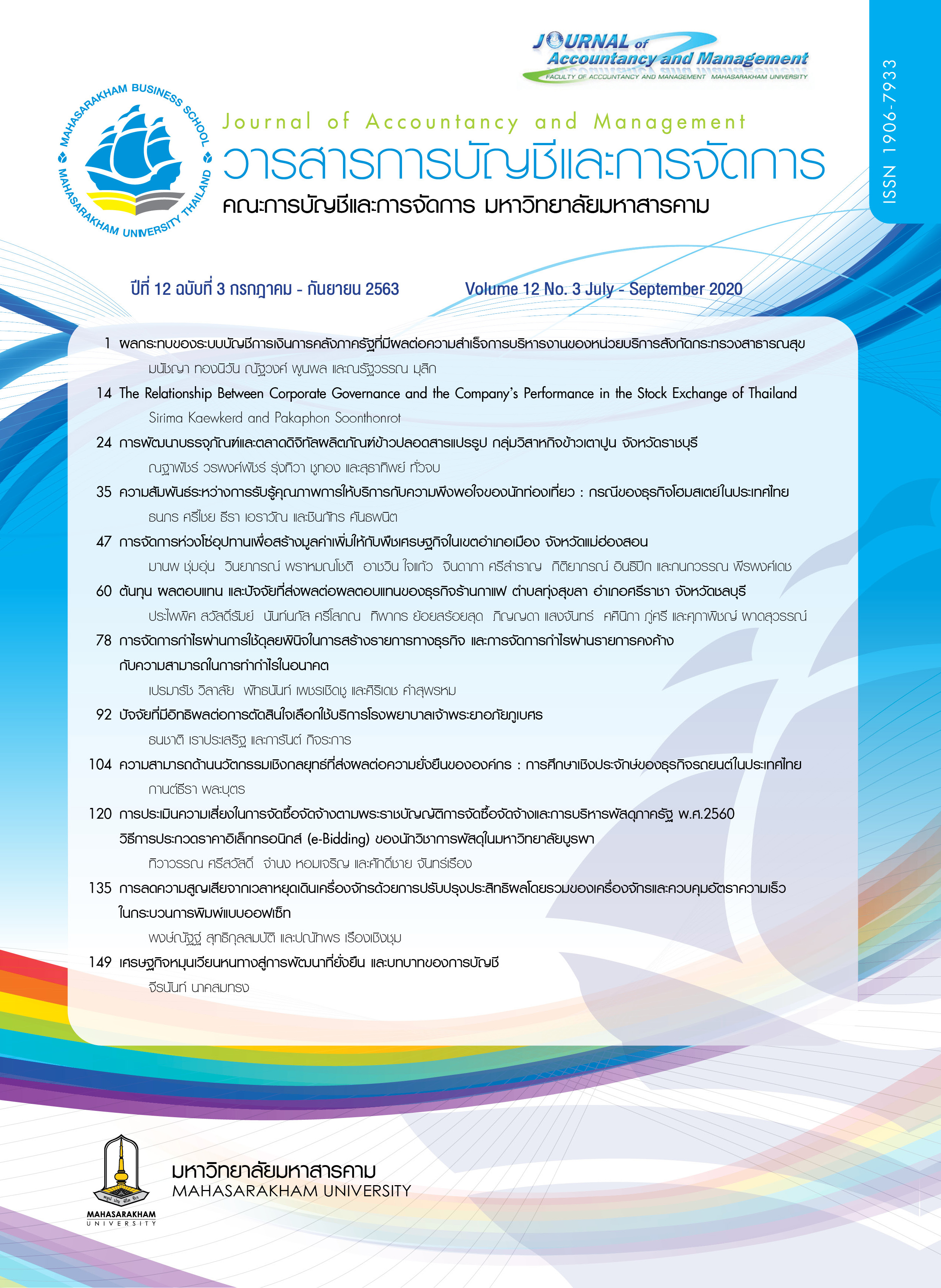
ความสามารถด้านนวัตกรรมเชิงกลยุทธ์ที่ส่งผลต่อความยั่งยืนขององค์กร : การศึกษาเชิงประจักษ์ของธุรกิจรถยนต์ในประเทศไทย
คำสำคัญ:
ความสามารถด้านนวัตกรรมเชิงกลยุทธ์, การก่อให้เกิดผลิตภัณฑ์ใหม่, การยกระดับการมีส่วนร่วมของผู้มีส่วนได้ส่วนเสีย, ความเป็นเลิศในกระบวนการทางธุรกิจ และความยั่งยืนขององค์กรบทคัดย่อ
การศึกษาครั้งนี้มีวัตถุประสงค์เพื่อศึกษาความสามารถด้านนวัตกรรมเชิงกลยุทธ์ที่ส่งผลต่อความยั่งยืนขององค์กร ซึ่งเป็นการศึกษาเชิงประจักษ์ของธุรกิจรถยนต์ในประเทศไทย โดยอาศัยปัจจัยต่างๆ ได้แก่ การก่อให้เกิดผลิตภัณฑ์ใหม่ การยกระดับการมีส่วนร่วมของผู้มีส่วนได้ส่วนเสีย และความเป็นเลิศในกระบวนการทางธุรกิจ เพื่อก่อให้เกิดความยั่งยืนขององค์กร โดยจะใช้การวิเคราะห์ถดถอยวิธีกำลังสองน้อยที่สุด (OLS Regression) ในการวิเคราะห์ความสัมพันธ์ระหว่างตัวแปรและใช้ข้อมูลจากธุรกิจรถยนต์ในประเทศไทย จำนวน 91 แห่ง ผลการศึกษาพบว่า ทั้ง 5 มิติของความสามารถด้านนวัตกรรมเชิงกลยุทธ์ ส่งผลกระทบเชิงบวกต่อผลการดำเนินงานของธุรกิจรถยนต์ในประเทศไทยทั้งสิ้น และที่ส่งผลกระทบเชิงบวกอย่างมีนัยสำคัญทางสถิติมากที่สุดคือ การสนับสนุนกิจกรรมเชิงรุก และการส่งเสริมการขับเคลื่อนทางการตลาด รองลงมาคือ ความยึดมั่นในการปรับตัวอย่างเป็นพลวัต การส่งเสริมแนวคิดใหม่ และการยอมรับในสถานการณ์ที่ต้องรับความเสี่ยง นอกจากนี้ยังพบว่า การก่อให้เกิดผลิตภัณฑ์ใหม่ การยกระดับการมีส่วนร่วมของผู้มีส่วนได้ส่วนเสีย และความเป็นเลิศในกระบวนการทางธุรกิจ ส่งผลกระทบเชิงบวกอย่างมีนัยสำคัญทางสถิติต่อความยั่งยืนขององค์กร
Downloads
เอกสารอ้างอิง
Baden - Fuller, C., & Volberda, H. W. (1997). Strategic renewal: How large complex organizations prepare for the future. International Studies of Management and Organization, 27(2), 95-120.
Bandyopadhyay, P. K. (2011). Using of six sigma in adopting business excellence model in Indian context. International Journal of Business and Management, 6(10), 273-277.
Braganza, A., Brooks, L., Nepelski, D., Ali, M., & Moro, R. (2017). Resource management in big data initiatives : Processes and dynamic capabilities. Journal of Business Research, 70, 328-337.
Chen, T., Tribbitt, M. A., Yang, Y., & Li, X. (2017). Does rivals’ innovation matter? A competitive dynamic perspective on firms’ product strategy. Journal of Business Research, 76, 1-7.
Dixon, S., Meyer, K., & Day, M. (2014). Building dynamic capabilities of adaptation and innovation : A study of micro-foundations in a transition economy. Long Range Planning, 47, 186-205.
Eisenhardt, K. M., & Martin, J. A. (2000). Dynamic capabilities: What are they?. Strategic Management Journal, 21(4), 1105-1121.
Garcia - Granero, A., Llopis, O., Fernandez - Mesa, A., & Alegre, J. (2014). Unraveling the link between managerial risk-taking and innovation: The mediating role of a risk-taking climate. Journal of Business Research, 68(5), 1094-1104.
Hair, Jr. J. F., Babin, B. J., & Anderaon, R. E. (2010). Multivariate data analysis: a global perspective 7thed. New Jersey : Pearson Prentice Hall.
Hockerts, K., & Wustenhagen, R. (2010). Greening goliaths versus emerging devids theorizing about the role of incumbents and new entrants in sustainable entrepreneurship. Journal of Business Venturing, 25, 481-492.
Jean, R. J. B., Kim, D., & Bello, D. C. (2017). Relationship-based product innovations: Evidence from the global supply chain. Journal of Business Research, 80, 127-140.
Kumar, S., & Gulati, R. (2010). Measuring efficiency, effectiveness and performance of Indian public sector banks. International Journal of Productivity and Performance Management, 59(1), 51-74.
Leiblein, M. J., Rener, J. J., & Dalsace, F. (2002). Do make or buy decision matter? The influence of organizational governance on technological performance. Strategic Management Journal, 23(9), 817-833.
Liu, X., Huang, Q., Dou, J., & Zhao, X. (2017). The impact of informal social interaction on innovation capability in the context of buyer-supplier dyads. Journal of Business Research, 78, 314-322.
Nunnally, J. C., & Bernstein, I. H. (1994). Psychometric Theory. 3th ed. New York : McGraw-Hill.
Oldham, G. R., & Da Silva, N. (2015). The impact of digital technology on the generation and implementation of creative ideas in the workplace. Computers in Human Behavior, 42, 5-11.
Palabud, K. (2019). Risk management strategy influencing on organizational survival: An empirical study of community enterprises in Loei province. Journal of Accountancy and Management, 11(4), 61-80.
Sariol, A. M., & Abebe, M. A. (2017). The influence of CEO power on explorative and exploitative organizational innovation. Journal of Business Research, 73, 38-45.
Tang, T. P., Fu, X., & Xie, Q. (2017). Influence of functional conflicts on marketing capability in channel relationships. Journal of Business Research, 78, 252-260.
Teece, D. J., Pisano, G., & Shuen, A. M. Y. (1997). Dynamic capabilities and strategic management. Strategic management Journal, 18(7), 509-533.
Thailand Automotive Institute. (2019). Auto manufacturers association 2019. October, 10, 2019, from http://thailandindustry.blogspot.com
The Federation of Thai Industries. (2019). Car production 2019. Searched on 10 October 2019, from http://www.fti.or.th
Wang, X., & Dass, M. (2017). Building innovation capability: The role of top management innovativeness and relative-exploration orientation. Journal of Business Research, 76, 127-135.
ดาวน์โหลด
เผยแพร่แล้ว
รูปแบบการอ้างอิง
ฉบับ
ประเภทบทความ
สัญญาอนุญาต
บทความที่ได้รับการตีพิมพ์เป็นลิขสิทธิ์ของวารสารการบัญชีและการจัดการ
ข้อความที่ปรากฏในบทความแต่ละเรื่องในวารสารวิชาการเล่มนี้เป็นความคิดเห็นส่วนตัวของผู้เขียนแต่ละท่านไม่เกี่ยวข้องกับมหาวิทยาลัยมหาสารคาม และคณาจารย์ท่านอื่นๆในมหาวิทยาลัยฯ แต่อย่างใด ความรับผิดชอบองค์ประกอบทั้งหมดของบทความแต่ละเรื่องเป็นของผู้เขียนแต่ละท่าน หากมีความผิดพลาดใดๆ ผู้เขียนแต่ละท่านจะรับผิดชอบบทความของตนเองแต่ผู้เดียว