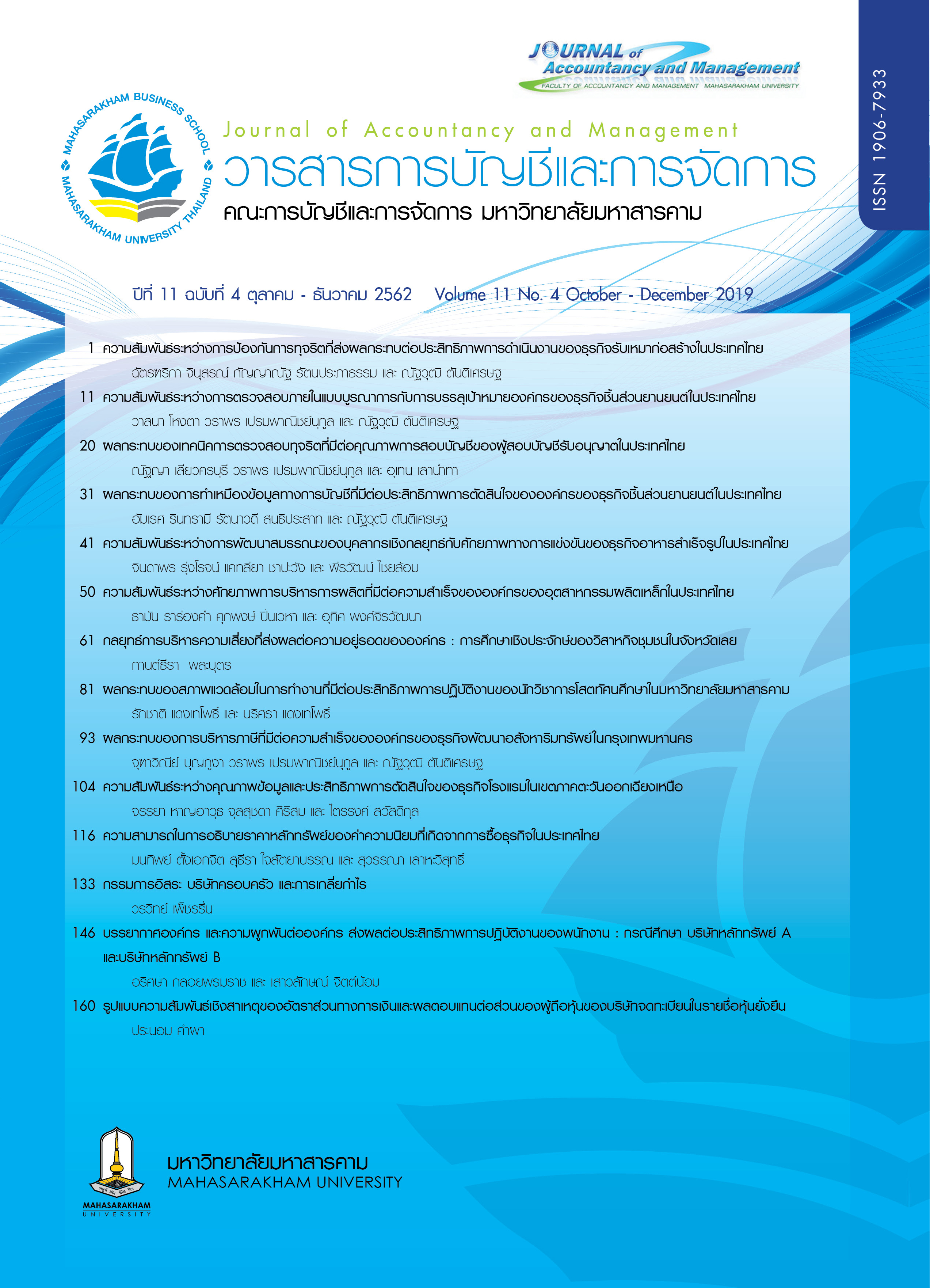
กลยุทธ์การบริหารความเสี่ยงที่ส่งผลต่อความอยู่รอดขององค์กร : การศึกษาเชิงประจักษ์ของวิสาหกิจชุมชนในจังหวัดเลย
คำสำคัญ:
กลยุทธ์การบริหารความเสี่ยง, ความคิดสร้างสรรค์ขององค์กร, ความยืดหยุ่นขององค์กร, นวัตกรรมองค์กร, ความสำเร็จขององค์กร, ความอยู่รอดขององค์กรบทคัดย่อ
การศึกษาครั้งนี้มีวัตถุประสงค์เพื่อศึกษากลยุทธ์การบริหารความเสี่ยงที่ส่งผลต่อความอยู่รอดขององค์กร ซึ่งเป็นการศึกษาเชิงประจักษ์ของวิสากิจชุมชนในจังหวัดเลย โดยอาศัยปัจจัยต่าง ๆ ได้แก่ ความคิดสร้างสรรค์ขององค์กร ความยืดหยุ่นขององค์กร นวัตกรรมองค์กร และความสำเร็จขององค์กร เพื่อก่อให้เกิดความอยู่รอดขององค์กร โดยจะใช้ การวิเคราะห์ถดถอยวิธีกำลังสองน้อยที่สุด (OLS Regression) ในการวิเคราะห์ความสัมพันธ์ระหว่างตัวแปร และใช้ข้อมูลจากวิสาหกิจชุมชนในจังหวัดเลย จำนวน 110 แห่ง ผลการศึกษาพบว่า ทั้ง 10 มิติของกลยุทธ์การบริหารความเสี่ยงของวิสาหกิจชุมชน ส่งผลกระทบเชิงบวกต่อผลการดำเนินงานของวิสาหกิจชุมชนทั้งสิ้น และที่ส่งผลกระทบเชิงบวกอย่างมีนัยสำคัญทางสถิติมากที่สุด คือ ขีดความสามารถด้านเทคโนโลยีสารสนเทศ รองลงมา คือ บรรยากาศองค์กร ประสบการณ์ทางธุรกิจ และความพร้อมของทรัพยากรขององค์กร กลยุทธ์การบริหารความเสี่ยงส่งผลกระทบต่อความสามารถขององค์กรที่จะตอบสนองต่อการดำเนินงานและวัตถุประสงค์เชิงกลยุทธ์ขององค์กร
Downloads
เอกสารอ้างอิง
สำนักงานบริหารมาตรฐานผลิตภัณฑ์ชุมชน สำนักงานมาตรฐานผลิตภัณฑ์อุตสาหกรรม. (2558). รายชื่อวิสาหกิจชุมชนที่ได้รับการรับรองคุณภาพผลิตภัณฑ์ชุมชน จังหวัดเลย. ค้นเมื่อ 17 กุมภาพันธ์ 2559, จาก http://www.tisi.go.th.
สำนักงานเลขานุการคณะกรรมการส่งเสริมวิสาหกิจชุมชนจังหวัดเลย. (2554). รายงานข้อมูลวิสาหกิจชุมชนจังหวัดเลย ข้อมูลประกอบตัวชี้วัดเกษตรจังหวัดรอบที่ 2/2554. เลย: สำนักงานเกษตรจังหวัดเลย.
Aaker, D.A., Kumar, V. & Day, G.S. (2001). Marketing research. 7th ed. New York: John Wiley and Sons.
Amabile, T. M. (1979). Effects of external evaluation on artistic creativity. Journal of Personality and Social Psychology, 25,23-37.
Amdam, R.P. (2014). Sharing knowledge in network organizations. Business Review. Andersen, P.H., Kragh, H., & Lettl, C. (2013). Spanning organizational boundaries to manage
creative processes : The case of the LEGO group. Industrial Marketing Management, 42(1), 125-134.
Armstrong, J.S. & Overton, T.S. (1979). Estimating Nonrespone Bias in Mail Surveys. Journal of Marketing Research, 14(3), 396-402.
Arnold, V., Tanya, B., Joseph, C. & Steve, G.S. (2011). The role of strategic enterprise risk management and organizational flexibility in Easing New Regulatory Compliance. International Journal of Accounting Information Systems. 12, 171-188.
Baden-Fuller, C. & Volberda, H.W. (1997). Strategic renewal : How large complex organizations prepare for the future. International Studies of Management and Organization, 27(2), 95-120.
Cadez, S., & Guilding, C. (2008). An exploratory investigation of an integrated contingency model of strategic management accounting. Accounting, Organizations and Society, 33, 836-863.
Capek, F.W. (2013). The experimentation imperative innovating at the pace of changing customer expectations. Customer Innovation, 1-5.
Chalatharawat, J., and Ussahawanitcakit, P. (2009). Accounting in formation usefulness for performance evaluation and its impact on the firm success : An empirical investigation of food manufacturing firm in Thailand. Review of Business Research, 9(2), 1-25.
Cheung, SO., Wong, P.S.P., Fung, Ada,S.Y., & Coffey, W.V. (2006). Predicting project performance through neural networks. International Journal of Project Management, 24(3), 207-15.
Chirico, F. (2008). The creation, sharing and transfer of knowledge in family business. Journal of Small Business and Entrepreneurship, 21(4), 413-433.
Damanpour, F. (1991). Organizational innovation : A meta-analysis of effects of determinants and moderators. Academy of Management Journal, 34, 555-90.
Danish, R.Q., Yasin M., Sadaf N., Hina A. & Hira H. (2013). Effect of knowledge sharing, participative decision making and transformational leadership on organizational performance. World Applied Sciences Journal, 24(10), 1339-1347.
Essinger J., Rosen J., editors. (1991). Using technology for risk management. England.
Figueira-de-Lemos, F., Jan, J., & Jan-Erik, V. (2011). Risk management in the internationalization process of the firm: A note on the Uppsala model. Journal of World Business. 46, 143-153.
Grant, R.M. (1996). Prospering in dynamically-competitive environments : Organizational capability as knowledge integration. Organizational Science, 7(4), 375-87.
Hair, Jr. J.F., Babin, B.J., & Anderson, R.E. (2010). Multivariate data analysis : A global perspective 7th ed. New Jersey : Pearson Prentice Hall.
Ionescu, V.C., Viorel, C. & Elena D. (2012). Flexible organization. Global Business and Management Research : An International Journal, 4(3&4), 277-285.
Leiblein, M.J., Rener, J.J. & Dalsace, F. (2002). Do make or buy decision matter? The influence of organizational governance on technological performance. Strategic Management Journal, 23(9), 817-833.
Nadkarni, S. & Herrmann, P. (2010). CEO personality, strategic flexibility, and firm performance : The case of the Indian business process outsourcing industry. Academy of Management Journal, 53(5), 1050-1073.
Nonaka, I. (1994). A dynamic theory of organizational knowledge creation. Organization Science, 5(1), 14-37.
Nunnally, J.C. & Bernstein, I.H. (1994). Psychometric Theory. 3th ed. New York: McGraw-Hill.
Oldham, G. R. & Cummings, A. (1996). Employee creativity: Personal and contextual factors at work. Academy of management journal, 39(3), 607-634.
Pansuppawatt, P., & Ussahawanitchakit, P. (2011). Strategic organizational creativity of medical and cosmetic businesses in Thailand : An empirical investigation of the antecedents and consequences. International Journal of Strategic Management, 11(2), 1-25.
Quaadgras, A., Peter W. & Jeanne, W.R. (2014). Management commitments that maximize business impact from IT. Journal of Information Technology, 29, 114-127.
Rodrighez, E., & John S.E. (2011). Transferring knowledge of risk management to the board of directors and executives. Journal of Risk Management in Financial Institutions. 5(2), 162-180.
Verbano, C. & Karen, V. (2011). Development paths of risk management : Approaches, methods and fields of application. Journal of Risk Research. 14, 519-550.
Shirazi, A., Saeed M. & Naser, P.A. (2011). Factors affecting enployees’ readines for knowledge management. European Journal of Economics, 33, 167-177.
Slater, S.F., & Narver, J.C. (1995). Market orientation and the learning organization. Journal of Marketing, 59(7), 63-74.
Smith, H.A. & James, D.M. (2012). Instilling a shared-knowledge culture. Queens University School of Business Kingston, Ontario Canada
Szczepanski, R. & Justyna, S-S. (2012). Risk management system in business relationships – polish case studies. Industrial Marketing Management. 1-10.
Tan, W.L. & So-Jin Y. (2013). Organizational learning platform and new product development. Singapore Management University, 1-12.
Thomke, S. (2013). Unlocking innovation through business experimentation. The European Business Review.
Zahra, S., Neubaum, D., & Larrenta, B. (2007). Knowledge sharing and technological capabilities : The moderating role of family involvement. Journal of Business Research, 60,1070-1979.
ดาวน์โหลด
เผยแพร่แล้ว
รูปแบบการอ้างอิง
ฉบับ
ประเภทบทความ
สัญญาอนุญาต
บทความที่ได้รับการตีพิมพ์เป็นลิขสิทธิ์ของวารสารการบัญชีและการจัดการ
ข้อความที่ปรากฏในบทความแต่ละเรื่องในวารสารวิชาการเล่มนี้เป็นความคิดเห็นส่วนตัวของผู้เขียนแต่ละท่านไม่เกี่ยวข้องกับมหาวิทยาลัยมหาสารคาม และคณาจารย์ท่านอื่นๆในมหาวิทยาลัยฯ แต่อย่างใด ความรับผิดชอบองค์ประกอบทั้งหมดของบทความแต่ละเรื่องเป็นของผู้เขียนแต่ละท่าน หากมีความผิดพลาดใดๆ ผู้เขียนแต่ละท่านจะรับผิดชอบบทความของตนเองแต่ผู้เดียว