Effects of Information Technology Acceptance and Smart Citizenship on Job Efficiency of Support Staff in The Public Higher Education Institutions
Keywords:
Information Technology Acceptance, Smart Citizenship, Job EfficiencyAbstract
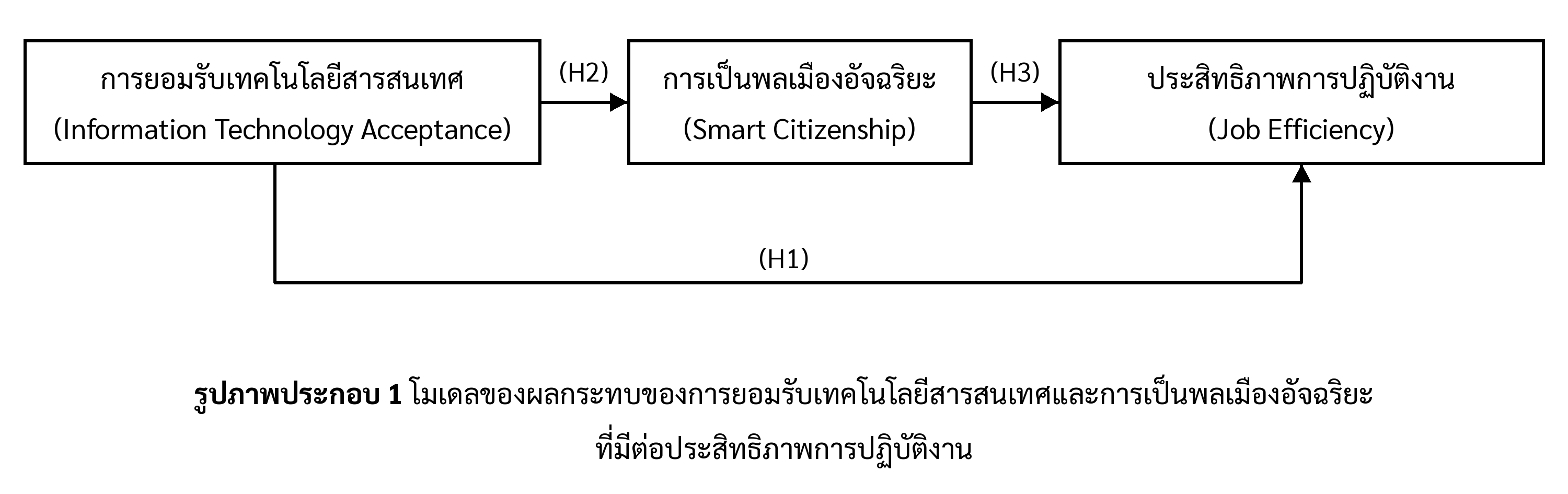
This research aimed to investigate the effects of information technology acceptance and smart citizenship on the job efficiency of support staff in public higher education institutions in Thailand. A questionnaire was used as the data collection instrument, which was distributed to 218 support staff from these institutions. Statistical analyses included multiple correlation analysis and multiple regression analysis. The research revealed three key findings: 1) Information technology acceptance, system usage expectations, and social influence demonstrated positive correlations with job efficiency; 2) Information technology acceptance, system usage expectations, and social influence also had a positive correlation with smart citizenship behavior; and 3) Smart citizenship competencies such as creative in innovation skills; critical thinking and problem-solving skills; cooperation, teamwork and leadership skills; and flexibility and intercultural understanding skills had a positive correlation with job efficiency. In summary, information technology acceptance relates to behavioral attitudes that influence decision-making processes regarding the adoption of new technologies, creating positive value at both individual and organizational levels in the digital age. Smart citizenship reflects the characteristics of individuals who possess the knowledge, abilities, and skills to effectively use information technology, create value, and promote effective collaboration. These abilities act as catalysts for increased job efficiency and effectiveness. The research findings can be a guideline for developing information technology acceptance and smart citizenship among support staff. By applying these capabilities in work practices aligned with organizational objectives, the results can also provide data for policy formulation and strategic planning to develop a human resource management system that aligns with the goals of becoming an internationally recognized, intelligent university capable of achieving international standards.
Downloads
References
กระทรวงเทคโนโลยีสารสนเทศและการสื่อสาร. (2566). Digital Thailand แผนพัฒนาดิจิทัลเพื่อเศรษฐกิจและสังคม 2566. สืบค้นเมื่อ 2 ธันวาคม 2567 จาก https://Users/Administrator/Desktop/2565/digital-thailand.pdf.
กระทรวงเทคโนโลยีสารสนเทศและการสื่อสาร. (2566). การยอมรับเทคโนโลยีสารสนเทศและการใช้ในองค์กร. สืบค้นเมื่อ 5 มกราคม 2568 จาก https://example-url/.
กระทรวงดิจิทัลเพื่อเศรษฐกิจและสังคม. (2567). การส่งเสริมเมืองอัจฉริยะ. สืบค้น 25 มีนาคม 2568, จาก https://www.depa.or.th/th/smart-city-plan/smart-city-office.
ชูชิต ชายทวีป, พิศณี พรหมเทพ, และธนิษฐา สมัย. (2565). ทักษะความเป็นพลเมืองดิจิทัลของนักศึกษาในสถาบันอุดมศึกษาเอกชน, วารสารวิชาการมหาวิทยาลัยราชภัฏศรีสะเกษ. 16(3), 147-160.
ธัญธัช วิภัติภูมิประเทศ. (2567). ทักษะการเป็นพลเมืองดิจิทัลของนักศึกษาระดับปริญญาตรี, วารสารมนุษย์ศาสตร์และสังคมศาสตร์ มหาวิทยาลัยมหาสารคาม. 43(1), 43-53.
บุญชม ศรีสะอาด. (2553). การวิจัยเบื้องต้น. พิมพ์ครั้งที่ 9. กรุงเทพฯ : สุวีริยาสาส์น.
พิศิษฐ ตัณฑวิณิช และพนา จินดาศรี. (2561). ความหมายที่แท้จริงของค่า IOC (Item Objective Congruence), วารสารการวัดผลการศึกษา คณะศึกษาศาสตร์ มหาวิทยาลัยมหาสารคาม. 24(2), 3-12.
มหาวิทยาลัยมหาสารคาม. (2568). ระบบค้นหาบุคลากร กองการเจ้าหน้าที่ มหาวิทยาลัยมหาสารคาม, สืบค้น 22 มีนาคม 2568 จาก https://pd.msu.ac.th/staff/hr.
มหาวิทยาลัยมหาสารคาม. (2567). แผนกลยุทธ์และแผนพัฒนาการศึกษามหาวิทยาลัยมหาสารคาม ฉบับที่ 13 (พ.ศ.2565-2569), สืบค้นเมื่อ 29 กุมภาพันธ์ 2568 จาก https://plan.msu.ac.th/th.
สุขทิพย์ สุกใส, ศิโรจน์ ผลพันธิน, สุขุม เฉลยทรัพย์, และพิทักษ์ จันทร์เจริญ. (2567). ภาวะผู้นำและวัฒนธรรมองค์กรในสถาบันอุดมศึกษา แนงทางการพัฒนาสู่ความเป็นเลิศในยุคแห่งการเปลี่ยน, วารสารวิชาการบัณฑิตวิทยาลัยสวนดุสิต มหาวิทยาลัยสวนดุสิต. 19(2), 171-191.
สำนักงานคณะกรรมการข้าราชการพลเรือน. (2566). คู่มือการพัฒนาตามแผนพัฒนาทรัพยากรบุคคลของกรุงเทพมหานคร พ.ศ. 2561–2565, สืบค้นเมื่อ 2 กุมภาพันธ์ 2568 จาก http://www.mua.go.th/index2.
สถาบันพัฒนาข้าราชการพลเรือน คณะกรรมการข้าราชการพลเรือน. (2565). คู่มือการพัฒนาตามแผนพัฒนาทรัพยากรบุคคลของข้าราชการพลเรือน พ.ศ. 2565. กรุงเทพฯ.
สถาบันเพิ่มผลผลิตแห่งชาติ กระทรวงอุตสาหกรรม. (2567). แนวทางการพัฒนาทรัพยากรมนุษย์เพื่อเพิ่มประสิทธิภาพในการปฏิบัติงาน เพิ่มผลผลิตและขับเคลื่อนเศรษฐกิจไทย, สืบค้นเมื่อ 25 ธันวาคม 2567 จาก https://www.enablesurvey.com.
Ahmad, M., Rahman, A., & Hassan, S. (2025). Influence of digital transformation on employee innovative behavior: Roles of challenging appraisal, organizational culture support, and transformational leadership style. Frontiers in Psychology, 16, 1532977.
Akhtar, N., Alharthi, M. F., & Khan, M. S. (2024). Mitigating multicollinearity in regression: A study on improved ridge estimators. Mathematics, 12, 3027.
Andrina, Granic. (2023). Information technology acceptance and digital skills in higher education institutions. International Journal of Educational Technology, 38(2), 100–112.
Alshammari, S. H., & Alkhwaldi, A. F. (2025). An integrated approach using social support theory and technology acceptance model to investigate the sustainable use of digital learning technologies. Scientific Reports, 15, 342.
Altınay, F., Altınay, Z., Shaidullina, A. R., Rebrina, F., & Tagayeva, A. (2024). Digital skills and digital citizenship education: An analysis based on structural equation modeling. Social Sciences & Humanities Open, 9,
Astriana Anggraini, M. Agif Gandawari, Rauzatul Aflal, & Fitriatun Nadila. (2025) Role Of Digital Competence, Digital Culture, Individual Experience, In Increasing Job Satisfaction And Employee Performance At Bumn Banks In Palopo City. BIMA Journal (Business Management & Accounting Journal), 6(1), 627-642.
Bhandari, P. (2020). Questionnaire Design Research Methods & Examples, Question Types & Examples. Published on January 14.
Bindel Sibassaha, J. L., Pea-Assounga, J. B. B., & Bambi, P. D. R. (2024). Influence of digital transformation on employee innovative behavior: roles of challenging appraisal, organizational culture support, and transformational leadership style. Frontiers in Psychology, 16,
Cheng Wang, X., Li, Y., & Zhang, Q. (2023). Technology experimentation and digital skills development: A longitudinal study. Educational Technology & Society, 26(1), 89-104.
Davit, K., & Savvas, A. (2023). Digital transformation and organizational performance: The role of behavioral intention. Journal of Information Systems and Innovation, 15(1), 45–62.
Dziallas, M., & Blind, K. (2024). Digital transformation and innovation: The influence of digital technologies on turnover from innovation activities and types of innovation. Journal of Manufacturing and Materials Processing, 12(9), 1-25.
Lee, K., & Kim, Y. (2023). The effect of environmental disclosure on corporate performance: Evidence from emerging markets. Journal of Business Ethics, 18(4), 1157-1173.
Liangyong, Xue, Abdullah Mat Rashid & Sha Ouyang. (2024). The Unified Theory of Acceptance and Use of Technology (UTAUT) in Higher Education: A Systematic Review. Journal of Literature Review. 22(1), 1-22.
Martinez, E., & Lopez, F. (2023). Organizational culture and innovation in higher education institutions. Higher Educat Soares, Lerigo Sampson & Barker ion Management Review, 34(2), 156-173.
Nadeem Akhtar, Muteb Faraj Alharthi, & Muhammad Shakir Khan, (2024) Mitigating Multicollinearity in Regression: A Study on Improved Ridge Estimators. (Mathematics, MDPI, 2024).
Thompson, G., & Lee, C. (2022). Team effectiveness and knowledge sharing in higher education: A systematic review. Review of Educational Research, 92(4), 567-589.
Tugiman, Herman, & Anton Yudhana. (2023). The UTAUT Model for Measuring Acceptance of the Application of the Patient Registration System. 12(3), 3792-3803.
Wang, T., & Zhang, S. (2023). The relationship between market value added (MVA) and firm value: Evidence from global corporations. Journal of Corporate Finance, 78. 23-35.
Wongwanich, S., & Sangsawang, T. (2023). The impact of digital infrastructure on administrative efficiency in Thai public universities. International Journal of Educational Management, 37(4), 567–582.
Wilson, J., & Kumar, S. (2022). Cultural diversity understanding and the workplace Effectiveness: Enhancing collaboration and performance in globalization organizations. International Journal of Cross-Cultural Management and Organizational Behavior, 28(4), 156-178.
Xue, L., Rashid, A. M., & Ouyang, S. (2024). The Unified Theory of Acceptance and Use of Technology (UTAUT) in higher education: A systematic review. SAGE Open, 14(1). 1-22.
Downloads
Published
How to Cite
Issue
Section
License
Copyright (c) 2025 Journal of Accountancy and Management

This work is licensed under a Creative Commons Attribution-NonCommercial-NoDerivatives 4.0 International License.
บทความที่ได้รับการตีพิมพ์เป็นลิขสิทธิ์ของวารสารการบัญชีและการจัดการ
ข้อความที่ปรากฏในบทความแต่ละเรื่องในวารสารวิชาการเล่มนี้เป็นความคิดเห็นส่วนตัวของผู้เขียนแต่ละท่านไม่เกี่ยวข้องกับมหาวิทยาลัยมหาสารคาม และคณาจารย์ท่านอื่นๆในมหาวิทยาลัยฯ แต่อย่างใด ความรับผิดชอบองค์ประกอบทั้งหมดของบทความแต่ละเรื่องเป็นของผู้เขียนแต่ละท่าน หากมีความผิดพลาดใดๆ ผู้เขียนแต่ละท่านจะรับผิดชอบบทความของตนเองแต่ผู้เดียว