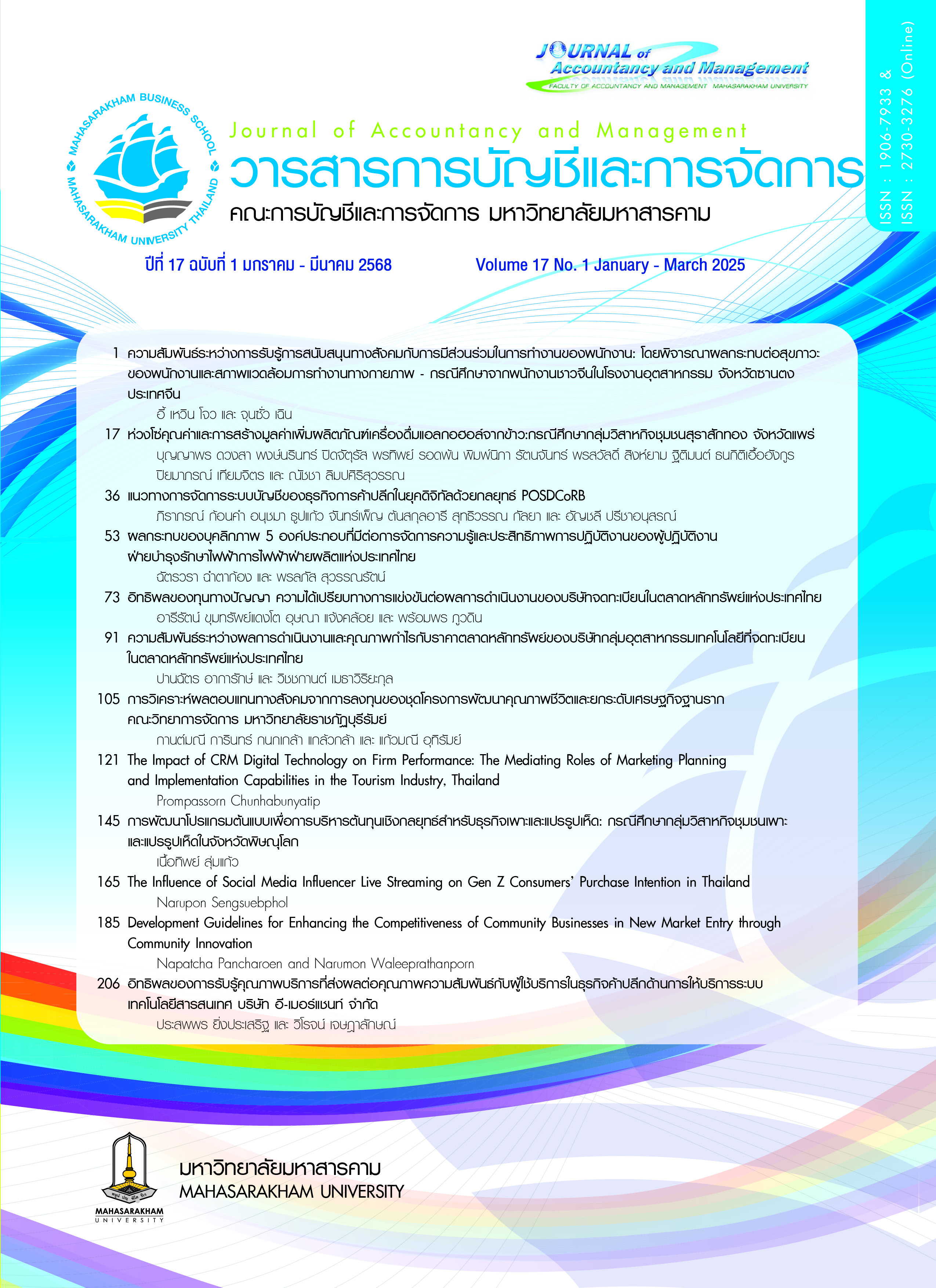
การวิเคราะห์ผลตอบแทนทางสังคมจากการลงทุนของชุดโครงการพัฒนาคุณภาพชีวิต และยกระดับเศรษฐกิจฐานราก คณะวิทยาการจัดการ มหาวิทยาลัยราชภัฏบุรีรัมย์
คำสำคัญ:
ผลตอบแทนทางสังคม , การพัฒนาคุณภาพชีวิต , เศรษฐกิจฐานราก , มหาวิทยาลัยราชภัฏบุรีรัมย์บทคัดย่อ
งานวิจัยนี้มีวัตถุประสงค์เพื่อวิเคราะห์ผลตอบแทนทางสังคมจากการลงทุนของชุดโครงการ โดยเป็นการวิจัยเชิงคุณภาพ กลุ่มตัวอย่างที่ใช้ในการวิจัย คือ ผู้มีส่วนได้เสีย จำนวน 37 คน โดยเลือกกลุ่มตัวอย่างแบบเจาะจง เครื่องมือในการวิจัย คือ แบบสัมภาษณ์เชิงลึก วิเคราะห์ข้อมูลโดยการวิเคราะห์การวางแผนที่ผลลัพธ์และวิเคราะห์ข้อมูลการประเมินผลตอบแทนทางสังคม (SROI) ด้วยการคำนวณอัตราส่วนผลตอบแทนทางสังคมจากการลงทุนเปรียบเทียบกับมูลค่าการลงทุน ผลการวิจัยพบว่า 1) อัตราส่วนผลตอบแทนทางสังคมจากการลงทุน เท่ากับ 2.92 หมายความว่า หากลงทุนไป 1 บาท จะก่อให้เกิดผลประโยชน์หรือมูลค่าทางการเงินของสังคมที่ได้รับกลับคืนมา จำนวน 2.92 บาท แสดงว่า มีความคุ้มค่าในการลงทุน และ 2) ควรให้การสนับสนุนโครงการที่มีรูปแบบและลักษณะการดำเนินงานที่อยู่ในกระแสของสังคม ณ ปัจจุบัน และส่งผลกระทบกับคนส่วนใหญ่ ตลอดทั้งมีกระบวนการพัฒนาการเรียนรู้และต่อยอดกิจกรรมร่วมกันเพื่อสร้างความยั่งยืนอย่างต่อเนื่องระหว่างผู้มีส่วนได้เสีย
Downloads
เอกสารอ้างอิง
Archawananthakun, S., & Yaemlaoar, P. (2014). Guide to Social Results and Returns Social Investment. Bangkok: Dan Suthat.
Ashwanuntakul, S., & Yamla-or, P. (2017). Handbook of the Assessment of Social Return on Investment. Bangkok: Thailand Research Fund.
Bank of Thailand. (2023). Results of the Monetary Policy Committee Meeting No. 5/2023. Bangkok: Monetary Policy Strategy Office.
Becker, H. A. (2001). Social impact assessment. European Journal of Operational Research, 128, 311–321.
Bristol Food Network. (2015). Bristol’s Urban Food Growing Enjoying, Learning, Eating, Connecting. Bristol: Bristol Food Network.
Buathong, S., Sakawee, K., & Panitjaroen, B. (2022). Social impact assessment: sia and social return on investment: sroi. Social Projects. Pathum Thani. Puey Ungphakorn School of Development Studies, Thammasat University.
Corvo, L., Pastore, L., Mastrodascio, M., & Cepiku, D. (2022). The social return on investment model: a systematic literature review. Meditari Accountancy Research, 30(7), 49-86.
Denzin, N. K. (1970). The Research Act: A Theoretical Introduction to Sociological Methods. Chicago: Aldine. Emerson, J. (2003). The blended value proposition: integrating social and financial returns. California Management Review, 45(4), 35-51
Faculty of Management Science. (2023). Annual Budget Plan for 2023. Buriram: Buriram Rajabhat University.
Farr, M., & Cressey, P. (2019). The Social Impact of Advice During Disability Welfare Reform: From Social Return on Investment to Evidencing Public Value Through Realism and Complexity. Public Management Review, 21(2), 238-263.
FCFCG. (2009). Gorgie City Farm Community Gardening Pro-Ject: Social Return on Investment. Bristol: The Federation of City Farms and Community Gardens.
Gosselin, V., Boccanfuso, D., & Laberge, S. (2020). Social return on investment (sroi) method to evaluate physical activity and sport interventions: a systematic review. International Journal of Behavioral Nutrition and Physical Activity, 17(1), 1-11
Hunter, R., Dallat, M., Tully, M., O'Neill, C., Heron, L., & Kee, F. (2020). Social return on investment analysis of an urban greenway. Cities & Health, 6(4), 693–710. doi:10.1080/23748834.2020.1766783.
Joyce, S. A., & MacFarlane, M. (2001). Social Impact Assessment in the Mining Industry: Current Situation and Future Directions. London: Mining, Minerals and Sustainable Development.
Kaewpuang, T., Yongphet, P., Pimpo, P., Chaiyanam, J., Senkwankaew, C., Ananphutthimet, V., & Vongpramate, D. (2023). The assessment of outcomes and social returns from investment for community academic service: a case study of building knowledge and upgrading occupational skills in renewable energy technology, baan mun kong rural network wang nam yen district sa kaeo province. RMUTL Journal Socially of Engaged Scholarship, 7(1), 33-46.
Kongmanee, C., Satsue, P., & Phitthayaphinant, P. (2018). Social return on investment of scientific research projects in project package of para-rubber industry development. Modern Management Journal, 16(2), 43-56.
KPMG. (2015). A Case Study of How Understanding Impacts of Mine Community Development Can Help Maximise Value for Stakeholders. South Africa: Exxaro.
Kulsawat, T. (2015). Determining the Quality of Research Tools. Chonburi: Faculty of Political Science and Law, Burapha University.
Naksanee, T., Sangkhae, R., & Phithuk, A. (2022). Social return on investment from community enterprise business to promote sports tourism in the organization of chom bueng marathon: a case study of uyenpensook thai-mon folkway learning center. Iawasri Journal Thepsatri Rajabhat University, 6(1), 88-105.
Nicholls, J. (2017). Social Return on Investment – Development and Convergence. Evaluation and Program Planning, 64, 127-135.
Nicholls, J., Lawlor, E., Neitzert, E., & Goodspeed, T. (2012). A Guide to Social Return on Investment SROI Network. http://socialvalueuk.org/publications/publicati-ons/cat_view/29-the-guide-to-social-return-on-investment/223-the-guide-in-english-2012-edition
Olsen, S., & Nicholls, J. (2005). A Framework for Approaches to SROI Analysis. Berkeley: University of California.
Policy and Planning Division. (2023). Buriram Rajabhat University Budget Plan for 2023. Buriram: Buriram Rajabhat University.
Sangchai, S. (2018). Evolution of the concept of sustainable development. Journal of Environmental Management, 14(2), 96-111.
Schlten, P., Nicholls, J., Olsen, S., & Galimidi, B. (2006). Social Return on Investment: a Guide to SROI Analysis. Amstele Veen: Lenthe.
Schoen, V., Caputo, S., & Blythe, C. (2020). Valuing physical and social output: a rapid assessment of a london community garden. Sustainability, 12(13), 5452. doi:10.3390/su12135452
Srichantra, T., & Sathueanprai, T. (2019). The assessment of social impact and social return on investment for social services a case study of the create knowledge project to career community promotion: healthy massage nakhon nayok and srakaew provinces. Modern Management Journal, 17(2), 118-125.
Vallaeys, F. (2011). University Social Responsibility: A Mature and Responsible Definition. Higher Education in the World 5.
Wattanachaiyingchareun, D. (2010). Social Impact Assessment. Phitsanulok: The Path of Wisdom.
White, H., & Raitzer, D. A. (2017). Impact Evaluation of Development Interventions a Practical Guide : Theory of Change. Manila: Asian Development Bank.
Yutto, K., Sinnatong, N., Bejrananda, T., & Autchariyapanitkul, K. (2023). Social return on investment case study : learning development in emergency medicine in chiang rai province. Journal of Management Science Research, Surindra Rajabhat University, 7(2), 140-153.
ดาวน์โหลด
เผยแพร่แล้ว
รูปแบบการอ้างอิง
ฉบับ
ประเภทบทความ
สัญญาอนุญาต
ลิขสิทธิ์ (c) 2024 วารสารการบัญชีและการจัดการ

อนุญาตภายใต้เงื่อนไข Creative Commons Attribution-NonCommercial-NoDerivatives 4.0 International License.
บทความที่ได้รับการตีพิมพ์เป็นลิขสิทธิ์ของวารสารการบัญชีและการจัดการ
ข้อความที่ปรากฏในบทความแต่ละเรื่องในวารสารวิชาการเล่มนี้เป็นความคิดเห็นส่วนตัวของผู้เขียนแต่ละท่านไม่เกี่ยวข้องกับมหาวิทยาลัยมหาสารคาม และคณาจารย์ท่านอื่นๆในมหาวิทยาลัยฯ แต่อย่างใด ความรับผิดชอบองค์ประกอบทั้งหมดของบทความแต่ละเรื่องเป็นของผู้เขียนแต่ละท่าน หากมีความผิดพลาดใดๆ ผู้เขียนแต่ละท่านจะรับผิดชอบบทความของตนเองแต่ผู้เดียว