
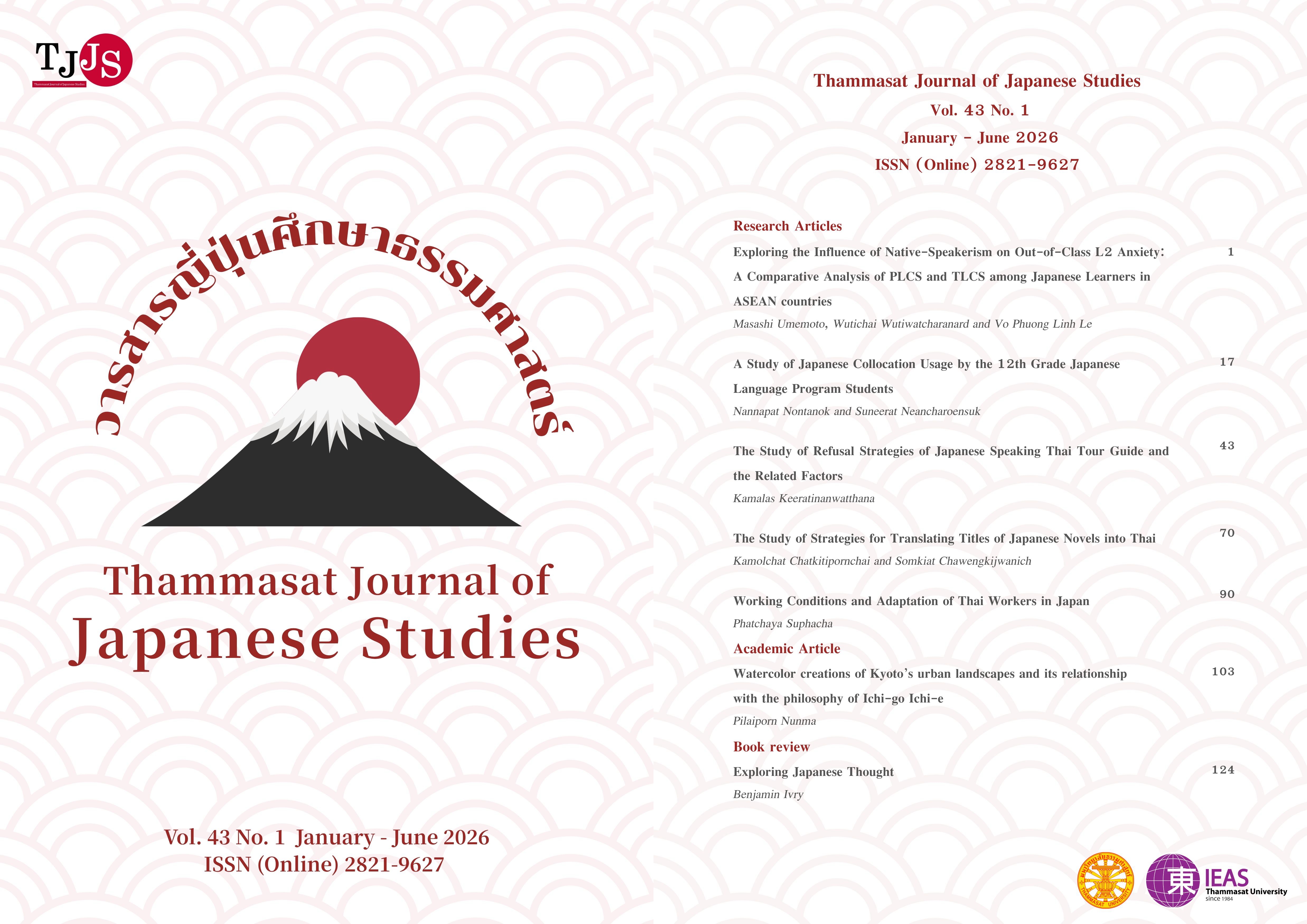
Exploring Japanese Thought
คำสำคัญ:
Japanese philosophy, Buddhism, Japanese literatureบทคัดย่อ
This publication by Sueki Fumihiko, professor emeritus at the University of Tokyo, the Graduate University for Advanced Studies, and the International Research Center for Japanese Studies in Kyoto, is a thematic annotated historical anthology of influential thinking in Japan. It discusses writers over more than a millennium of Japanese history and culture, including Hirata Atsutane, Yanagita Kunio, Tanabe Hajime, Musō Soseki, Tominaga Nakamoto, and Suzuki Daisetsu, among many others. The author observes that the impact of Buddhism in Japan was more lasting than some historians have assumed.
Professor Emeritus Sueki has adeptly assembled a wide range of brief excerpts of noteworthy texts, adding his own personal comments to each. Seven chapters focus on such themes as People and Nature; Questions from the Dead; From Introspective Life to Secular Engagement; Views on the Physical Body; Redefining Buddhism; What Is “Japan”?; and Society and the State.
The further addition of brief biographical data and a short list of suggested further reading for each writer included is especially useful for international students. This analysis points to some debatable choices by the author, including omitting women thinkers despite their presence elsewhere in the literature.
And the Japanese Constitution, mainly written by American civilian officials after the Second World War, is included as a Japanese text, which is another arguable point. A minor, potentially confusing detail for Western readers is that the traditional East Asian age reckoning is used in this book to calculate the ages at time of death of the writers cited, which differs from the method of determining ages in the West.
Nevertheless, the range and variety of material that is included makes Exploring Japanese Thought relevant for anyone interested in the history of Japanese philosophy, Buddhism, and related subjects.
Downloads
เอกสารอ้างอิง
Heisig, J. W., Kasulis, T. P., & Maraldo, J. C. (Eds.). (2011). Japanese philosophy: A sourcebook. University of Hawai’i Press. http://www.jstor.org/stable/j.ctt6wqg76
Hunter, J. (1984). Concise dictionary of modern Japanese history. University of California Press and Kodansha.
Krummel, J. W. M. (Ed.). (2019). Contemporary Japanese philosophy: A reader. Rowman & Littlefield.
McMullen, J. (2019). Murasaki Shikibu’s The tale of genji: Philosophical perspectives. Oxford University Press.
Sueki, F. (2025). Exploring Japanese thought. Japan Publishing Industry Foundation for Culture.
Theodore de Bary, W., Keene, D., Tanabe, G., & Varley, P. (Eds.). (1964) Sources of Japanese traditions (2nd ed.). Columbia University Press.
Wawrytko, S. A. (2022). Murasaki’s Epistemological Awakening: Buddhist Philosophical Roots of The Tale of Genji. Journal of Chinese Philosophy, 49(1), 36–49.
Yamakawa, K. (1992). Women of the Mito domain: Recollections of samurai family life. University of Tokyo Press.
ดาวน์โหลด
เผยแพร่แล้ว
ฉบับ
ประเภทบทความ
สัญญาอนุญาต
ลิขสิทธิ์ (c) 2026 วารสารญี่ปุ่นศึกษาธรรมศาสตร์

อนุญาตภายใต้เงื่อนไข Creative Commons Attribution-NonCommercial-NoDerivatives 4.0 International License.



