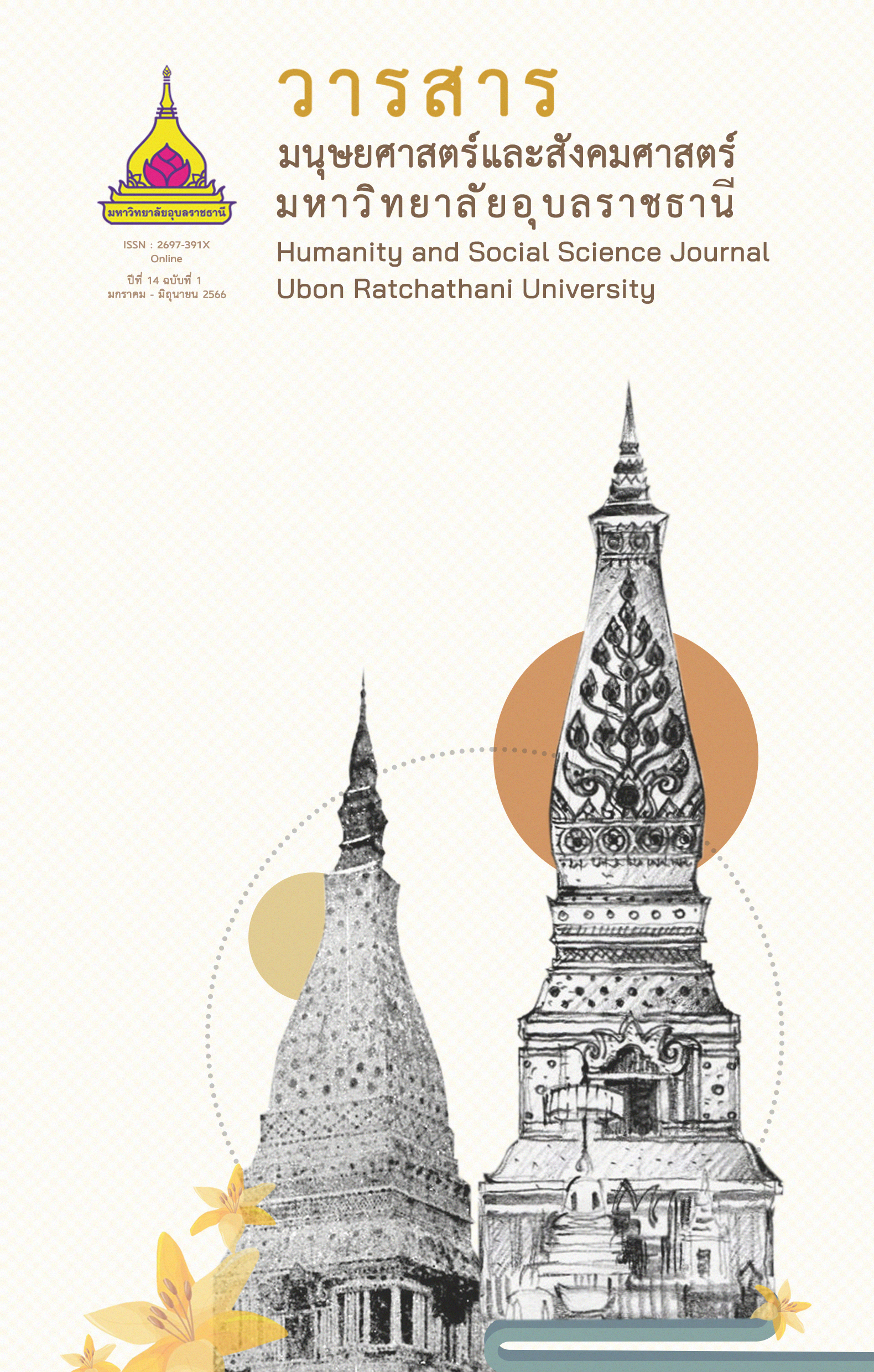
The Changing Meaning of Phra That Phanom in The Context of Thai-Lao History
Article Sidebar
Main Article Content
Abstract
The Changing Meaning of Phra That Phanom in the Context of Thai-Lao History This article aimed to study the changing meanings of Phra That Phanom in the Thai-Lao historical context from 1826 to 2010. The data used to write this article was from documentary research. According to the study, Phra That Phanom—a pagoda enshrined in the Thai-Laos border area—reflected the changed meanings in 5 periods as follows: 1) Chao Anouvong Battle Period: Phra That Phanom became a tool for politics and war. While the Lao Kingdom employed Phra That Phanom as a sacred power crucial to the political situation in the royal court, the Siamese court used Phra That Phanom as a symbol in maps for warfare and fighting against the expansion of the Western powers. 2) The Indochina War Period: The French colonial government attempted to overthrow the faith of people on the left bank of the Mekong River towards Phra That Phanom. Meanwhile, the Thai state linked the meaning of Phra That Phanom with the creation of Thai citizenship. 3) The Cold War Period: Phra That Phanom has become the emblem of the first higher education institution in the Northeast of Thailand. In addition, there was a new meaning of the pagoda from the archaeological knowledge of the Fine Arts Department and the reproduction of discourses on Urangadhat Legend. 4) The Mekong Sub-Region Development Period: Phra That Phanom became a commodity. There were many productions of merchandise linked to Phra That Phanom, and the sale of such products in the Phra That Phanom area continues to the present. 5) The Campaigning for Phra That Phanom to be a Cultural Heritage Site Period: To become an international space, Phra That Phanom is associated with new meanings, especially in political and economic dimensions. Still, Phra That Phanom retains its meaning of being a sacred space and the spiritual center of the people until now.
Article Details

This work is licensed under a Creative Commons Attribution-NonCommercial-NoDerivatives 4.0 International License.
บทความที่ได้รับการตีพิมพ์เป็นลิขสิทธิ์ของวารสารมนุษยศาสตร์และสังคมศาสตร์ มหาวิทยาลัยอุบลราชธานี
ข้อความที่ปรากฏในบทความแต่ละเรื่องในวารสารวิชาการเล่มนี้เป็นความคิดเห็นส่วนตัวของผู้เขียนแต่ละท่านไม่เกี่ยวข้องกับมหาวิทยาลัยอุบลราชธานี และคณาจารย์ท่านอื่นๆในมหาวิทยาลัยฯ แต่อย่างใด ความรับผิดชอบองค์ประกอบทั้งหมดของบทความแต่ละเรื่องเป็นของผู้เขียนแต่ละท่าน หากมีความผิดพลาดใดๆ ผู้เขียนแต่ละท่านจะรับผิดชอบบทความของตนเองแต่ผู้เดียว
References
Ankitchit, K. (2014). The process of building awareness and understanding of the arts of Thai society. Case study: Bangkok Art and Culture Center [Master’s thesis, Silpakorn University]. (in Thai)
Chalongpak, S. & Chantamala, O. (2017). Forn Bhu Cha Phra Thard Panom: Artificial Process of Performing Art in The End of Buddhist Lent [Master’s thesis, Mahasarakham University]. (in Thai)
Chinnabutr, S. (2016). The Identity and Inheritance of the Monastery Serfs of Wat Phra That Phanom Nakhon Phanom Province in Kao Bichabhagaya Offering and Sia Kha Hua Ritual [Master’s thesis, Sakon Nakhon Rajabhat Unive]. (in Thai)
Fine Arts Department. (1979). Archives of the restoration of Phra That Phanom at Wat Phra That Phanom Woramahawihan, That Phanom District, Nakhon Phanom Province, 1975-1979. Bangkok: Pikanet Press (in Thai)
Karnthak, A. (2011). Phra That Phanom: Development of Historical, Social, Cultural, Urban and Community [Master’s thesis, Mahasarakham University]. (in Thai)
Kotchare, T. (2012). Thai tourist’s behavior in birthday’s relic of the buddha religious tourism Nakhon Phanom Province [Master’s thesis, Khon Kaen university]. (in Thai)
Manichot, S. (2011). Phra That Phanom: Sacred Religious Sites in the dimension of social and cultural symbols [Master’s thesis, Mahasarakham University]. (in Thai)
Meekaew, N. (2012). Chaikong road: cultural commodification for tourism in Chiang Khan District, Loei province [Master’s thesis, Khon Kaen University]. (in Thai)
Narasaj, B. (2018). Lan Chang Buddhist pagodas and the cultural heritage management of local communities in Mekong Basin [Master’s thesis, Khon Kaen University]. (in Thai)
Patarasuk, U. (2011). The study of the Influence of Phra That Phanom in Beliefs and rituals of Mekong Basin Community [Master’s thesis, Mahachulalongkornrajavidyalaya University]. (in Thai)
Pramong, S. (2017). Thung Sumrit Heroism Memorial: The Commodification of Local Culture [Master’s thesis, Khon Kaen University]. (in Thai)
Promphakping, N. (2014). The Construction of Social Space of the Phu Thai National Development Cooperators of the Thai Nation [Doctoral dissertation, Khon Kaen University]. (in Thai)
Rajanuwat, D. (2008). Urangadhat The Legend of Phra That Phanom (Bisadarn). Bangkok: June Publishing Company Limited. (in Thai)
Sirirat, P. (2020). The Development of Spiritual Tourism Model by Community Participation for Sustainable Tourism Nakhon Phanom Province [Doctoral dissertation, Mahidol University]. (in Thai)
Sriwongsa, K. (2019). The study of importance of Phra That Phanom through its replica [Doctoral dissertation, Silpakorn University]. (in Thai)
Suwakanth, P. (2011). Economy and Politics in the Mekong Region. Bangkok: Thammasat University Press. (in Thai)
Tantimala, C. (2017). Public Spheres and Production of Space: The Meaning of Social Relationships [Doctoral dissertation, Srinakharinwirot University]. (in Thai)
Testham, P. (1986) A study of the legends of Phra That based on the twelve year’s astrological cycle [Master’s thesis]. Thai epigraphy, Silpakorn University. (in Thai)
The committee is working to request the registration of Phra That Phanom as a world heritage site. (2017). “Phra That Phanom as a World Heritage Site” Strategies for applying for registration of Phra That Phanom as a World Heritage Site. Nakhon Phanom: Wat Phra That Phanom. (in Thai)
Tonlerd, S. (2015). A critical introduction of modern popular culture: Paradigm of culture and cultural phenomena in Southeast Asia. Journal of Language and Culture, 34(1), 29-59. (in Thai)
Viravong, S. (1996). History of Laos (2nd edition). Bangkok: Matichon Publishing House. (in Thai)
Wanliphodom, S. (2003). The meaning of the Buddha's relics in the Siamese civilization. Bangkok: Ancient City. (in Thai)
Wat Phra That Phanom Woramahawihan. (2014). Phra That Phanom. Nakhon Phanom: Wat Phra That Phanom Woramahawihan.
(in Thai)
Wiphakphachanakij, T. (1999). History of Isan. Bangkok: Foundation for the Textbook of Humanities and Social Sciences Project. (in Thai)
