
A model of developing the potential of health tourism to promote well-being for older adults in tourist destinations along the Thai-Cambodian border, Sisaket province
Article Sidebar
Main Article Content
Abstract
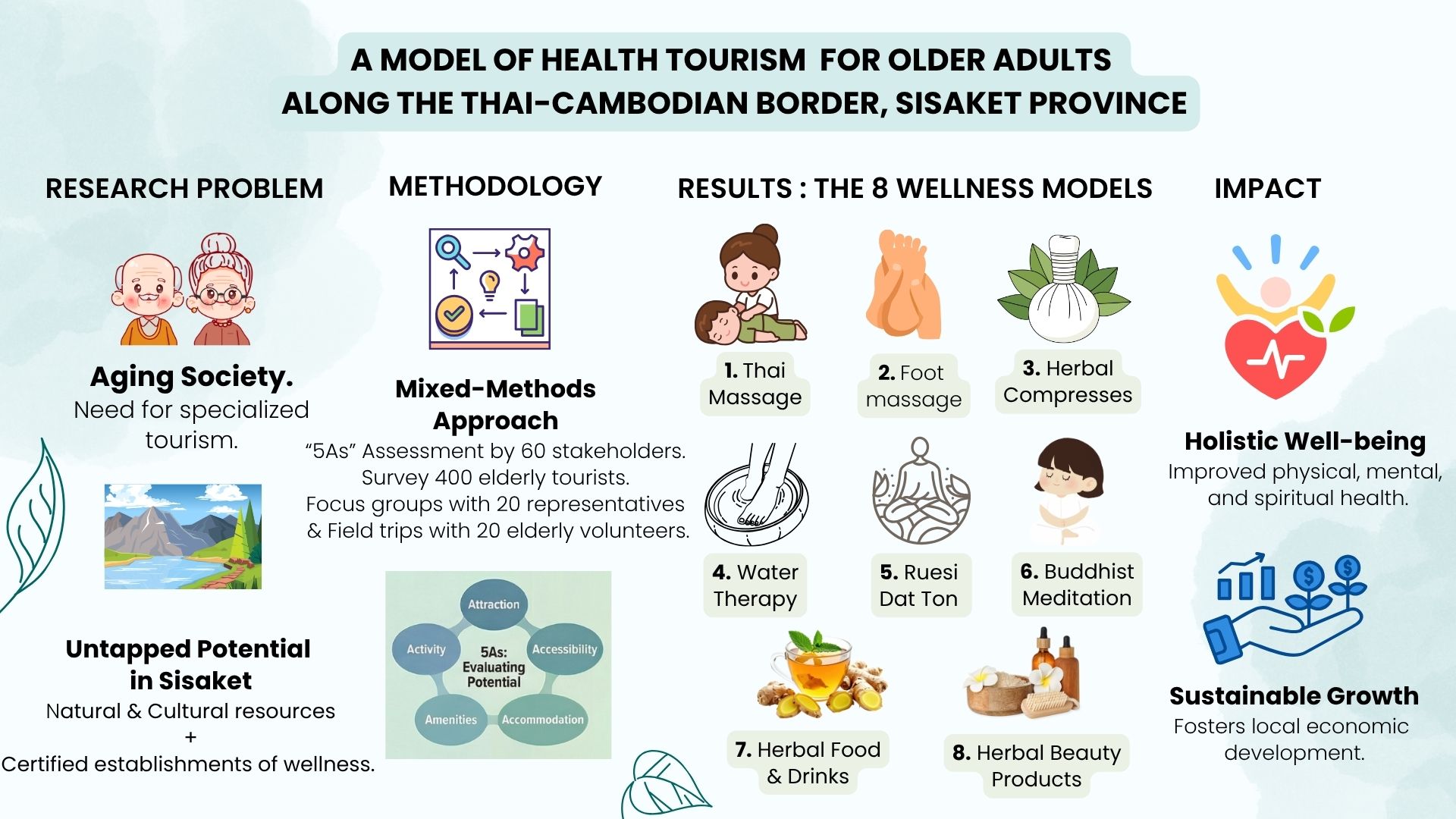
The purposes of this research were to 1) assess the potential of health tourism destinations, 2) survey the demand for health tourism activities, and 3) develop health tourism models to promote health for the older adults in Thai-Cambodian border tourist destinations in Sisaket province. The research adopted a mixed-methods approach. The samples included 1) 60 representatives from the public and private sectors, 2) 400 older tourists, and 3) 20 older volunteer tourists. The instruments were 1) an evaluation form, 2) a questionnaire, and 3) a semi-structured interview. Data were analyzed using descriptive and content analysis techniques. The findings revealed that the overall score of health tourism destination was high (4.06), the highest average rating was attractions, followed by activities, accessibility, facilities, and accommodations. In addition, the main purpose of older tourists was to relax, they travel twice a year to natural destinations. Their family and relatives influenced their decision-making. They preferred traveling independently by private cars and stay overnight, and taking journey as convenient. Their expenditure per trip was over 5,000 THB. They would travel with family/relatives and on their own. The demand for health tourism activities was consisted of Thai massage, aromatic oil therapy, Vipassana meditation, skincare products, herbal health foods and drinks, Thai massage demonstrations, foot massage, herbal compress treatment, yoga or physical exercises, herbal steam baths, massage machines, mineral baths, and fish spa. The study suggested eight health tourism models to promote well-being for older tourists in the Thai-Cambodian border area, Sisaket province. The models included: 1) Thai traditional massage, 2) foot massage, 3) herbal knee and stomach compresses, 4) foot soaking in herbal decoction and walking barefoot on volcanic rocks, 5) practicing 15 Ruesi Dat Ton postures, 6) Buddhist chanting and meditation, 7) vegetarian food and beverages, and 8) herbal health and beauty products.
Downloads
Article Details

This work is licensed under a Creative Commons Attribution-NonCommercial-NoDerivatives 4.0 International License.
All rights reserved. Apart from citations for the purposes of research, private study, or criticism and review,no part of this publication may be reproduced, stored or transmitted in any other form without prior written permission by the publisher.
References
Albu, A., Chasovschi, C. E., Muristaja, H., Tooman, H., & Patier, S. S. (2015). Handbook of senior tourism. Grwp Llandrillo Menai.
Álvarez-Sánchez, A., Rojas-Lara, G. A., & Vaca-González, E. (2024). The impact of health and wellness tourism on tourists’ physical, mental, and emotional balance. In A. Abreu, J. V. Carvalho, P. Liberato, & H. C. Monroy (Eds.), Advances in tourism, technology and systems (pp. 539–548). Springer. https://doi.org/10.1007/978-981-99-9765-7_47
Ashton, A. S., & Klinhom, C. (2020). Wellness tourism development in the hotel industry: Tourist perspective. Journal of Tourism Quarterly, 2(3–4), 54–66. http://htmjournals.com/jtq/index.php/jtq/article/view/15
Câmara, E., Pocinho, M., Neves de Jesus, S., & Agapito, D. (2024). Senior tourists’ well-being, happiness, and satisfaction with life: A systematic literature review. Journal of Tourism, Sustainability and Well-being, 12(2), 87–110. https://journals.cinturs.pt/jtsw/article/view/457
Carrera, L. (2025). Age tourism: Going beyond health and “triple S” tourism toward a new request of journey. Frontiers in Sociology, 9, Article 1395405. https://doi.org/10.3389/fsoc.2024.1395405
Chamber of Commerce Sisaket. (2022). Working towards a smart city by supporting tourism. BSAC. https://bsac.chemcu.org/wp-content/uploads/2022/04/IQPISSP2-Smart-City-Final-Report.pdf
Chinnak, S., & Chinnak, K. (2023). Transborder health services in Southern Isan amid the situations and contexts relevant to the countries of origin (Cambodia and Lao PDR). Journal of Liberal Arts, Ubon Ratchathani University, 19(1), 128–157. https://so03.tci-thaijo.org/index.php/jla_ubu/article/view/263875/178877 [in Thai]
Deci, E. L., & Ryan, R. M. (1985). Intrinsic motivation and self-determination in human behavior. Plenum Press.
Department of Older Persons. (2023). Situation of the Thai older persons 2022. Amarin Corporations. [in Thai]
Department of Thai Traditional and Alternative Medicine. (2025). Wellness Center, Certified health establishments. Ministry of Public Health. https://wellnesscenter.dtam.moph.go.th/contentSearch.php [in Thai]
Fan, D. X. F., Lyu, J., Huang, Y., Shang, K., & Buhalis, D. (2024). Senior tourists’ digital travel experience: A humanisation perspective. In K. Berezina, L. Nixon, & A. Tuomi (Eds.), Information and communication technologies in tourism 2024 (pp. 317–322). Springer. https://doi.org/10.1007/978-3-031-58839-6_34
Güçlü Nergiz, H., & Toker, F. (2025). Healthy aging in the tourism industry: A systematic literature review. SAGE Open, 15(3). https://doi.org/10.1177/21582440251379664
Hair, J. F., Black, W. C., Babin, B. J., Anderson, R. E., & Tatham, R. L. (2006). Multivariate data analysis (6th ed.). Pearson Prentice Hall.
Hennadige, B. D. (2024). The role of social media towards ensuring good health and the well-being of tourists by promoting wellness tourism. In V. Nadda, P. Tyagi, R. Moniz Vieira, & P. Tyagi (Eds.), Implementing sustainable development goals in the service sector (pp. 185–198). IGI Global. https://doi.org/10.4018/979-8-3693-2065-5.ch014
Horneman, L., Carter, R. W., Wei, S., & Ruy, H. (2002). Profiling the senior traveler: An Australian perspective. Journal of Travel Research, 41(1), 23–37. https://doi.org/10.1177/004728750204100104
Jang, S. S., & Wu, C. M. E. (2006). Seniors’ travel motivation and the influential factors: An examination of Taiwanese seniors. Tourism Management, 27(2), 306–316. https://doi.org/10.1016/j.tourman.2004.11.006
Kanchanathaveekul, K., Jankaweekool, P., Siriyanun, S., & Sungrugsa, N. (2023). Development of products and packaging for health tourism promotion in southern Thailand. International Journal of Advanced Research (IJAR), 11(5), 977–988. https://doi.org/10.21474/IJAR01/16954
Klinmuenwai, K., & Eurvongkul, R. (2023). A study of guidelines for the management of health tourism according to the perceptions behaviors of stakeholders in Nakhornratchasima province. Journal of Applied Economics and Management Strategy, 10(2), 124–141. https://kuojs.lib.ku.ac.th/index.php/jaems/article/view/5439 [in Thai]
Kongkhaw, P., Thumniyom, A., & Onsoung, P. (2024). Handbook of health tourism to promote well-being for older adults in tourist destinations along the Thai-Cambodian border, Sisaket province. Sisaket Rajabhat University. [in Thai]
Ministry of Public Health. (2025). Strategy house. Office of the Permanent Secretary, Ministry of Public Health. [in Thai]
Ministry of Tourism and Sports. (2023). The national tourism development plan No. 3 (2023–2027). Office of the Permanent Secretary. [in Thai]
Office of Sisaket Province. (2023). Sisaket provincial development plan (2023–2027). Ministry of Interior. https://www.sisaket.go.th/plan_si/index.html [in Thai]
Pacheco, A., Moniz, A. I., & Silva, O. (2022). Senior travel behavior before and after retirement. In A. Abreu, D. Liberato, & J. C. Garcia Ojeda (Eds.), Advances in tourism, technology and systems (pp. 299–309). Springer. https://doi.org/10.1007/978-981-19-1040-1_26
Podhisita, C. (2016). The art and science of qualitative research. Amarin Printing. [in Thai]
Puangchuen, K., & Phumsathan, S. (2020). Travel behaviors and needs of senior visitors for tourism in Khao Yai National Park. Journal of Thai Hospitality and Tourism, 15(2), 29–42. https://so04.tci-thaijo.org/index.php/tourismtaat/article/view/241938 [ in Thai]
Riwattana, S., Phon-ngam, P., & Sriwatanakul, K. (2023). Development of activities model to promote wellness tourism in Chonburi province. Journal of Social Science and Cultural, 7(10), 182–191. https://so06.tci-thaijo.org/index.php/JSC/article/view/268303 [in Thai]
Srisa-ard, B. (2011). Introduction to research (8th ed.). Suriyasan. [in Thai]
Thaotrakool, N., & Wannaluk, P. (2020). Guidelines for marketing communication development of health tourism at Samoeng district and Mae-On district in Chiang Mai province. Christian University Journal, 26(2), 73–83. https://he01.tci-thaijo.org/index.php/CUTJ/article/view/236377 [in Thai]
Tiamiyu, T. (2024). Older the better: Senior tourists’ curiosity towards the home-sharing platform. Consumer Behavior in Tourism and Hospitality, 19(1), 18–36. https://doi.org/10.1108/cbth-05-2023-0050
Tourism and Sports Economics Division. (2024). Domestic tourism statistics (classify by region and province 2023). Ministry of Tourism and Sports. https://www.mots.go.th/news/category/705 [in Thai]
Wongpratum, N., & Phumvitchuvet, D. (2021). The health tourism management model for community based on the King’s philosophy. Journal of Arts Management, 5(2), 299–311. https://so02.tci-thaijo.org/index.php/jam/article/view/244676 [in Thai]
Yamane, T. (1973). Statistics: An introductory analysis. Harper & Row.
Závodná, L. S. (2025). Seniors constraints to travel: Analyzing discussions on TripAdvisor. Current Issues in Tourism, 28(15), 2381–2397. https://doi.org/10.1080/13683500.2024.2372937
