
The impact of multi-level anonymity in asynchronous online peer feedback for EFL writing in higher education
Article Sidebar
Main Article Content
Abstract
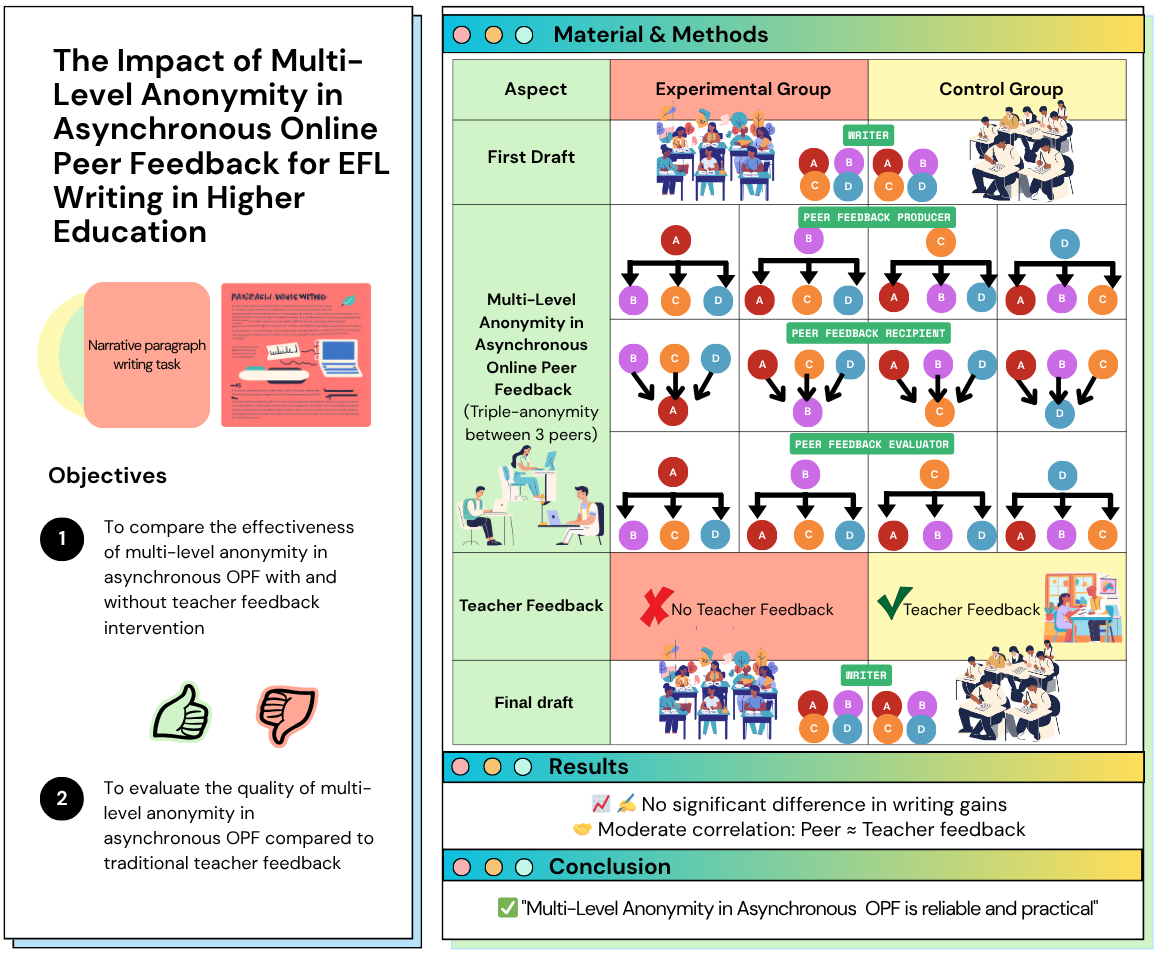
Online Peer Feedback (OPF) is a proven and effective peer editing tool in EFL writing classrooms. However, the level of effectiveness varies depending the relationship between peer editors and on the available peer editing tools. This study investigates the impact of multi-level anonymity in asynchronous OPF by addressing two key objectives 1) to compare the effectiveness of multi-level anonymity in asynchronous OPF with and without teacher feedback intervention; and 2) to evaluate the quality of multi-level anonymity in asynchronous OPF compared to traditional teacher feedback. The study utilized a randomized pretest-posttest control group design. 62 first-year English major students from a mid-sized university in Thailand were randomly assigned to a control group of 31, and they received triple-anonymity asynchronous OPF together with teacher feedback. The experimental group of 31 received triple-anonymity asynchronous OPF without any teacher feedback. All participants completed a narrative paragraph writing task, which was used for data collection and analysis. Quantitative data were analyzed using descriptive statistics and bivariate correlations. Two key findings emerged: 1) There was no significant difference in writing skill improvement between the experimental and control groups. Triple-anonymity asynchronous OPF with or without teacher feedback intervention are both practical peer assessment tools in EFL writing classrooms; and moreover, 2) there was a moderate positive correlation between peers and the teacher feedback in the experimental group. This indicates reliability of peer feedback in the triple-anonymity asynchronous OPF group without teacher intervention. These results suggest that the incorporation of triple-anonymity asynchronous OPF into writing instruction can develop students' writing skills and can enhance assessment methods in higher education EFL classrooms.
Downloads
Article Details

This work is licensed under a Creative Commons Attribution-NonCommercial-NoDerivatives 4.0 International License.
All rights reserved. Apart from citations for the purposes of research, private study, or criticism and review,no part of this publication may be reproduced, stored or transmitted in any other form without prior written permission by the publisher.
References
Awada, G. M., & Diab, N. M. (2023). Effect of online peer review versus face-to-face peer review on argumentative writing achievement of EFL learners. Computer Assisted Language Learning, 36(1–2), 238–256. http://doi.org/10.1080/09588221.2021.1912104
Aydawati, E. N., Rukmini, D., Mujiyanto, J., & Fitriati, S. W. (2023). The impact of synchronous and asynchronous online peer review activities on students’ academic writing skills. Research Studies, 3(5), 954–957. https://doi.org/10.55677/ijssers/V03I5Y2023-28
Brodie, S., Frainer, A., Pennino, M. G., Jiang, S., Kaikkonen, L., Lopez, J., Ortega-Cisneros, K., Peters, C. A., Selim, S. A., & Văidianu, M. (2021). Equity in science: Advocating for a triple-blind review system. Trends in Ecology & Evolution, 36(11), 957–959. https://doi.org/10.1016/j.tree.2021.07.011
Chang, C.-F. (2012). Peer review via three modes in an EFL writing course. Computers and Composition, 29(1), 63–78. https://doi.org/10.1016/j.compcom.2012.01.001
Chen, T. (2016). Technology-supported peer feedback in ESL/EFL writing classes: A research synthesis. Computer Assisted Language Learning, 29(2), 365–397. https://doi.org/10.1080/09588221.2014.960942
Chew, S. Y., & Ng, L. L. (2021). Computer-mediated communication (CMC). In Interpersonal Interactions and Language Learning (pp. 27–52). Palgrave Macmillan. https://doi.org/10.1007/978-3-030-67425-0_3
Falchikov, N. (2005). Improving assessment through student involvement: Practical solutions for aiding learning in higher and further education. Routledge.
Falchikov, N., & Goldfinch, J. (2000). Student peer assessment in higher education: A meta-analysis comparing peer and teacher marks. Review of Educational Research, 70(3), 287–322. https://doi.org/10.2307/1170785
Guardado, M., & Shi, L. (2007). ESL students’ experiences of online peer feedback. Computers and Composition, 24(4), 443–461. https://doi.org/10.1016/j.compcom.2007.03.002
Huisman, B., Saab, N., van den Broek, P., & van Driel, J. (2019). The impact of formative peer feedback on higher education students’ academic writing: A meta-analysis. Assessment & Evaluation in Higher Education, 44(6), 863–880. https://doi.org/10.1080/02602938.2018.1545896
Jin, X., Jiang, Q., Xiong, W., Feng, Y., & Zhao, W. (2024). Effects of student engagement in peer feedback on writing performance in higher education. Interactive Learning Environments, 32(1), 128–143. https://doi.org/10.1080/10494820.2022.2081209
Jones, J. (2018). The importance of peer review. The Journal of Academic Librarianship, 44(1), 10–11.
Jongsma, M. V., Scholten, D. J., van Muijlwijk-Koezen, J. E., & Meeter, M. (2023). Online versus offline peer feedback in higher education: A meta-analysis. Journal of Educational Computing Research, 61(2), 329–354. https://doi.org/10.1177/07356331221114181
Kerman, N. T., Noroozi, O., Banihashem, S. K., Karami, M., & Biemans, H. J. A. (2024). Online peer feedback patterns of success and failure in argumentative essay writing. Interactive Learning Environments, 32(2), 614–626. https://doi.org/10.1080/10494820.2022.2093914
Li, J., Link, S., & Hegelheimer, V. (2015). Rethinking the role of automated writing evaluation (AWE) feedback in ESL writing instruction. Journal of Second Language Writing, 27, 1–18. https://doi.org/10.1016/j.jslw.2014.10.004
Li, Y., Luo, L., Wang, J., & Huang, H. (2020). Effectiveness of peer review in developing students' writing skills: A systematic review and meta-analysis. Educational Psychology Review, 32(1), 1–27.
Luo, Y., & Liu, Y. (2017). Comparison between peer feedback and automated feedback in college English writing: A case study. Open Journal of Modern Linguistics, 7(4), 197–215.
Neff, P. (2015). Peer review use in the EFL writing classroom (Publication No. 3703033) [Doctoral dissertation, Temple University]. ProQuest Dissertations and Theses Global.
Nicol, D., Thomson, A., & Breslin, C. (2014). Rethinking feedback practices in higher education: A peer review perspective. Assessment & Evaluation in Higher Education, 39(1), 102–122. https://doi.org/10.1080/02602938.2013.795518
Özkanal, Ü., & Gezen, E. E. (2023). Students' attitudes and perceptions of e-feedback types: Online teacher feedback (OTF), online peer feedback (OPF), and automated writing evaluation feedback (AWE). Journal of Advanced Education Studies, 5, 53–79.
Panadero, E., & Alqassab, M. (2019). An empirical review of anonymity effects in peer assessment, peer feedback, peer review, peer evaluation, and peer grading. Assessment & Evaluation in Higher Education, 44(8), 1253–1278.
Ranalli, J., & Yamashita, T. (2022). Automated written corrective feedback: Error-correction performance and timing of delivery. Language Learning & Technology, 26(1), 1–25.
Rietsche, R., Caines, A., Schramm, C., Pfütze, D., & Buttery, P. (2022, July). The specificity and helpfulness of peer-to-peer feedback in higher education. In Proceedings of the 17th Workshop on Innovative Use of NLP for Building Educational Applications (BEA) (pp. 107–117). Association for Computational Linguistics.
Rød, J. K., & Nubdal, M. (2022). Double-blind multiple peer reviews to change students' reading behaviour and help them develop their writing skills. Journal of Geography in Higher Education, 46(2), 284–303. http://doi.org/10.1080/03098265.2021.1901265
Shadiev, R., & Feng, Y. (2024). Using automated corrective feedback tools in language learning: A review study. Interactive Learning Environments, 32(6), 2538–2566. https://doi.org/10.1080/10494820.2022.2153145
Shang, H.-F. (2022). Exploring online peer feedback and automated corrective feedback on EFL writing performance. Interactive Learning Environments, 30(1), 4–16.
Smith, A. B. (2020). The impact of peer review on research quality: A case study of a scientific journal. Journal of Scholarly Publishing, 51(2), 122–134.
Tan, S., Cho, Y. W., & Xu, W. (2023). Exploring the effects of automated written corrective feedback, computer-mediated peer feedback, and their combination mode on EFL learner's writing performance. Interactive Learning Environments, 31(10), 7276–7286. https://doi.org/10.1080/10494820.2022.2066137
Topping, K. J. (1998). Peer assessment between students in colleges and universities. Review of Educational Research, 68(3), 249–276. https://doi.org/10.2307/1170598
Topping, K. J. (2017). Peer assessment: Learning by judging and discussing the work of other learners. Interdisciplinary Education and Psychology, 1(1), Article 7. http://doi.org/10.31532/InterdiscipEducPsychol.1.1.007
van den Berg, I., Admiraal, W., & Pilot, A. (2019). The effectiveness of peer feedback on academic writing: A meta-analysis of quantitative studies. Assessment & Evaluation in Higher Education, 44(5), 611–636. http//doi.org/10.1080/02602938.2018.1545896
van den Berg, I., Admiraal, W., & Pilot, A. (2006). Designing student peer assessment in higher education: Analysis of written and oral peer feedback. Teaching in Higher Education, 11(2), 135–147. https://doi.org/10.1080/13562510500527685
Waluyo, B. (2020). Thai EFL learners’ WTC in English: Effects of ICT support, learning orientation, and cultural perception. Humanities, Arts and Social Sciences Studies, 20(2), 477–514. https://so02.tci-thaijo.org/index.php/hasss/article/view/171253
Waluyo, B., & Panmei, B. (2024). Students' peer feedback engagements in online English courses facilitated by a social network in Thailand. Journal of Technology and Science Education, 14(2), 306–323. https://doi.org/10.3926/jotse.2305
Yang, M., Badger, R., & Yu, Z. (2006). A comparative study of peer and teacher feedback in a Chinese EFL writing class. Journal of Second Language Writing, 15(3), 179–200. https://doi.org/10.1016/j.jslw.2006.09.004
Zhou, Y. (2023). The effectiveness of automated written corrective feedback on L2 learners’ revision outcomes: A case for ChatGPT. International Journal of New Developments in Education, 5(25), 58–65. https://doi.org/10.25236/IJNDE.2023.052511
Zong, Z., Schunn, C. D., & Wang, Y. (2021). Learning to improve the quality peer feedback through experience with peer feedback. Assessment & Evaluation in Higher Education, 46(6), 973–992. https://doi.org/10.1080/02602938.2020.1833179
