
การพัฒนาแบบทดสอบและเกณฑ์ความสามารถของนักกีฬายิงธนูเยาวชนระดับชาติ
Article Sidebar
Main Article Content
บทคัดย่อ
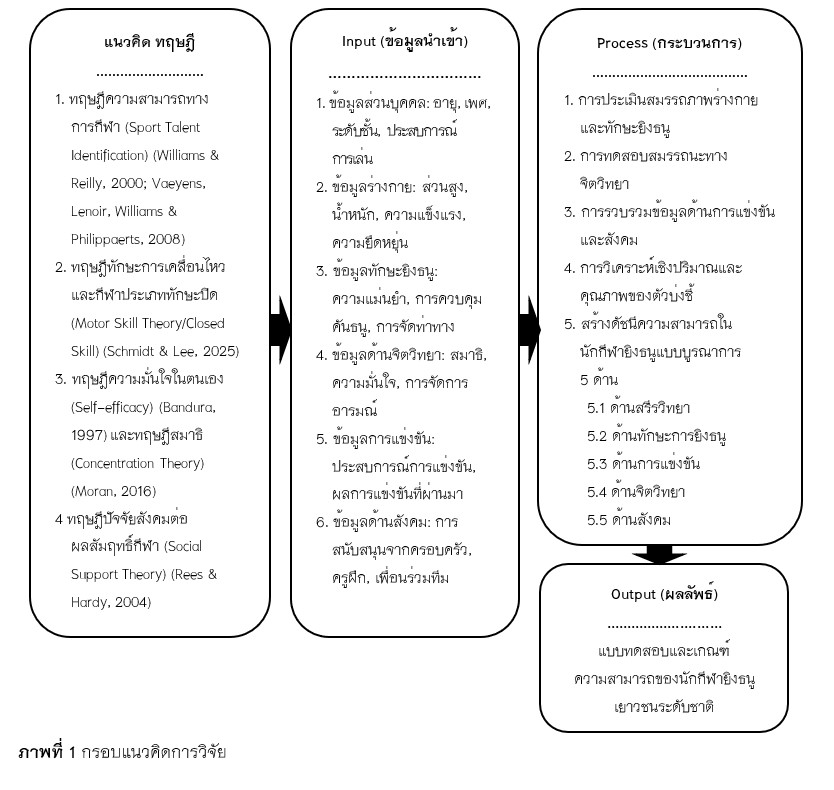
การวิจัยนี้มีวัตถุประสงค์เพื่อ 1) สร้างตัวบ่งชี้ความสามารถพิเศษของนักกีฬายิงธนูเยาวชนระดับชาติในระดับมัธยมศึกษา 2) ทดสอบประสิทธิภาพของแบบทดสอบตัวบ่งชี้ และ 3) สร้างเกณฑ์คะแนนมาตรฐานความสามารถพิเศษสำหรับนักกีฬายิงธนูในโรงเรียนกีฬาสังกัดมหาวิทยาลัยการกีฬาแห่งชาติ กลุ่มตัวอย่างเป็นนักกีฬายิงธนูชายและหญิง ชั้นมัธยมศึกษาปีที่ 1 – 6 อายุไม่เกิน 18 ปี สังกัดโรงเรียนกีฬาจังหวัดลำปาง โรงเรียนกีฬาจังหวัดตรัง โรงเรียนกีฬาจังหวัดยะลา และโรงเรียนกีฬาจังหวัดนครนายก โดยเป็นนักกีฬาชาย จำนวน 59 คน และนักกีฬาหญิงจำนวน 16 คน รวมทั้งสิ้น 75 คน เครื่องมือที่ใช้ในการวิจัย ได้แก่ แบบทดสอบด้านสรีรวิทยา แบบทดสอบทักษะยิงธนู แบบสอบถามประเมินเชิงจิตวิทยา แบบทดสอบความสามารถในการแข่งขัน และแบบทดสอบความสามารถด้านสังคม สถิติที่ใช้ในการวิเคราะห์ข้อมูล ได้แก่ ค่าเฉลี่ย ส่วนเบี่ยงเบนมาตรฐาน การทดสอบความแตกต่างระหว่างกลุ่มด้วยสถิติ t-test สำหรับกลุ่มตัวอย่างอิสระ (Independent t-test) การวิเคราะห์ความเที่ยงของเครื่องมือด้วยค่าสัมประสิทธิ์สหสัมพันธ์เพียร์สัน และการสร้างเกณฑ์มาตรฐานด้วยคะแนนที (T-score) โดยแบ่งระดับความสามารถออกเป็น 5 ระดับ ได้แก่ ดีมาก ดี ปานกลาง ต่ำ และต้องปรับปรุง ซึ่งใช้แนวคิด Norm-referenced classification ของ Safrit & Wood
ผลการวิจัยพบว่า 1) ตัวบ่งชี้ความสามารถพิเศษของนักกีฬายิงธนูแบ่งเป็น 5 ด้าน ได้แก่ สรีรวิทยา (14 ตัวบ่งชี้) ทักษะยิงธนู (18 ตัวบ่งชี้) การแข่งขัน (5 ตัวบ่งชี้) จิตวิทยา (4 ตัวบ่งชี้) และ สังคม (2 ตัวบ่งชี้) 2) แบบทดสอบตัวบ่งชี้มีความตรงเชิงเนื้อหาด้านสรีรวิทยา ด้านทักษะยิงธนู ด้านการแข่งขัน ด้านจิตวิทยา และด้านสังคม เท่ากับ 0.91, 0.89, 0.86, 0.90 และ 0.87 ตามลำดับ โดยทุกด้านมีความตรงเชิงโครงสร้างทฤษฎีและความเที่ยงในระดับสูงอย่างมีนัยสำคัญทางสถิติที่ระดับ .05 และ 3) แบบทดสอบสามารถแบ่งระดับความสามารถออกเป็น 5 ระดับ คือ ดีมาก ดี ปานกลาง ต่ำ และต้องปรับปรุง สรุปได้ว่า แบบทดสอบที่พัฒนาขึ้นสามารถใช้เป็นเครื่องมือเบื้องต้นในการคัดกรองและประเมินความสามารถของนักกีฬายิงธนูเยาวชนระดับชาติ
Downloads
Article Details

อนุญาตภายใต้เงื่อนไข Creative Commons Attribution-NonCommercial-NoDerivatives 4.0 International License.
เอกสารอ้างอิง
Abbott, A. & Collins, D. (2004). Eliminating the dichotomy between theory and practice in talent identification and development: Considering the role of psychology. Journal of Sports Sciences, 22(5), 395–408. https://doi.org/10.1080/02640410410001675324
Bailey, R., Collins, D., Ford, P., MacNamara, Á., Toms, M., & Pearce, G. (2010). Participant development in sport: An academic review. Leeds, UK: Sports Coach UK.
Bandura, A. (1997). Self-efficacy: The exercise of control. New York: Macmillan.
Cronbach, L. J. & Meehl, P. E. (1955). Construct validity in psychological tests. Psychological Bulletin, 52(4), 281–302. https://doi.org/10.1037/h0040957
Cureton, K. J. & Warren, G. L. (1990). Criterion-referenced standards for youth fitness testing. Pediatric Exercise Science, 2(1), 33–46.
Cox, R. H., Martens, M. P., & Russell, W. D. (2003). Measuring anxiety in athletics: the revised competitive state anxiety inventory–2. Journal of sport and exercise psychology, 25(4), 519-533. https://doi.org/10.1123/jsep.25.4.519
da Silva Neto, L. V. (2024). Conhecimento e Competências de Liderança como Elemento Diferenciador na Carreira dos Treinadores de Futebol. (Doctoral dissertation, Universidade da Beira Interior (Portugal)).
DeVellis, R. F. (2016). Scale development: Theory and applications (4th ed.). Thousand Oaks, CA: Sage Publications.
Djurić-Jovičić, M., Jovičić, N. S., Roby-Brami, A., Popović, M. B., Kostić, V. S., & Djordjević, A. R. (2017). Quantification of finger-tapping angle based on wearable sensors. Sensors, 17(2), 203.
Ertan, H., Kentel, B., Tümer, S., & Korkusuz, F. (2003). Activation patterns in forearm muscles during archery shooting. Human Movement Science, 22(1), 37–45.
Foley, R. C., Callaghan, D. H., Forman, G. N., Graham, J. D., Holmes, M. W., & La Delfa, N. J. (2025). A comprehensive scoping review and meta-analysis of upper limb strength asymmetry. Scientific Reports, 15(1), 4636.
Gillen, Z. M., Miramonti, A. A., McKay, B. D., Leutzinger, T. J., & Cramer, J. T. (2018). Test-retest reliability and concurrent validity of athletic performance combine tests in 6–15-year-old male athletes. The Journal of Strength & Conditioning Research, 32(10), 2783–2794.
Hakim, N. A. M. L., Pairan, M. R., & Zakaria, M. I. (2025). Step-by-step guide to calculating content validity index (cvi) for single constructs using excel. International Journal of Research and Innovation in Social Science, 9(3), 1717-1726.
Haynes, S. N., Richard, D. C. S., & Kubany, E. S. (1995). Content validity in psychological assessment: A functional approach to concepts and methods. Psychological Assessment, 7(3), 238–247. https://doi.org/10.1037/1040-3590.7.3.238
Kim, E. J., Kang, H. W., & Park, S. M. (2021). The effects of psychological skills training for archery players in Korea: Research synthesis using meta-analysis. International Journal of Environmental Research and Public Health, 18(5), 2272.
Leelanoi, J. & Khajornsilp, J. (2021). The results of archery balance with stability and accuracy archery recurve bow of male athletes’, Institute of Physical Education, Chon Buri Campus. Academic Journal of Thailand National Sports University, 13(1), 189-199. [In Thai]
MacNamara, Á., Button, A., & Collins, D. (2010). The role of psychological characteristics in facilitating the pathway to elite performance Part 2: Examining environmental and stage-related differences in skills and behaviors. The Sport Psychologist, 24(1), 74–96. https://doi.org/10.1123/tsp.24.1.74
Martens, R., Vealey, R. S., & Burton, D. (1990). Competitive anxiety in sport. Champaign, IL: Human Kinetics.
Kim, E. J., Kang, H. W., & Park, S. M. (2021). The effects of psychological skills training for archery players in Korea: Research synthesis using meta-analysis. International Journal of Environmental Research and Public Health, 18(5), 2272.
Moran, A. P. (2016). The psychology of concentration in sport performers: A cognitive analysis. London, UK: Psychology Press.
Nawawi, W., Alias, B. S., & Isa, W. M. K. W. (2024). A validity and reliability of instrument to evaluate the principal technology leadership: A pilot study. International Journal of Evaluation and Research in Education, 13(6), 4093-4100.
Ning, X., Liu, Y., Miao, J. L., & Li, W. L. (2024). Enhancing the potentials of the focus group discussion–engaging frequently neglected but essential situational factors for analyzing data. International Journal of Qualitative Methods, 23, 16094069241306332.
Polit, D. F. & Beck, C. T. (2006). The content validity index: Are you sure you know what's being reported? Critique and recommendations. Research in Nursing & Health, 29(5), 489–497. https://doi.org/10.1002/nur.20147
Prasetyo, Y., Pamungkas, O. I., Prasetyo, H., & Susanto, S. (2022). Analysis of anthropometry, physical conditions, and archery skills as the basic for identification of talent in the sport of arrow. Sports Science and Health, 24(2), 183–188.
Rees, T. & Hardy, L. (2004). Matching social support with stressors: Effects on factors underlying performance in tennis. Psychology of Sport and Exercise, 5(3), 319-337.
Rovinelli, R. J. & Hambleton, R. K. (1997). On the use of content specialists in the assessment of criterion-referenced test item validity. Dutch Journal of Educational Research, 2, 49–60.
Sarro, K. J., Viana, T. D. C., & De Barros, R. M. L. (2021). Relationship between bow stability and postural control in recurve archery. European Journal of Sport Science, 21(4), 515-520.
Schmidt, R. A. & Lee, T. D. (2025). Motor learning and performance: From principles to application. Champaign, IL: Human Kinetics.
Safrit, M. J. & Wood, T. M. (1995). Introduction to measurement in physical education and exercise science. St. Louis, MO: Mosby.
Smith, R. E., Schutz, R. W., Smoll, F. L., & Ptacek, J. T. (1995). Development and validation of a multidimensional measure of sport-specific psychological skills: The Athletic Coping Skills Inventory-28. Journal of Sport and Exercise Psychology, 17(4), 379–398. https://doi.org/10.1123/jsep.17.4.379
Srisomsup, P. & Boonrod, W. (2013). The effects of the five-step strategy training on the scores in archery. Journal of Sports Science and Health, 14(3), 13–20. [In Thai]
Tansalee, Y. & Panyakham, C. (2021). The construction of archery skill test for excellence. Journal of Faculty of Physical Education, 24(2), 28–37. [In Thai]
Toulmin, S. E. (2003). The uses of argument. Cambridge, UK: Cambridge university press.
Vaeyens, R., Lenoir, M., Williams, A. M., & Philippaerts, R. M. (2008). Talent identification and development programmes in sport: Current models and future directions. Sports medicine, 38(9), 703-714.
Vendrame, E., Belluscio, V., Truppa, L., Rum, L., Lazich, A., Bergamini, E., & Mannini, A. (2024). Performance assessment in archery: A systematic review. Sports Biomechanics, 23(12), 2444-2466.
Wang, D., Hu, T., Luo, R., Shen, Q., Wang, Y., Li, X., ... & Yin, H. (2022). Effect of cognitive reappraisal on archery performance of elite athletes: The mediating effects of sport-confidence and attention. Frontiers in psychology, 13, 860817.
Williams, A. M. & Reilly, T. (2000). Talent identification and development in soccer. Journal of Sports Sciences, 18(9), 657-667.
Xu, N., Yan, W., Sun, M., Li, R., Wang, Y., & Chi, L. (2024). Applying skill-oriented and spirit-oriented psychological training to Chinese national archery team athletes: A single-case mixed-methods study. International Journal of Sport and Exercise Psychology, 22(4), 926-952.
Yamane, T. (1973). Statistics: An introductory analysis. New York: Harper & Row.
