
การศึกษาองค์ประกอบและความต้องการจำเป็นในการพัฒนาสมรรถนะรายวิชาวิทยาการคอมพิวเตอร์พื้นฐาน สำหรับนักศึกษาระดับปริญญาตรี
Article Sidebar
Main Article Content
บทคัดย่อ
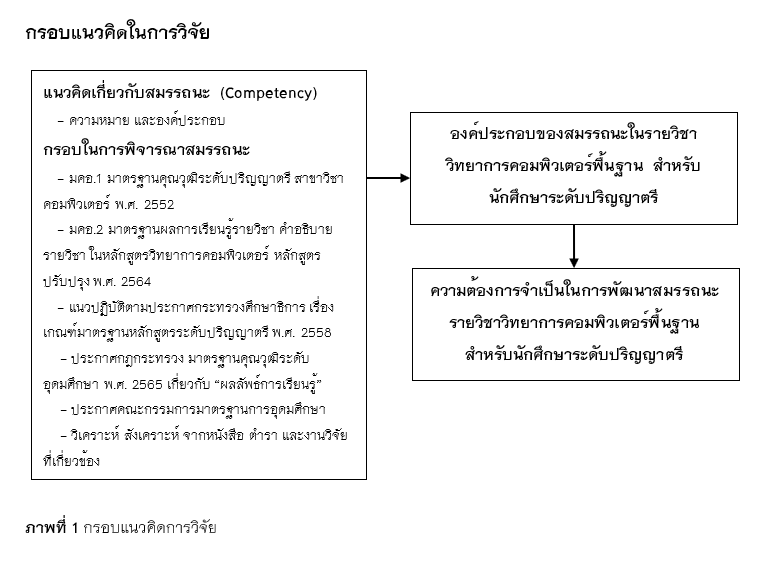
งานวิจัยนี้เป็นส่วนหนึ่งของการศึกษาวิจัยการพัฒนาหลักสูตรฐานสมรรถนะรายวิชาวิทยาการคอมพิวเตอร์พื้นฐาน โดยใช้แนวคิดการเรียนรู้แบบผสมผสานและทฤษฎีการเรียนรู้แบบร่วมมือ สำหรับนักศึกษาระดับปริญญาตรี มีวัตถุประสงค์เพื่อ 1) ศึกษาองค์ประกอบของสมรรถนะในรายวิชาวิทยาการคอมพิวเตอร์พื้นฐาน สำหรับนักศึกษาระดับปริญญาตรี และ 2) ศึกษาสภาพที่มีอยู่จริง สภาพที่คาดหวัง และความต้องการจำเป็นในการพัฒนาสมรรถนะรายวิชาวิทยาการคอมพิวเตอร์พื้นฐาน สำหรับนักศึกษาระดับปริญญาตรี การเก็บรวบรวมข้อมูล ระยะที่ 1 โดยการสัมภาษณ์ผู้ทรงคุณวุฒิ จำนวน 6 คน เพื่อสอบถามองค์ประกอบของสมรรถนะในรายวิชาและประเมินความเหมาะสมขององค์ประกอบและตัวบ่งชี้สมรรถนะในรายวิชา โดยผู้ทรงคุณวุฒิ จำนวน 15 คน ระยะที่ 2 กลุ่มตัวอย่าง คือ นักศึกษาหลักสูตรวิทยาการคอมพิวเตอร์ ชั้นปีที่ 1 ปีการศึกษา 2566 สังกัดมหาวิทยาลัยราชภัฏภาคตะวันออกเฉียงเหนือตอนบน 4 แห่ง กำหนดขนาดตัวอย่างขั้นต่ำร้อยละ 80 จำนวน 110 คน โดยการสุ่มตัวอย่างแบบชั้นภูมิอย่างเป็นสัดส่วน ผลการวิจัยพบว่า 1) ผลการประเมินความเหมาะสมขององค์ประกอบและตัวบ่งชี้สมรรถนะในรายวิชาวิทยาการคอมพิวเตอร์พื้นฐาน พบว่า มีองค์ประกอบ 4 สมรรถนะ รวม 77 ตัวบ่งชี้ คือ (1) สมรรถนะการเข้าถึง ประเมิน และจัดการข้อมูลด้านวิทยาการคอมพิวเตอร์ มี 16 ตัวบ่งชี้ (2) สมรรถนะการวิเคราะห์และแก้ปัญหาทางคอมพิวเตอร์ มี 47 ตัวบ่งชี้ (3) สมรรถนะการทำงานเป็นทีม มี 7 ตัวบ่งชี้ และ (4) สมรรถนะการมีจริยธรรมจรรยาบรรณ และเจตคติที่ดีต่อการปฏิบัติงานด้านคอมพิวเตอร์ มี 7 ตัวบ่งชี้
ความเหมาะสมในภาพรวมอยู่ในระดับมากที่สุด (= 4.70, S.D. = 0.52) และ 2) ผลการประเมินความต้องการจําเป็นในการพัฒนาสมรรถนะรายวิชาวิทยาการคอมพิวเตอร์พื้นฐาน เรียงตามค่าความต้องการจำเป็นจากมากไปน้อย ดังนี้ (1) สมรรถนะการวิเคราะห์และแก้ปัญหาทางคอมพิวเตอร์ มีค่าความต้องการจำเป็น 0.55 (2) สมรรถนะการเข้าถึง ประเมิน และจัดการข้อมูลด้านวิทยาการคอมพิวเตอร์ มีค่าความต้องการจำเป็น 0.42 (3) สมรรถนะการมีจริยธรรมจรรยาบรรณ และเจตคติที่ดีต่อการปฏิบัติงานด้านคอมพิวเตอร์ มีค่าความต้องการจำเป็น 0.35 และ (4) สมรรถนะการทำงานเป็นทีม มีค่าความต้องการจำเป็น 0.33 สำหรับดัชนีความต้องการจําเป็นในภาพรวมทั้ง 4 สมรรถนะ เท่ากับ 0.41 หมายความว่า สภาพที่มีอยู่จริงในปัจจุบันมีน้อยกว่าสภาพที่คาดหวัง โดยอัตราการเปลี่ยนแปลงในเชิงพัฒนาจากสภาพที่มีอยู่จริงในปัจจุบันไปสู่สภาพที่คาดหวังมีค่าเท่ากับ 0.41 หรือร้อยละ 41
Downloads
Article Details

อนุญาตภายใต้เงื่อนไข Creative Commons Attribution-NonCommercial-NoDerivatives 4.0 International License.
เอกสารอ้างอิง
Academic Office. (2014). Summary of issues in Thailand's educational reforms. Bangkok: Secretariat of the House of Representatives. [in Thai]
Clear, A., Clear, T., Vichare, A., Charles, T., Frezza, S., Gutica, M., …, Szynkiewicz, J. (2020). Designing computer science competency statements: A process and curriculum model for the 21st Century. In ITiCSE-WGR '20: Proceedings of the Working Group Reports on Innovation and Technology in Computer Science Education (pp. 211-246), June 17-18 2020, Trondheim, Norway. Retrieved from https://dl.acm.org/doi/pdf/10.1145/3437800.3439208
Department of Computer. (2021). Bachelor of science program, computer science revised curriculum 2021. Sakon Nakhon: Faculty of Science and Technology, Sakon Nakhon Rajabhat University. [in Thai]
Department of Computer. (2022). Self-assessment report of the bachelor of science program, computer science academic year 2021. Sakon Nakhon: Faculty of Science and Technology, Sakon Nakhon Rajabhat University. [in Thai]
Good, C. V. (1973). Dictionary of education. (3rd ed.). New York: McGraw-Hill.
HREX.asia. (2021). Strengthen the competency of personnel promote effective human resource management in the organization. Retrieved from https://th.hrnote.asia/orgdevelopment/190624-competency/ [in Thai]
Jobs DB (Thailand) Recruitment Company Limited. (2024). In-depth look at software developer, the dream career of the new generation. Retrieved from https://th.jobsdb.com/th/career-advice/article/software-developer [in Thai]
Kaewmanee, P., Kasinant, C., Chumruksa, C., & Sirikulpipat P. (2024). A needs assessment for developing a new normal Massive Open Online Course (MOOC) learning system to promote creativity of student teachers of Rajabhat Universities in the Southern Region. Journal of graduate research, 15(1), 93-108. [in Thai]
Kelly, K. T. (1998). Clinical and staff development. (2nd ed.). Philadelphia: Lippincott-Raven.
McClelland, D. C. (1973). Testing for competence rather than for "intelligence". American Psychologist, 28(1), 1-14. Retrieved from https://www.therapiebreve.be/documents/mcclelland-1973.pdf
Ministry of Education. (2017). The basic education core curriculum B.E. 2560 (A.D. 2017). Retrieved from https://www.ipst.ac.th/curriculum [in Thai]
Nwokeji, C. J., Stachel, R., Holmes, T., & Orji, O. R. (2019). Competencies Required for Developing Computer and Information Systems Curriculum. In 2019 IEEE Frontiers in Education Conference (FIE) (pp. 1-9), Covington, KY, USA.
Office of the Education Council. (2017). Research and development of models for curriculum development and competency-based teaching and learning according to the national qualifications framework. Bangkok: Prikwan Graphics Ltd. [in Thai]
Panlert, C. (2019). Competency-based curriculum and student quality development. Academic Journal, 22(1), 22-30. [in Thai]
Parry, S. B. (1998). Evaluation the impact of training Alexandria. Virginia: American Society for training and Development.
Phiwma, N., Mutchima, P., & Pantrakul, S. (2016). IT competency development guidelines for Suan Dusit university students. Panyapiwat Journal, 8(Special), 234-247. [in Thai]
Rassametummachot, S. (2010). Competency based learning. Bangkok: Sirivatana Interprint. [in Thai]
Saelow, W., Yuangsoi, P., & Roungrong, P. (2022). The development of TPACK model online instruction to promote team work for undergraduate students. STOU Education journal, 15(2), 102-116. [in Thai]
Sakolkijrungroj, S. (2023). The synthesis of definition, components, and indicators of digital literacy skills for Sukhothai Thammathirat Open University graduate students. Electronic Journal of Open and Distance Innovative Learning, 10(1), 82-97. [in Thai]
Sakulphram, S., Prasittichok, P., Jirangsuwan, N., & Klaykaew, K., K. (2022). The effects of instructional media to cultivate moral behavior through social media for undergraduate students. Journal of Behavioral Science, 28(1), 61-79. [in Thai]
Slavin, E. R. (1995). Cooperative learning theory: Theory, research and practice. Boston: Allyn & Bacon.
Thianboocha, A. (2016). A curriculum for higher education focusing on competency-based achievement. Journal of Chandrakasemsarn, 22(43), 33-47. [in Thai]
Wongwanich, S. (2007). Needs assessment research. (2nd ed.). Bangkok: Chulalongkorn University Press. [in Thai]
Zuckerberg, M. (2022). It’s just exceptionally rare to find people’ with both ‘IQ and EQ. Retrieved from https://www.cnbc.com/2022/04/20/mark-zuckerberg-sheryl-sandbergs-superpower-is-combination-of-iq-eq.html
