
แนวทางการจัดการเรียนรู้แบบปรับเหมาะร่วมกับการใช้บอร์ดเกมเพื่อพัฒนาความก้าวหน้าในการเรียนรู้วิทยาศาสตร์ เรื่อง สิ่งมีชีวิต สำหรับนักเรียนชั้นประถมศึกษาปีที่ 4
Article Sidebar
Main Article Content
บทคัดย่อ
การวิจัยในครั้งนี้มีวัตถุประสงค์เพื่อศึกษาแนวทางและผลการจัดการเรียนรู้แบบปรับเหมาะร่วมกับการใช้บอร์ดเกมเพื่อพัฒนาความก้าวหน้าในการเรียนรู้วิทยาศาสตร์ เรื่อง สิ่งมีชีวิต สำหรับนักเรียนชั้นประถมศึกษาปีที่ 4 เป็นการวิจัยเชิงปฏิบัติการ ประชากร คือ นักเรียนชั้นประถมศึกษาปีที่ 4 โรงเรียนขยายโอกาสแห่งหนึ่งในจังหวัดแพร่ จำนวน 14 คน ได้มาด้วยวิธีการเลือกแบบเจาะจง เครื่องมือที่ใช้ในการวิจัย ประกอบด้วย 1) แผนการจัดการเรียนรู้กิจกรรมการเรียนรู้แบบปรับเหมาะร่วมกับการใช้บอร์ดเกม 2) แบบสะท้อนการจัดการเรียนรู้แบบปรับเหมาะร่วมกับการใช้บอร์ดเกม 3) แบบวัดความก้าวหน้าในการเรียนรู้แบบปรับเหมาะร่วมกับการใช้บอร์ดเกม และ 4) ใบกิจกรรมการเรียนรู้แบบปรับเหมาะร่วมกับการใช้บอร์ดเกมวิเคราะห์ข้อมูลเชิงคุณภาพโดยการวิเคราะห์เชิงเนื้อหาและตรวจสอบความถูกต้องการวิเคราะห์ข้อมูลเชิงคุณภาพด้วยการตรวจสอบสามเส้าด้านแหล่งข้อมูล (Resource Triangulation) วิเคราะห์ข้อมูลเชิงปริมาณโดยหาค่าร้อยละ
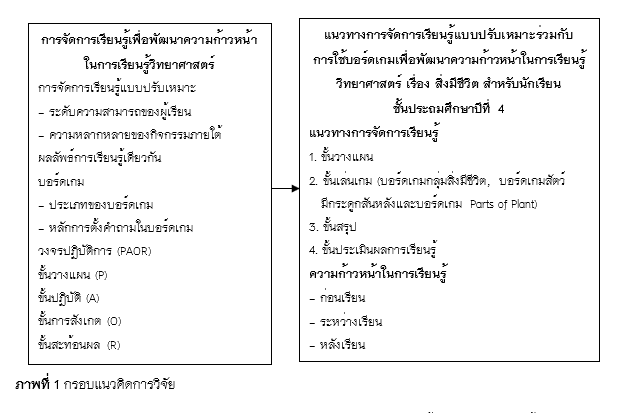
ผลการวิจัย พบว่า แนวทางทางการจัดการเรียนรู้แบบปรับเหมาะร่วมกับการใช้บอร์ดเกมเพื่อพัฒนาความก้าวหน้าในการเรียนรู้วิทยาศาสตร์ เรื่อง สิ่งมีชีวิต ประกอบด้วย 4 ขั้น ได้แก่ ขั้นที่ 1 การวางแผน ขั้นที่ 2 การเล่นเกม ขั้นที่ 3 การสรุป และขั้นที่ 4 การประเมินผลการเรียนรู้ 2) หลังการจัดการเรียนรู้แบบปรับเหมาะร่วมกับการใช้บอร์ดเกม นักเรียนมีพัฒนาความก้าวหน้าในการเรียนรู้วิทยาศาสตร์เพิ่มขึ้น
Downloads
Article Details

อนุญาตภายใต้เงื่อนไข Creative Commons Attribution-NonCommercial-NoDerivatives 4.0 International License.
เอกสารอ้างอิง
Bennett, R. E. (2011). Formative assessment: A critical review. Assessment in Education: Principles, Policy & Practice, 18(1), 5–25.
Boonmaton, R., Supap, W., and Wiriyapong, R. (2018). The development of grade 11 students’ mathematical literacy on probability using context-based learning. Academic Services Journal, Prince of Songkla University, 29(2), 51-61. Retrieved from https://journal.oas.psu.ac.th/index.php/asj/article/view/1250 [In Thai]
Chansook, R. (2022). A development of biology learning activities by using the inquiry method (5E) with using board games to enhance systems thinking of mathayomsuksa 4 students. Rajabhat Maha Sarakham University Journal, 16(3), 64-75. Retrieved from https://so05.tci-thaijo.org/index.php/rmuj/article/view/262764/176758 [In Thai]
Chincharoen, P. (2021). The development of board games for promoting ecoliteracy for grade 10 students. Journal of Humanities and Social Sciences Mahasarakham University, 15(1), 85-99. Retrieved from https://so05.tci-thaijo.org/index.php/edjour_stou/article/view/254912/175020 [In Thai]
Corcoran, T., Mosher, F. A., and Roget, A. (2009). Learning progressions in science: An evidence-based approach to reform. Retrieved from https://files.eric.ed.gov/fulltext/ED506730.pdf
Cullinane, A. (2011). Formative assessment classroom techniques. Resource & Research Guides, 2(13), 1-4.
Dermthamram, K., Ruangsiri, J., and Chanthaphot, J. (2020). Developing AR board game for education in topic using information technology with responsibility for the secondary 2 students at Nawamintrachinutit Suankularb Wittayalai Samutprakarn. In the 12th NPRU National Academic Conference (pp. 690-697). 9-10 July 2023. Nakhon Pathom: Nakhon Pathom Rajabhat University. Retrieved from https://shorturl.asia/wfB5v [In Thai]
Gotwals, A. W. and Alonzo, A. C. (2012). Introduction: Leaping into learning progressions in science. In A. C. Alonzo, and A. W. Gotwals (eds.), Learning progression in science: Current challenges and future direction (pp. 3-12). Rotterdam: Sense Publishers.
Jamornman, U., Pitiyanuwat, S., Chantarasonthi, U., and Ngudgratoke, S. (2019). Classroom assessment. Retrieved from https://www.stou.ac.th/Offices/rdec/Lampang/Main/EBOOK/20302/ch8.pdf [In Thai]
Janjumpa, C., Thitivesa, T., Yodboplub, P., and Boonman, N., (2019). The development of educational fame as a supplementary tool for learning on the topic of plant reproduction and growth for grade 11 students. Journal of Industrial Education, 18(3), 36-44. Retrieved from https://ph01.tci-thaijo.org/index.php/JIE/article/view/215807/163582 [In Thai]
Jehnum, T. and Boonprakran, K. (2023). The development of learning achievement by inquiry-based learning (5E) with scientific board game for grade 5 students. Journal of MCU Nakhondhat, 10(8), 1-8. Retrieved from https://so03.tci-thaijo.org/index.php/JMND/issue/download/17340/4767 [In Thai]
Jungpanich, N. (2018). Factors affecting the intention to play Gacha game of teenage and working age. (Master of Business Administration, Business Administration, Silpakorn University).
Kaemanee, T. (2017). Teaching science: Knowledge for organizing an effective learning process. (6th ed.) Bangkok: Darnsutha Press Printing.
Kaewsri, S. (2019). Design and development a board game about the immune system. (Master’s thesis, Department of Science Education, Thaksin University). [In Thai]
Khamman, W., Heemadam, F., and Topitak, K., (2021). Empowerment evaluation: Application to enhance the assessment for learning to be the professional teachers in the 21st century. Journal of Humanities and Social Sciences Mahasarakham University, 40(6), 54-67. Retrieved from https://so03.tci-thaijo.org/index.php/humsujournal/article/view/250999/172155 [In Thai]
Kitichantaropas, Y. (2019). What are learning games?. IPST Magazine, 48(221), 14-16. Retrieved from https://emagazine.ipst.ac.th/221/14/ [In Thai]
Ladachart, L. and Ladachart, L. (2018). Formative assessment: A gateway to science teachers’ professional growth and science education reform. Journal of Research Unit on Science, Technology and Environment for Learning, 9(2), 297-323. Retrieved From https://ejournals.swu.ac.th/index.php/JSTEL/article/view/9733 [In Thai]
Laosum, T. (2019). An authentic assessment of students with special educational needs. Journal of Ratchasuda Institute for Research and Development of Persons with Disabilities, 15(2), 91-104. Retrieved from https://rs.mahidol.ac.th/rs-journal/eng/vol.15/02-07.pdf [In Thai]
Noda, S., Shirotsuki, K., & Nakao, M. (2019). The effectiveness of Intervention with Board Games: A systematic review. Bio Psycho Social Medicine, 13(1). Retrieved from https://bpsmedicine.biomedcentral.com/counter/pdf/10.1186/s13030-019-0164-1.pdf?pdf=button%20sticky
Omchaikad, S. and Tipayakesorn, S. (2022). Science communication ability of upper secondary school students learning through inquiry method supplemented with group discussion technique. Academic Journal of MBU; Lanna Campus, 11(2), 97-101. Retrieved From https://so01.tci-thaijo.org/index.php/mbulncjournal/article/view/260001/172587 [In Thai]
Ounraun, W. and Onthanee, A., (2023). An instructional model development based on social constructivism and authentiv learning approaches to enhance differentiated instruction ability for student teachers. Journal of Education Naresuan University, 25(1), 222-237. Retrieved from https://so06.tci-thaijo.org/index.php/edujournal_nu/article/view/247948/176037 [In Thai]
Ozan, C. & Kincal, R. Y. (2018). The effects of formative assessment on academic achievement, attitudes toward the lesson, and self-regulation skills. Educational Science: Theory & Practice, 18(1), 85-118.
Pattanamas, C. and Kongwijit, P. (2022). The development of Thai grammatical concept and learning engagement of matthayomsuksa 1 students by using gamification with peer teaching techniques. Journal of Education Studies, 50(2), 1-13. Retrieved from https://lib.edu.chula.ac.th/FILEROOM/CU_FORMJOURNAL/DRAWER001/GENERAL/DATA0017/00017696.PDF [In Thai]
Pattiyathani, S. (2022). Educational measurement. (13th ed.). Kalasin: Prasankarnpim printing.
Phochan, P. and Sengsri, T. (2020). The result of students’ learning progress through adaptive learning lesson in computing science of mathayomsuksa 5 students, Phromphiramwittaya School, the Secondary Educational Service Area Office 39. Journal for Research and Innovation, Institute of Vocational Education Bangkok, 3(1), 111-126. Retrieved from https://so06.tci-thaijo.org/index.php/ivebjournal/article/view/245029/166193 [In Thai]
Pimpakhun, K. & Phetwong, W. (2022). Creating a board game that affected learning achievement on essential factors of plants’ life for grade 2 students. Rmutsb Academic Journal (Humanities and Social Sciences), 7(1), 109-119. Retrieved from https://so05.tci-thaijo.org/index.php/rmutsb-hs/article/view/250777/174539 [In Thai]
Prakobpol, T. (2017). Adaptive tutorial system with collaborative learning VIA the internet. (Doctoral Dissertation, Educational Research, Measurement and Statistics, Burapha University). [In Thai]
Sangprateeptong, V. (2018). Guidelines for assessment of learning outcomes in the 21st century. Ubon Ratchathani Journal of Research and Evaluation, 7(1), 1-48. Retrieved from https://edu.stou.ac.th/wp-content/uploads/2021/09/Doc017.pdf [In Thai]
Saran, M., Al-Magsoosi, D., & Mohammed, D. (2018). Gamification in e-learning: The effect on student performance. In 9th Annual International Conference on Computer Science Education: Innovation and Technology (CSEIT 2018). October 2018. Singapore. Retrieved from https://www.researchgate.net/publication/329415817_Gamification_in_e-learning_The_Effect_on_Student_Performance
Sittiwong, T. (2021). The effects of using board game to promote learning for undergraduate students Faculty of Education, Naresuan University. Journal of Education Naresuan University, 23(4), 187-200. Retrieved from https://so06.tci-thaijo.org/index.php/edujournal_nu/article/view/250067/169959 [In Thai]
Suparasingh, W., (2019). Effects of using REAP strategy on Thai literature learning achievement and critical thinking ability of eleventh grade students. (Master’s thesis, Educational Science & Learning Management, Srinakharinwirot University). [In Thai]
Tanongkit, M. and Sakulprahmne, S. (2022). Formative assessment in general education. Srinakharinwirot Academic Journal of Education, 23(2), 262-279. Retrieved from https://ejournals.swu.ac.th/index.php/jedu/article/download/14696/12186/50343 [In Thai]
Taveebot, P., Chanunan, S., and Klamtet, J. (2020). An action research on enhancing gifted students’ collaborative problem solving through using creative problem solving approach on stoichiometry. Journal of Education Naresuan University, 22(1), 147-161. Retrieved from https://so06.tci-thaijo.org/index.php/edujournal_nu/article/view/91867/153744 [In Thai]
Thepphuthorn, T., Pattanasith, S., and Srifa, P. (2022). The development of augmented reality technology educational board game for game base learning to promote learning achievement of prathomsuksa 3 students. Journal of Education Measurement, 39(105), 64-75. Retrieved from https://so06.tci-thaijo.org/index.php/JEMEPTB/article/view/257488/173343 [In Thai]
Vasasiri, P. and Watjana, A. (2020). A comparison of science leaning achievement on heat energy and the weather of mathayomsuksa year 1 students at Protpittayapayat School by using game instructional medias and traditional teaching. (Master’s thesis, Department of Science Education, Ramkhamhaeng University). [In Thai]
Wichitwanna, S. (2022). Situational test: Applied to measure characteristics. Journal of Social Sciences in Measurement Evaluation Statistics and Research, 3(1), 11-19. Retrieved from https://so03.tci-thaijo.org/index.php/mesr/article/download/261879/174131 [In Thai]
Wongyai, W. and Phatphol, M. (2021). Adaptive learning. Retrieved from http://www.curriculumandlearning.com/upload/Books/Adaptive%20Learning_1616200602.pdf [In Thai]
Wungso, P., Yamkasikorn, M., and Jiraro, P. (2019). The development of authentic assessment standards for teachers in primary schools under Office of the Basic Education Commission by participatory action research. Journal of Technical Education Development, 31(109), 111-120. Retrieved from https://buuir.buu.ac.th/bitstream/1234567890/7300/1/Fulltext.pdf [In Thai]
Yusoff, M. S. B. (2019). ABC of content validation and content validity index calculation. Education in Medicine Journal, 11(2), 49–54. DOI: 10.21315/eimj2019.11.2.6. Retrieved from https://eduimed.usm.my/EIMJ20191102/EIMJ20191102_06.pdf [In Thai]
