
การสังเคราะห์รูปแบบสิ่งแวดล้อมการเรียนรู้แบบเสมือนตามแนวคอนสตรักติวิสต์ร่วมกับการคิดเชิงออกแบบเพื่อส่งเสริมความคิดสร้างสรรค์ของนักเรียน
Article Sidebar
Main Article Content
บทคัดย่อ
การวิจัยนี้มีวัตถุประสงค์เพื่อ 1) สังเคราะห์รูปแบบสิ่งแวดล้อมการเรียนรู้แบบเสมือนตามแนวคอนสตรักติวิสต์ร่วมกับการคิดเชิงออกแบบที่ส่งเสริมความคิดสร้างสรรค์ของนักเรียน และ 2) ประเมินความเหมาะสมของรูปแบบสิ่งแวดล้อมการเรียนรู้แบบเสมือนตามแนวคอนสตรักติวิสต์ร่วมกับการคิดเชิงออกแบบที่ส่งเสริมความคิดสร้างสรรค์ของนักเรียน โดยผู้เชี่ยวชาญจำนวน 5 คน ด้านเทคโนโลยีทางการศึกษา ด้านวัดผลและประเมินผลการศึกษา และด้านวิชาการศึกษา ประเมินความเหมาะสมของรูปแบบสิ่งแวดล้อมการเรียนรู้แบบเสมือนตามแนวคอนสตรักติวิสต์ร่วมกับการคิดเชิงออกแบบเพื่อส่งเสริมความคิดสร้างสรรค์ของนักเรียน เครื่องมือการวิจัย คือ แบบประเมินรูปแบบสิ่งแวดล้อมการเรียนรู้แบบเสมือนตามแนวคอนสตรักติวิสต์ร่วมกับการคิดเชิงออกแบบ วิเคราะห์ข้อมูลโดยใช้สถิติเชิงพรรณนา ได้แก่ ค่าเฉลี่ยและส่วนเบี่ยงเบนมาตรฐาน
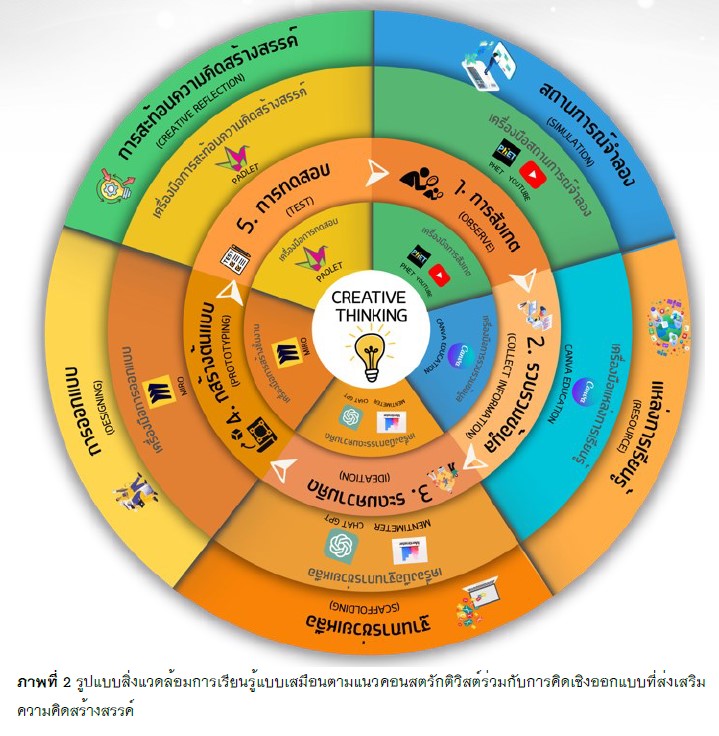
ผลการวิจัยพบว่า 1) การสังเคราะห์รูปแบบสิ่งแวดล้อมการเรียนรู้แบบเสมือนตามแนวคอนสตรักติวิสต์ร่วมกับการคิดเชิงออกแบบ มี 2 องค์ประกอบหลัก ได้แก่ 1) สิ่งแวดล้อมการเรียนรู้แบบเสมือนตามแนวคอนสตรักติวิสต์ มี 5 องค์ประกอบ ได้แก่ (1) สถานการณ์จำลอง (2) แหล่งเรียนรู้ (3) การออกแบบ (4) การสะท้อนความคิดสร้างสรรค์ และ (5) ฐานการช่วยเหลือ 2) ขั้นตอนการคิดเชิงออกแบบ มี 5 ขั้นตอน ได้แก่ (1) การสังเกต (2) การรวบรวมข้อมูล (3) การระดมความคิด (4) การสร้างต้นแบบ และ (5) การทดสอบ 2) ความเหมาะสมของรูปแบบสิ่งแวดล้อมการเรียนรู้แบบเสมือนตามแนวคอนสตรักติวิสต์ร่วมกับการคิดเชิงออกแบบเพื่อส่งเสริมความคิดสร้างสรรค์ของนักเรียนในภาพรวมอยู่ในระดับมากที่สุด (M = 4.61, S.D. = 0.40) แต่เมื่อพิจารณาเป็นรายด้านที่มีค่าเฉลี่ยสูงสุด 3 อันดับแรกและอยู่ในระดับมากที่สุด คือ ด้านประโยชน์การใช้งานรูปแบบสิ่งแวดล้อมการเรียนรู้แบบเสมือนตามแนวคอนสตรักติวิสต์ร่วมกับการคิดเชิงออกแบบ ด้านขั้นตอนการคิดเชิงออกแบบ และด้านองค์ประกอบของรูปแบบสิ่งแวดล้อมการเรียนรู้แบบเสมือนตามแนวคอนสตรักติวิสต์ ส่วน 2 อันดับสุดท้ายอยู่ในระดับมาก คือ ด้านรูปแบบสิ่งแวดล้อมการเรียนรู้แบบเสมือนตามแนวคอนสตรักติวิสต์และด้านเครื่องมือที่ใช้ในรูปแบบสิ่งแวดล้อมการเรียนรู้แบบเสมือนตามแนวคอนสตรักติวิสต์ โดยสามารถนำไปใช้พัฒนานักเรียนเพื่อส่งเสริมความคิดสร้างสรรค์ได้
Downloads
Article Details

อนุญาตภายใต้เงื่อนไข Creative Commons Attribution-NonCommercial-NoDerivatives 4.0 International License.
เอกสารอ้างอิง
Alam, A., & Mohanty, A. (2023). Evaluation of software engineering virtual laboratory in determining undergraduate students’ conceptual understanding: A blended learning model using collaborative-creative virtual learning environment employing critical pedagogy. In S. P. Mohanty, S. Alawneh, K. H. W. O. N. T. K., & V. Kumar (Eds.), Sentiment analysis and deep learning: Proceedings of ICSADL 2022 (pp. 875–899). Springer Nature Singapore. https://doi.org/10.1007/978-981-19-5443-6_65
Alina, K. R. U. K. (2022). The benefits of virtual learning environment (VLE) in teaching ESP. Humanities science current issues, 2(52). 171-175. https://doi.org/10.24919/2308-4863/52-2-26
Almulla, M. A. (2023). Constructivism learning theory: A paradigm for students’ critical thinking, creativity, and problem solving to affect academic performance in higher education. Cogent Education, 10(1), 2172929. https://doi.org/10.1080/2331186X.2023.2172929
Asad, M. M., Naz, A., Churi, P., & Tahanzadeh, M. M. (2021). Virtual reality as pedagogical tool to enhance experiential learning: A systematic literature review. Education Research International, 2021(1), 7061623. https://doi.org/10.1155/2021/7061623
Association for Educational Communications and Technology [AECT]. (2012). AECT standards, 2012 version. Association for Educational Communications and Technology. https://www.aect.org
Ayuba, J. O., Abdulkadir, S., & Mohammed, A. A. (2025). Integration of digital tools for teaching and learning of Islamic studies among senior secondary schools in Ilorin Metropolis, Nigeria. INJIES: Journal of Islamic Education Studies, 2(1), 1–9. https://doi.org/10.34125/injies.v2i1.16
Barrot, J. S. (2023). Using ChatGPT for second language writing: Pitfalls and potentials. Assessing Writing, 57, Article 100745. https://doi.org/10.1016/j.asw.2023.100745
Bell, S. J. (2008). Design thinking. American Libraries, 39(1/2), 44–49. http://dx.doi.org/10.34944/dspace/112
Brown, T., & Wyatt, J. (2009). Design thinking for social innovation. Stanford Social Innovation Review, 8(1), 31–35. https://doi.org/10.48558/58Z7-3J85
Cakir, M. (2008). Constructivist approaches to learning in science and their implications for science pedagogy: A literature review. International Journal of Environmental and Science Education, 3(4), 193–206. https://www.researchgate.net/publication/238105956_Constructivist_Approaches_to_Learning_in_Science_and_Their_Implications_for_Science_Pedagogy_A_Literature_Review
Cárdenas, M. Á. L., & Estrada, C. C. P. (2022). Instructional design and technological resources in the improvement of teachers’ digital competencies. Apertura, 14(2), 40–61. https://doi.org/10.32870/ap.v14n2.2241
Carroll, M., Goldman, S., Britos, L., Koh, J., Royalty, A., & Horn, M. (2010). Destination, imagination and the fires within: Design thinking in a middle school classroom. International Journal of Art & Design Education, 29(1), 37–53. https://doi.org/10.1111/j.1476-8070.2010.01632.x
Ceylan, S., Şahin, P., Seçmen, S., Somer, M. E., & Süher, H. K. (2024). The contribution of digital tools to architectural design studio: A case study. Ain Shams Engineering Journal, 15(7), 102795. https://doi.org/10.1016/j.asej.2024.102795
Chicago Architecture Center. (2018). Discover design handbook: What is the design process? Why is it helpful? Scribd. https://www.scribd.com/document/409354317/Discover-Design
Cunningham, D. J., & Knuth, R. (1993). Tools for constructivism: Designing environments for constructive leaning. Springer.
de Jong, T., Lazonder, A., Pedaste, M., & Zacharia, Z. (2018). Simulations, games, and modeling tools for learning. In F. Fischer, C. E. Hmelo-Silver, S. R. Goldman, & P. Reimann (Eds.), International handbook of the learning sciences (pp. 256–266). Routledge. https://doi.org/10.4324/9781315617572-25
Deng, L., Shen, Y. W., & Chan, J. W. (2021). Supporting cross-cultural pedagogy with online tools: Pedagogical design and student perceptions. TechTrends, 65, 760–770. https://doi.org/10.1007/s11528-021-00633-5
Estriegana, R., Medina, J., Robina, R., & Barchino, R. (2021). Virtual learning environment to encourage students' relationships and cooperative competence acquisition. In ITiCSE '21: Proceedings of the 26th ACM Conference on Innovation and Technology in Computer Science Education V. 1 (pp. 53–59). https://doi.org/10.1145/3430665.3456363
Fan, X. (2015). Effectiveness of an inquiry-based learning using interactive simulations for enhancing students' conceptual understanding in physics [Doctoral dissertation, The University of Queensland]. UQ eSpace. https://doi.org/10.14264/uql.2015.1005
Fusic, S. J., Rajalakshmi, R., & Sugumari, T. (2023). Digital transformation of industrial automation course in virtual learning environment during COVID-19 pandemic. Journal of Engineering Education Transformations, 36(Special Issue), 81–92. https://doi.org/10.16920/jeet/2023/v36is2/23012
Guilford, J. P. (1967). The nature of human intelligence. McGraw-Hill.
Gunawan, G., Nisrina, N., Suranti, N. M. Y., Herayanti, L., & Rahmatiah, R. (2018). Virtual laboratory to improve students' conceptual understanding in physics learning. In MISEIC 2018. IOP Conference Series: Journal of Physics: Conference Series, 1108(1), 1–6. https://doi.org/10.1088/1742-6596/1108/1/012049
Hamutoglu, N. B., Gemikonakli, O., Duman, I., Kirksekiz, A., & Kiyici, M. (2020). Evaluating students experiences using a virtual learning environment: Satisfaction and preferences. Educational Technology Research and Development, 68, 437–462. https://doi.org/10.1007/s11423-019-09705-z
Hannafin, M., Land, S., & Oliver, K. (1999). Open learning environments: Foundations, methods, and models. In C. M. Reigeluth (Ed.), Instructional-design theories and models: A new paradigm of instructional theory (Vol. 2, pp. 115–140). Lawrence Erlbaum Associates. https://www.researchgate.net/publication/237035032_Open_Learning_Environments_Foundations_methods_and_models
Haowharn, S., & Ruangsuwan, C. (2022). Development of a virtual learning environment model to fortify life skills for teenage of Thailand. Journal of Educational Issues, 8(1), 21-29. https://doi.org/10.5296/jei.v8i1.19314
Herrington, J., & Oliver, R. (1995). Critical characteristics of situated learning: Implications for the instructional design of multimedia. In J. M. Pearce & A. Ellis (Eds.), Proceedings of the 12th Annual Conference of the Australasian Society for Computers in Learning in Tertiary Education (pp. 253–262). University of Melbourne. https://www.researchgate.net/publication/228591409_Critical_characteristics_of_situated_
learning_Implications_for_the_instructional_design_of_multimedia
Intakeaw, C., & Napapong, W. (2025). Learning management using problem-based learning together with design thinking process to promote creative thinking skills in digital photography for educational communication course. Journal of Information and Learning, 36(1), e272723. https://so04.tci-thaijo.org/index.php/jil/article/view/272723 [In Thai]
Johnson, B., & McClure, R. (2004). Validity and reliability of a shortened, revised version of the Constructivist Learning Environment Survey (CLES). Learning Environments Research, 7(1), 65–80. https://doi.org/10.1023/B:LERI.0000022279.89075.9f
Jonassen, D. H. (1999). Designing constructivist learning environments. In C. M. Reigeluth (Ed.), Instructional-design theories and models: A new paradigm of instructional theory (Vol. 2, pp. 215–239). Lawrence Erlbaum Associates.
Khlaisang, J., & Songkram, N. (2019). Designing a virtual learning environment system for teaching twenty-first century skills to higher education students in ASEAN. Technology, Knowledge and Learning, 24, 41–63. https://doi.org/10.1007/s10758-017-9310-7
Kwek, S. H. (2011). Innovation in the classroom: Design thinking for 21st century learning. Academia.edu. https://www.academia.edu/34378215/Innovation_in_the_Classroom_Design_Thinking_for_21_st_Century_Learning
Lin, H., & Chen, Q. (2024). Artificial intelligence (AI) -integrated educational applications and college students' creativity and academic emotions: Students and teachers' perceptions and attitudes. BMC Psychology, 12, Article 487. https://doi.org/10.1186/s40359-024-01979-0
Maneeratana, K., Chancharoen, R., Thongnuek, P., Sukmuen, P., Inkaew, C., & Suwannatthachote, P. (2019). A reflection on teaching design thinking to first-year engineering students. In Proceedings of the IEEE International Conference on Engineering, Technology and Education (TALE). IEEE. https://doi.org/10.1109/TALE48000.2019.9225890
Ministry of Industry. (2017). Thailand industry 4.0 development strategy 20-year period (2017–2036). Ministry of Industry. [In Thai]
Mishra, N. R. (2023). Constructivist approach to learning: An analysis of pedagogical models of social constructivist learning theory. Journal of Research and Development, 6(01), 22–29. https://doi.org/10.3126/jrdn.v6i01.55227
Office of the Education Council [OEC]. (2017). The national education plan B.E. 2560–2579. Prikwarn Graphic. [In Thai]
Office of the Education Council [OEC]. (2022). Report on the monitoring and evaluation of the national education plan B.E. 2560–2579. Office of the Education Council. [In Thai]
Office of the National Economic and Social Development Board [NESDB]. (2017). The 20-year national strategy (2018–2037). Office of the National Economic and Social Development Board. [In Thai]
Park, J. C., Kwon, H. J. E., & Chung, C. W. (2021). Innovative digital tools for new trends in teaching and assessment methods in medical and dental education. Journal of Educational Evaluation for Health Professions, 18, 13. https://doi.org/10.3352/jeehp.2021.18.13
Poultsakis, S., Papadakis, S., Kalogiannakis, M., & Psycharis, S. (2021). The management of digital learning objects of natural sciences and digital experiment simulation tools by teachers. Advances in Mobile Learning Educational Research, 1(2), 58–71. https://doi.org/10.25082/AMLER.2021.02.002
Ra-Ngubtook, W. (1998). Student-centered learning management. Love & Press. [In Thai]
Rabiman, R., Sudira, P., Sofyan, H., & Nurtanto, M. (2021). Practical learning media in subject maintenance of chassis and power (MCP) based online: Simple learning using videos on YouTube. International Journal of Interactive Mobile Technologies, 15(3), 130–145. https://doi.org/10.3991/ijim.v15i03.14943
Rasmussen, K. (2022). You don't have to be a rocket scientist. The Science Teacher, 89(5), 50–55. https://doi.org/10.1080/00368555.2022.12293699
Santosa, M. H., Ivone, F. M., Jacobs, G. M., & Flores, J. C. (2022). Student-to-Student cooperation in virtual learning without breakout rooms. Beyond Words, 10(1), 70–82. https://doi.org/10.33508/bw.v10i1.3774
Saxena, R. (2025). Design thinking and a human-centered approach to explore the potential of mobile phone and AI-enabled just-in-time mental health solution for university students in India. In Proceedings of the 20th International Conference on Evaluation of Novel Approaches to Software Engineering - ENASE (pp. 508–519). SciTePress. https://doi.org/10.5220/0013288200003928
Slamet, J. (2024). Potential of ChatGPT as a digital language learning assistant: EFL teachers’ and students’ perceptions. Discover Artificial Intelligence, 4(1), 46. https://doi.org/10.1007/s44163-024-00143-2
Srikan, P., Pimdee, P., Leekitchwatana, P., & Narabin, A. (2021). A problem-based learning (PBL) and teaching model using a cloud-based constructivist learning environment to enhance Thai undergraduate creative thinking and digital media skills. International Journal of Interactive Mobile Technologies, 15(22), 68–83. https://doi.org/10.3991/ijim.v15i22.24963
Stanford d.school. (2010). An introduction to design thinking process guide. Hasso Plattner Institute of Design at Stanford. https://web.stanford.edu/~mshanks/MichaelShanks/files/509554.pdf
Thammaariyasakun, P., Napapongs, W., Tansakul, J., & Inkaew, C. (2025). Development of a virtual learning environment with the engineering design process to enhance students’ creative thinking skills. International Journal of Information and Education Technology, 15(1), 137–147. https://doi.org/10.18178/ijiet.2025.15.1.2226
Tsalapatas, H., Heidmann, O., Pata, K., Vaz de Carvalho, C., Bauters, M., Papadopoulos, S., Katsimendes, C., Taka, C., & Houstis, E. (2019). Teaching design thinking through gamified learning. In Proceedings of the 11th International Conference on Computer Supported Education (pp. 278–283). SciTePress. https://doi.org/10.5220/0007697402780283
Uddin, S. M. J., Albert, A., Tamanna, M., Ovid, A., & Alsharef, A. (2024). ChatGPT as an educational resource for civil engineering students. Computer Applications in Engineering Education, 32(4), e22747. https://doi.org/10.1002/cae.22747
United Nations Educational, Scientific and Cultural Organization. (2023). Technology in education: A tool on whose terms? Global Education Monitoring Report 2023. UNESCO. https://doi.org/10.54676/UZQV8501
Wylant, B. (2008). Design thinking and the experience of innovation. Design Issues, 24(2), 3–14. https://doi.org/10.1162/desi.2008.24.2.3
Yalçın, V. (2022). Design thinking model in early childhood education. International Journal of Psychology and Educational Studies, 9(1), 196–210. https://doi.org/10.52380/ijpes.2022.9.1.715
Zwart, D. P., Goei, S. L., Van Luit, J. E., & Noroozi, O. (2023). Nursing students’ satisfaction with the instructional design of a computer-based virtual learning environment for mathematical medication learning. Interactive Learning Environments, 31(10), 7392–7407. https://doi.org/10.1080/10494820.2022.2071946
