
การพัฒนากิจกรรมเสริมหลักสูตรแบบมีส่วนร่วมของนักเรียน ครู และผู้ปกครองสำหรับการสร้างความตระหนักรู้และความเข้าใจเพื่อป้องกันและลดการใช้คำพูดเกลียดชังกับนักเรียนมัธยมศึกษาตอนต้น จังหวัดเพชรบุรี
Article Sidebar
Main Article Content
บทคัดย่อ
การวิจัยนี้มีวัตถุประสงค์เพื่อ 1) พัฒนากิจกรรมเสริมหลักสูตรแบบมีส่วนร่วมของนักเรียน ครู และผู้ปกครอง สำหรับการสร้างความตระหนักรู้และความเข้าใจเพื่อป้องกันและลดการใช้คำพูดเกลียดชังกับนักเรียนมัธยมศึกษาตอนต้น จังหวัดเพชรบุรี 2) ศึกษาผลการใช้กิจกรรมเสริมหลักสูตรแบบมีส่วนร่วม และ 3) ประเมินความพึงพอใจที่มีต่อกิจกรรมเสริมหลักสูตร กลุ่มตัวอย่าง คือ นักเรียนมัธยมศึกษาตอนต้น 811 คน ครู 76 คน และผู้ปกครอง 703 คน จาก 6 โรงเรียนในจังหวัดเพชรบุรี ปีการศึกษา 2568 ได้มาโดยการกำหนดแบบเจาะจง เครื่องมือการวิจัย ได้แก่ แผนการจัดกิจกรรมเสริมหลักสูตรแบบมีส่วนร่วม มีคุณภาพในระดับมากที่สุด โดยมีคะแนนเฉลี่ยรวม 4.66 จากคะแนนเต็ม 5.00 แบบประเมินความตระหนักรู้และความเข้าใจเพื่อป้องกันและลดการใช้คำพูดเกลียดชังกับนักเรียนมัธยมศึกษาตอนต้น แบบประเมินพฤติกรรมการใช้คำพูดเกลียดชังกับผู้อื่น โดยแบบประเมินทั้ง 2 ชนิด มีค่าความเที่ยงที่ 0.93 และแบบประเมินความพึงพอใจ มีความเที่ยงที่ 0.89 สถิติที่ใช้วิเคราะห์ข้อมูล ได้แก่ ร้อยละ ค่าเฉลี่ย ส่วนเบี่ยงเบนมาตรฐาน และการทดสอบทีแบบกลุ่มตัวอย่างไม่เป็นอิสระต่อกัน (Paired Samples t-test)
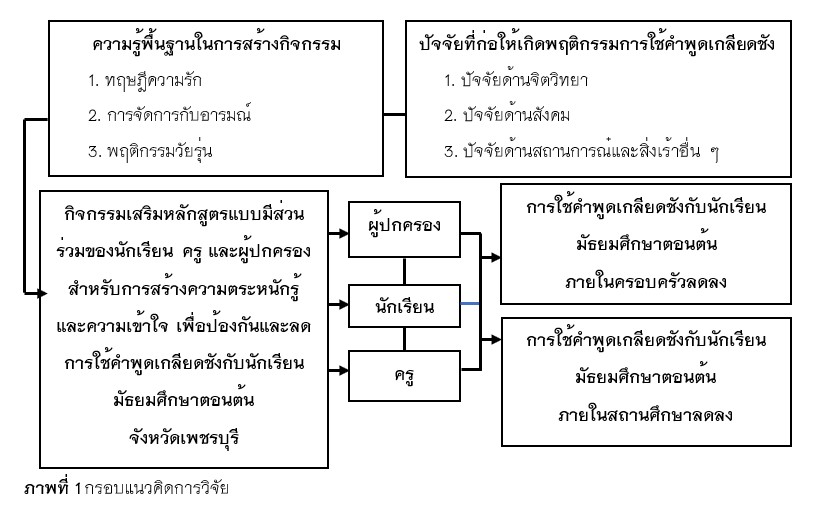
ผลการวิจัยพบว่า 1) กิจกรรมเสริมหลักสูตรแบบมีส่วนร่วม ประกอบด้วย 4 กิจกรรม ได้แก่ กิจกรรมสร้างรัก กิจกรรมเข้าใจรัก กิจกรรมส่งรัก และกิจกรรมถนอมรัก ซึ่งทุกกิจกรรมมีพื้นฐานการพัฒนากิจกรรมมาจาก กล่องทฤษฎีความรัก การจัดการกับอารมณ์ และพฤติกรรมวัยรุ่น 2) หลังการใช้กิจกรรมเสริมหลักสูตร นักเรียน ครู และผู้ปกครองมีความตระหนักรู้และความเข้าใจเพื่อป้องกันและลดการใช้คำพูดเกลียดชังกับนักเรียนมัธยมศึกษาตอนต้นสูงขึ้น และมีพฤติกรรมการใช้คำพูดเกลียดชังกับผู้อื่นลดลงกว่าก่อนใช้กิจกรรมเสริมหลักสูตรอย่างมีนัยสำคัญทางสถิติที่ระดับ .01 และ 3) กลุ่มตัวอย่างทั้ง 3 กลุ่ม มีความพึงพอใจต่อกิจกรรมเสริมหลักสูตรแบบมีส่วนร่วมในระดับมากที่สุด แสดงให้เห็นว่ากิจกรรมเสริมหลักสูตรแบบมีส่วนร่วมที่พัฒนาขึ้น สามารถใช้เป็นกลไกสำคัญในการสร้างความตระหนักรู้และความเข้าใจเพื่อป้องกันและลดการใช้คำพูดเกลียดชังกับนักเรียนมัธยมศึกษาตอนต้นได้อย่างมีประสิทธิภาพ
Downloads
Article Details

อนุญาตภายใต้เงื่อนไข Creative Commons Attribution-NonCommercial-NoDerivatives 4.0 International License.
เอกสารอ้างอิง
Anittha, R. (2023). What should I do when my child is punished or bullied/humiliated by a teacher at school? M.O.M. mood of Motherhood. https://aboutmom.co/uncategorized/when-the-teacher-is-the-bully/18349/
Chapman, G. D. (2015). The five love languages: The secret to love that lasts. Northfield Publishing.
European Foundation of Human Rights (EFHR). (2025). Training on recognising and responding to hate speech. EFHR. https://en.efhr.eu/2025/12/22/efhr-training-on-recognising-and-responding-to-hate-speech/
Kaewchinda, M. (2022). How to survive if you become a victim of domestic violence and 3 ways to prevent it. Better Mind. https://www.bettermindthailand.com/content/5814/3-วิธีป้องกันการใช้ความรุนแรงในครอบครัว
Laohasthit, S. (2024). Extra-curricular activities development for social skills development to reduce Phetchaburi province secondary school students’ digital hate speech. Sripatum Review of Humanities and Social Sciences, 24(1), 109-121. https://so05.tci-thaijo.org/index.php/spurhs/article/view/270014/182822
McIntyre, A. (2008). Participatory action research. SAGE Publications, Inc. https://doi.org/10.4135/9781483385679
Mayer, J. D., & Salovey, P. (1997). What is emotional intelligence? In P. Salovey & D. Sluyter (Eds.), Emotional development and emotional intelligence: Implications for educators (pp. 3-31). Basic Books. https://www.researchgate.net/publication/256840188_What_is_Emotional_Intelligence_Salovey_and_D
Nanetoranee, J. (2022). Beware! Bullying that teachers are unaware of. EDUCA. https://www.educathai.com/knowledge/articles/538
Padilla-Petry, P., & Puigcercós, R. M. (2022). Engaging young people in a research project: The complexities and contributions of using participatory methods with young people in schools. SAGE Open, 12(1). https://journals.sagepub.com/doi/10.1177/21582440211068457
Phetchaburi Provincial Education Office. (2023). Report on the performance results of the government action plan for fiscal year 2566. Policy and Planning Group, Phetchaburi Provincial Education Office, Office of the Permanent Secretary, Ministry of Education. https://www.pbipeo.go.th/information2/
Phetchaburi Provincial Social Development and Human Security Office. (2023). Phetchaburi provincial social situation report 2023. Policy and Academic Group, Phetchaburi Provincial Social Development and Human Security Office. http://mis.m-society.go.th/
Sae-Tang, P. (2021). A psychology professor points out that psychological and social problems are what cause people to engage in bullying behavior. Faculty of Mass Communication Ramkhamhaeng University.
Sternberg, R. J. (1986). Beyond IQ: A triarchic theory of human intelligence. Cambridge University Press.
The Center for the Protection of Children's Rights Foundation. (2023). Parental emotional management to reduce violence toward children. The Center for the Protection of Children’s Rights Foundation. https://www.thaichildrights.org/articles/infographic-parental-emotional-balance/
Thomkapanit, W. (2023). A happy family when you plant love the right way. Manarom Hospital. https://www.manarom.com/blog/healthy_family_relationship.html
Wachs, S., Bilz, L., Wettstein, A., Wright, M. F., Kansok-Dusche, J., Krause, N., & Ballaschk, C. (2024). Associations between witnessing and perpetrating online hate speech among adolescents: Testing moderation effects of moral disengagement and empathy. Psychology of Violence, 12(6), 371. https://pmc.ncbi.nlm.nih.gov/articles/PMC6843940/
