
Components of a Hyflex Supervision Model for Enhancing Teachers’ Coding Instruction
Article Sidebar
Main Article Content
Abstract
In today’s world, coding is no longer a skill exclusively for learners who aspire to become programmers. All learners should have opportunities to learn coding because it not only expands future career opportunities but also promotes systematic thinking skills. However, coding instruction in Thailand still faces several challenges and limitations. Therefore, this study is significant in seeking and creating innovations in educational supervision to support coding instruction. This study aimed to: 1) examine the components of a HyFlex supervision model for enhancing teachers’ coding instruction, 2) investigate the suitability and feasibility of the HyFlex supervision model and its implementation manual, and 3) evaluate the content validity of the HyFlex supervision model and its implementation manual for enhancing teachers’ coding instruction. The data sources consisted of 13 stakeholders and 5 experts. The research instruments included 1) a document and related research synthesis form, 2) a focus group discussion record form, and 3) a content validity evaluation form for the HyFlex supervision model and its implementation manual.
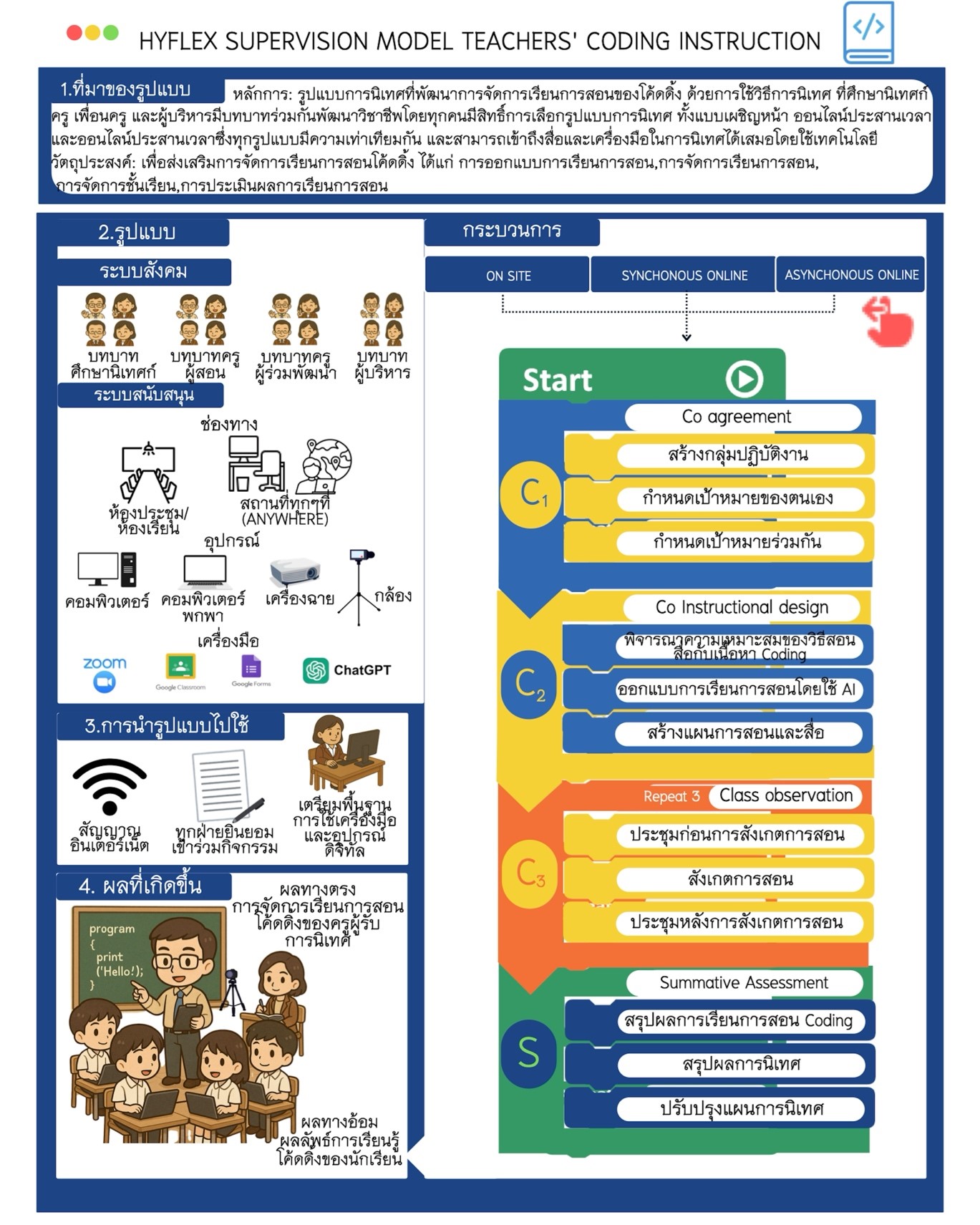
The findings revealed that:1) the HyFlex supervision model for enhancing teachers’ coding instruction consists of four components. The first component is the foundation of the model, including the principles and objectives of the model. The second component is the supervision model, which includes 1) the HyFlex supervision process known as the 3C1S process consisting of four steps, namely 1) Co-Agreement, 2) Co-Instructional Design, 3) Class Observation, and 4) Summative Assessment, 2) the social system, and 3) the support system. The third component is the implementation of the model, and the fourth component is the outcomes of supervision. 2) The HyFlex supervision model and its implementation manual were found to be appropriate and feasible for implementation. 3) The HyFlex supervision model demonstrated a high level of content validity, while the implementation manual demonstrated the highest level of content validity.
Downloads
Article Details

This work is licensed under a Creative Commons Attribution-NonCommercial-NoDerivatives 4.0 International License.
References
Amirova, A., Zhumabayeva, A., Zhunusbekova, A., Kalbergenova, S., Nygymanova, N., & Arenova, A. (2023). Effect of using hyflex technology learning on preservice teachers' success and attitudes. International Journal of Education in Mathematics, Science and Technology, 11(3), 623-642. https://doi.org/10.46328/ijemst.3309
Beatty, B. (2019). Hybrid-flexible course design. EdTech Books.
Buosonte, R. (2020). Research and development of educational innovation (2nd ed.). Chulalongkorn University Press. [In Thai]
Burton, W. H., & Brueckner, L. J. (1965). Supervision: A social process (3rd ed.). Appleton Crofts.
Chaiwong, N. (2017). Development of a supervision model based on the blended learning concept to improve classroom research ability of teachers under the Office of Nakhon Phanom Primary Education Service Area 1 [Doctoral Dissertation, Sakon Nakhon Rajabhat University]. https://gsmis.snru.ac.th/e-thesis/thesis_detail?r=55632227108 [In Thai]
Choi, J., & Kang, W. (2019). Sustainability of cooperative professional development: Focused on teachers’ efficacy.
Sustainability, 11(3), 585. https://doi.org/10.3390/su11030585
Glatthorn, A. A. (1997). Differentiated supervision. Association for supervision and curriculum development (ASCD).
Glickman, C. D. (1990). Supervision of instruction a developmental approach (2nd ed.). A Division of Simon and Schuyter.
Institute for the Promotion of Teaching Science and Technology. (2019). Curriculum manual for technology (computer science) Science learning area (2017 revised edition) for primary and secondary levels. SCIMATH. https://www.scimath.org/ebook-technology/item/8376-2560-2551 [In Thai]
Kamjan, P. (2022). The future of educational supervision for supervisors under the primary education service area office in the next decade: in case of technology content (Computing Science) [Doctoral dissertation, Naresuan University]. https://nuir.lib.nu.ac.th/dspace/handle/123456789/5495 [In Thai]
Khummanee, O. (2021). The supervision model promoting the implementation of education quality assurance system development based on ministerial regulations for education quality assurance 2018 for educational institutions under Hua Hin Municipality, Thailand. International Journal of Crime, Law and Social Issues, 8(1), 44-60. https://ssrn.com/abstract=3921646
Koskinen, M. (2018). Understanding the needs of adult graduate students: An exploratory case study of a Hyflex learning environment [Doctoral dissertation, Northeastern University]. https://repository.library.northeastern.edu/files/neu:m044c738v/fulltext.pdf
Laowreandee, W. (2010). Supervision of teaching. Silpakorn University Printing. [In Thai]
Mette, I. M., Range, B. G., Anderson, J., Hvidston, D. J., & Nieuwenhuizen, L. (2015). Teachers' perceptions of teacher supervision and evaluation: A reflection of school improvement practices in the age of reform. Education Leadership Review, 16(1), 16-30. https://eric.ed.gov/?id=EJ1105545
Ministry of Education. (2017). Indicators and concepts in Science subject. (Revision B.E.2560). According to basic education core curriculum B.E. 2551. The agricultural co-operative federation of Thailand printing house. [In Thai]
Office of the Education Council, Ministry of Education. (2020). Lesson learned: Coding teaching and innovation: developing students to have the desired characteristics of Thai people 4.0 according to national education standard. 21 Century Co., Ltd. [In Thai]
Office of the Teacher Civil Service and Educational Personnel Commission. (2021). Guidelines for implementing the criteria and methods for evaluating the positions and academic qualifications of teachers and educational personnel in the teacher position. Office of the Teacher Civil Service and Educational Personnel Commission. https://otepc.go.th/images/00_YEAR2564/03_PV1/1Mv9-2564.pdf [In Thai]
O'Neill, D. K. (2016). 21st century bunkum: What do we value about kids learning to code, and why?. Teacher Learning and Professional Development, 1(2), 111 – 116. https://tlpd.journals.publicknowledgeproject.org/tlpd/index.php/tlpd/article/view/14/pdf
Paje, S. (2021). Principles and theories of instructional design. Muang Phrae Printing. [In Thai]
Paniagua, A., & Istance, D. (2018). Teachers as designers of learning environments: The importance of innovative pedagogies. Educational Research and Innovation, OECD Publishing. https://doi.org/10.1787/9789264085374-en
Piyasinchart, A. (2022). Coding is more valuable than developing the ability of Thai youths to learn programming to control robots skillfully. Journal of Mass Communication Technology, RMUTP. 7(2), 85-96. https://so05.tci-thaijo.org/index.php/jmctrmutp/article/view/261223/176770 [In Thai]
Richey, R. C. (2005). Validating instructional design and development models. In J. M. Spector, C. Ohrazda, A. Van Schaack, & D. A. Wiley (Eds.), Innovations in instructional technology: Essays in honor of M. David Merrill (pp. 171–185). Lawrence Erlbaum Associates Publishers.
Rojas-López, A., Rincón-Flores, E. G., Mena, J., García-Peñalvo, F. J., & Ramírez-Montoya, M. S. (2019). Engagement in the course of programming in higher education through the use of gamification. Universal Access in the Information Society, 18(3), 583-597. https://doi.org/10.1007/s10209-019-00680-z
Wade, D. T. (2009). Goal setting in rehabilitation: An overview of what, why and how. Clinical Rehabilitation, 23(4), 291-295. https://doi.org/10.1177/0269215509103551
Walsh, K. (2010). Differentiating teacher supervision: The disconnect between beliefs and behaviors. New Jersey Journal of Supervision and Curriculum Development. 54, 72–78.
Wing, J. M. (2006). Computational thinking. Communications of the ACM, 49(3), 33-35. https://www.cs.cmu.edu/~15110-s13/Wing06-ct.pdf
Worathadasawat, W. (2025). The mixed educational supervision model to enhance active learning management of secondary school teachers [Doctoral dissertation, Naresuan University]. https://nuir.lib.nu.ac.th/dspace/handle/123456789/5835 [In Thai]
