
Approaches for Utilizing External Quality Assessment Results to Reduce Educational Inequality in Child Development Centers in the Northeastern Region
Article Sidebar
Main Article Content
Abstract
This study aimed to 1) examine the current and desired conditions of utilizing external quality assessment results to reduce educational inequality in Child Development Centers, 2) analyze and compare needs, and 3) develop approaches for utilizing external quality assessment results. The research was conducted in three phases. In Phase 1, the current utilization of external quality assessment results was investigated among 20 Child Development Centers identified as good governance models in the Northeastern region, selected using simple random sampling. Data was collected through in-depth interviews with 140 stakeholders. In Phase 2, the current conditions, desired conditions, and priority needs were examined among 99 model Child Development Centers and 567 Child Development Centers in the Northeastern region using multistage sampling. Data was collected using questionnaires. In Phase 3, approaches for utilizing external quality assessment results were developed and evaluated by 37 experts and stakeholders using an assessment form. Data were analyzed using statistical methods including means and standard deviations, independent samples t-test, One- way ANOVA, PNI, and generalized entropy index based on the median.
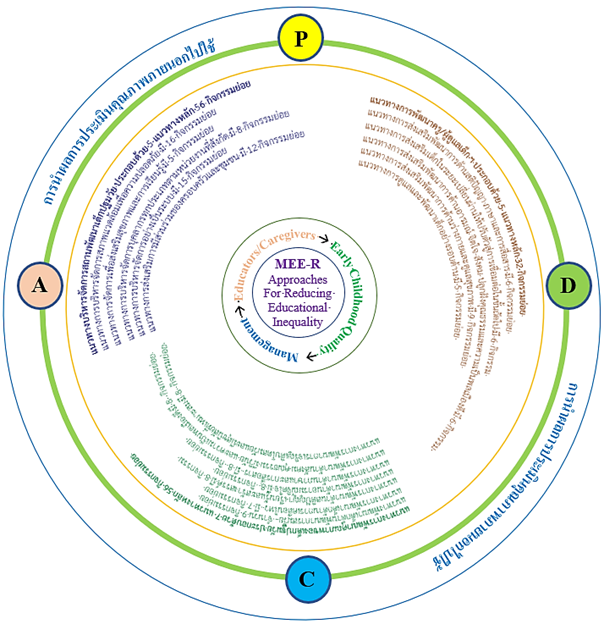
The findings revealed that 1) the current level of utilizing external quality assessment results to reduce educational inequality was lower than the desired level. Child Development Centers under sub-district municipalities demonstrated significantly higher levels of utilization in management, teachers and child caregivers, and early childhood quality than those under sub-district administrative organizations at the .05 level of significance. The highest level of inequality was found in management (GEm = 1.52), followed by teachers and child caregivers (GEm = 1.27), and early childhood quality (GEm = 0.05). (2) The priority need for utilizing external quality assessment results was highest in early childhood quality (PNI = 0.53), followed by management (PNI = 0.52) and teachers and child caregivers (PNI = 0.45). (3) The developed approaches for utilizing external quality assessment results to reduce educational inequality were synthesized from research findings and related literature. The approaches consist of three domains, 17 main approaches, and 144 sub-activities, collectively referred to as the “MEE-R Approaches.” The evaluation of the approaches indicated high levels in all aspects, including accuracy (Mean = 4.81, SD = 0.40), propriety (Mean = 4.80, SD = 0.41), feasibility (Mean = 4.76, SD = 0.45), utility (Mean = 4.80, SD = 0.41), and accountability (Mean = 4.82, SD = 0.40).
Downloads
Article Details

This work is licensed under a Creative Commons Attribution-NonCommercial-NoDerivatives 4.0 International License.
References
Ardpaksa, S. (2014). The needs assessment to self-development of teachers, Ratchaburi private education schools [Master’s thesis, Silpakorn University]. https://sure.su.ac.th/xmlui/handle/123456789/10516?attempt=3&&attempt=2 [In Thai]
Australian Institute of Family Studies. (2019). Needs assessment. Australian Government.
Baum, F. (2008). The new public health (3rd ed.). Oxford University Press.
Boonna, S. (2023). Narrative of educational inequality and education management guidelines for the equality of secondary school students in Bangkok Metropolis [Master’s thesis, Silpakorn University].
Boonurai, S. (2022). Development of an online educational inequality assessment criterion for early childhood education [Doctoral dissertation, Burapha University]. Burapha University Institutional Repository. http://ir.buu.ac.th/dspace/handle/1513/625 [In Thai]
Cochran, W. G. (1977). Sampling techniques (3rd ed.). John Wiley & Sons.
Cowell, F. A. (2009). Measuring inequality (3rd ed.). Oxford University Press.
Creswell, J. W. (2013). Research design: Qualitative, quantitative, and mixed methods approaches (4th ed.). SAGE Publications.
Department of Local Administration. (2022). Department of Local Administration letter, Ref. No. 0816.4/1046 dated April 11, 2022: Announcement of the selection results for one district, one model early childhood development center with good management for the fiscal year 2022. Department of Local Administration. [In Thai]
Dittabanjong, K., Wora-in, C., & Toncharoenrat, B. (2014). Needs assessment for inner quality assurance development system in school. Humanities and Social Sciences Journal of Pibulsongkram Rajabhat University, 8(1), 105–118. https://so01.tci-thaijo.org/index.php/GraduatePSRU/article/view/55536/46111 [In Thai]
Hawtin, M., & Percy-Smith, J. (2007). Community profiling: A practical guide (2nd ed.). Open University Press.
Jubjaisook, N., & Tongiam, S. (2023). The internal quality assurance operation development needs assessment in Dvaravati school group under the Bangkok Primary Educational Service Area Office. Journal of MCU Ubon Review, 8(3), 331-324. https://so06.tci-thaijo.org/index.php/mcjou/article/view/270055/181166 [In Thai]
Kanjanavasri, S. (2009). Evaluation theory. Chulalongkorn University Press. [In Thai]
Khantha, N., & Waroonroj, J. (2022). Needs for the performance on the child development center's standard under the local administrative organizations in Ban Phai District, Khon Kaen. Journal of Buddhist Education and Research, 8(1), 1–12.
https://so06.tci-thaijo.org/index.php/jber/article/view/256268 [In Thai]
Kijratphan, P. (2012). Educational inequality in Thailand: Origins and solutions. Academic Journal Phranakhon Rajabhat University, 3(2), 213–216.
http://ithesis-ir.su.ac.th/dspace/bitstream/123456789/4787/1/640620055.pdf [In Thai]
Krejcie, R. V., & Morgan, D. W. (1970). Determining sample size for research activities. Educational and Psychological Measurement, 30(3), 607–610. https://doi.org/10.1177/001316447003000308
Lakchai, A., & Srisa-ard, B. (2019). Developing guidelines management of child development center under sub- district administrative organization in Udonthani. Journal of Educational Administration and Leadership, 8(29), 154–163. https://jeal.snru.ac.th/ArticleViewFile?ArticleID=696&FileArticle=696-ArticleTextFile-20200114132400.pdf [In Thai]
Lane, K. R., Crofton, C., & Hall, G. J. (1983). Assessing needs for school district allocation of federal funds. In Annual Meeting of the American Educational Research Association. Montreal, Canada, April (pp. 11-15).
National Early Childhood Development Committee [NECDC], (2019). National standards for early childhood development centers. Secretariat Office of the Education Council. Prikhwan Graphic. [In Thai]
Naka, L., & Rooyuenyong, W. (2024). The needs of the internal quality assurance operation in early childhood centers under local government organizations, Khon Kaen Province. NEU Academic and Research Journal, 14(2), 278–289.
https://so04.tci- thaijo.org/index.php/neuarj/article/view/272148/184620 [In Thai]
Office for National Education Standards and Quality Assessment (Public Organization). (2024). External quality assurance manual: For educational institutions and external evaluators (2024–2028). Office for National Education Standards and Quality Assessment (Public Organization). [In Thai]
Patton, M. Q. (1981). Creative evaluation. Sage Publications.
Patton, M. Q. (1986). Utilization-focused evaluation (2nd ed.). Sage Publications.
Piromrak, M., & Senakhun, C. (2017). The development of guidelines for the implementation of the child development center under the local government Mahasarakham. Journal of Educational Administration and Leadership, 6(21), 205–214.
https://jeal.snru.ac.th/ArticleView?ArticleID=126 [In Thai]
Potipipittanakorn, P., Kallawicha, S., & Vichuphong, P. (2023). Examining educational resource allocation and educational quality inequality: A case study of schools in Chumphon Province. Journal of Multidisciplinary in Humanities and Social Sciences, 6(6), 3382–3402. https://so04.tci-thaijo.org/index.php/jmhs1_s/article/view/267375/182287 [In Thai]
Prommaboon, T., Bungthong, S., Pinthong, K., Seesan, P., & Neungchalerm, P. (2023). The development of a model for utilizing external quality assessment utilization to improve the internal quality assurance system of early childhood development centers in Surin Province (Research report). Office for National Education Standards and Quality Assessment (Public Organization). [In Thai]
Rossi, P. H., Lipsey, M. W., & Freeman, H. E. (2004). Evaluation: A systematic approach (7th ed.). Sage Publications.
Scheffé, H. (1953). A method for judging all contrasts in the analysis of variance. Biometrika, 40(1–2), 87–104. https://doi.org/10.1093/biomet/40.1-2.87
Singngao, N., & Sriputtarin, S. (2021). Current situation, desirable situation and guidelines to develop administration of infant and child development center under the local government organization, Nakhon Phanom Province. Institute of Vocational Education Southern Region 1 Journal, 6(2), 146–154. https://ph01.tci-thaijo.org/index.php/csnp_veis1/article/view/243508/168079 [In Thai]
Sleezer, C. M., Fuss-Eft, D. F., & Gupta, K. (2014). A practical guide to needs assessment (3rd ed.). John Wiley & Sons.
Sripakdee, S., & Srisa-ard, B. (2023). The development guideline of standard criteria of child development centers under the local government organization, Nakhon Ratchasima Province. Journal of Buddhist Philosophy and Development, 7(2), 449–461.
https://ojs.mbu.ac.th/index.php/jbpe/article/view/2325/1482 [In Thai]
Srisuttiyakorn, S. (2019). Educational inequality and its factors: Multilevel analysis integrated with median-based class of generalized entropy inequality index. Journal of Research Methodology, 32(3), 341–379. https://search.tci-thailand.org/author.html?b3BlbkF1dGhvciZpZD0yNzU5MTIyJmFydGljbGVfaWQ9NTkxOTk5 [In Thai]
The Nation. (2024). Childhood development in Thailand, especially language skills, has worsened. The nation. https://www.nationthailand.com/health-wellness/40043135
Varasunun, P., Prasertsin, U., & Chanchusakun, S. (2015). Needs assessment of the educational testing for using into the student quality development. Silpakorn Educational Research Journal, 7(2), 108–120. https://so05.tci-thaijo.org/index.php/suedureasearchjournal/article/view/37409/42754 [In Thai]
Wiratchai, N., & Wongwanich, S. (2007). Needs assessment research. Chulalongkorn University Press. [In Thai]
Wongwanich, S. (2015). Needs assessment. Chulalongkorn University Press. [In Thai]
Yimyam, C. (2023). Needs and Guidelines for Developing the Operation of the Student Assistance System for Educational Opportunity Expansion Schools under Sakon Nakhon Primary Education Service Area Office 1 [Master’s thesis, Sakon Nakhon Rajabhat University]. [In Thai]
