
A Study of the Components of a Happy Organization in Schools Under Local Administrative Organizations
Article Sidebar
Main Article Content
Abstract
This study aimed to examine the components of a happy organization in schools under local administrative organizations. The research was conducted in three stages: (1) synthesizing the components of a school happiness organization from 12 related documents and research studies; (2) conducting interviews with seven experts regarding the components of a school happiness organization; and (3) assessing the appropriateness and feasibility of the proposed components by five experts. The research instruments included a document analysis form, an interview protocol, and a five-point Likert-scale questionnaire. Data were analyzed using means, percentages, and standard deviations.
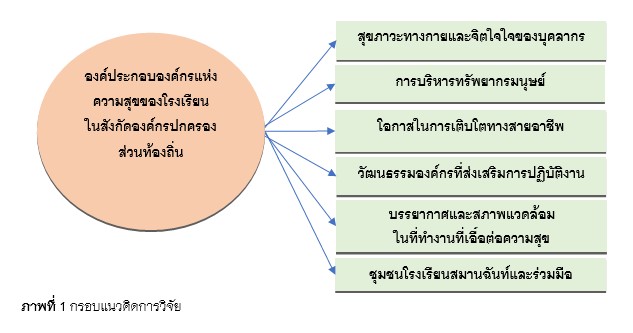
The results revealed that the components of a happy organization in schools, derived from document synthesis and expert interviews, comprised six components: 1) personnel’s physical and mental well-being, 2) human resource management, 3) opportunities for career growth, 4) an organizational culture that supports job performance, 5) a positive workplace atmosphere and environment, and 6) a harmonious and collaborative school community. The overall appropriateness of the components was rated at the highest level (M = 4.81, SD = 0.39), and the overall feasibility was also rated at the highest level (M = 4.79, SD = 0.44). These findings indicate that the proposed components are appropriate and feasible for adoption as the core components of a happy organization in schools under local administrative organizations.
Downloads
Article Details

This work is licensed under a Creative Commons Attribution-NonCommercial-NoDerivatives 4.0 International License.
References
Burton, J. (2010). WHO healthy workplace framework and model: Background and supporting literature and practice. http://www.who.int/occupational_health/healthy_workplace_framework.pdf
Diener, E. (2000). Subjective well-being: The science of happiness and a proposal for a national index. American Psychologist, 55(1), 34–43. https://doi.org/10.1037/0003-066X.55.1.34
Fisher, C. D. (2010). Happiness at work. International Journal of Management Reviews, 12(4), 384–412. https://doi.org/10.1111/j.1468-2370.2009.00270.x
Guna, N. (2021). Happiness at work of personnel of sub-district administrative organizations in Mueang Pattani District, Pattani Province [Unpublished Master’ thesis]. Prince of Songkla University. PSU Knowledge Bank. https://kb.psu.ac.th/items/72c7332e-0601-4aef-b413-938df0104852 [In Thai]
iOpener Institute. (2010). The Science of happiness at work. https://iopenerinstitute.com/happiness-at-work/
Jantaprom, A. (2021). Factors Affecting Happiness at Work of the Employees of Sakon Nakhon Provincial Administrative. M.P.A. (Public Administration) Sakon Nakhon Rajabhat University. https://gsmis.snru.ac.th/e-thesis/file_att1/2022042162426423101_fulltext.pdf [In Thai]
Kanput, N. (2019). Environment administration in extra lareg school of Kanchananukor School [Master’s Independent Study, Silpakorn University]. DSpace JSPUI. http://ithesis-ir.su.ac.th/dspace/handle/123456789/2400 [In Thai]
Kaeodumkoeng, K. (2021). Health literacy: Processes, practices, and assessment tools. Ideol Digital Print. https://hepa.or.th/assets/file/journal/book/31.%E0%B8%84%E0%B8%A7%E0%B8%B2%E0%B8%A1%E0%B8%A3%E0%B8%AD%E0%B8%9A%E0%B8%A3%E0%B8%B9%E0%B9%89%E0%B8%94%E0%B9%89%E0%B8%B2%E0%B8%99%E0%B8%AA%E0%B8%B8%E0%B8%82%E0%B8%A0%E0%B8%B2%E0%B8%9E%20%E0%B8%81%E0%B8%A3%E0%B8%B0%E0%B8%9A%E0%B8%A7%E0%B8%99%E0%B8%81%E0%B8%B2%E0%B8%A3%20%E0%B8%9B%E0%B8%8F%E0%B8%B4%E0%B8%9A%E0%B8%B1%E0%B8%95%E0%B8%B4%E0%B8%81%E0%B8%B2%E0%B8%A3.pdf [In Thai]
Khammala, K. (2020). Development of work happiness indicators for primary school teachers under the Office of the Basic Education Commission in Northeastern Thailand [Doctoral Dissertation, Sakon Nakhon Rajabhat University]. https://gsmis.snru.ac.th/e-thesis/file_att1/2021122360632233202_fulltext.pdf [In Thai]
Hatthakam, R., Promchart, R., Jeatamrong, N., Rattakul, W., & Keawkla, K. (2017). Gross Happiness Components and Indicators Development of Community Based Tourism Management Interdisciplinary Journal, 1(1), 99–108. https://so02.tci-thaijo.org/index.php/journalfms-thaijo/article/view/190753/133390 [In Thai]
Luekitinun, W. (2023). The expected role of human resource management: Mixed method research. Sripatum Chonburi Academic Journal, 20(1) 75-85. https://www.chonburi.spu.ac.th/journal/booksearch/upload/2166_1695105005.pdf [In Thai]
Manion, J. (2003). Joy at work: Creating a positive workplace. Journal of Nursing Administration, 33(12), 652-659. https://doi.org/10.1097/00005110-200312000-00008
Ministry of Education. (2023). A study report on the development of a learning ecosystem model conducive to the potential development of Thailand 4.0 citizens. Bangkok, Thailand: Author. https://backoffice.onec.go.th/uploads/Book/2004-file.pdf [In Thai]
Noikotr, N. (2022). Guidelines for developing educational institutions into happy organizations under the Maha Sarakham Primary Educational Service Area Office 2 [Master’s thesis, Mahasarakham University]. http://202.28.34.124/dspace/bitstream/123456789/1473/1/63010581018.pdf [In Thai]
Phutachot, N. (2022). Organizational behavior (3rd ed.). Chulalongkorn University. [In Thai]
Pumchang, P. (2016). The Composition Analysis of the Organization of educational institution happiness: Analysis of the model comparison between basic education and higher education [Master's thesis, Rajamangala University of Technology Thanyaburi]. DSpace at Rajamangala University of Technology Thanyaburi. http://www.repository.rmutt.ac.th/xmlui/bitstream/123456789/3083/1/RMUTT-155565.pdf [In Thai]
Saiwaeo, P. (2021). Guidelines for promoting happy workplace organization of schools under Secondary Educational Service Area Office Pathum Thani [Master's Thesis, Rajamangala University of Technology Thanyaburi]. http://www.repository.rmutt.ac.th/dspace/bitstream/123456789/4322/1/RMUTT-175915.pdf [In Thai]
Saram, W. (2020). The personnel administration of school administrators in Pathum Thani Primary Educational Service Area. Rajamangala University of Technology Thanyaburi. Pathumthani University Academic Journal, 12(1), 136-150. https://so05.tci-thaijo.org/index.php/ptujournal/article/view/237052/165585 [In Thai]
Srisuratchai, P. (2025). A study on employee motivation for career growth and advancement [Master’s thesis, Mahidol University]. CMMU Digital Archive. https://archive.cm.mahidol.ac.th/handle/123456789/5769?mode=full [In Thai]
Suwanmalee, S., Pienthunyakorn, S., & Jantharangsee, T. (2022). Stress factors affecting of teachers’ performance in Schools Under Sakon Nakhon Primary Educational Service Area Office 1. Journal of Educational Administration and Leadership, 10(39), 185-195. https://jeal.snru.ac.th/ArticleViewFile?ArticleID=1102&FileArticle=1102-ArticleTextFile-20220625221748.pdf [In Thai]
Thai Health Promotion Foundation. (2023). Organizational well-being assessment handbook: Happy workplace index. Thai Health Promotion Foundation. https://dol.thaihealth.or.th/File/media/dcdc7e47-b2da-4565-831c-14b7053907d3.pdf [In Thai]
Warr, P. (2007). Searching for happiness at work. The Psychologist, 20(12), 726-729. https://www.researchgate.net/publication/283915827_Searching_for_happiness_at_work
Wasanthanarat, C. & Wutthiwatchaikaew. T. (2017). Happy organization 4.0. At Four Print. [In Thai]
