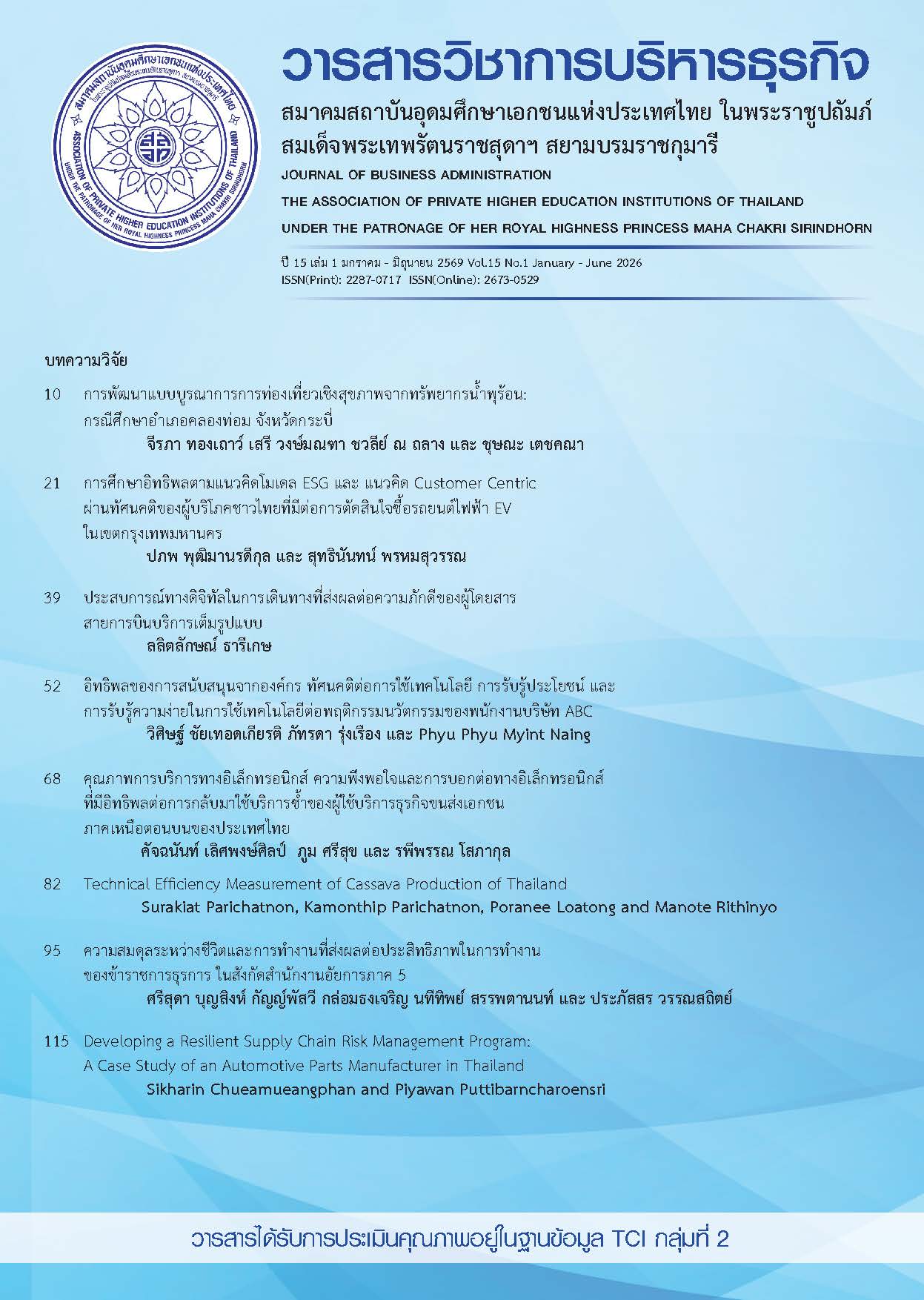
อิทธิพลของการสนับสนุนจากองค์กร ทัศนคติต่อการใช้เทคโนโลยี การรับรู้ประโยชน์ และการรับรู้ความง่ายในการใช้เทคโนโลยีที่มีต่อพฤติกรรมนวัตกรรมของพนักงานบริษัท ABC
คำสำคัญ:
การสนับสนุนจากองค์กร , ทัศนคติต่อการใช้เทคโนโลยี , การรับรู้ประโยชน์ , การรับรู้ความง่ายในการใช้เทคโนโลยี, พฤติกรรมนวัตกรรมบทคัดย่อ
การวิจัยครั้งนี้มีวัตถุประสงค์เพื่อ 1. ศึกษาความสัมพันธ์ของการสนับสนุนจากองค์กร ทัศนคติต่อการใช้เทคโนโลยี ความง่ายในการใช้งาน การรับรู้ประโยชน์ กับพฤติกรรมนวัตกรรมในการทำงาน และ 2. ศึกษาอิทธิพลของการสนับสนุนจากองค์กร ทัศนคติต่อการใช้เทคโนโลยี การรับรู้ประโยชน์ และการรับรู้ความง่ายในการใช้เทคโนโลยีที่มีต่อพฤติกรรมนวัตกรรมของพนักงานบริษัท ABC ซึ่งเป็นผู้ผลิตเครื่องมือแพทย์ของไทยที่ดำเนินธุรกิจมายาวนานกว่า 50 ปี และกำลังอยู่ในช่วงการปรับตัวสู่การใช้เทคโนโลยีดิจิทัลในกระบวนการดำเนินงาน กลุ่มตัวอย่างคือพนักงานบริษัท ABC จำนวน 88 คน โดยใช้แบบสอบถาม เป็นเครื่องมือในการเก็บรวบรวมข้อมูล วิเคราะห์ข้อมูลด้วยสถิติเชิงพรรณนา ประกอบด้วย ความถี่ ร้อยละ ค่าเฉลี่ย และส่วนเบี่ยงเบนมาตรฐาน และสถิติเชิงอนุมาน ประกอบด้วย การวิเคราะห์สัมประสิทธิ์สหสัมพันธ์เพียร์สัน และการวิเคราะห์การถดถอยพหุคูณ ผลการวิจัยพบว่า (1) ผลการวิเคราะห์สัมประสิทธิ์สหสัมพันธ์เพียร์สัน ตัวแปรทุกตัว ประกอบด้วย การสนับสนุนจากองค์กร ทัศนคติต่อการใช้เทคโนโลยี ความง่ายในการใช้งาน และการรับรู้ประโยชน์ มีความสัมพันธ์เชิงบวกกับพฤติกรรมนวัตกรรมในการทำงานอย่างมีนัยสำคัญทางสถิติที่ระดับ 0.01 โดยพบว่าตัวแปรที่มีความสัมพันธ์สูงที่สุด คือ การรับรู้ความง่ายในการใช้งาน (r = 0.837) และ (2) ผลการวิเคราะห์การถดถอยพหุคูณ พบว่า โมเดลสามารถอธิบายความแปรปรวนของพฤติกรรมนวัตกรรมได้ร้อยละ 57.6 (R² = 0.576) อย่างมีนัยสำคัญทางสถิติที่ระดับ 0.05 โดยเรียงลำดับจากมากไปน้อยดังนี้ คือ การรับรู้ประโยชน์ (β=0.63) ทัศนคติต่อการใช้เทคโนโลยี (β= 0.337) และความง่ายในการใช้งาน (β= 0.196) เรียงตามลำดับ ผลการวิจัยสะท้อนให้เห็นว่า องค์กรควรมุ่งพัฒนาเทคโนโลยีที่ใช้งานง่ายและก่อให้เกิดประโยชน์ต่อการทำงานจริง ควบคู่กับการสนับสนุนเชิงนโยบาย เพื่อส่งเสริมพฤติกรรมนวัตกรรมของพนักงานและเพิ่มขีดความสามารถในการแข่งขันขององค์กรในระยะยาว
เอกสารอ้างอิง
Agarwal, R., & Karahanna, E. (2000). Time flies when you’re having fun: cognitive absorption and beliefs about information technology usage. MIS quarterly, 24(4), 665-694.
Ajzen, I. (1991). The theory of planned behavior. Organizational Behavior and Human Decision Processes, 50(2), 179–211.
Al-Taie, M., & Khattak, M. N. (2024). The impact of perceived organizational support and human resources practices on innovative work behavior: does gender matter?. Frontiers in Psychology, 15, 1401916. https://doi.org/10.3389/fpsyg.2024.1401916
Amabile, T. M. (1983). The social psychology of creativity. Springer.
Amabile, T. M. (1996). Creativity in context. Westview Press.
Arif, S., Zubair, A., & Manzoor, Y. (2012). Innovative work behavior and communication climate among employees of advertising agencies. FWU Journal of Social Sciences, 6(1), 65-72.
Aryany Pratiwi, N., Fatimah, S., & Kukuh Susilo, A. (2023). The impact of organizational support and employee attitude to innovative work behavior mediating role of psychologic empowerment. Journal of Information and Organizational Sciences, 47(2), 445-472. https://doi.org/10.31341/jios.47.2.11
Boonyachai, Y. (2024). Technology Acceptance and Marketing Mix Affecting Attitude and Intention of Working-Age People to use Electric Vehicles in Bangkok and Metropolitan Region. Journal of Business Administration The Association of Private Higher Education Institutions of Thailand, 13(2), 140-156. [in Thai]
Davis, F. D. (1989). Perceived usefulness, perceived ease of use, and user acceptance of information technology. MIS Quarterly, 13(3), 319–340.
De Jong, J. P. J., & Den Hartog, D. N. (2010). Measuring innovative work behavior. Creativity and Innovation Management, 19(1), 23–36.
Eisenberger, R., Huntington, R., Hutchison, S., & Sowa, D. (1986). Perceived organizational support. Journal of Applied Psychology, 71(3), 500–507.
Ekmekcioglu, E. B., & Öner, K. (2024). Servant leadership, innovative work behavior and innovative organizational culture: the mediating role of perceived organizational support. European Journal of Management and Business Economics, 33(3), 272-288. https://doi.org/10.1108/EJMBE-08-2022-0251
Fishbein, M., & Ajzen, I. (1975). Belief, attitude, intention, and behavior: An introduction to theory and research. Addison-Wesley.
Good, K. J. (1973). Social facilitation: Effects of performance anticipation, evaluation, and response competition on free associations. Journal of Personality and Social Psychology, 28(2), 270-275.
Green, S. B. (1991). How many subjects does it take to do a regression analysis. Multivariate behavioral research, 26(3), 499-510.
Hair, J. F., Black, W. C., Babin, B. J., & Anderson, R. E. (2019). Multivariate Data Analysis (8th ed.). Cengage Learning.
Janssen, O. (2000). Job demands, perceptions of effort–reward fairness and innovative work behavior. Journal of Occupational and Organizational Psychology, 73(3), 287–302. https://doi.org/10.1348/096317900167038
Khan, M. I., Salendu, A., Azzahra, F., & Hussain, S. (2025). The Impact of Organizational Culture on Innovative Work Behavior Mediating Role of Perceived Organizational Support in Indonesian Small and Medium Enterprises (SMEs). Journal of Psychological Perspective, 7(1), 61-76.
Krungsri Research. (2023). Medical devices industry outlook in Thailand. Bank of Ayudhya. Krungsri Research. [in Thai]
Kurniawati, A. D., & Wijayadne, D. R. (2026). The Role of Trust and Perceived Usefulness as Mediators of the Influence of Personal Innovation on Intention to Use. Calitatea, 27(210), 183-191.
Kurtessis, J. N., Eisenberger, R., Ford, M. T., Buffardi, L. C., Stewart, K. A., & Adis, C. S. (2017). Perceived organizational support: A meta-analytic evaluation. Journal of Management, 43(6), 1854–1884. https://doi.org/10.1177/0149206315575554
Manuel III, M. C., & Capistrano, E. P. S. (2025). Self-efficacy and attitudes toward healthcare technology use: Empirical evidences from the Philippines. Asia Pacific Management Review, 30(3), 100338. https://doi.org/10.1016/j.apmrv.2024.12.002
Nunnally, J. C. (1978). Psychometric theory (2nd ed.). McGraw-Hill.
NXPO. (2024, September 11). White Paper: Advancing the Medical Device Industry through Local Innovation in Thailand 2024. Office of the National Higher Education Science Research and Innovation Policy Council. https://www.nxpo.or.th/th/en/27933/
Pansuppawatt, A., Samart, Y., Thoumrungroje, P., & Pansuppawatt, P. (2024). Causal Factors of Intention to use e-payment: An Empirical Investigation in Thailand. Journal of Business Administration The Association of Private Higher Education Institutions of Thailand, 13(1), 33-47. [in Thai]
Rhoades, L., & Eisenberger, R. (2002). Perceived organizational support: A review of the literature. Journal of Applied Psychology, 87(4), 698–714.
Rogers, E. M. (2003). Diffusion of innovations (5th ed.). Free Press.
Salele, N., & Khan, M. S. H. (2022). Engineering trainee-teachers’ attitudes toward technology use in pedagogical practices: extending computer attitude scale (CAS). Sage Open, 12(2), 21582440221102436. https://doi.org/10.1177/21582440221102436
Scott, S. G., & Bruce, R. A. (1994). Determinants of innovative behavior: A path model of individual innovation in the workplace. Academy of Management Journal, 37(3), 580–607.
Thailand Development Research Institute (TDRI). (2025, August28). Breaking barriers for Thai innovations. Thailand Development Research Institute. https://tdri.or.th/en/2025/08/breaking-barriers-for-thai-innovations/
Venkatesh, V., & Davis, F. D. (2000). A theoretical extension of the technology acceptance model: Four longitudinal field studies. Management Science, 46(2), 186–204. https://doi.org/10.1287/mnsc.46.2.186.11926
Vial, G. (2019). Understanding digital transformation: A review and a research agenda. Journal of Strategic Information Systems, 28(2), 118–144. https://doi.org/10.1016/j.jsis.2019.01.003
West, M. A., & Farr, J. L. (1990). Innovation at work. In M. A. West, & J. L. Farr (Eds.), Innovation and creativity at work: Psychological and organizational strategies (pp. 3–13). John Wiley.
Yamane, T. (1973). Statistics: An introductory analysis (3rd ed.). Harper & Row.
Zargar, P., Daouk, A., & Chahine, S. (2025). Driving innovative work behavior among university teachers through work engagement and perceived organizational support. Administrative Sciences, 15(7), 246. https://doi.org/10.3390/admsci15070246
Zhang, X., & Bartol, K. M. (2010). Linking empowering leadership and employee creativity: The influence of psychological empowerment, intrinsic motivation, and creative process engagement. Academy of management journal, 53(1), 107-128.
ดาวน์โหลด
เผยแพร่แล้ว
รูปแบบการอ้างอิง
ฉบับ
ประเภทบทความ
สัญญาอนุญาต
ลิขสิทธิ์ (c) 2026 วารสารวิชาการบริหารธุรกิจ สมาคมสถาบันอุดมศึกษาเอกชนแห่งประเทศไทย

อนุญาตภายใต้เงื่อนไข Creative Commons Attribution-NonCommercial-NoDerivatives 4.0 International License.
บทความที่ลงตีพิมพ์ในวารสารวิชาการบริหารธุรกิจ สมาคมสถาบันอุดมศึกษาเอกชนแห่งประเทศไทยต้องเป็นบทความที่ไม่เคยได้รับการตีพิมพ์เผยแพร่ หรืออยู่ระหว่างการพิจารณาตีพิมพ์ในวารสารอื่นๆ การละเมิดลิขสิทธิ์เป็นความรับผิดชอบของผู้ส่งบทความโดยตรง

