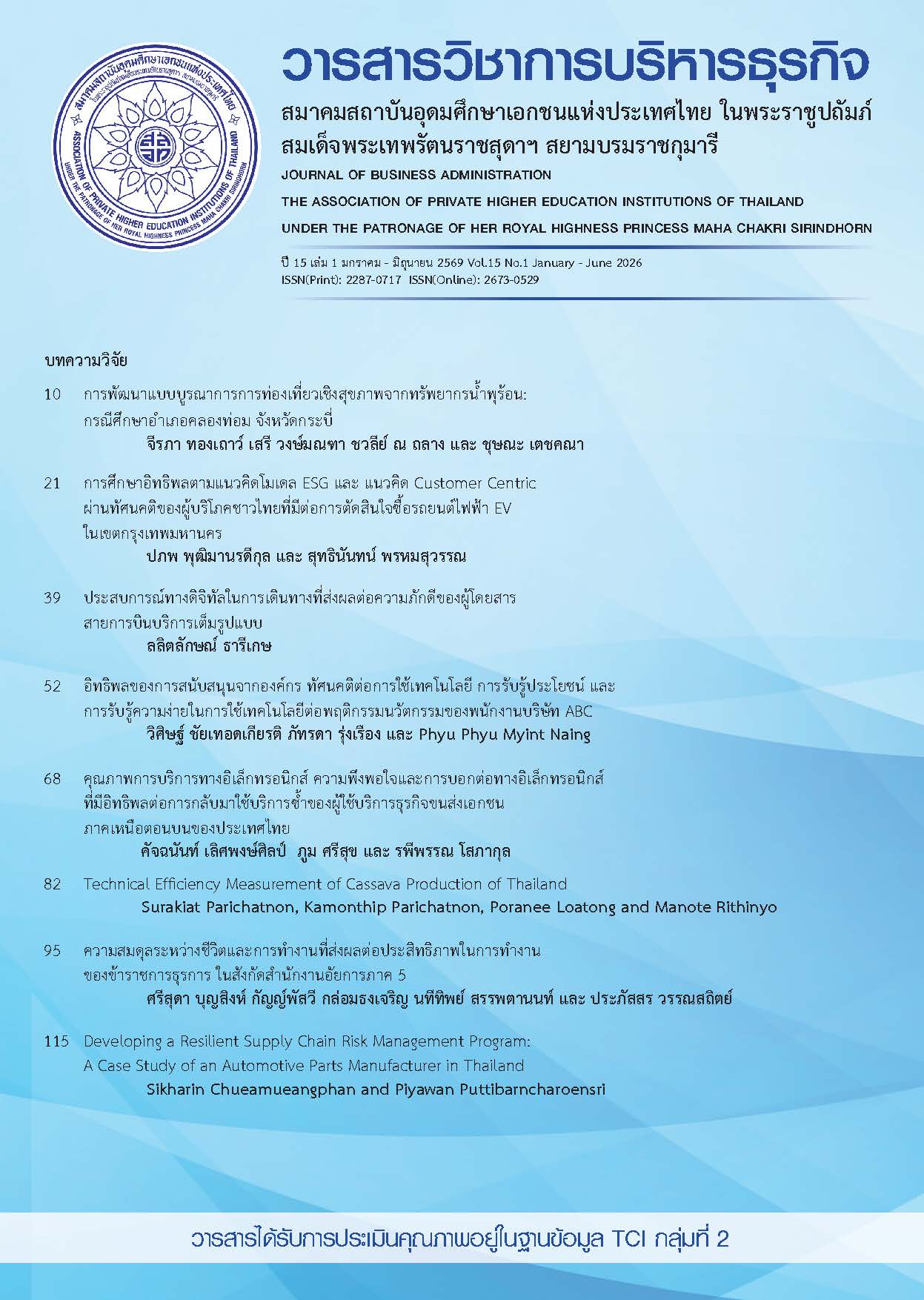
ประสบการณ์ทางดิจิทัลในการเดินทางที่ส่งผลต่อความภักดีของผู้โดยสารสายการบินบริการเต็มรูปแบบ
คำสำคัญ:
ประสบการณ์ทางดิจิทัล , ความภักดีของผู้โดยสาร , สายการบินบริการเต็มรูปแบบบทคัดย่อ
การวิจัยนี้มีวัตถุประสงค์ 1) เพื่อศึกษาประสบการณ์ทางดิจิทัลในการเดินทางของผู้โดยสารสายการบินบริการเต็มรูปแบบ 2) เพื่อศึกษาความภักดีของผู้โดยสารที่มีต่อสายการบินบริการเต็มรูปแบบ และ 3) เพื่อศึกษาอิทธิพลของประสบการณ์ทางดิจิทัลในการเดินทางที่ส่งผลต่อความภักดีของผู้โดยสารสายการบินบริการเต็มรูปแบบ การวิจัยครั้งนี้เป็นการวิจัยเชิงปริมาณใช้แบบสอบถาม ประชากรเป็นผู้โดยสารชาวไทยที่มีอายุ 20 ปีขึ้นไป ซึ่งเคยเดินทางโดยสารด้วยสายการบินบริการเต็มรูปแบบคำนวณกลุ่มตัวอย่างแบบไม่ทราบประชากรโดยใช้สูตรการคำนวณของ Cochran กำหนดค่าความเชื่อมั่นร้อยละ 95 และค่าความคลาดเคลื่อนที่ยอมรับได้ร้อยละ 5 ได้กลุ่มตัวอย่างจำนวน 385 คน โดยใช้การสุ่มกลุ่มตัวอย่างแบบสะดวก วิเคราะห์ข้อมูลด้วยสถิติเชิงบรรยาย ประกอบด้วย ความถี่ ร้อยละ ค่าเฉลี่ย ส่วนเบี่ยงเบนมาตรฐาน และ สถิติเชิงอนุมาน โดยการวิเคราะห์การถดถอยเชิงเส้นอย่างง่าย ผลการวิจัย พบว่า (1) กลุ่มตัวอย่างมีประสบการณ์ทางดิจิทัลก่อนการเดินทางและระหว่างการเดินทางอยู่ในระดับดีมาก และหลังการเดินทางอยู่ในระดับปานกลาง (2) ด้านความภักดีของผู้โดยสาร กลุ่มตัวอย่างมีความภักดีเชิงทัศนคติ และเชิงพฤติกรรมต่อสายการบินบริการเต็มรูปแบบอยู่ในระดับดีมาก และ (3) ประสบการณ์ทางดิจิทัลในทุกช่วงของการเดินทางประกอบด้วย ก่อนการเดินทาง ระหว่างการเดินทาง และหลังการเดินทาง มีอิทธิพลเชิงบวกต่อความภักดีของผู้โดยสารสายการบินบริการเต็มรูปแบบอย่างมีนัยสำคัญทางสถิติที่ระดับ 0.01 โดยพบว่า ประสบการณ์ทางดิจิทัลในช่วงก่อนการเดินทาง มีอิทธิพลต่อความภักดีของผู้โดยสารทั้งเชิงพฤติกรรมและเชิงทัศนคติมากที่สุด ผลการวิจัยในครั้งนี้ สามารถเป็นข้อมูลให้แก่สายการบิน ในการปรับปรุงพัฒนาระบบเทคโนโลยีดิจิทัลในการบริการ และการพัฒนาแอปพลิเคชั่นแบบศูนย์รวมที่ครอบคลุมการเช็กอิน ติดตามสัมภาระ แจ้งเตือนเที่ยวบินล่าช้า แสดงประตูขึ้นเครื่อง และการสะสมไมล์เชื่อมโยงไว้ในแพลตฟอร์มเดียวเพื่อยกระดับความพึงพอใจและเสริมสร้างความภักดีของผู้โดยสารต่อสายการบินบริการเต็มรูปแบบได้มากยิ่งขึ้น
เอกสารอ้างอิง
Airports of Thailand Public Company Limited. (2024). Annual report 2024 (One Report). Airports of Thailand. https://investor.airportthai.co.th/misc/one-report/20250115-aot-one-report-2024-th.pdf [in Thai]
Al Abri, I., Alkazemi, M., Abdeljalil, W., Al Harthi, H., & Al Maqbali, F. (2023). Attitudinal and behavioral loyalty: Do psychological and political factors matter in tourism development? Sustainability, 15(6), 5042. https://doi.org/10.3390/su15065042
Ali, N., & Alfayez, M. (2024). The impact of E-CRM on customer loyalty in the airline industry: The mediating role of customer experience. Cogent Business & Management, 11(1), 2364838. https://doi.org/10.1080/23311975.2024.2364838
Bakır, M., Atalık, Ö., & Itani, N. (2025). Service quality and repurchase intentions in the airline industry: a multiple mediation analysis through customer citizenship behaviour. Current issues in tourism, 28(24), 4025-4046. https://doi.org/10.1080/13683500.2024.2410935
Ban, H.J., & Kim, H.S. (2019). Understanding customer experience and satisfaction through airline passengers’ online review. Sustainability, 11(15), 4066. https://doi.org/10.3390/su11154066.
Baran, R. J., & Galka, R. J. (2017). Customer relationship management: The foundation of contemporary marketing strategy (2nd ed.). Routledge.
Best, J. W., & Kahn, J. V. (2006). Research in education (10th ed.). Pearson Education.
Chou, S., Chen, C. W., & Wong, M. (2023). When social media meets low-cost airlines: Will customer engagement increase customer loyalty? Research in Transportation Business & Management, 47, 100945. https://doi.org/10.1016/j.rtbm.2023.100945
Cochran, W. G. (1977). Sampling techniques (3rd ed.). John Wiley & Sons.
Cronbach, L. J. (1951). Coefficient alpha and the internal structure of tests. Psychometrika, 16(3), 297-334.
Geng, L., & Li, X. (2018). An empirical study on the relationship between consumption emotions and brand loyalty. Chinese Journal of Communication, 11(3), 267-288. https://doi.org/10.1080/17544750.2018.1445118
Heiets, I., La, J., Zhou, W., Xu, S., Wang, X., & Xu, Y. (2022). Digital transformation of airline industry. Research in Transportation Economics, 92, 101186. https://doi.org/10.1016/j.retrec.2022.101186
Khamwilai, A., Nimitphuwanon, P., Pannopapha, O., Khamchang, T., & Srisat, P. (2025). The development of e-boarding pass technology and its impact on passenger experience. Modern Academic Development and Promotion Journal, 3(2), 1000-1018. [in Thai]
Kotler, P., Kartajaya, H., & Setiawan, I. (2021). Marketing 5.0: Technology for Humanity. John Willey & Sons.
Mingcharoen, J. M., & Lekcharoen, S. (2020). The influence of perceived e-service quality on perceived value and customer loyalty in purchasing airline tickets via Thai airline websites. Journal of Communication Arts Review, 24(3), 179–192. [in Thai]
Pahuwattanakorn, S., Joungtrakul, J., & Chitwattanakorn, T. (2024). Study of causal factors influencing the development of a marketing innovation model 5.0 to encourage repeat usage among Gen Y customers of low-cost airlines in Thailand. Journal of MCU Social Science Review, 13(6), 374–385. [in Thai]
Pinkum, S., & Kidrakarn, K. (2023). An investigation into improving service quality distribution and perceived value in the passenger loyalty of low-cost airlines in Thailand. Journal of Distribution Science, 21(4), 21-33. [in Thai]
Ragab, H., Polo-Peña, A. I., & Mahrous, A. A. (2024). The effect of airline service quality, perceived value, emotional attachment, and brand loyalty on passengers’ willingness to pay: The moderating role of airline origin. Case Studies on Transport Policy, 18, 101313. https://doi.org/10.1016/j.cstp.2024.101313
Rubio-Andrada, L., Celemín-Pedroche, M. S., Escat-Cortés, M. D., & Jiménez-Crisóstomo, A. (2023). Passengers satisfaction with the technologies used in smart airports: An empirical study from a gender perspective. Journal of Air Transport Management, 107, 102347. https://doi.org/10.1016/j.jairtraman.2022.102347
Sarker, M., Mohd-Any, A. A., & Kamarulzaman, Y. (2021). Validating a consumer-based service brand equity (CBSBE) model in the airline industry. Journal of Retailing and Consumer Services, 59, 102354.
Shiwakoti, N., Hu, Q., Pang, M. K., Cheung, T. M., Xu, Z., & Jiang, H. (2022). Passengers’ perceptions and satisfaction with digital technology adopted by airlines during COVID-19 pandemic. Future Transportation, 2(4), 988–1009. https://doi.org/10.3390/futuretransp2040055
Siqueira, J. R., Bendixen, M., Reinoso-Carvalho, F., & Campo, R. (2023). Key drivers of brand trust in a Latin American airline: the impact of Colombia’s Avianca customer experience. Journal of Marketing Analytics, 11(2), 186 - 201.
Tarkang, M. E., Alola, U. V., Nange, R. Y., & Ozturen, A. (2022). Investigating the factors that trigger airline industry purchase intention. Current Psychology, 41(4), 1716-1727.
Violin, V., Hasan, S., & Sufri, M. (2022). Analysis of the Influence of Marketing Technology Concepts, Service Quality, and Low-Cost Carrier on Customers and Customer Loyalty on Lion Air Airlines in Indonesia. Journal of Management Science (JMAS), 5(3), 64-73.
Wikraisakda, K., Kittisaknavin, C., & Paiboonwongsakul, S. (2021).Customer experience management: A new proposal for boutique hotel development in Thailand. Kasem Bundit Journal, 22(2), 54–71. [in Thai]
Wongyai, P. H., Ngo, T., Wu, H., Tsui, K. W. H., & Nguyen, T. H. (2024). Self-service technology in aviation: A systematic literature review. Journal of the Air Transport Research Society, 2, 100016. https://doi.org/10.1016/j.jatrs.2024.100016
Xue, Y., & Ylagan, A. D. (2024). Airline services, passenger satisfaction and loyalty among passengers of China Southern Airline. International Journal of Research Studies in Management, 12(10), 57–72.
ดาวน์โหลด
เผยแพร่แล้ว
รูปแบบการอ้างอิง
ฉบับ
ประเภทบทความ
สัญญาอนุญาต
ลิขสิทธิ์ (c) 2026 วารสารวิชาการบริหารธุรกิจ สมาคมสถาบันอุดมศึกษาเอกชนแห่งประเทศไทย

อนุญาตภายใต้เงื่อนไข Creative Commons Attribution-NonCommercial-NoDerivatives 4.0 International License.
บทความที่ลงตีพิมพ์ในวารสารวิชาการบริหารธุรกิจ สมาคมสถาบันอุดมศึกษาเอกชนแห่งประเทศไทยต้องเป็นบทความที่ไม่เคยได้รับการตีพิมพ์เผยแพร่ หรืออยู่ระหว่างการพิจารณาตีพิมพ์ในวารสารอื่นๆ การละเมิดลิขสิทธิ์เป็นความรับผิดชอบของผู้ส่งบทความโดยตรง

