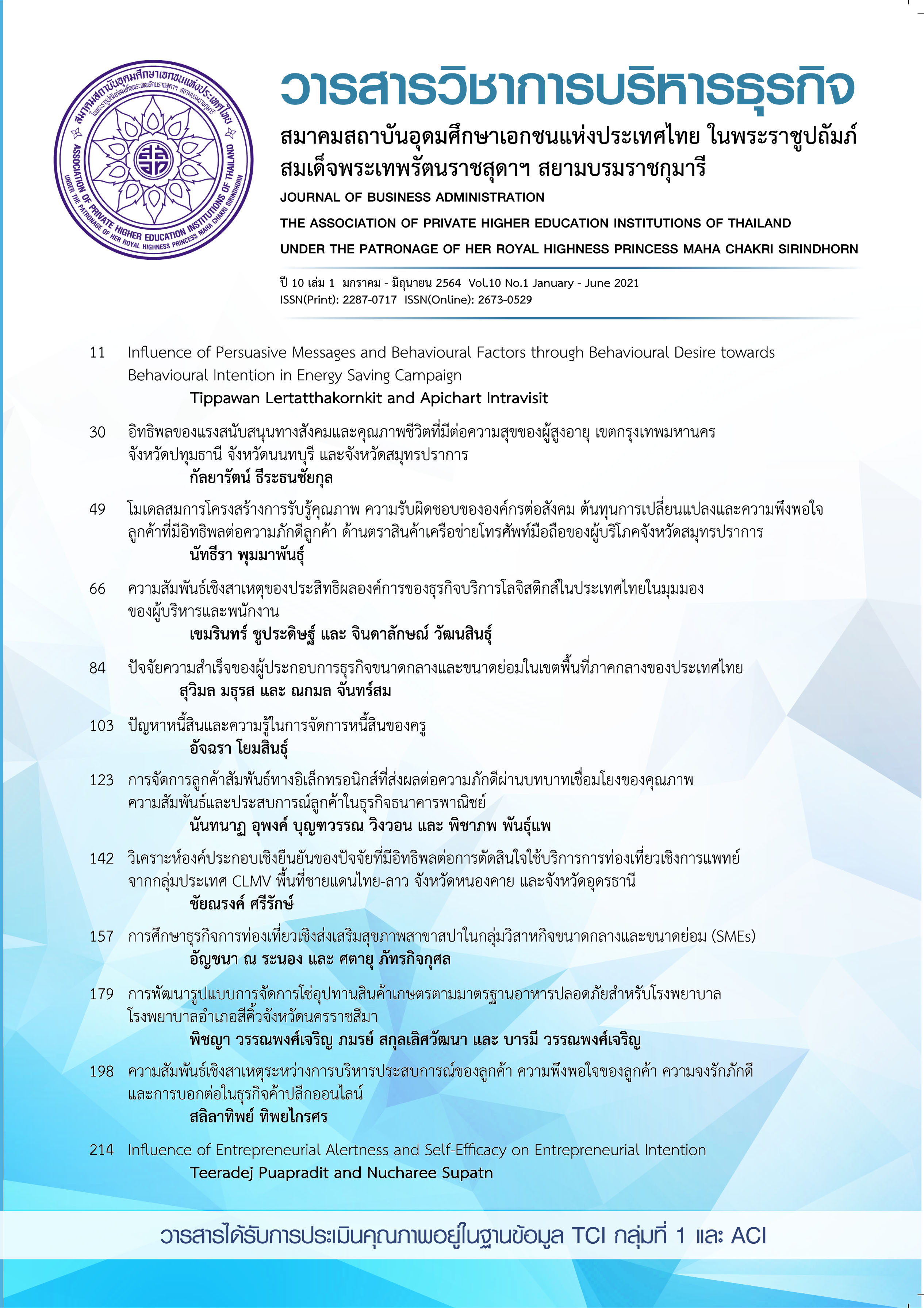
The การวิเคราะห์องค์ประกอบเชิงยืนยันของปัจจัยที่มีอิทธิพลต่อการตัดสินใจใช้บริการการท่องเที่ยวเชิงการแพทย์จากกลุ่มประเทศ CLMV พื้นที่ชายแดนไทย-ลาวจังหวัดหนองคาย และจังหวัดอุดรธานี
คำสำคัญ:
การท่องเที่ยวเชิงการแพทย์, บริการการท่องเที่ยวเชิงการแพทย์, นักท่องเที่ยวจากกลุ่มประเทศ CLMVบทคัดย่อ
บทความวิจัยนี้มีวัตถุระสงค์เพื่อ 1) ศึกษาพฤติกรรมการท่องเที่ยวเชิงการแพทย์ของนักท่องเที่ยวจากกลุ่มประเทศ CLMV พื้นที่ชายแดนไทย-ลาว จังหวัดหนองคาย และจังหวัดอุดรธานี และ 2) เพื่อวิเคราะห์องค์ประกอบเชิงยืนยันปัจจัยที่มีอิทธิพลต่อการตัดสินใจใช้บริการการท่องเที่ยวเชิงการแพทย์ของนักท่องเที่ยวจากกลุ่มประเทศ CLMV พื้นที่ชายแดนไทย-ลาว จังหวัดหนองคาย และจังหวัดอุดรธานีศึกษาโดยการวิจัยเชิงสำรวจ เก็บข้อมูลด้วยใช้แบบสอบถามจากนักท่องเที่ยว จำนวน 400 คน โดยใช้วิธีการสุ่มแบบบังเอิญด้วยสถิติเชิงพรรณนาเพื่อวิเคราะห์ข้อมูลพื้นฐานได้แก่ ความเบ้ ความโด่ง ค่าความถี่ ร้อยละ ค่าเฉลี่ยเลขคณิต ส่วนเบี่ยงเบนมาตรฐาน และสถิติเชิงอนุมานด้วยดัชนียืนยันความสอดคล้องได้แก่ ค่าดัชนีไค-สแควร์(c2), CMIN/df , RMSEA , RMR AGFI, GFI
ผลการศึกษาพบว่า นักท่องเที่ยวเชิงการแพทย์จากกลุ่มประเทศ CLMV ส่วนใหญ่เป็นเจ้าของธุรกิจ เพศหญิง และข้ามแดนมาใช้บริการตรวจวินิจฉัยโรคเฉพาะทาง ตรวจสุขภาพทั่วไป บริการตรวจตา/จักษุ ตรวจทางสูตินรีและการทำคลอด ตรวจรักษาหัวใจและหลอดเลือด บริการตรวจทันตกรรม ศัลยกรรมตกแต่ง และบริการส่งเสริมและฟื้นฟูสุขภาพรูปแบบอื่นๆ ตามลำดับแบบจำลองที่พัฒนาขึ้นมีความสอดคล้องกับข้อมูลเชิงประจักษ์ในระดับดีc2 = 11.42, df = 8, P = 0.11, GFI = 0.99, AGFI = 0.89, RMR= 0.0025, RMSEA= 0.0034โดยปัจจัยที่อยู่ในตัวแบบสามารถร่วมกันอธิบายความแปรปรวนของการตัดสินใจใช้บริการทางการแพทย์ได้ร้อยละ64 (R2 = .64)สามารถเรียงลำดับค่าน้ำหนักองค์ประกอบของปัจจัยองค์ประกอบได้ดังนี้ ปัจจัยด้านการส่งเสริมการตลาด(β = 0.83) ปัจจัยด้านการตอบสนองความต้องการส่วนตัว (β = 0.74) ปัจจัยด้านคุณภาพและราคาบริการ(β = 0.69) ปัจจัยด้านสถานที่และการเข้าถึง (β = 0.58) ปัจจัยด้านสิ่งอำนวยความβ = 0.53) และ ปัจจัยด้านทรัพยากรท่องเที่ยว/แหล่งท่องเที่ยว (β = 0.41)เรียงตามลำดับ ผลการวิจัยเป็นประโยชน์ต่อการกำหนดกลยุทธ์ การพัฒนา และการส่งเสริมการท่องเที่ยวเชิงการแพทย์ของนักท่องเที่ยวจากกลุ่มประเทศ CLMV ในพื้นที่ชายแดนไทย-ลาว
เอกสารอ้างอิง
Aday, L. A., & Andersen, R. (1981). Equity of access to medical care a conceptual and empirical overview. Medical Care, 19(12), 4-27.
Al‐Amin, M., Makarem, S. C., & Pradhan, R. (2011). Hospital ability to attract international patients: a conceptual framework. International Journal of Pharmaceutical and Healthcare Marketing, 5(3), 205-221.
Bollen, K. A. (1989). Structural equations with latent variables. New York: John Wiley and Sons.
Bye, D. H. (2007). Shopping Abroad for Medical Care: The Next Step in Controlling the Escalating Health Care Costs of American Group Health Plans.Health Lawyer, 19(5), 30-38.
Chusri, W., & Lalitsasivimol, W. (2020). Health Tourisms: Thailand’s Competitiveness. Princess of Naradhiwas University Journal of Humanities and Social Sciences, 7(2), 205-226.
Department of Tourism. (2019). ASEAN Tourism Strategic Plan 2016-2025. Ministry of Tourism and Sports, Bangkok.Retrieved from https://www.mots.go.th/ewt_dl_link.php?nid=7114
Diamantopoulos, A., & Siguaw, J. A. (2000). Introduction to LISREL: A guide for the uninitiated. London: SAGE Publications, Inc,.
Gan, L. L., &Frederuck, J.R. (2011). Medical Tourism Facilitators: Patterns of Service Differentiation.Journal of Vacation marketing, 17(3). 165-183.
Global Wellness Summit. (2016). Wellness Now a $3.72 Trillion Global Industry – with 10.6% Growth from 2013–2015.Retrieved from http://www.prweb.com/releases/GWI/Wellness/prweb13768540.htm.
Hair, J. F., Anderson, R, E., Basin, B. J., & Black, W. C. (2010). Multivariate data analysis: A global perspectives. (7thed). Upper Saddle River, NJ: Pearson Education.
Harrison-Walker, L. J. (2001). The measurement of word-of-mouth communication and an investigation of service quality and customer commitment as potential antecedents. Journal of Service Research, 4(1), 60-75.
Horowitz, M.D., Marsek, P., Mohanasundaram, S., Pachisa, M., Jones, C.A., Keith, L.G.,Metaxotos, N., Heng Boon Chin, A., Yuen Tan, Y., & Yiun Teo, S. (2008). Why in the world do patients travel for health care? Asia Pacific Biotech News, 12, 24-53.
Khasuwan, S. (2017). Usage behavior of medical services in Thailand among medical tourists from the middle-east region: Perception of medical service providers.Kasetsart Applied Business Journal, 11(14), 53-76.
Kulkalyuenyong, P. (2017). Medical Tourism Thailand: Challenges and Development. The Journal of Social Communication Innovation, 5(1), 125-132.
Lam, C., du Cros, H., & Vong, T.N. (2011). Macao's potential for developing regional Chinese medical tourism. Tourism Review, 66(1/2), 68-82. https://doi.org/10.1108/16605371111127242
Loedlukthanathan, S., Onmung, P., & Liblub, A. (2016). Factors Influencing Health Tourism Among Foreign Visitors to Thailand: A Promotional Model. Academic Journal Phranakhon Rajabhat University, 7(1), 1-10.
Marohabutr, T. (2018). Medical Hub Policy Strategy and Situations Reflecting Impact on the Health System of Thailand. Quality of Life and Law Journal, 14(2), 27-41.
Office of Small and Medium Enterprises Promotion (OSMEP) E-Saan Center for Business and Economic Research. (2018). CLMV Pulse the Heartbeat of Southeast Asia’s Consumer. Faculty of Economics, KhonKaen University.
Patthamaritthikul, T., Na Thalang, C., Jittithavorn, C., & Tungbenchasirikul, S. (2019). The Attitude Analysis the needs of steak holder the potential of BorderTourism Cities to Create the Linkage of Greater Mekong Subregion: Mukdahan-Savannakhet-Quang Tri. Rajapark Journal, 13(30), 245-255.
Pattharapinyophong, W. (2019). The Opportunities and Challenges for Thailand in Becoming the Medical Tourism Hub of the ASEAN Region. Journal of Management Sciences Suratthani Rajabhat University, 6(1), 1-16.
Sriampornekkul, L., & Chuntuk, T.(2018). Quality Tourism for Senior Tourists. Journal of Humanities and Social Sciences, Rajapruk University, 4(1), 12-28.
Stăncioiu, A. F., BĂLTESCU, C. A., BOTOŞ, A., & Pârgaru, I. (2013). Conceptual aspects regarding balneotherapy tourism marketing in Romania. Theoretical & Applied Economics, 20(2),145-158.
Sujarinpong, P,Manirochana, N., & Permphon, N. (2018). A Study of relationships between medical tourism potential and behavioral intentions of medical tourists in Thailand. Journal of Liberal Arts, Prince of Songkla University, 10(1), 229-253.
Weerakit, N.,Chaiyasain, C.,Aksornpairoj, P., & Sonpiam, S. (2019). The Development Guidelines of Medical Tourism to Upgrade Phuket to be an International Medical Hub. Journal of International and Thai Tourism, 15(2), 35-57.
Yu, J. Y., & Ko, T. G. (2012). A cross-cultural study of perceptions of medical tourism among Chinese, Japanese and Korean tourists in Korea. Tourism management, 33(1), 80-88.
ดาวน์โหลด
เผยแพร่แล้ว
รูปแบบการอ้างอิง
ฉบับ
ประเภทบทความ
สัญญาอนุญาต
บทความที่ลงตีพิมพ์ในวารสารวิชาการบริหารธุรกิจ สมาคมสถาบันอุดมศึกษาเอกชนแห่งประเทศไทยต้องเป็นบทความที่ไม่เคยได้รับการตีพิมพ์เผยแพร่ หรืออยู่ระหว่างการพิจารณาตีพิมพ์ในวารสารอื่นๆ การละเมิดลิขสิทธิ์เป็นความรับผิดชอบของผู้ส่งบทความโดยตรง

