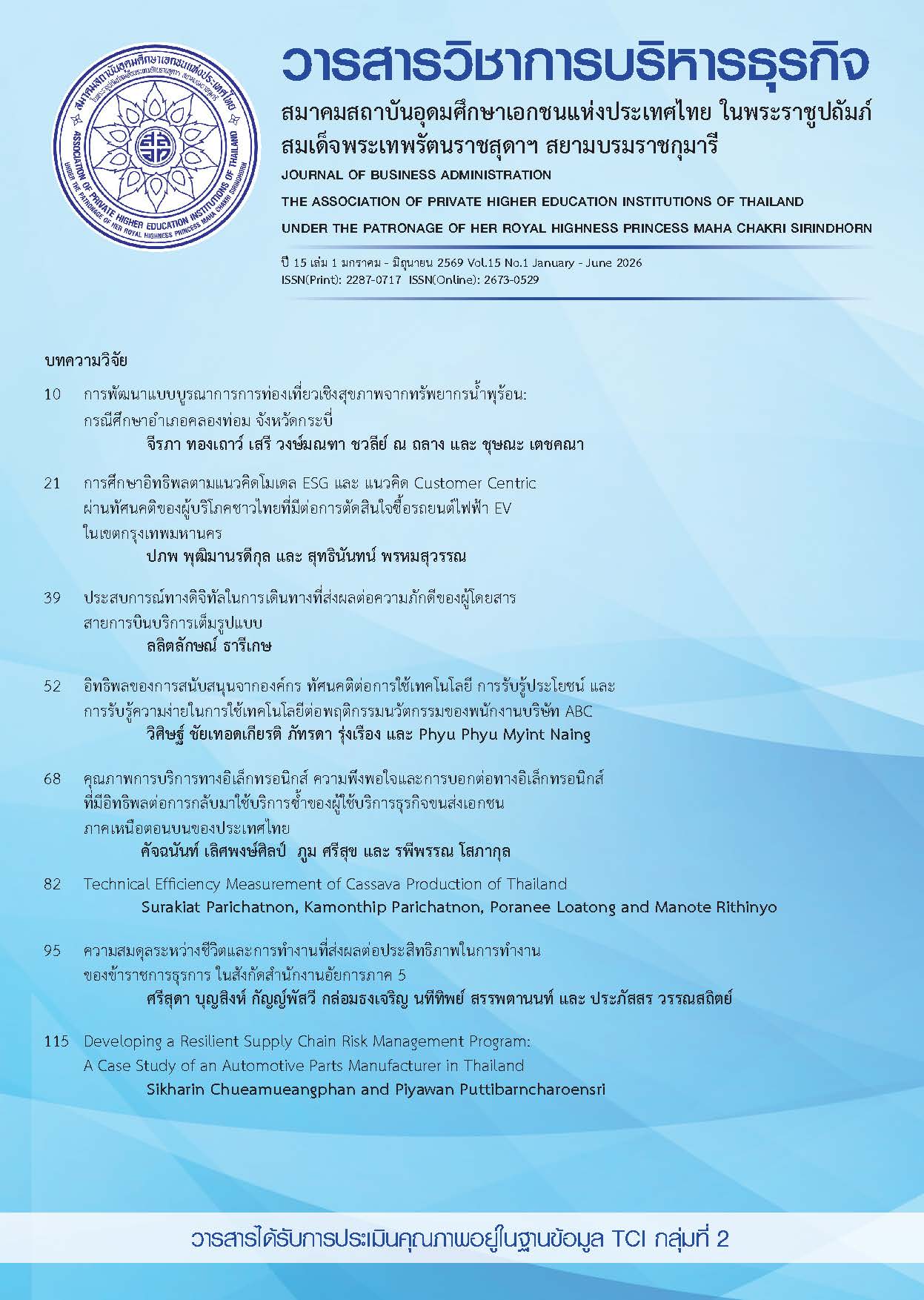
Digital Travel Experience Influencing Passenger Loyalty in Full-Service Airlines
Keywords:
Digital Experience, Passenger Loyalty, Full-Service AirlinesAbstract
This research aimed to: (1) examine the digital travel experiences of full-service airline passengers; (2) investigate passenger loyalty to full-service airlines; and (3) analyze the influence of digital travel experiences on passenger loyalty. The study employed quantitative research design using questionnaires. The population consisted of Thai passengers aged 20 years and older who had traveled with full-service airlines. The sample size was determined using Cochran’s formula with a 95% confidence level and a 5% margin of error, resulting in a total of 385 respondents selected through convenience sampling. Data were analyzed using descriptive statistics, including frequency, percentage, mean, and standard deviation, as well as inferential statistics through simple linear regression analysis. The results indicated that: (1) respondents reported very good digital experiences before and during travel, and moderate experiences after travel; (2) passengers demonstrated very high levels of both attitudinal and behavioral loyalty toward full-service airlines; and (3) overall digital experiences across all stages of travel—before, during, and after—were at a moderate level. The study further revealed that pre-travel digital experiences significantly influenced passenger loyalty to full-service airlines at the 0.01 level of statistical significance. Notably, pre-travel digital experiences had the strongest impact on both behavioral and attitudinal loyalty. These findings suggest that airlines can enhance passenger satisfaction and strengthen loyalty by improving their digital technology systems and developing integrated platforms that include check-in, baggage tracking, flight delay notifications, gate information, and mileage accumulation within a single application.
References
Airports of Thailand Public Company Limited. (2024). Annual report 2024 (One Report). Airports of Thailand. https://investor.airportthai.co.th/misc/one-report/20250115-aot-one-report-2024-th.pdf [in Thai]
Al Abri, I., Alkazemi, M., Abdeljalil, W., Al Harthi, H., & Al Maqbali, F. (2023). Attitudinal and behavioral loyalty: Do psychological and political factors matter in tourism development? Sustainability, 15(6), 5042. https://doi.org/10.3390/su15065042
Ali, N., & Alfayez, M. (2024). The impact of E-CRM on customer loyalty in the airline industry: The mediating role of customer experience. Cogent Business & Management, 11(1), 2364838. https://doi.org/10.1080/23311975.2024.2364838
Bakır, M., Atalık, Ö., & Itani, N. (2025). Service quality and repurchase intentions in the airline industry: a multiple mediation analysis through customer citizenship behaviour. Current issues in tourism, 28(24), 4025-4046. https://doi.org/10.1080/13683500.2024.2410935
Ban, H.J., & Kim, H.S. (2019). Understanding customer experience and satisfaction through airline passengers’ online review. Sustainability, 11(15), 4066. https://doi.org/10.3390/su11154066.
Baran, R. J., & Galka, R. J. (2017). Customer relationship management: The foundation of contemporary marketing strategy (2nd ed.). Routledge.
Best, J. W., & Kahn, J. V. (2006). Research in education (10th ed.). Pearson Education.
Chou, S., Chen, C. W., & Wong, M. (2023). When social media meets low-cost airlines: Will customer engagement increase customer loyalty? Research in Transportation Business & Management, 47, 100945. https://doi.org/10.1016/j.rtbm.2023.100945
Cochran, W. G. (1977). Sampling techniques (3rd ed.). John Wiley & Sons.
Cronbach, L. J. (1951). Coefficient alpha and the internal structure of tests. Psychometrika, 16(3), 297-334.
Geng, L., & Li, X. (2018). An empirical study on the relationship between consumption emotions and brand loyalty. Chinese Journal of Communication, 11(3), 267-288. https://doi.org/10.1080/17544750.2018.1445118
Heiets, I., La, J., Zhou, W., Xu, S., Wang, X., & Xu, Y. (2022). Digital transformation of airline industry. Research in Transportation Economics, 92, 101186. https://doi.org/10.1016/j.retrec.2022.101186
Khamwilai, A., Nimitphuwanon, P., Pannopapha, O., Khamchang, T., & Srisat, P. (2025). The development of e-boarding pass technology and its impact on passenger experience. Modern Academic Development and Promotion Journal, 3(2), 1000-1018. [in Thai]
Kotler, P., Kartajaya, H., & Setiawan, I. (2021). Marketing 5.0: Technology for Humanity. John Willey & Sons.
Mingcharoen, J. M., & Lekcharoen, S. (2020). The influence of perceived e-service quality on perceived value and customer loyalty in purchasing airline tickets via Thai airline websites. Journal of Communication Arts Review, 24(3), 179–192. [in Thai]
Pahuwattanakorn, S., Joungtrakul, J., & Chitwattanakorn, T. (2024). Study of causal factors influencing the development of a marketing innovation model 5.0 to encourage repeat usage among Gen Y customers of low-cost airlines in Thailand. Journal of MCU Social Science Review, 13(6), 374–385. [in Thai]
Pinkum, S., & Kidrakarn, K. (2023). An investigation into improving service quality distribution and perceived value in the passenger loyalty of low-cost airlines in Thailand. Journal of Distribution Science, 21(4), 21-33. [in Thai]
Ragab, H., Polo-Peña, A. I., & Mahrous, A. A. (2024). The effect of airline service quality, perceived value, emotional attachment, and brand loyalty on passengers’ willingness to pay: The moderating role of airline origin. Case Studies on Transport Policy, 18, 101313. https://doi.org/10.1016/j.cstp.2024.101313
Rubio-Andrada, L., Celemín-Pedroche, M. S., Escat-Cortés, M. D., & Jiménez-Crisóstomo, A. (2023). Passengers satisfaction with the technologies used in smart airports: An empirical study from a gender perspective. Journal of Air Transport Management, 107, 102347. https://doi.org/10.1016/j.jairtraman.2022.102347
Sarker, M., Mohd-Any, A. A., & Kamarulzaman, Y. (2021). Validating a consumer-based service brand equity (CBSBE) model in the airline industry. Journal of Retailing and Consumer Services, 59, 102354.
Shiwakoti, N., Hu, Q., Pang, M. K., Cheung, T. M., Xu, Z., & Jiang, H. (2022). Passengers’ perceptions and satisfaction with digital technology adopted by airlines during COVID-19 pandemic. Future Transportation, 2(4), 988–1009. https://doi.org/10.3390/futuretransp2040055
Siqueira, J. R., Bendixen, M., Reinoso-Carvalho, F., & Campo, R. (2023). Key drivers of brand trust in a Latin American airline: the impact of Colombia’s Avianca customer experience. Journal of Marketing Analytics, 11(2), 186 - 201.
Tarkang, M. E., Alola, U. V., Nange, R. Y., & Ozturen, A. (2022). Investigating the factors that trigger airline industry purchase intention. Current Psychology, 41(4), 1716-1727.
Violin, V., Hasan, S., & Sufri, M. (2022). Analysis of the Influence of Marketing Technology Concepts, Service Quality, and Low-Cost Carrier on Customers and Customer Loyalty on Lion Air Airlines in Indonesia. Journal of Management Science (JMAS), 5(3), 64-73.
Wikraisakda, K., Kittisaknavin, C., & Paiboonwongsakul, S. (2021).Customer experience management: A new proposal for boutique hotel development in Thailand. Kasem Bundit Journal, 22(2), 54–71. [in Thai]
Wongyai, P. H., Ngo, T., Wu, H., Tsui, K. W. H., & Nguyen, T. H. (2024). Self-service technology in aviation: A systematic literature review. Journal of the Air Transport Research Society, 2, 100016. https://doi.org/10.1016/j.jatrs.2024.100016
Xue, Y., & Ylagan, A. D. (2024). Airline services, passenger satisfaction and loyalty among passengers of China Southern Airline. International Journal of Research Studies in Management, 12(10), 57–72.
Downloads
Published
How to Cite
Issue
Section
License
Copyright (c) 2026 Journal of Business Administration The Association of Private Higher Education Institutions of Thailand

This work is licensed under a Creative Commons Attribution-NonCommercial-NoDerivatives 4.0 International License.
บทความที่ลงตีพิมพ์ในวารสารวิชาการบริหารธุรกิจ สมาคมสถาบันอุดมศึกษาเอกชนแห่งประเทศไทยต้องเป็นบทความที่ไม่เคยได้รับการตีพิมพ์เผยแพร่ หรืออยู่ระหว่างการพิจารณาตีพิมพ์ในวารสารอื่นๆ การละเมิดลิขสิทธิ์เป็นความรับผิดชอบของผู้ส่งบทความโดยตรง

