
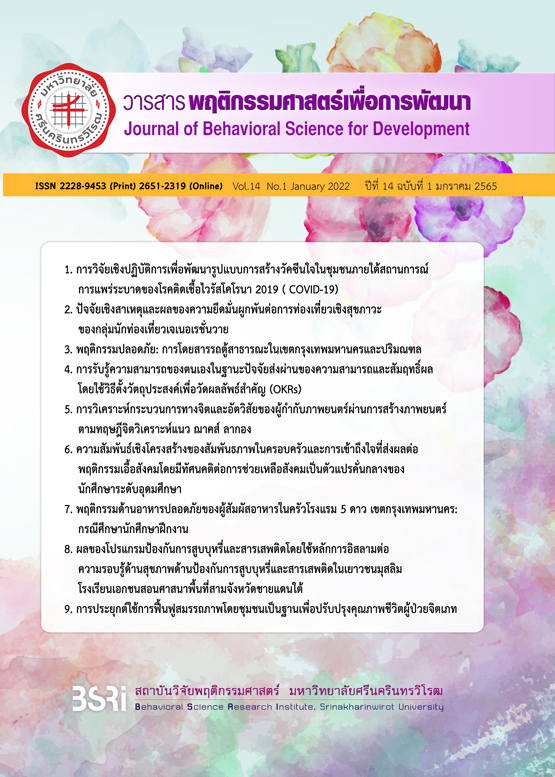
พฤติกรรมปลอดภัย: การโดยสารรถตู้สาธารณะในเขตกรุงเทพมหานครและปริมณฑล
คำสำคัญ:
การโดยสาร, รถตู้โดยสารสาธารณะ, พฤติกรรมปลอดภัยบทคัดย่อ
การวิจัยนี้มีวัตถุประสงค์เพื่อ 1) ศึกษาปัจจัยที่มีผลต่อพฤติกรรมปลอดภัยการโดยสารรถตู้สาธารณะในเขตกรุงเทพมหานครและปริมณฑล 2) อธิบายปัจจัยเงื่อนไขที่เกี่ยวข้องกับพฤติกรรมปลอดภัยในการโดยสารรถตู้สาธารณะ ผ่านมุมมองของผู้โดยสารและคนขับรถตู้สาธารณะ เป็นการวิจัยผสานวิธี พื้นที่วิจัย คือ วินรถตู้กรุงเทพ-ชลบุรี กรุงเทพ-เพชรบุรี และกรุงเทพ-นครนายก กลุ่มตัวอย่าง คือ ผู้โดยสารรถตู้สาธารณะ 212 คน และคนขับรถตู้สาธารณะ 45 คน เก็บข้อมูลโดยการใช้แบบสอบถามและการสัมภาษณ์เชิงลึก การวิเคราะห์ข้อมูลปริมาณใช้การวิเคราะห์การถดถอยพหุคูณ การวิเคราะห์ข้อมูลคุณภาพใช้การวิเคราะห์เนื้อหา ผลการวิจัย 1) ปัจจัยด้านความรู้ และด้านทัศนคติต่อความปลอดภัยมีอิทธิพลต่อพฤติกรรมปลอดภัยการโดยสารรถตู้สาธารณะอย่างมีนัยสำคัญทางสถิติที่ระดับ 0.001 โดยสามารถทำนายได้ร้อยละ 29 และ 2) มุมมองจากคนขับรถตู้สาธารณะ พบว่า มีการรับรู้ความรุนแรงจากพฤติกรรมเสี่ยง การรับรู้ความสามารถของตนเองในการขับรถ มีการรับรู้กฎและรับรู้แนวทางการปฏิบัติแบบรอบด้านเพื่อพฤติกรรมปลอดภัย แต่ยังไม่สามารถปฏิบัติได้ต่อเนื่อง ส่วนมุมมองจากผู้โดยสารรถตู้สาธารณะ พบว่ามีการรับรู้การปฏิบัติตามกฎในการโดยสาร มีการรับรู้อุปสรรคที่มีต่อการเกิดพฤติกรรมปลอดภัย และมีพฤติกรรมส่งเสริมให้เกิดความปลอดภัย จากผลการวิจัยสามารถนำไปในส่งเสริมพฤติกรรมปลอดภัยในการใช้รถโดยสารรถตู้สาธารณะได้
เอกสารอ้างอิง
Abraham, C., & Sheeran, P. (2005). The Health Belief Model. In M. Conner, & P. Norman (Eds.), Predicting Health Behaviours: Research and Practice with Social Cognition Models (2th ed.). Open University Press.
Ajzen, I. (1991). The theory of planned behaviour. Organizational Behaviour and Human Decision Processes, 50(2), 179-211.
Asif, M., Xuhui, W., Nasiri, A., & Ayyub, S. (2018). Determinant factors influencing organic food purchase intention and the moderating role of awareness: A comparative analysis. Food Quality and Preference, 63, 144–150.
Beck, L. F., Kresnow, M. J., & Bergen, G. (2019). Belief about seat belt use and seat belt wearing Behaviour among front and rear seat passengers in the United States. Journal of Safety Research, 68, 81-88.
Becker, M. H. (1974). The Health Belief Model and Personal Health Behavior. Health Education
Monographs, 2, 324-473.
Beirness, D. J. (1993). Do we really drive as we live? The role of personality factors in road crashes. Alcohol, Drugs and Driving, 9(3-4), 129-143.
Brotherhood Mutual Insurance Company. (2008). The Big Book of Checklists Risk Management Checklists for Ministries. Brotherhood Mutual Insurance Company. http://www.brotherthoodmutual.com
Chetwanna, K., Saengsuwan, C., & Duangpan, K. (2013). Rāingān kānwičhai kān wikhro̜ sāhēt chœ̄ng lưk panhā dān khwāmplō̜tphai khō̜ng rottū dōisān sāthārana nai prathēt Thai [Analysis research report: In-depth causes of safety problems of public vans in Thailand]. Rajamangala University of Technology Phra Nakhon.
Creswell, J. W. (2013). Research Design: Qualitative, Quantitative, and Mixed Methods Approaches (2nd ed.). Sage publications.
Creswell, J. W., & Plano Clark, V. L. (2018). Designing and conducting Mixed Methods Research (3nd ed.). SAGE.
Dadipoor, S., Ranaei, V., Ghaffari, M., Rakhshanderou, S., & Moradabadi, A. S. (2020). Safe driving Behaviours among taxi drivers: a predictive cross-sectional study based on the health belief model. Archives of Public Health, 78(1), 1-6.
Glanz, K., Rimer, B. K., & Viswanath, K. (2008). Health Behaviour and Health Education: Theory, Research, and Practice. John Wiley & Sons.
Guest, G., Bunce, A. and Johnson, L. (2006). How many interviews are enough? An experiment with data saturation and variability. Field Methods, 18(1), 59-82.
Kasl, S. V., & Cobb, S. (1966). Health Behaviour, illness Behaviour and sick role Behaviour: I. Health and illness Behaviour. Archives of Environmental & Occupational Health, 12(2), 246-266.
Limanon, T., Chaichanvatik, P., Sophapan, A., & Suwan, V. (2014). Kānphatthanā rabop kān pramœ̄n khwāmplō̜tphai khō̜ng rot dōisān sāthārana rawāng čhangwat khō̜ng prathēt Thai [The Development of Safety Evaluation System for Intercity Bus in Thailand]. Kasem Bundit Engineering Journal, 4(2), 37-53.
Mallia, L., Lazuras, L., Violani, C., & Lucidi, F. (2015). Crash risk and aberrant driving Behaviours among bus drivers: The role of personality and attitudes towards traffic safety. Accident Analysis & Prevention, 79, 145-151.
Miles, M. B., & Huberman, A. M. (1994). Qualitative Data Analysis: An Expanded Sourcebook. Sage.
Ongkittikun, S., Sayamwala, A., Panpiamrat, J., Tantivet, V., Tongpat, N., Tantipitok, P., & Tongchompoo, C. (2016). ʻubattihēt rot dōisān sāthārana: phonkrathop kānprakan phai læ kān chotchœ̄i yīeoya [Public bus accidents: consequences, insurance and compensation]. Thailand Development Research Institute.
Öz, B., Özkan, T., & Lajunen, T. (2013). An investigation of professional drivers: Organizational safety climate, driver behaviours and performance. Transportation Research Part F Traffic Psychology and Behaviour, 16, 81-91.
Poolpol, J. (2015). kānsưksā khwāmplō̜tphai nai kānhai bō̜rikān rottū dōisān rawāng mư̄ang nai phāk tai [A Study of Safety of Inter-City Passenger Van Services in Southern Thailand] (Master’s Thesis). Prince of Songkla University.
Ravn, M. E. (2010). The Road to Safer Transportation. Church Mutual Insurance Company. http://www.churchmutual.com/admin/store/downloads/BSafer-Trans.pdf
Razmara, A., Aghamolaei, T., Madani, A., Hosseini, Z., & Zare, S. (2018). Prediction of safe driving Behaviours based on health belief model: the case of taxi drivers in Bandar Abbas, Iran. BMC Public Health, 18(1), 380-388.
Road Safety Policy Foundation. (2010). wārasān rūam thāng chabap phisēt pathommarœ̄k [Companion Journal: First Special Issue]. Thai Health Promotion Foundation.
Rosenstock, I. (1974). Historical origins of the health belief model. Health Education Monographs, 2(4), 328-335.
Ruangkham, S. (2017). thatsanakhati læ phrưttikam khō̜ng phūchai bō̜rikān rottū dōisān sēnthāng Krung Thēp... (ʻēkkamai) - bāng sǣn [Attitudes and Behaviours of van passengers on the Bangkok Ekkamai-Bangsaen route] (Master Thesis). Burapha University, Chonburi.
Ryan, J., & Wretstrand, A. (2019). What’s mode got to do with it? Exploring the links between public transport and car access and opportunities for everyday activities among older people. Travel Behaviour and Society, 14, 107-118.
Soltani, R., & Sharifirad, G. (2012). Use of helmets by motorcycle drivers based on health belief model. Journal of Health Systems Research, 8(4), 688-694.
Somsri, N. (2017). Nayōbāi songsœ̄m khwāmplō̜tphai nai rot dōisān sāthārana: Kō̜ranī sưksā kān khāt khemkhatniraphai khō̜ng phūdōisān rottū dōisān sāthārana nai khēt sathānī khonsong phūdōisān Krung Thēp Mahā Nakhō̜n [The Policy to Promote Safety in Public Transport: A Case Study of Passengers Wearing A Seat Belt in Public Van, Bangkok Bus Terminal]. Journal of Pacific Institute of Management Science, 4(1), 15-30.
Tan, A. S., & Bigman, C. A., (2014). E-cigarette awareness and perceived harmfulness: prevalence and associations with smoking-cessation outcomes. American Journal of Preventive Medicine, 47(2), 141–149.
Tanprasan, P., & Phangkesorn, R. (2014). kāntatsinčhai chai bō̜rikān rottū sāthārana khō̜ng phūdōisān thā rottū ʻanusāwarī chai samō̜raphūm [The decision to use the public van service of the passengers of the Victory Monument van terminal]. Journal of Finance, Investment, Marketing and Business Management, 4(2), 612-626.
Tansakul, S. (2007). thritsadī thāng phrưttikam sāt: nǣothāng kāndamnœ̄n ngān nai ngān sukkhasưksā læ songsœ̄m sukkhaphāp [Behavioural Science Theory: Guidelines for Health Education and Health Promotion]. Thai Journal of Health Education, 30(105), 1-14.
Taylor, N. (2010). Personality and Driving Behaviour. Jopie van Rooyen & Partners.
Uthayarat, W. (2013). kān wikhro̜ khwāmplō̜tphai rottū dōisān sāthārana [Public Transport Van Safety Analysis] (Master thesis). Burapha University, Chonburi.
Vanichbuncha, K. (2006). sathiti samrap ngānwičhai [Statistics for Research] (2nd ed.). Chulalongkorn University.
Wang, X., Yuen, K. F., Shi, W., & Ma, F. (2020). The determinants of passengers’ safety behaviour on public transport. Journal of Transport & Health, 18, 1-12.
Wong, T. H., Lim, G. H., Chow, K. Y., Trauma Coordinators and Trauma Service Representatives, Zaw, N. N., Nguyen, H. V., Chin, H. C., & Ong, M. E. (2016). Buckling up in Singapore: Residency and other risk factors for seatbelt non-compliance - a cross-sectional study based on trauma registry data. BMC Public Health, 16, 402. https://doi.org/10.1186/s12889-016-3080-3
ดาวน์โหลด
เผยแพร่แล้ว
รูปแบบการอ้างอิง
ฉบับ
ประเภทบทความ
สัญญาอนุญาต
ลิขสิทธิ์ (c) 2022 วารสารพฤติกรรมศาสตร์เพื่อการพัฒนา

อนุญาตภายใต้เงื่อนไข Creative Commons Attribution-NonCommercial-NoDerivatives 4.0 International License.


