
Exploring GenAI Impacts on Thai EFL Undergraduates’ Writing Process Patterns and Writing Behaviors
คำสำคัญ:
AI technologies, writing process patterns, writing behaviorsบทคัดย่อ
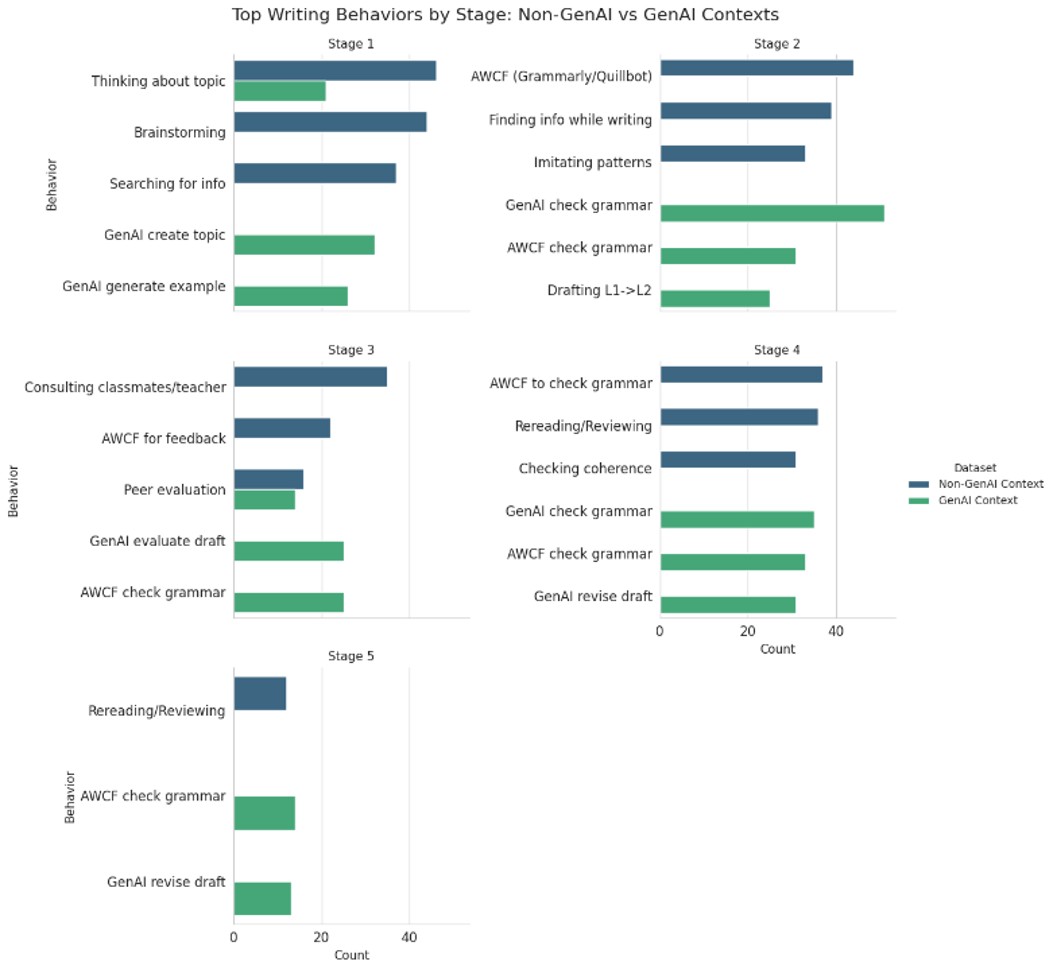
GenAI is a critical factor in the learning behaviors associated with students' writing development. The conventional writing process is based on the principles of writing behaviors and process patterns and comprises four or five phases. There is a scarcity of research investigating changes in students' writing process patterns resulting from the use of AI technologies. The objectives of this study were to explore the impacts of GenAI on writing process patterns and to determine the writing behaviors of Thai EFL undergraduates. The research included a survey of 91 undergraduates who were majoring in English. A descriptive statistic was employed to analyze the quantitative data obtained from an online questionnaire. The qualitative data were analyzed using thematic analysis. The findings showed that most students completed the assignment using a variety of writing process patterns, transitioning from the third, fourth, and fifth patterns to the first and second patterns. The students’ writing behaviors in the planning and composing stages underwent a substantial transition from self-reliance to AI-reliance after the introduction of GenAI. It may be advisable for educators to monitor students' writing progress by gradually prompting them to reflect on their learning with GenAI and to focus on their writing process rather than assessing their writing proficiency.
เอกสารอ้างอิง
Abas, I. H., & Abd Aziz, N. H. (2016). Classification of L2 writing process and writing strategies. Proceedings of the ICECRS, 1(1), 367-380. http://dx.doi.org/10.21070/picecrs.v1i1.505
Aluemalai, K., & Maniam, M. (2020). Writing strategies utilized by successful and unsuccessful ESL undergraduate students in writing classroom. Journal of English Language and Culture, 10(2), 100-110. https://www.researchgate.net/publication/341523861_Writing_Strategies_Utilized_by_Successful_and_Unsuccessful_ESL_Undergraduate_Students_in_Writing_Classroom
Angelova, M. (1999). An exploratory study of factors affecting the process and product of writing in English as a foreign language. [Unpublished doctoral dissertation]. State University of New York.
Arndt, V. (1987). Six writers in search of texts: A protocol-based study of L2 and L2 writing. ELTJournal, 41(4), 257-267. https://doi.org/10.1093/elt/41.4.257
Atkinson, D. (2018). Theory in second language writing. In M. DelliCarpini (ed.), The TESOL Encyclopedia of English Language teaching (pp.1-6). https://doi.org/10.1002/9781118784235.eelt0524
Atlas, S. (2023). ChatGPT for higher education and professional development: A guide to Conversational AI. https://digitalcommons.uri.edu/cba_facpubs/548
Barrett, A., & Pack, A. (2023). Not quite eye to AI: Student and teacher perspectives on the use of generative artificial intelligence in the writing process. International Journal of Educational Technology in Higher Education, 20, 59. https://doi.org/10.1186/s41239-023-00427-0
Barrot, J. S. (2023) Using ChatGPT for second language writing: Pitfalls and potentials. Assessing Writing, 57, 100745. https://doi.org/10.1016/j.asw.2023.100745
Beare, S. (2000). Differences in content generating and planning processes of adult L1 and L2 proficient writers. [Doctoral dissertation, University of Ottawa]. https://ruor.uottawa.ca/server/api/core/bitstreams/ae4d944b-3d58-4a01-a48c-8b62555374f7/content
Chompurach, W. (2021). "Please let me use Google Translate": Thai EFL students' behavior and attitudes toward Google Translate use in English writing. English Language Teaching, 14(12), 23-35. https://doi.org/10.5539/elt.v14n12p23
Clarizia, F., Colace, F., Lombardi, M., Pascale, F., & Santaniello, D. (2018). Chatbot: An education support system for student. In A. Castiglione, F. Pop, M. Ficco & F. Palmieri (eds.), International symposium on Cyberspace Safety and Security (pp.291-302). Springer, Cham. https://doi.org/10.1007/978-3-030-01689-0_23
Fan, N. (2023). Exploring the effects of automated written corrective feedback on EFL students’ writing quality: A mixed methods study. SAGE Open, 13(2), 1-7. https://doi.org/10.1177/21582440231181296
Fyfe, P. (2023). How to cheat on your final paper: Assigning AI for student writing. AI & Society, 38, 1395–1405. https://doi.org/10.1007/s00146-022-01397-z
Gayed, J. M., Carlon, M. K. J., Oriola, A. M., & Cross, J. S. (2022). Exploring an AI-based writing assistant's impact on English language learners. Computers and Education: Artificial Intelligence, 3, 100055, 1-7. https://doi.org/10.1016/j.caeai.2022.100055
George, D., & Mallery, P. (2010). SPSS for Windows step by step: A simple guide and reference 17.0 update (10th ed). Allyn & Bacon.
Graham, S., Bruch, J., Fitzgerald, J., Friedrich, L., Furgeson, J., Greene, K., Kim, J., Lyskawa, J., Olson, C. B., & Wulsin, C. S. (2016). Teaching secondary students to write effectively. National Center for Education Evaluation and Regional Assistance (NCEE), Institute of Education Sciences, U.S. Department of Education. https://ies.ed.gov/ncee/wwc/Docs/PracticeGuide/508_WWCPG_SecondaryWriting_122719.pdf
Harmer, J. (2015). The practice of English language teaching (5th ed.). Pearson Longman.
He, T. H., Chang, S. M., & Chen, S. H. E. (2011). Multiple goals, writing strategies, and written outcomes for college students learning English as a second language. Perceptual and Motor Skills, 112(2), 401-416. https://doi.org/10.2466/11.21.28.PMS.112.2.401-416
Hong, W. C. H. (2023). The impact of ChatGPT on foreign language teaching and learning: Opportunities in education and research. Journal of Education Technology and Innovation, 5(1), 37–45. https://jeti.thewsu.org/index.php/cieti/article/view/103
Huang, H. W., Li, Z., & Taylor, L. (2020). The effectiveness of using Grammarly to improve students' writing skills. In ICDEL 2020: 2020 the 5th International Conference on Distance Education and Learning (pp. 122-127). Association for Computing Machinery. https://doi.org/10.1145/3402569.3402594
Hwang, M., Jeens, R., & Lee, H. K. (2025). Exploring learner prompting behavior and its effect on ChatGPT-assisted English writing revision. The Asia-Pacific Education Researcher, 34, 1157-1167. https://doi.org/10.1007/s40299-024-00930-6
Hyland, K. (2022). Teaching and Researching Writing (4th ed.). Routledge.
Jaboob, M., Hazaimeh, M., & Al-Ansi, A. M. (2024). Integration of GenAI techniquesand applications in student behavior and cognitive achievement in Arab higher education. International Journal of Human–Computer Interaction, 41(1), 353-366. https://doi.org/10.1080/10447318.2023.2300016
Kasneci, E., Sessler, K., Kuchemann, S., Bannert, M., Dementieva, D., Fischer, F., Grasser, U., Groh, G., Günnemann, S., Hüllermeier, E., Krusche, S.,
Kutyniok, G., Michaeli, T., Nerdel, C., Pfeffer, J., Poquet, O., Sailer, M., Schmidt, A., Seiel, T., … Kasneci, G. (2023). ChatGPT for good? On opportunity and challenges of large language models for education. Learning and Individual Differences, 103, 102274. https://doi.org/10.1016/j.lindif.2023.102274
Kim, J., Lee S., Detrick, R., & Wang, J. (2025). Students-Generative AI interaction patterns and its impact on academic writing. Journal of Computing in Higher Education, 38(1), 504-525. https://doi.org/10.1007/s12528-025-09444-6
Kohnke, L., Moorhouse, B. L., & Zou, D. (2023). ChatGPT for language teaching and learning. RELC Journal, 54(2), 537-550. https://doi.org/10.1177/00336882231162868
Krejcie, R. V., & Morgan, D. W. (1970) Determining sample size for research activities. Educational and Psychological Measurement, 30(3), 607-610. https://doi.org/10.1177/001316447003000308
Li, X., Yang, Z., Zhang, J., & Li, Q. (2025). Application of AI tools in education: A quantitative and qualitative analysis of the student writing process. In 2025 5th International Conference on Artificial Intelligence and Education (ICAIE). Institute of Electrical and Electroinics Engineers. https://doi.org/10.1109/ICAIE64856.2025.11158215
Liu, M., Zhang, L. J., & Biebricher, C. (2024). Investigating students’ cognitive processes in GenAI-assisted digital multimodal composing and traditional writing. Computers & Education, 211, 104977. https://doi.org/10.1016/j.compedu.2023.104977
Malik, A. R., Pratiwi, Y., Andajani, K., Numertayasa, I. W., Suharti, S., Darwis, A., & Marzuki (2023). Exploring artificial intelligence in academic essay: Higher education student’s perspective. International Journal of Educational Research Open, 5, 100296. https://doi.org/10.1016/j.ijedro.2023.100296
Marzuki, Widiati, U., Rusdin, Diyenti, D. & Indrawati, I. (2023) The impact of AI writing tools on the content and organization of students’ writing: EFL teachers’ perspective. Cogent Education, 10(2), 2236469, https://doi.org/10.1080/2331186X.2023.2236469
Mizumoto, A., & Eguchi, M. (2023). Exploring the potential of using an AI language model for automated essay scoring. Research Methods in Applied Linguistics, 2(2), 100050. https://doi.org/10.1016/j.rmal.2023.100050
Nopmanotham, N. (2016). A study of writing strategies used by Thai EFL high school students. [Master’s thesis, Thammasat University]. https://doi.org/10.14457/TU.the.2016.1326
Nunan, D., & Choi, J. (2023). Product and process approaches to writing in clarity and coherence in academic writing: Using language as a resource. NY: Routledge.
Oxford, R. L. (1990). Language learning strategies: What every teacher should know. Newbury House.
Rovinelli, R. J., & Hambleton, R. K. (1977). On the use of content specialists in the assessment of criterion-referenced test item validity. Tijdschrift voor Onderwijsresearch, 2(2), 49-60. https://psycnet.apa.org/record/1979-12368-001
Saunders, S. (2023). Rather than ban GenAI, universities must learn from the past. https://www.universityworldnews.com/post.php?story=20230221075136410
Seow, A. (2002). The writing process and process writing. In J. C. Richards & W. A. Renandya (Eds.), Methodology in language teaching: An anthology of current practice (pp. 315–320). Cambridge University Press.
Sheir, A. A., Zahran, F. A. A., & Koura, A. A. (2015). The effectiveness of process writing approach in developing EFL writing performance of ESP college students. Educations Sciences Journal, 23(3), 1-23.
Steele, V. (2004). Product and process writing: A comparison. https://www.teachingenglish.org.uk/professional-development/teachers/knowing-subject/product-and-process-writing-comparison
Vanderpyl, G. D. (2012). The Process approach as writing instruction in EFL (English as a Foreign Language) classrooms [SIT Graduate Institute, Brattleboro]. In MA TESOL Collection. https://digitalcollections.sit.edu/ipp_collection/545/
Yilmaz, R., & Yilmaz, F. G. K. (2023). Augmented intelligence in programming learning: Examining student views on the use of ChatGPT for programming learning. Computers in Human Behavior: Artificial Humans, 1(2), 100005. https://doi.org/10.1016/j.chbah.2023.100005
Zhang, T., Lu, X., Zhu, X., & Zhang, J. (2023). The contributions of AI in the development of ideological and political perspectives in education, Heliyon, 9(3), E13403. https://doi.org/10.1016/j.heliyon.2023.e13403
ดาวน์โหลด
เผยแพร่แล้ว
รูปแบบการอ้างอิง
ฉบับ
ประเภทบทความ
สัญญาอนุญาต
ลิขสิทธิ์ (c) 2026 คณะมนุษยศาสตร์และสังคมศาสตร์ มหาวิทยาลัยราชภัฏพิบูลสงคราม

อนุญาตภายใต้เงื่อนไข Creative Commons Attribution-NonCommercial-NoDerivatives 4.0 International License.
บทความที่ได้รับการตีพิมพ์เป็นลิขสิทธิ์ของคณะมนุษยศาสตร์และสังคมศาสตร์ มหาวิทยาลัยราชภัฏพิบูลสงคราม
บทความหรือข้อคิดใด ๆ ที่ปรากฏในวารสารอักษราพิบูลที่เป็นวรรณกรรมของผู้เขียน บรรณาธิการ หรือ มหาวิทยาลัยราชภัฏพิบูลสงคราม ไม่จำเป็นต้องเห็นด้วย



