อิทธิพลของผลการดำเนินงานด้านสิ่งแวดล้อม สังคม และธรรมาภิบาล (ESG) การปล่อยก๊าซเรือนกระจกและค่าตอบแทนผู้บริหารต่อโอกาสการลงทุน โดยมีต้นทุนเงินทุนเป็นตัวแปรส่งผ่าน สำหรับบริษัทจดทะเบียนในตลาดหลักทรัพย์แห่งประเทศไทย
คำสำคัญ:
ESG , การปล่อยก๊าซเรือนกระจก , ค่าตอบแทนผู้บริหาร , ต้นทุนส่วนของผู้ถือหุ้น , โอกาสในการลงทุนบทคัดย่อ
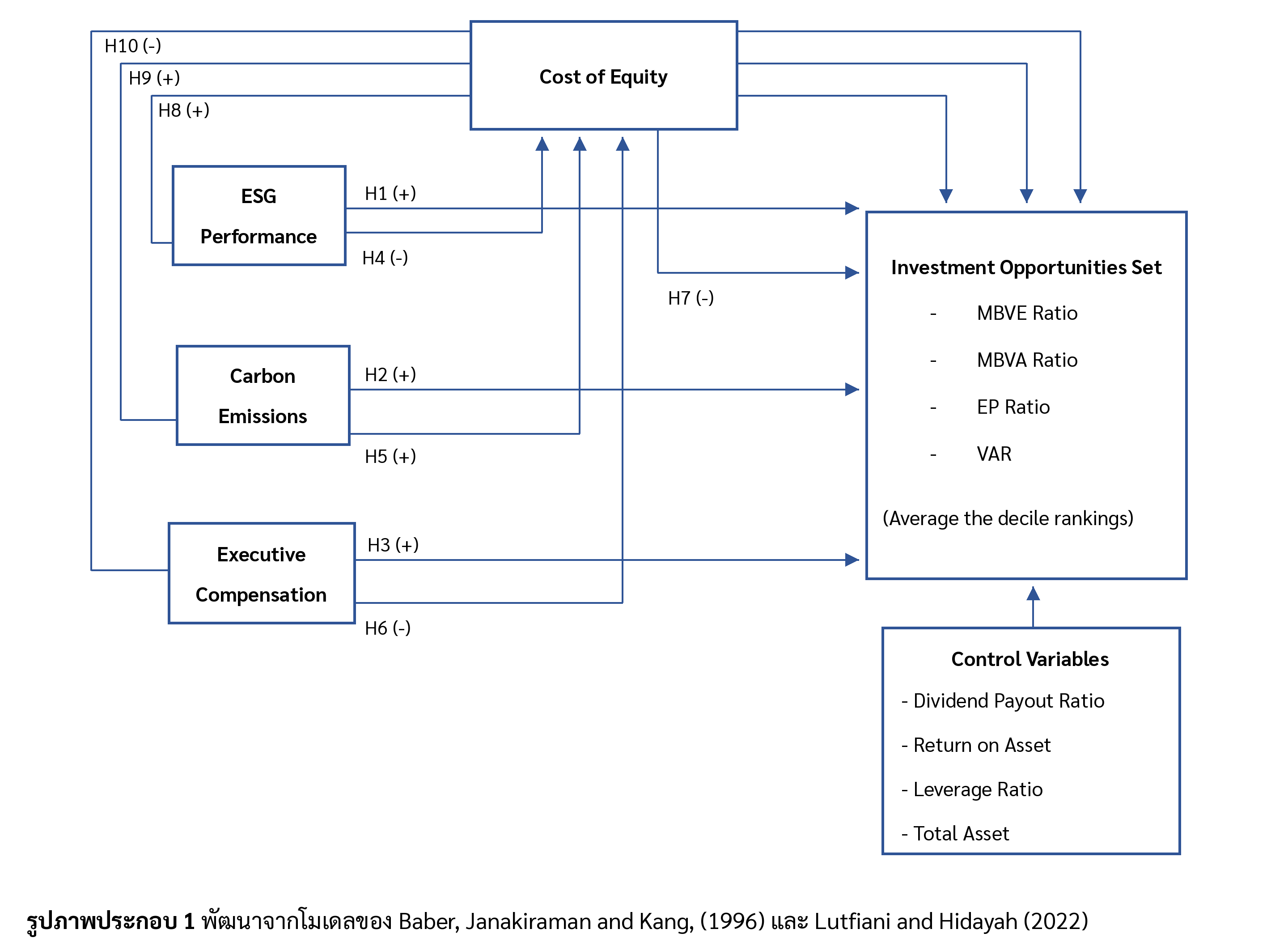
การวิจัยครั้งนี้มีวัตถุประสงค์เพื่อวิเคราะห์อิทธิพลทั้งทางตรงและทางอ้อมของผลการดำเนินงานด้านสิ่งแวดล้อม สังคม และธรรมาภิบาล (Environmental, Social, and Governance: ESG) การปล่อยก๊าซเรือนกระจก และค่าตอบแทนผู้บริหารต่อโอกาสการลงทุน (Investment Opportunity Set: IOS) โดยมีต้นทุนส่วนของผู้ถือหุ้นเป็นตัวแปรส่งผ่าน สำหรับบริษัทจดทะเบียนในตลาดหลักทรัพย์แห่งประเทศไทยที่เปิดเผยข้อมูลด้าน ESG ในฐานข้อมูล Bloomberg ระหว่างปี พ.ศ. 2563–2566 รวมจำนวนตัวอย่างทั้งสิ้น 223 รายปีบริษัท โดยใช้เทคนิคการวิเคราะห์เส้นทาง (Path Analysis)
ผลการศึกษา พบว่า ESG การปล่อยก๊าซเรือนกระจก และค่าตอบแทนผู้บริหารมีอิทธิพลทางบวกต่อโอกาสการลงทุน นอกจากนี้ ESG มีอิทธิพลทางลบต่อต้นทุนส่วนของผู้ถือหุ้น ในขณะที่การปล่อยก๊าซเรือนกระจกมีอิทธิพลทางบวกต่อต้นทุนส่วนของผู้ถือหุ้น ส่วนค่าตอบแทนผู้บริหารไม่พบอิทธิพลต่อต้นทุนส่วนของผู้ถือหุ้น อีกทั้งยังพบว่า ต้นทุนส่วนของผู้ถือหุ้นมีอิทธิพลทางบวกต่อโอกาสการลงทุน สะท้อนว่าต้นทุนส่วนของผู้ถือหุ้นที่สูงขึ้นอาจเป็นผลจากการขยายการลงทุนในโครงการที่มีความเสี่ยงและผลตอบแทนคาดหวังสูงมากกว่าจะเป็นข้อจำกัดต่อการลงทุนในด้านอิทธิพลทางอ้อม พบว่า ESG มีอิทธิพลทางลบต่อโอกาสการลงทุนผ่านต้นทุนส่วนของผู้ถือหุ้น สะท้อนบทบาทของต้นทุนส่วนของผู้ถือหุ้นในฐานะเกณฑ์คัดกรองโครงการลงทุนมากกว่าการเป็นกลไกกระตุ้นการขยายการลงทุนโดยตรง ขณะที่การปล่อยก๊าซเรือนกระจกมีอิทธิพลทางบวกต่อโอกาสการลงทุนผ่านต้นทุนส่วนของผู้ถือหุ้น โดยสะท้อนการลงทุนเชิงรุกของบริษัทเพื่อปรับตัวต่อความเสี่ยงจากการเปลี่ยนผ่านสู่เศรษฐกิจคาร์บอนต่ำ อย่างไรก็ตาม ไม่พบอิทธิพลทางอ้อมของค่าตอบแทนผู้บริหารต่อโอกาสการลงทุนผ่านต้นทุนส่วนของผู้ถือหุ้น ผลการศึกษาชี้ให้เห็นบทบาทของ ESG และการปล่อยก๊าซเรือนกระจกในการกำหนดต้นทุนส่วนของผู้ถือหุ้นและโอกาสการลงทุน ขณะเดียวกันสามารถนำไปใช้ในการบริหารความเสี่ยงและสนับสนุนการพัฒนานโยบายด้านการเงินและการลงทุนอย่างยั่งยืนได้
Downloads
เอกสารอ้างอิง
กริช แรงสูงเนิน. (2554). การวิเคราะห์ปัจจัยด้วย SPSS และ AMOS เพื่อการวิจัย. กรุงเทพฯ: ซีเอ็ดยูเคชั่น.
จันทร์เพ็ญ ธงไชย และสายเพชร อักโข. (2568). รางวัลการดำเนินธุรกิจอย่างยั่งยืนและมูลค่ากิจการ: หลักฐานจากบริษัทจดทะเบียนในตลาดหลักทรัพย์แห่งประเทศไทย. วารสารการบัญชีและการจัดการ มหาวิทยาลัยมหาสารคาม, 17(2), 30-48.
เจณิสตา มะละกา จิรัฐติกาล วุฒิพันธุ์ เดชอนันต์ บังกิโล และธนภณ วิมูลอาจ. (2567). ความสัมพันธ์ระหว่างระดับความรับผิดชอบด้านสิ่งแวดล้อม สังคมและธรรมาภิบาล (ESG) กับผลการดำเนินงานของบริษัทจดทะเบียนในตลาดหลักทรัพย์แห่งประเทศไทยในช่วงสถานการณ์การระบาดของโควิด-19. วารสารการบัญชีและการจัดการ, 16(2), 46-63.
พรพิชชา พรหมประสิทธิ์. (2565). ความสัมพันธ์ระหว่างความรับผิดชอบด้านสิ่งแวดล้อม สังคม และบรรษัทภิบาลขององค์กร (ESG) กับโอกาสการเติบโตของบริษัทจดทะเบียนในตลาดหลักทรัพย์แห่งประเทศไทย. [การค้นคว้าอิสระปริญญา บริหารธุรกิจมหาบัณฑิต, มหาวิทยาลัยธรรมศาสตร์].
องค์การบริหารจัดการก๊าซเรือนกระจก (องค์การมหาชน). (2565). คู่มือตัวชี้วัดและเกณฑ์การประเมินธุรกิจคาร์บอนต่ำและยั่งยืน. กรุงเทพฯ: องค์การบริหารจัดการก๊าซเรือนกระจก (องค์การมหาชน).
Adam, T., & Goyal, V. K. (2007). The Investment Opportunity Set and its Proxy Variables. Journal of Financial Research, 31(1), 41–63.
Albuquerque, A. M., DeAngelis, D., & Sutherland, A. (2024). How Large is the Pay Premium from Executive Incentive Compensation?. The Accounting Review, 99(5), 1-30.
Baber, W. R., Janakiraman, S. N., & Kang, S. H. (1996). Investment Opportunities and the Structure of Executive Compensation. Journal of Accounting and Economics, 21(3), 297-318.
Bani Ismail, M., & Ismaeel, B. (2025). The Cost of Equity Capital and Investment Sensitivity to the Cash Flow: Evidence from Jordanian Industrial Companies. Future Business Journal, 11(1), 1–15.
Baron, R. M., & Kenny, D. A. (1986). The Moderator-Mediator Variable Distinction in Social Psychological Research: Conceptual, Strategic, and Statistical Considerations. Journal of Personality and Social Psychology, 51(6), 1173-1182.
Bebchuk, L. A., Fried, J. M., & Walker, D. I. (2002). Managerial Power and Rent Extraction in the Design of Executive Compensation. University of Chicago Law Review, 69(3), 751–846.
Berk, J. B., & van Binsbergen, J. H. (2025). The impact of impact investing. Journal of Financial Economics, 164, 103972. https://doi.org/10.1016/j.jfineco.2024.103972
Botosan, C. A. (1997). Disclosure Level and The Cost of Equity Capital. The Accounting Review, 72(3), 323–349.
Botosan, C. A., & Plumlee, M. A. (2005). Assessing Alternative Proxies for the Expected Risk Premium. The Accounting Review, 80(1), 21-53.
Bucchetti, B., Arduino, F. R., & Perdichizzi, S. (2025). A Literature Review on Corporate Governance and ESG Research: Emerging Trends and Future Directions. International Review of Financial Analysis, 97.
Cai, X., Li, Y., & Zhang, X.-Y. (2024). CEO Labor Market Incentives and Cost of Equity Capital. Conference Paper. European Financial Management Association (EFMA) 2024 Annual Meeting, Lisbon, Portugal.
Chung, K. H., & Charoenwong, C. (1991). Investment options, Assets in Place, and the Risk of Stocks. Financial Management, 20(3), 21–33.
Core, J. E., Holthausen, R. W., & Larcker, D. F. (1999). Corporate Governance, Chief Executive Officer Compensation, and Firm Performance. Journal of Financial Economics, 51(3), 371–406.
Dhaliwal, D. S., Li, O. Z., Tsang, A., & Yang, Y. G. (2011). Voluntary Nonfinancial Disclosure and the Cost of Equity Capital. The Accounting Review, 86(1), 59-100.
Di Febo, E. (2025). Correction: Di Febo (2025). Transition Risk in Climate Change: A Literature Review. Risks, 13(7), 139.
Dincergok, B., & Pirgaip, B. (2025). Financial Constraints and the ESG-Firm Performance Nexus in the Automotive Industry: Evidence from A Global Panel Study. Sustainability, 17(15), 6985.
Durbin, J., & Watson, G. S. (1951). Testing for Serial Correlation in Least Squares Regression. Biometrika, 38(1-2), 159-178.
Easley, D., & O’Hara, M. (2004). Information and The Cost of Capital. The Journal of Finance, 59(4), 1553–1583.
Esqueda, O. A., & O’Connor, T. (2024). The Cost of Equity to Earnings Yield Differential and Dividend Policy. Managerial Finance, 50(2), 451-471.
Fama, E. F., & French, K. R. (2004). The Capital Asset Pricing Model: Theory and Evidence. Journal of Economic Perspectives, 18(3), 25-46.
Fama, E. F., & Jensen, M. C. (1983). Separation of Ownership and Control. Journal of Law and Economics, 26(2), 301-325.
Fernando, Y., Halili, H., Tseng, M. L., Tseng, J. W., & Lim M. K. (2022). Sustainable Social Supply Chain Practices and Firm Social Performance: Framework and Empirical Evidence. Sustainable Production and Consumption, 32, 160-172.
Field, A. (2017). Discovering Statistics Using IBM SPSS Statistics. (5th ed.). Andy Field: Sage.
Frank, M. Z., & Shen, T. (2016). Investment and The Weighted Average Cost of Capital. Journal of Financial Economics, 119(2), 300-315.
Gang, W., & Hongrui, Z. (2025). Research on the Impact of Cost of Equity Capital on Firm New Quality Productive Forces in China. Total Quality Management & Business Excellence, 36(7-8), 617-639.
Gaver, J. J., & Gaver, K. M. (1993). Additional Evidence on the Association between the Investment Opportunity Set and Corporate Financing, Dividend, and Compensation Policies. Journal of Accounting and Economics, 16(1-3), 125-160.
Gerayli, M. S., Pitenoei, Y. R., & Abdollahi, A. (2021). Do Audit Committee Characteristics Improve Financial Reporting Quality in Emerging Markets? Evidence from Iran. Asian Review of Accounting, 29(2), 251-267.
Goncalves, T. C., Dias, J., & Barros, V. (2022). Sustainability Performance and the Cost of Capital. International Journal of Financial Studies, 10(3), 63.
Gormsen, N. J., & Huber, K. (2024). Firms’ Perceived Cost of Capital. Conference: National Bureau of Economic Research, Chicago.
Groth, J. C., & Anderson, R. C. (1997). Capital Structure: Perspectives for Managers. Management Decision, 5(7), 552-561.
Hair, J. F., Black, W. C., Babin, B. J., & Anderson, R. E. (2010). Multivariate Data Analysis (7th ed.). New York: Pearson Education.
Hair, J.F., Howard, M.C., & Nitzl, C. (2020) Assessing Measurement Model Quality in PLS-SEM Using Confirmatory Composite Analysis. Journal of Business Research, 109, 101-110.
Hao, Y., & Wu, W. (2024). Environment, Social, and Governance Performance and Corporate Financing Constraints. Finance Research Letters, 62(P A).
Hayes, A. F. (2013). Introduction to Mediation, Moderation, and Conditional Process Analysis: A Regression-Based Approach. New York: The Guilford Press.
Henriques, A., & Richardson, J. (Eds.). (2013). The Triple Bottom Line: Does it All Add Up? Assessing the Sustainability of Business and CSR. Barcelona: Earthscan.
Hikmah, K., Satmoko, A., Sudaryatie, S., & Nasrulloh, R. S. (2023). Investment opportunity set (IOS) in mediating company advantage to funding policies in LQ45-indexed companies. International Journal of Current Science Research and Review, 6(5). https://doi.org/10.47191/ijcsrr/V6-i5-09
Hinkle, D. E., Wiersma, W., & Jurs, S. G. (1998). Applied Statistics for the Behavioral Sciences (4th ed.). Chicago: Rand McNally College Publishing.
Hossain, A., Masum, A. A., Saadi, S., Benkraiem, R., & Das, N. (2023). Firm-Level Climate Change Risk and CEO Equity Incentives. British Journal of Management, 34(3), 1387-1419.
Hussain, I., Zhonggen, S., Aman, J., & Alam, S. (2025). Impact of Environmental, Social, and Governance Risks and Mitigation Strategies of Innovation and Sustainable Practices of Host Country on Project Performance of CPEC. Sustainability, 17(15), 6861.
Jafar, R., Basuki, B., Windijarto, W., Setiawan, R., & Yaacob, Z. (2024). Environmental, Social and Governance (ESG) Disclosure and Cost of Equity: The Moderating Effects of Board Structures. Cogent Business and Management, 11(1), 1-20.
Jensen, M. C., & Meckling, W. H. (1976). Theory of the Firm: Managerial Behavior, Agency Costs and Ownership Structure. Journal of Financial Economics, 3(4), 305-360.
Johnson, H. (1999). Determining Cost of Capital: The Key to Firm Value. Australia: Financial Times.
Kallapur, S., & Trombley, M. A. (2001). The Investment Opportunity Set: Determinants, Consequences and Measurement. Managerial Finance, 27(3), 3-15.
Khan, H., Metaxoglou, K., Knittel, C. R., & Papineau, M. (2019). Carbon emissions and business cycles. Journal of Macroeconomics, 60, 1–19. https://doi.org/10.1016/j.jmacro.2019.01.005
Kester, W. C. (1984). Today’s Options for Tomorrow’s Growth. Harvard Business Review, 62(2), 153-160.
Kraus, A., & Litzenberger, R. H. (1973). A State-Preference Model of Optimal Financial Leverage. The Journal of Finance, 28(4), 911-922.
Kumar, M., & Purnanandam, A. (2022, November 17). Carbon Emissions and Shareholder Value: Causal Evidence from the U.S. Power Utilities. SSRN.
Lambert, R., Leuz, C., & Verrecchia, R. E. (2007). Accounting Information, Disclosure, and the Cost of Capital. Journal of Accounting Research, 45(2), 385-420.
Li, H., Henry, D., & Chou, H. I. (2011). Stock Market Mispricing, Executive Compensation and Corporate Investment: Evidence from Australia. Journal of Behavioral Finance, 12(3), 131-140.
Lutfiani, A. P., & Hidayah, R. (2022). ESG Performance and Ownership Structure on Cost of Capital and Research & Development Investment. Fokus Bisnis: Media Pengkajian Manajemen dan Akuntansi, 21(1), 25-42.
Machmuddah, Z., & Wardhani, A. (2020). Environmental, Social, Governance (ESG) Disclosure Score Rating of Bloomberg. Proceedings of the 1st International Conference on Science, Health, Economics, Education and Technology (ICoSHEET 2019).
Makni Fourati, Y., & Dammak, M. (2021). Corporate Social Responsibility and Financial Performance: International Evidence of the Mediating Role of Reputation. Corporate Social Responsibility and Environmental Management, 28(6), 1749 – 1759.
Modigliani, F., & Miller, M. H. (1958). The Cost of Capital, Corporation Finance and the Theory of Investment. American Economic Review, 48(3), 261-297.
Modigliani, F., & Miller, M. H. (1963). Corporate Income Taxes and the Cost of Capital: A Correction. American Economic Review, 53(3), 433-443.
Myers, S. C. (1977). Determinants of Corporate Borrowing. Journal of Financial Economics, 5(2), 147-175.
Nuanpradit, S. (2014). Accounting Conservatism and Future Investment Opportunities [Doctoral Dissertation, Chulalongkorn University]. http://doi.org/10.14457/CU.the.2014.30
Pedersen, L. H. (2023). Carbon Pricing Versus Green Finance. Journal of Finance. 1-52.
Pei, J. (2024). A Study of Executive Compensation Incentives and Firm Performance. Highlights in Business, Economics and Management, 24(2024), 338 – 343.
Penman, S. H. (1996). The Articulation of Price-Earnings Ratios and Market-to-Book Ratios and the Evaluation of Growth. Journal of Accounting Research, 34(2), 235-259.
Perfect, S. B., & Wiles, K. W. (1994). Alternative Constructions of Tobin’s Q: An Empirical Comparison. Journal of Empirical Finance, 1(3-4), 313-341.
Phuong, T. T. (2024). Managerial Compensation, Agency Costs, and Corporate Governance Interplay. Corporate Board: Role, Duties and Composition, 20(2), 34-41.
Pindyck, R. S. (1988). Irreversible Investment, Capacity Choice, and the Value of the Firm. American Economic Review, 78(5), 969-985.
Preacher, K. J., & Hayes, A. F. (2008). Asymptotic and Resampling Strategies for Assessing and Comparing Indirect Effects in Multiple Mediator Models. Behavior Research Methods, 40(3), 879-891.
Principles for Responsible Investment. (2025). Annual Report 2025. Principles for Responsible Investment. https://www.unpri.org/about-PRI/annual-report?utm_source=chatgpt.com
Rahat, B., & Nguyen, P. (2024). The Impact of ESG Profile on Firm’s Valuation in Emerging Markets. International Review of Financial Analysis, 95(Part A).
Sahin, O., Bax, K., Czado, C., & Paterlini, S. (2022). Environmental, Social, Governance Scores and the Missing Pillar-Why does Missing Information Matter?. Corporate Social Responsibility and Environmental Management, 29(5), 1782-1798.
Salvi, A., Petruzzella, F., Raimo, N., & Vitolla, F. (2024). Exploring the Impact of Sustainability Disclosure on the Cost of Equity Capital in the Hospitality and Tourism Industry. International Journal of Managerial and Financial Accounting, 16(2), 139-158.
Sanchez-Marín, G., Lucas-Perez, M. E., Baixauli-Soler, J. S., Main, B. G. M., & Minguez-Vera, A. (2022). Excess Executive Compensation and Corporate Governance in the United Kingdom and Spain: A Comparative Analysis. Managerial and Decision Economics, 43(7), 2817-2837.
Sanoran, K. (Lek). (2022). Transmission Mechanisms of Executive Compensation to Cost of Equity Capital. Global Business & Finance Review, 27(4), 108-117.
Sharpe, W. F. (1964). Capital Asset Prices: A Theory of Market Equilibrium Under Conditions of Risk. The Journal of Finance, 19(3), 425-442.
Smith, C. W., Jr., & Watts, R. L. (1992). The Investment Opportunity Set and Corporate Financing, Dividend, and Compensation Policies. Journal of Financial Economics, 32(3), 263-292.
Sudi y atno, B., Sudarsi, S., Hartoto, W. E., & Fitriati, I. R. (2023). Does capital structure moderate the impact of the investment opportunity set and institutional ownership on firm value? Investment Management and Financial Innovations, 20(2), 79–88. https://doi.org/10.21511/imfi.20(2).2023.07
Tanjung, M. (2023). Cost of Capital and Firm Performance of ESG Companies: What Can We Infer from COVID-19 Pandemic?. Sustainability Accounting, Management and Policy Journal, 14(6), 1242-1267.
The Stock Exchange of Thailand. (2023). SET Announces Sustainable Stock Evaluation Results: 193 Companies Receive SET ESG Ratings [News Release]. Retrieved November 6, 2023, from https://www.set.or.th/th/about/mediacenter/news-release/article/366-setesg
Tobin, J. (1969). A General Equilibrium Approach to Monetary Theory. Journal of Money, Credit and Banking, 1(1), 15-29.
Trinks, A., Ibikunle, G., Mulder, M., & Scholtens, B. (2022). Carbon Intensity and the Cost of Equity Capital. The Energy Journal, 43(2), 181-214.
Wang, Y., Shen, S., Xie, J., Fujii, H., Keeley, A. R., & Managi, S. (2024). How Corporate Climate Change Mitigation Actions Affect the Cost of Capital. Corporate Social Responsibility and Environmental Management, 31(6), 5139-5154.
West, S. G., Finch, J. F., & Curran, P. J. (1995). Structural Equation Models with Nonnormal Variables: Problems and Remedies. In R. H. Hoyle (Ed.), Structural Equation Modeling: Concepts, Issues, and Applications (pp. 56-75). Sage Publications, Inc.
Yan, J., Guo, Y., & Wen, F. (2025). Carbon Risk and the Cost of Equity Capital: Evidence from China. International Review of Economics & Finance, 99.
Zhang, J. (2025). Corporate Carbon Emissions and Market Value. Scientific Reports, 15, 30593.
ดาวน์โหลด
เผยแพร่แล้ว
รูปแบบการอ้างอิง
ฉบับ
ประเภทบทความ
สัญญาอนุญาต
ลิขสิทธิ์ (c) 2026 วารสารการบัญชีและการจัดการ

อนุญาตภายใต้เงื่อนไข Creative Commons Attribution-NonCommercial-NoDerivatives 4.0 International License.
บทความที่ได้รับการตีพิมพ์เป็นลิขสิทธิ์ของวารสารการบัญชีและการจัดการ
ข้อความที่ปรากฏในบทความแต่ละเรื่องในวารสารวิชาการเล่มนี้เป็นความคิดเห็นส่วนตัวของผู้เขียนแต่ละท่านไม่เกี่ยวข้องกับมหาวิทยาลัยมหาสารคาม และคณาจารย์ท่านอื่นๆในมหาวิทยาลัยฯ แต่อย่างใด ความรับผิดชอบองค์ประกอบทั้งหมดของบทความแต่ละเรื่องเป็นของผู้เขียนแต่ละท่าน หากมีความผิดพลาดใดๆ ผู้เขียนแต่ละท่านจะรับผิดชอบบทความของตนเองแต่ผู้เดียว