โมเดลเชิงสาเหตุของปัจจัยขับเคลื่อนความภักดีของลูกค้าในการไลฟ์สตรีมมิ่งคอมเมิร์ซ
คำสำคัญ:
ไลฟ์สตรีมมิ่งคอมเมิร์ซ, ความภักดีของลูกค้า, การโต้ตอบแบบเรียลไทม์, ความเชี่ยวชาญของสตรีมเมอร์บทคัดย่อ
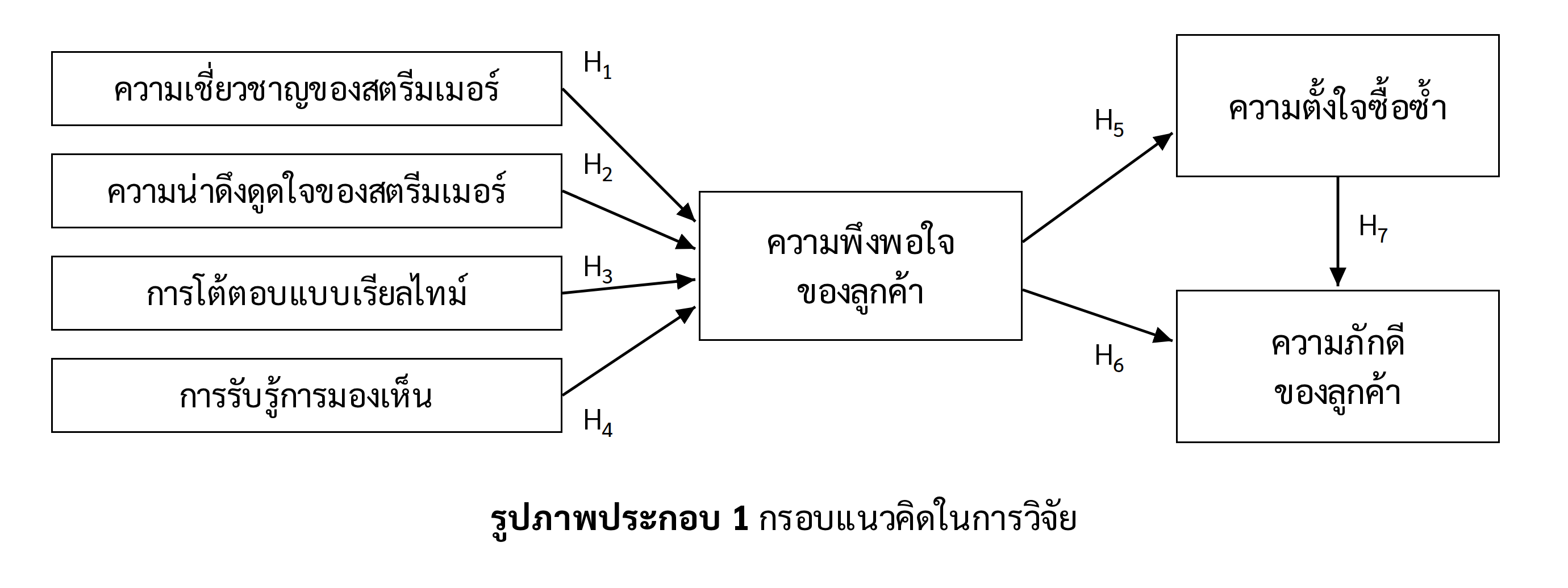
การวิจัยนี้มีวัตถุประสงค์เพื่อศึกษา 1) ปัจจัยที่มีอิทธิพลต่อความพึงพอใจของลูกค้าในการไลฟ์สตรีมมิ่งคอมเมิร์ซ และ2) อิทธิพลของความพึงพอใจของลูกค้าในการไลฟ์สตรีมมิ่งคอมเมิร์ซต่อความตั้งใจซื้อซ้ำและความภักดีของลูกค้า กลุ่มตัวอย่างเป็นผู้บริโภคชาวไทยที่มีประสบการณ์ในการซื้อสินค้าประเภทเสื้อผ้าและเครื่องแต่งกายผ่านการไลฟ์สตรีมมิ่งคอมเมิร์ซบนแพลตฟอร์มติ๊กต็อก จำนวน 400 คน สุ่มตัวอย่างแบบเจาะจง ใช้แบบสอบถามเป็นเครื่องมือในการเก็บรวบรวมข้อมูล และวิเคราะห์โมเดลสมการโครงสร้าง (SEM) ด้วยโปรแกรม AMOS ผลการวิจัยพบว่า ความเชี่ยวชาญของสตรีมเมอร์และการโต้ตอบแบบเรียลไทม์ ล้วนมีอิทธิพลต่อความพึงพอใจของลูกค้าในการไลฟ์สตรีมมิ่งคอมเมิร์ซ โดยการโต้ตอบแบบเรียลไทม์เป็นปัจจัยที่มีอิทธิพลมากที่สุด นอกจากนี้ ความพึงพอใจของลูกค้ายังมีอิทธิพลต่อความตั้งใจในการซื้อซ้ำและความภักดีของลูกค้า เช่นเดียวกับความตั้งใจในการซื้อซ้ำมีบทบาทในการเสริมสร้างความภักดีของลูกค้าในการไลฟ์สตรีมมิ่งคอมเมิร์ซ โมเดลสามารถอธิบายความแปรปรวนของความภักดีของลูกค้าได้ร้อยละ 31.2 (R2 = 0.312) ผลการวิจัยนี้สามารถใช้เป็นแนวทางกำหนดนโยบายขับเคลื่อนเศรษฐกิจดิจิทัล โดยภาครัฐควรส่งเสริมการพัฒนาทักษะผู้ประกอบการและยกระดับมาตรฐานการไลฟ์สตรีมมิ่งคอมเมิร์ซเพื่อเพิ่มประสิทธิภาพตลาดออนไลน์
Downloads
เอกสารอ้างอิง
ลภัสวัฒน์ ศุภผลกุลนันทร์. (2568). อิทธิพลของนวัตกรรมบริการ คุณภาพสินค้า และการตลาดแบบครบวงจรต่อความภักดีผ่านบทบาทของความเชื่อมั่นในตราสินค้าและความพึงพอใจ. วารสารการจัดการธุรกิจ มหาวิทยาลัยบูรพา, 14(1), 116–133. https://so01.tci-thaijo.org/index.php/BJBM/article/view/277878
Adibah, R., & Sufiati, M. (2024). Analysis of purchasing intention in the fashion industry: Enhancing product sales through live commerce streaming. International Journal of Current Science Research and Review, 7(3), 1948-1965. https://doi.org/10.47191/ijcsrr/V7-i3-57
Algharabat, R., Rana, N. P., Dwivedi, Y. K., Alalwan, A. A., & Qasem, Z. (2018). The effect of telepresence, social presence and involvement on consumer brand engagement: An empirical study of non-profit organizations. Journal of Retailing and Consumer Services, 40, 139-149. https://doi.org/10.1016/j.jretconser.2017.09.011
Bao, Z., & Zhu, Y. (2023). Understanding customers’ stickiness of live streaming commerce platforms: an empirical study based on modified e-commerce system success model. Asia Pacific Journal of Marketing and Logistics, 35(3), 775-793. https://doi.org/10.1108/apjml-09-2021-0707
Barich, H., & Kotler, P. (1991). A framework for marketing image management. MIT Sloan Management Review, 32(2), 94-104.
Bygstad, B., Munkvold, B. E., & Volkoff, O. (2016). Identifying Generative Mechanisms through Affordances: A Framework for Critical Realist Data Analysis. Journal of Information Technology, 31(1), 83-96. https://doi.org/10.1057/jit.2015.13
Cabiddu, F., Carlo, M. D., & Piccoli, G. (2014). Social media affordances: Enabling customer engagement. Annals of Tourism Research, 48, 175-192. https://doi.org/10.1016/j.annals.2014.06.003
Cai, J., & Wohn, D. Y. (2019). Live Streaming Commerce: Uses and Gratifications Approach to Understanding Consumers' Motivations. Proceedings of the 52nd Hawaii International Conference on System Sciences (pp. 2548–2557). IEEE Computer Society. https://doi.org/10.24251/HICSS.2019.307
Cai, J., Wohn, D. Y., Mittal, A., & Sureshbabu, D. (2018). Utilitarian and Hedonic Motivations for Live Streaming Shopping. Proceedings of the 2018 ACM International Conference on Interactive Experiences for TV and Online Video (pp. 81–88). ACM. https://doi.org/10.1145/3210825.3210837
Chandraa, M., Sukmaningsih, D. W., & Sriwardiningsih, E. (2024). The Impact of Live Streaming On Purchase Intention In Social Commerce In Indonesia. Procedia Computer Science, 234, 987-995. https://doi.org/10.1016/j.procs.2024.03.088
Chen, H., Dou, Y., & Xiao, Y. (2023). Understanding the role of live streamers in live-streaming e-commerce. Electronic Commerce Research and Applications, 59, 101266. https://doi.org/10.1016/j.elerap.2023.101266
Chen, J., & Liao, J. (2022). Antecedents of Viewers’ Live Streaming Watching: A Perspective of Social Presence Theory. Frontiers in Psychology, 13, 839629. https://doi.org/10.3389/fpsyg.2022.839629
Cochran, W. G. (1977). Sampling Techniques (3rd ed.). John Wiley & Sons.
Cronbach, L. J. (1951). Coefficient Alpha and the Internal Structure of Tests. Psychometrika, 16(3), 297-334.
Fornell, C., & Larcker, D. F. (1981). Evaluating Structural Equation Models with Unobservable Variables and Measurement Error. Journal of Marketing Research, 18(1), 39-50. https://doi.org/10.2307/3151312
Gibson, J. J. (1977). The theory of affordances. In Perceiving, acting, and knowing: Toward an ecological psychology (pp. 67-82). Lawrence Erlbaum Associates.
Guo, L., Hu, X., Lu, J., & Ma, L. (2021). Effects of Customer Trust on Engagement in Live Streaming Commerce: Mediating Role of Swift Guanxi. Internet Research, 31(5), 1718-1744. https://doi.org/10.1108/INTR-02-2020-0078
Guo, Y., Zhang, K., & Wang, C. (2022). Way to success: Understanding top streamer's popularity and influence from the perspective of source characteristics. Journal of Retailing and Consumer Services, 64, 102786. https://doi.org/10.1016/j.jretconser.2021.102786
Hair, J. F., Anderson, R. E., Babin, B. J., & Black, W. C. (2010). Multivariate Data Analysis A Global Perspective (7th ed.). Pearson.
He, W., & Jin, C. (2024). A study on the influence of the characteristics of key opinion leaders on consumers’ purchase intention in live streaming commerce: based on dual-systems theory. Electronic Commerce Research, 24, 1235-1265. https://doi.org/10.1007/s10660-022-09651-8
He, Y., Li, W., & Xue, J. (2022). What and how driving consumer engagement and purchase intention in officer live streaming? A two-factor theory perspective. Electronic Commerce Research and Applications, 56, 101223. https://doi.org/10.1016/j.elerap.2022.101223
Heo, J., Kim, Y., & Yan, J. (2020). Sustainability of Live Video Streamer’s Strategies: Live Streaming Video Platform and Audience’s Social Capital in South Korea. Sustainability, 12(5), 1969. https://doi.org/10.3390/su12051969
Jiang, Z., Wang, H., Xue, J., & Zhai, T. (2022). Propelling Consumer Engagement via Entrepreneurs' Live Streaming? Frontiers in Psychology, 13, 890707. https://doi.org/10.3389/fpsyg.2022.890707
Kang, K., Lu, J., Guo, L., & Li, W. (2021). The dynamic effect of interactivity on customer engagement behavior through tie strength: Evidence from live streaming commerce platforms. International Journal of Information Management, 56. https://doi.org/10.1016/j.ijinfomgt.2020.102251
Kim, J., & Lee, K. H. (2019). Influence of integration on interactivity in social media luxury brand communities. Journal of Business Research, 99, 422-429. https://doi.org/10.1016/j.jbusres.2017.10.001
Kim, M. (2022). How can I Be as attractive as a Fitness YouTuber in the era of COVID-19? The impact of digital attributes on flow experience, satisfaction, and behavioral intention. Journal of Retailing and Consumer Services, 64, 102778. https://doi.org/10.1016/j.jretconser.2021.102778
Koroleva, K., & Kane, G. C. (2017). Relational affordances of information processing on Facebook. Information & Management, 54(5), 560-572. https://doi.org/10.1016/j.im.2016.11.007
Kotler, P. (2005). The Role Played by the Broadening of Marketing Movement in the History of Marketing Thought. Journal of Public Policy & Marketing, 24(1), 114-116. https://doi.org/10.1509/jppm.24.1.114.63903
Labinskyi, A. (2022). The Livestream Shopping Revolution: How to Join E-commerce’s Essential Sales Strategy. Retrieved March 31, 2025, from https://www.forbes.com/sites/forbesbusinesscouncil/2022/02/16/the-livestream-shopping-revolution-how-to-join-e-commerces-essential-sales-strategy
Lee, C. H., & Chen, C. W. (2021). Impulse buying behaviors in live streaming commerce based on the stimulus-organism-response framework. Information, 12(6), 241. https://doi.org/10.3390/info12060241
Li, J., & Lee, G. (2024). The Role of Broadcasters and Brand Image in Improving Consumer Loyalty—Evidence From Live Streaming on Chinese Social Platforms. SAGE Open, 14(1), 1-15. https://doi.org/10.1177/21582440241239457
Meng, L., Duan, S., Zhao, Y., Lü, K., & Chen, S. (2021). The Impact of Online Celebrity in Livestreaming E-commerce on Purchase Intention from the Perspective of Emotional Contagion. Journal of Retailing and Consumer Services, 63. https://doi.org/10.1016/j.jretconser.2021.102733
Moksony, F. (1990). Small is Beautiful. The Use and Interpretation of R2 in Social Research. Szociologiai Szemle, Special issue, 130-138.
Nisar, T. M., & Prabhakar, G. (2017). What Factors Determine E-satisfaction and Consumer Spending in E-commerce Retailing? Journal of Retailing and Consumer Services, 39, 135-144. https://doi.org/10.1016/j.jretconser.2017.07.010
Phan, L.-G. N., Tri, D. Q., Dang, S.-H., & Nguyen, L.-T. (2026). Hooked on Livestreaming: What Drives Customer Repurchase Intention in E-Commerce? Journal of Creative Communications, 21(1), 99-118. https://doi.org/10.1177/09732586241311001
Putsom, W., & Ngamsutti, S. (2025). Factors Influencing Purchase Behavior and Loyalty Among Showrooming and Webrooming Online Shoppers. Journal of Accountancy and Management, 17(4), 148-169. https://so02.tci-thaijo.org/index.php/mbs/article/view/279780
Rovinelli, R. J., & Hambleton, R. K. (1977). On the Use of Content Specialists in the Assessment of Criterion-Referenced Test Item Validity. Tijdschrift Voor Onderwijs Research, 2(2), 49-60.
Sah, T. (2024). Driving Millennial Satisfaction in L-Commerce: Perceived Price Advantage, Real-Time Interactivity, and Perceived Visibility as Key Factors. Journal of Applied Business Administration, 8(1), 14-28. https://doi.org/10.30871/jaba.v8i1.7325
Shobeiri, S., Mazaheri, E., & Laroche, M. (2018). Creating the right customer experience online: The influence of culture. Journal of Marketing Communications, 24(3), 270-290. https://doi.org/10.1080/13527266.2015.1054859
Statista Research. (2025a). Live commerce - statistics & facts. Retrieved September 20, 2025, from https://www.statista.com/topics/8752/livestream-commerce/#topicOverview
Statista Research. (2025b). Social commerce in Thailand - statistics & facts. Retrieved May 20, 2025, from https://www.statista.com/topics/9711/social-commerce-in-thailand/#topicOverview
Steinhoff, L., Arli, D., Weaven, S., & Kozlenkova, I. V. (2019). Online Relationship Marketing. Journal of the Academy of Marketing Science, 47, 369-393. https://doi.org/10.1007/s11747-018-0621-6
Sun, Y., Shao, X., Li, X., Guo, Y., & Nie, K. (2019). How live streaming influences purchase intentions in social commerce: An IT affordance perspective. Electronic Commerce Research and Applications, 37. https://doi.org/10.1016/j.elerap.2019.100886
Tabachnick, B. G., & Fidell, L. S. (2013). Using Multivariate Statistics. Pearson.
Treem, J. W., & Leonardi, P. M. (2013). Social Media Use in Organizations: Exploring the Affordances of Visibility, Editability, Persistence, and Association. Communication Yearbook, 36(1), 143-189. https://doi.org/10.1080/23808985.2013.11679130
Volkoff, O., & Strong, D. M. (2013). Critical Realism and Affordances: Theorizing IT-Associated Organizational Change Processes1. Management Information Systems Quarterly, 37(3), 819-834. https://doi.org/10.25300/misq/2013/37.3.07
Wang, Q., Li, X., Yan, X., & Li, R. (2024). How to enhance consumers’ purchase intention in live commerce? An affordance perspective and the moderating role of age. Electronic Commerce Research and Applications, 67, 101438. https://doi.org/10.1016/j.elerap.2024.101438
Wimolsophonkitti, P., & Naipinit, A. (2024). Drivers and performance impacts of live streaming commerce adoption: Revolutionizing the e-commerce supply chain. Uncertain Supply Chain Management, 12(3), 1479-1492. https://doi.org/10.5267/j.uscm.2024.4.003
Wongkitrungrueng, A., & Assarut, N. (2020). The role of live streaming in building consumer trust and engagement with social commerce sellers. Journal of Business Research, 117, 543-556. https://doi.org/10.1016/j.jbusres.2018.08.032
Wongkitrungrueng, A., Dehouche, N., & Assarut, N. (2020). Live Streaming Commerce from the Sellers’ Perspective: Implications for Online Relationship Marketing. Journal of Marketing Management, 36(5-6), 488-518. https://doi.org/10.1080/0267257X.2020.1748895
Wu, D., Guo, K., He, Q., & Zhang, J. (2023). The Impact of Live Streamers' Improvisational Responses to Unexpected Events on Their Entrepreneurial Performance. Journal of Retailing and Consumer Services, 70. https://doi.org/10.1016/j.jretconser.2022.103163
Xue, J., Liang, X., Xie, T., & Wang, H. (2020). See now, act now: How to interact with customers to enhance social commerce engagement? Information & Management, 57(6), 1-26. https://doi.org/10.1016/j.im.2020.103324
Yum, K., & Kim, J. (2024). The Influence of Perceived Value, Customer Satisfaction, and Trust on Loyalty in Entertainment Platforms. Applied Sciences, 14(13), 5763. https://doi.org/10.3390/app14135763
Yun, J., Lee, D., Cottingham, M., & Hyun, H. (2023). New generation commerce: The rise of live commerce (L-Commerce). Journal of Retailing and Consumer Services, 74, 1-10. https://doi.org/10.1016/j.jretconser.2023.103394
Zhang, M., Sun, L., Qin, F., & Wang, G. A. (2021). E-service quality on live streaming platforms: swift guanxi perspective. Journal of Services Marketing, 35(3), 312-324. https://doi.org/10.1108/JSM-01-2020-0009
ดาวน์โหลด
เผยแพร่แล้ว
รูปแบบการอ้างอิง
ฉบับ
ประเภทบทความ
สัญญาอนุญาต
ลิขสิทธิ์ (c) 2026 วารสารการบัญชีและการจัดการ

อนุญาตภายใต้เงื่อนไข Creative Commons Attribution-NonCommercial-NoDerivatives 4.0 International License.
บทความที่ได้รับการตีพิมพ์เป็นลิขสิทธิ์ของวารสารการบัญชีและการจัดการ
ข้อความที่ปรากฏในบทความแต่ละเรื่องในวารสารวิชาการเล่มนี้เป็นความคิดเห็นส่วนตัวของผู้เขียนแต่ละท่านไม่เกี่ยวข้องกับมหาวิทยาลัยมหาสารคาม และคณาจารย์ท่านอื่นๆในมหาวิทยาลัยฯ แต่อย่างใด ความรับผิดชอบองค์ประกอบทั้งหมดของบทความแต่ละเรื่องเป็นของผู้เขียนแต่ละท่าน หากมีความผิดพลาดใดๆ ผู้เขียนแต่ละท่านจะรับผิดชอบบทความของตนเองแต่ผู้เดียว