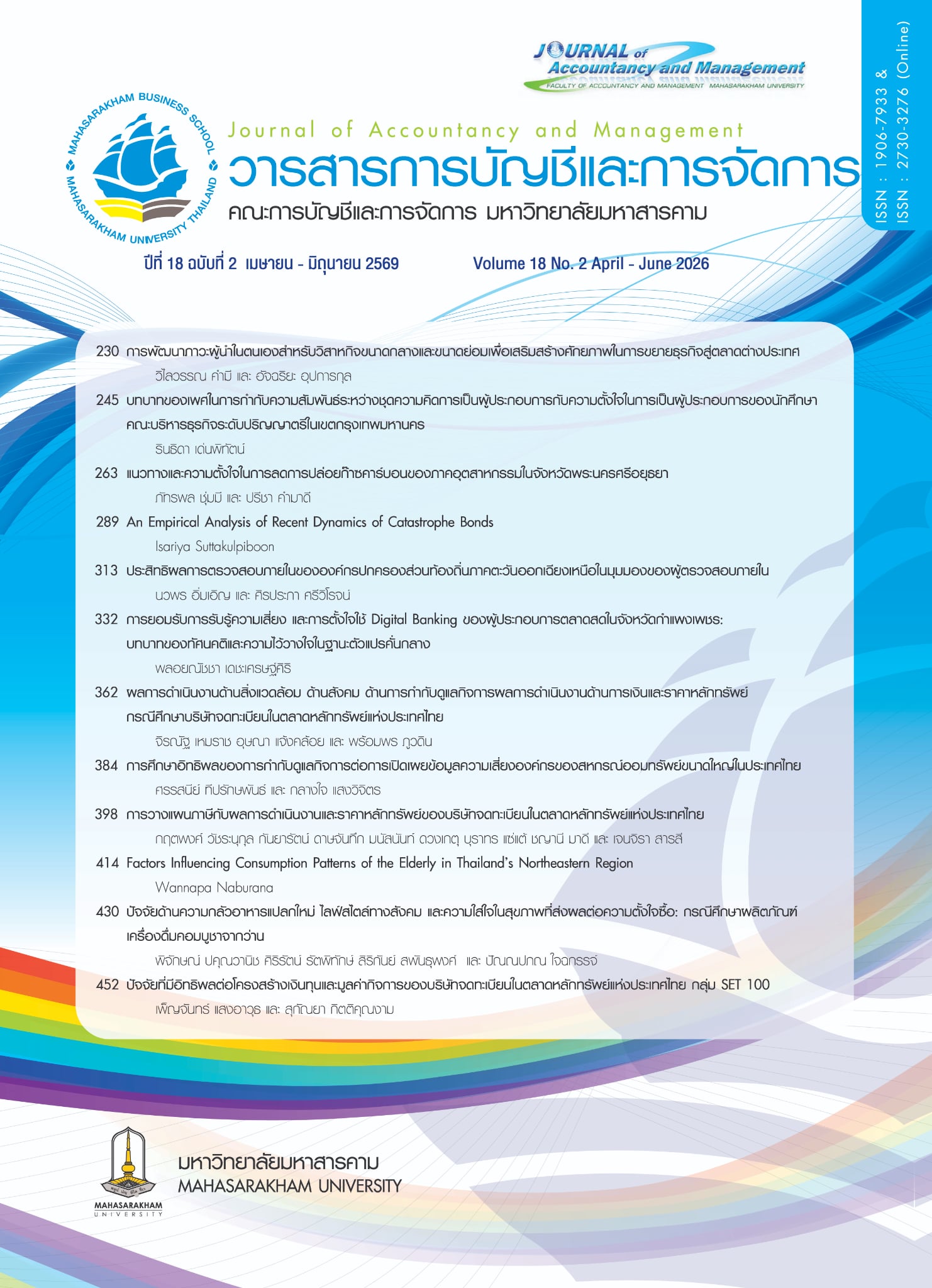
ปัจจัยด้านความกลัวอาหารแปลกใหม่ ไลฟ์สไตล์ทางสังคม และความใส่ใจในสุขภาพที่ส่งผลต่อความตั้งใจซื้อ: กรณีศึกษาผลิตภัณฑ์เครื่องดื่มคอมบูชาจากว่าน
คำสำคัญ:
คอมบูชา, ความกลัวอาหารแปลกใหม่, ไลฟ์สไตล์ทางสังคม , ความใส่ใจในสุขภาพ , ความตั้งใจซื้อบทคัดย่อ
การวิจัยนี้มีวัตถุประสงค์เพื่อศึกษาอิทธิพลของปัจจัยเชิงจิตวิทยา ได้แก่ ความกลัวอาหารแปลกใหม่
ไลฟ์สไตล์ทางสังคม และความใส่ใจในสุขภาพ ที่มีผลต่อความตั้งใจซื้อเครื่องดื่มคอมบูชาจากว่านกาบหอย ซึ่งเป็นผลิตภัณฑ์นวัตกรรมใหม่ การวิจัยนี้เป็นการวิจัยเชิงปริมาณ โดยเก็บรวบรวมข้อมูลจากกลุ่มตัวอย่างผู้บริโภคที่มีอายุระหว่าง 20-60 ปี ซึ่งเคยบริโภคหรือมีความสนใจในผลิตภัณฑ์คอมบูชา จำนวน 402 คน ด้วยวิธีการสุ่มตัวอย่างแบบมีระบบ และใช้แบบสอบถามเป็นเครื่องมือในการเก็บข้อมูล สถิติที่ใช้ในการวิเคราะห์คือการวิเคราะห์โมเดลสมการโครงสร้าง (Structural Equation Modeling: SEM) ผลการวิจัยพบว่า โมเดลการวิจัยมีความสอดคล้องกับข้อมูลเชิงประจักษ์ในระดับดี (CMIN/DF = 2.403, NFI = 0.922, RFI = 0.912, IFI = 0.953, CFI = 0.953, RMSEA = 0.059) ผลการทดสอบสมมติฐานพบว่า ความใส่ใจในสุขภาพมีอิทธิพลทางบวกต่อความตั้งใจซื้ออย่างมีนัยสำคัญทางสถิติ
(β = 0.23, p < .001) ในขณะที่ความกลัวอาหารแปลกใหม่มีอิทธิพลทางลบต่อความตั้งใจซื้ออย่างมีนัยสำคัญทางสถิติ (β = -0.36, p < .001) อย่างไรก็ตาม ไม่พบอิทธิพลจากไลฟ์สไตล์ทางสังคมต่อความตั้งใจซื้ออย่างมีนัยสำคัญทางสถิติ ผลการวิจัยชี้ให้เห็นว่า ในการทำการตลาดผลิตภัณฑ์เครื่องดื่มนวัตกรรมใหม่ ผู้ประกอบการควรให้ความสำคัญกับการสื่อสารคุณประโยชน์ด้านสุขภาพเพื่อกระตุ้นผู้บริโภคที่ใส่ใจในสุขภาพ ควบคู่ไปกับการสร้างความคุ้นเคยและลดการรับรู้ถึงความแปลกใหม่ของผลิตภัณฑ์เพื่อลดอุปสรรคจากความกลัวอาหารใหม่
Downloads
เอกสารอ้างอิง
Ajzen, I., & Kruglanski, A. W. (2019). Reasoned action in the service of goal pursuit. Psychological review,126(5), 774.
Akbar, A., Ali, S., Ahmad, M. A., Akbar, M., & Danish, M. (2019). Understanding the antecedents of organic food consumption in Pakistan: moderating role of food neophobia. International journal of environmental research and public health, 16(20), 4043.
Akkaya, M. (2021). Understanding the impacts of lifestyle segmentation & perceived value on brand purchase intention: An empirical study in different product categories. European research on management and business economics, 27(3), 100155.
Arvola, A., Lähteenmäki, L., & Tuorila, H. (1999). Predicting the intent to purchase unfamiliar and familiar cheeses: The effects of attitudes, expected liking and food neophobia. Appetite, 32(1), 113-126.
Bagozzi, R. P., & Burnkrant, R. E. (1979). Attitude organization and the attitude–behavior relationship. Journal of personality and social psychology, 37(6), 913.
Bollen, K. A. (1989). Structural equations with latent variables. John Wiley & Sons.
Browne, M. W., Cudeck, R., Bollen, K. A., & Long, J. S. (1993). Alternative ways of assessing model fit. Testing structural equation models, 154(4), 136-162.
Çınar, Ç., Karinen, A. K., & Tybur, J. M. (2021). The multidimensional nature of food neophobia. Appetite, 162, 105177.
Eagly, A. H., & Chaiken, S. (1993). The psychology of attitudes. Harcourt brace Jovanovich college publishers.
Espinosa, A., & Kadic-Maglajlic, S. (2018). The mediating role of health consciousness in the relation between emotional intelligence and health behaviors. Frontiers in psychology, 9, 2161.
Fornell, C., & Larcker, D. F. (1981). Evaluating structural equation models with unobservable variables and measurement error. Journal of marketing research, 18(1), 39-50.
George, D., & Mallery, P. (2024). IBM SPSS statistics 29 step by step: A simple guide and reference. Routledge.
Gould, S. J. (1988). Consumer attitudes toward health and health care: A differential perspective. Journal of Consumer Affairs, 22(1), 96-118.
Gould, S. J. (1990). Health consciousness and health behavior: the application of a new health consciousness scale. American journal of preventive medicine, 6(4), 228-237.
Hair, J. F., Babin, B. J., Anderson, R. E., & Black, W. C. (2018). Multivariate Data Analysis. CENGAGE INDIA.
Henseler, J., Ringle, C. M., & Sarstedt, M. (2015). A new criterion for assessing discriminant validity in variance-based structural equation modeling. Journal of the academy of marketing science, 43(1), 115-135.
Hu, L. t., & Bentler, P. M. (1999). Cutoff criteria for fit indexes in covariance structure analysis: Conventional criteria versus new alternatives. Structural equation modeling: a multidisciplinary journal, 6(1), 1-55.
Hung, K. p., Huiling Chen, A., Peng, N., Hackley, C., Amy Tiwsakul, R., & Chou, C. l. (2011). Antecedents of luxury brand purchase intention. Journal of Product & Brand Management, 20(6), 457-467.
Hung, N. T. T., & Tuan, H. Q. (2022, 25 -30 July, 2022 ). Factors and levels affecting vietnamese consumers’purchase intentions related to kombucha tea. In Dominique Valentin, Sylvie Chollet, Hervé Abdi, Uyen Thuy Xuan Phan, & D. H. Nguyen, SPISE 2020+2: From Concept to Market: Sensory Evaluation in Asia, Hanoi, Vietnam.
Jeyakumar, N. R., Soekmawati, S., Victor, V., Popp, J., Fekete-Farkas, M., & Oláh, J. (2021). Food innovation adoption and organic food consumerism—A cross national study between Malaysia and Hungary. Foods, 10(2), 363.
Kaiser, H. F. (1960). The application of electronic computers to factor analysis. Educational and psychological measurement, 20(1), 141-151.
Kallas, Z., Vitale, M., & Gil, J. M. (2019). Health innovation in patty products. the role of food neophobia in consumers’ non-hypothetical willingness to pay, purchase intention and hedonic evaluation. Nutrients, 11(2), 444.
Loewen, R., & Pliner, P. (2000). The food situations questionnaire: a measure of children's willingness to try novel foods in stimulating and non-stimulating situations. Appetite, 35(3), 239-250.
Michaelidou, N., & Hassan, L. M. (2008). The role of health consciousness, food safety concern and ethical identity on attitudes and intentions towards organic food. International journal of consumer studies, 32(2), 163-170.
Ostrom, T. M. (1969). The relationship between the affective, behavioral, and cognitive components of attitude. Journal of experimental social psychology, 5(1), 12-30.
Pliner, P., & Hobden, K. (1992). Development of a scale to measure the trait of food neophobia in humans. Appetite, 19(2), 105-120.
Proctor, A. S., Barth, A., & Holt‐Lunstad, J. (2023). A healthy lifestyle is a social lifestyle: The vital link between social connection and health outcomes. Lifestyle Medicine, 4(4), e91.
Schubert, E., & Bode, S. (2023). Positive emotions and their upregulation increase willingness to consume healthy foods. Appetite, 181, 106420.
Soper, D. S. (2020). A-priori sample size calculator for structural equation models [Software]. Retrieved 3rd of August 2025 from https://www.danielsoper.com/statcalc/calculator.aspx?id=89
Spears, N., & Singh, S. N. (2004). Measuring attitude toward the brand and purchase intentions. Journal of current issues & research in advertising, 26(2), 53-66.
Vargas, A. M., de Moura, A. P., Deliza, R., & Cunha, L. M. (2021). The role of local seasonal foods in enhancing sustainable food consumption: A systematic literature review. Foods, 10(9), 2206.
ดาวน์โหลด
เผยแพร่แล้ว
รูปแบบการอ้างอิง
ฉบับ
ประเภทบทความ
สัญญาอนุญาต
ลิขสิทธิ์ (c) 2025 วารสารการบัญชีและการจัดการ

อนุญาตภายใต้เงื่อนไข Creative Commons Attribution-NonCommercial-NoDerivatives 4.0 International License.
บทความที่ได้รับการตีพิมพ์เป็นลิขสิทธิ์ของวารสารการบัญชีและการจัดการ
ข้อความที่ปรากฏในบทความแต่ละเรื่องในวารสารวิชาการเล่มนี้เป็นความคิดเห็นส่วนตัวของผู้เขียนแต่ละท่านไม่เกี่ยวข้องกับมหาวิทยาลัยมหาสารคาม และคณาจารย์ท่านอื่นๆในมหาวิทยาลัยฯ แต่อย่างใด ความรับผิดชอบองค์ประกอบทั้งหมดของบทความแต่ละเรื่องเป็นของผู้เขียนแต่ละท่าน หากมีความผิดพลาดใดๆ ผู้เขียนแต่ละท่านจะรับผิดชอบบทความของตนเองแต่ผู้เดียว