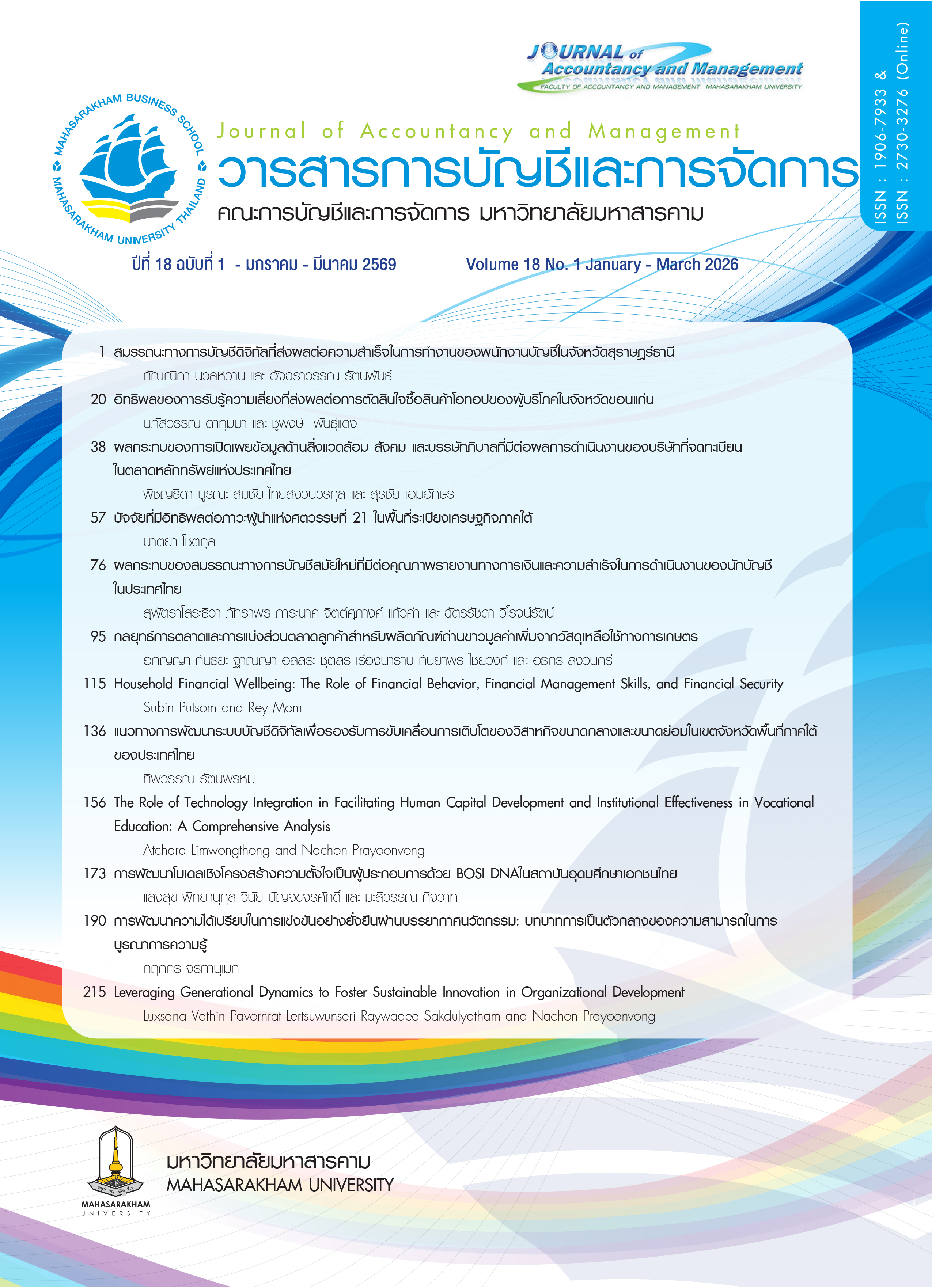
กลยุทธ์การตลาดและการแบ่งส่วนตลาดลูกค้าสำหรับ ผลิตภัณฑ์ถ่านขาวมูลค่าเพิ่มจากวัสดุเหลือใช้ทางการเกษตร
คำสำคัญ:
การแบ่งกลุ่มลูกค้า การมีส่วนร่วมกับลูกค้า กลยุทธ์ทางการตลาดบทคัดย่อ
การศึกษานี้มีวัตถุประสงค์เพื่อสำรวจความพึงพอใจและความต้องการของผู้บริโภคที่มีต่อถ่านขาวและผลิตภัณฑ์มูลค่าเพิ่มที่ผลิตจากวัสดุเหลือใช้ทางการเกษตร โดยใช้เทคโนโลยีเตาเผาแบบสองห้องพร้อมระบบแก๊สซิฟิเคชันที่ควบคุมด้วยเทคโนโลยีอินเตอร์เน็ตของทุกสรรพสิ่ง (Internet of Thing: IoT) ในพื้นที่ภาคเหนือตอนบน การศึกษานี้มุ่งแก้ไขความท้าทายในการยอมรับของตลาดสำหรับผลิตภัณฑ์ดังกล่าวจากแนวทางแก้ปัญหาในพื้นที่ที่ยั่งยืน เพื่อให้บรรลุวัตถุประสงค์ จึงได้ใช้วิธีวิจัยแบบผสมผสาน (Mixed Methodology Research) โดยการวิเคราะห์เชิงคุณภาพด้วยการวิเคราะห์ข้อมูลจากผู้ตอบแบบสอบถาม 74 คน กับข้อมูลเชิงปริมาณจากแบบสำรวจ รวมถึงการวิเคราะห์แบบ Discrete Choice Experiment (DCE) และการสร้างแบบจำลอง Latent Class Model (LCM) ผลการศึกษาพบว่า ความพึงพอใจโดยรวมมีค่าเฉลี่ยอยู่ที่ 4.1 ± 0.6 โดยปัจจัยด้านความปลอดภัย (4.5 ± 0.4) ประสิทธิภาพ (4.4 ± 0.5) และความสะดวกในการใช้งาน (4.3 ± 0.5) ได้รับการให้คุณค่าเป็นปัจจัยระดับสูง นอกจากนี้ยังมีการระบุกลุ่มผู้บริโภคสำหรับผลิตภัณฑ์ถ่านขาวที่แตกต่างกัน 3 กลุ่ม ซึ่งแต่ละกลุ่มมีความต้องการที่หลากหลายและระดับความเต็มใจที่จะจ่าย (Willing To Pay: WTP) ที่แตกต่างกัน ผลการศึกษาเหล่านี้ให้คำแนะนำเชิงปฏิบัติสำหรับการวางตำแหน่งผลิตภัณฑ์ กลยุทธ์การตลาดแบบเจาะกลุ่มเป้าหมาย และการส่งเสริมการบริโภคอย่างยั่งยืนสำหรับผลิตภัณฑ์ที่ได้จากวัสดุเหลือใช้ทางการเกษตร ซึ่งสามารถนำไปประยุกต์ใช้กับธุรกิจและการพัฒนาชุมชนที่มุ่งเน้นเศรษฐกิจสีเขียวและการจัดการของเสียในบริบทระดับภูมิภาค
Downloads
เอกสารอ้างอิง
Ajzen, I. (2020). The theory of planned behavior: Frequently asked questions. Human Behavior and Emerging Technologies, 2(4), 314–324.
Ammaiyappan, A., Vinodhini, S. M., Sekar, M., & Kalaimegam, A. (2025). Circular economy in modern agriculture: Waste to value.
Aroonsrimorakot, S., & Arunlertaree, C. (2019). Efficiency of activated carbon and white charcoal from textile dyeing industry in synthetic wastewater. Interdisciplinary Research Review, 14(6), 14–20.
Asioli, D., Aschemann-Witzel, J., Caputo, V., Vecchio, R., Annunziata, A., Næs, T., & Varela, P. (2017). Making sense of the “clean label” trends: A review of consumer food choice behavior and discussion of industry implications. Food Research International, 99(1), 58–71. https://doi.org/10.1016/j.foodres.2017.07.022.
Bliemer, M. C., & Rose, J. M. (2010). Construction of experimental designs for mixed logit models allowing for correlation across choice observations. Transportation Research Part B: Methodological, 44(6), 720–734.
Chia, C. H., Munroe, P., & Joseph, S. (2012). Microstructural characterization of white charcoal. Microscopy and Microanalysis, 18(6), 1562–1563.
Cornelissen, G., Pandit, N. R., Taylor, P., Pandit, B. H., Sparrevik, M., & Schmidt, H. P. (2016). Emissions and char quality of Flame-Curtain “Kon Tiki” kilns for farmer-scale charcoal/biochar production. PLoS ONE, 11(5), e0154617.
Geissdoerfer, M., Pieroni, M. P. P., Pigosso, D. C. A., & Soufani, K. (2020). Circular business models: A review. Journal of Cleaner Production, 277, 123741.
Gomes, S., Lopes, J. M., & Nogueira, S. (2023). Willingness to Pay More for Green products: a Critical Challenge for Gen Z. Journal of Cleaner Production, 390(136092).
Jainontee, K., Pongkiatkul, P., Wang, Y. L., Weng, R. J. F., Lu, Y. T., Wang, T. S., & Chen, W. K. (2023). Strategy design of PM2.5 controlling for northern Thailand. Aerosol and Air Quality Research, 23, 220432.
Junpen, A., Pansuk, J., Kamnoet, O., Cheewaphongphan, P., & Garivait, S. (2018). Emission of air pollutants from rice residue open Burning in Thailand, 2018. Atmosphere, 9(11), 449.
Kotler, P., Keller, K. L., & Chernev, A. (2021). Marketing management (16th ed.). Pearson Education.
Lim, H., Jang, K. S., Kim, M. K., & Lee, S. E. (2024). Current technology landscape of biochar in carbon capture and storage research via bibliometric analysis. AIMS Energy, 12(1), 162-181.
Luo, B., Li, L., & Sun, Y. (2022). Understanding the influence of consumers’ perceived value on energy-saving products purchase intention. Frontiers in Psychology, 12.
Mangus, H., Hall, D. A., & Markley, A. G. (2023). The sustainability-conscious consumer: An exploration of the motivations, values, beliefs, and norms guiding garment life extension practices. Sustainability, 15(15), 12033.
Mfokeu, A. M., Chrysostome, E. V., Gueyie, J.-P., & Mun Ngapna, O. E. (2023). Consumer motivation behind the use of ecological charcoal in Cameroon. Sustainability, 15(3), 1749.
Nekmahmud, M., & Fekete-Farkas, M. (2020). Why not green marketing? Determinates of consumers’ intention to green purchase decision in a new developing nation. Sustainability, 12(19), 7880.
Nam, K., Qiao, Y., & Ahn, B. (2021). Analysis of Consumer Preference for Green Tea with Eco-Friendly Certification in China. Sustainability, 14(1), 211.
Nicolet, A., Perraudin, C., Krucien, N., Wagner, J., Peytremann-Bridevaux, I., & Marti, J. (2024). Preferences for innovations in healthcare delivery models in the Swiss elderly population: A latent class, choice modelling study. European journal of public health, 34(2), 260–266.
Okimiji, O. P. (2024). Charcoal-production, air pollutant impacts on ambient environment and associated health risks: A systematic review. The Global Environmental Engineers, 11, 13–36.
Parasuraman, A. (2000). Technology readiness index (TRI): A multiple-item scale to measure readiness to embrace new technologies. Journal of Service Research, 2(4), 307–320.
Pongpiachan, S. (2015). Impacts of agricultural waste burning on the enhancement of -bound polycyclic aromatic hydrocarbons in northern Thailand. WIT Transactions on Ecology and the Environment, 1, 3–14.
Saija, M. E., Daniotti, S., Bosco, D., & Re, I. (2023). A choice experiment model for sustainable consumer goods: A systematic literature review and workflow design. Sustainability, 15(17), 13183.
Santos, S. M., Piekarski, C., Ugaya, C., Donato, D., Júnior, A. B., De Francisco, A., & Carvalho, A. (2017). Life cycle analysis of charcoal production in masonry kilns with and without carbonization process generated gas combustion. Sustainability, 9(9), 1558.
Sirithian, D., & Thanatrakolsri, P. (2022). Relationships between meteorological and particulate matter concentrations (PM2.5 and PM10) during the haze period in urban and rural areas, Northern Thailand. Air, Soil and Water Research, 15, 1–15.
Sriwaranun, Y., Gan, C., Lee, M., & Cohen, D. A. (2015). Consumers’ willingness to pay for organic products in Thailand. International Journal of Social Economics, 42(5), 480–510.
Sun, Z. Q., & Yoon, S. J. (2022). What makes people pay premium price for eco-friendly products? The effects of ethical consumption consciousness, CSR, and product quality, CSR, and Product Quality. Sustainability, 14(23), 15513.
ดาวน์โหลด
เผยแพร่แล้ว
รูปแบบการอ้างอิง
ฉบับ
ประเภทบทความ
สัญญาอนุญาต
ลิขสิทธิ์ (c) 2025 วารสารการบัญชีและการจัดการ

อนุญาตภายใต้เงื่อนไข Creative Commons Attribution-NonCommercial-NoDerivatives 4.0 International License.
บทความที่ได้รับการตีพิมพ์เป็นลิขสิทธิ์ของวารสารการบัญชีและการจัดการ
ข้อความที่ปรากฏในบทความแต่ละเรื่องในวารสารวิชาการเล่มนี้เป็นความคิดเห็นส่วนตัวของผู้เขียนแต่ละท่านไม่เกี่ยวข้องกับมหาวิทยาลัยมหาสารคาม และคณาจารย์ท่านอื่นๆในมหาวิทยาลัยฯ แต่อย่างใด ความรับผิดชอบองค์ประกอบทั้งหมดของบทความแต่ละเรื่องเป็นของผู้เขียนแต่ละท่าน หากมีความผิดพลาดใดๆ ผู้เขียนแต่ละท่านจะรับผิดชอบบทความของตนเองแต่ผู้เดียว