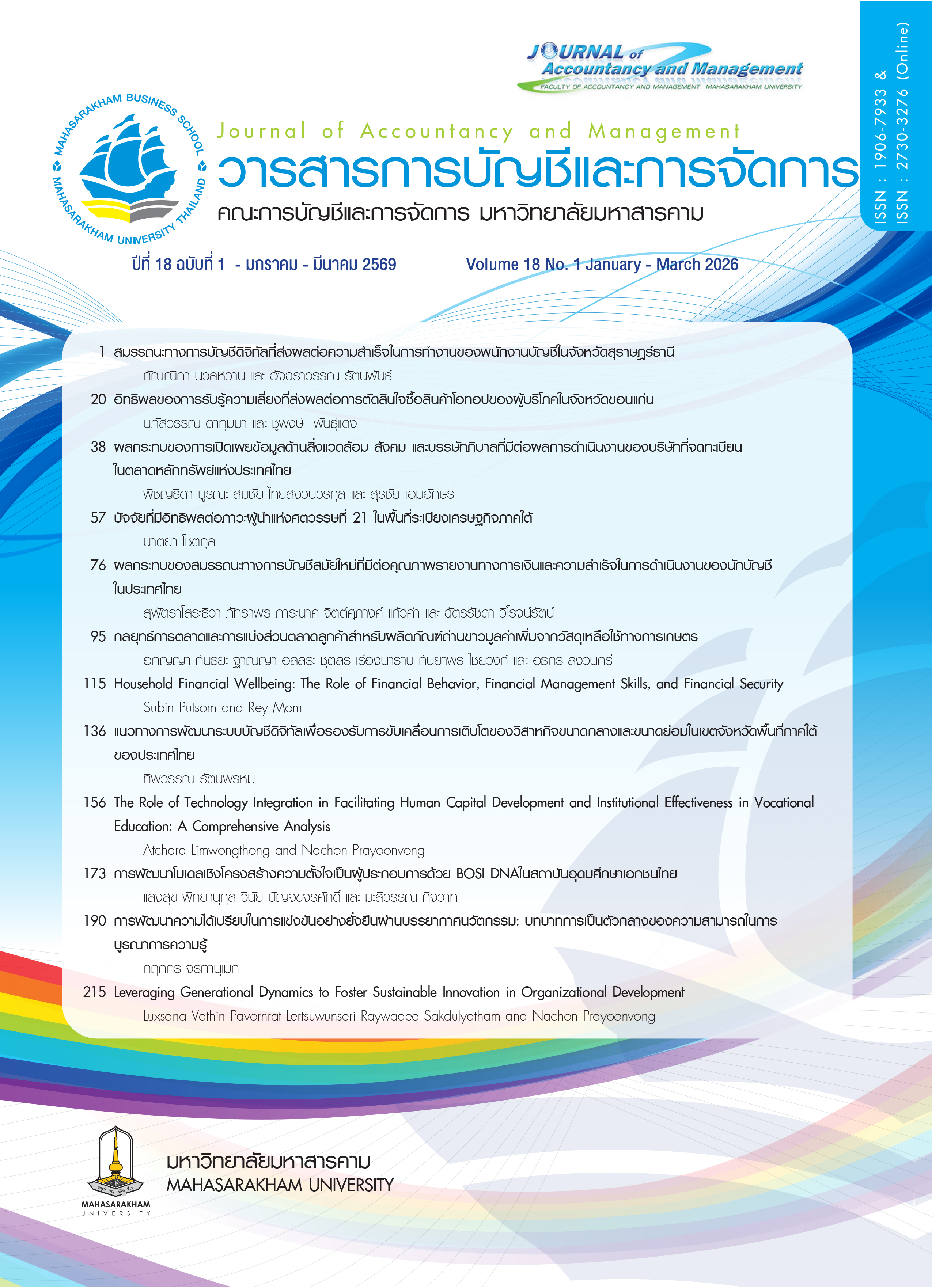
การพัฒนาความได้เปรียบในแข่งขันอย่างยั่งยืนผ่านบรรยากาศนวัตกรรม: บทบาทการเป็นตัวกลางของความสามารถในการบูรณาการความรู้
คำสำคัญ:
บรรยากาศนวัตกรรม, ความสามารถในการบูรณาการความรู้, ความได้เปรียบในการแข่งขันบทคัดย่อ
การพัฒนาเทคโนโลยีอย่างรวดเร็วและการแข่งขันทางธุรกิจที่เข้มข้นทำให้องค์กรต้องสร้างความได้เปรียบที่ยั่งยืนอย่างเร่งด่วน โดยเฉพาะในอุตสาหกรรมดิจิทัลของไทยที่เป็นยุทธศาสตร์สำคัญของประเทศ อย่างไรก็ตาม การศึกษาก่อนหน้านี้ยังขาดความชัดเจนเกี่ยวกับกลไกที่บรรยากาศนวัตกรรมและความสามารถในการบูรณาการความรู้ทำงานร่วมกันเพื่อขับเคลื่อนความได้เปรียบในการแข่งขันอย่างยั่งยืน การศึกษานี้มีวัตถุประสงค์เพื่อตรวจสอบผลกระทบของบรรยากาศนวัตกรรมต่อความได้เปรียบในการแข่งขันอย่างยั่งยืน และบทบาทการเป็นตัวกลางของความสามารถในการบูรณาการความรู้ โดยใช้ทฤษฎีมุมมองฐานความรู้เป็นกรอบทฤษฎีหลัก เพื่อให้ข้อเสนอแนะเชิงประจักษ์แก่ผู้บริหารบริษัทดิจิทัลในการพัฒนาขีดความสามารถองค์กร การวิจัยใช้แบบจำลอง PLS-SEM และการวิเคราะห์ cIPMA กับข้อมูลจากบริษัทดิจิทัลไทย 158 แห่ง โดยมีผู้บริหารและผู้เชี่ยวชาญ 474 คนเข้าร่วมการสำรวจ ผลการศึกษาพบว่าบรรยากาศนวัตกรรมส่งผลเชิงบวกต่อความได้เปรียบในการแข่งขันอย่างยั่งยืนทั้งทางตรงและทางอ้อมผ่านความสามารถในการบูรณาการความรู้อย่างมีนัยสำคัญ โดยความสามารถในการบูรณาการความรู้มีบทบาทเป็นตัวแปรกลางบางส่วน การวิเคราะห์ cIPMA พบว่า บรรยากาศนวัตกรรมเป็นจุดที่ควรมุ่งเน้นการพัฒนาเป็นลำดับแรก เนื่องจากมีความสำคัญสูงแต่ประสิทธิภาพต่ำ ขณะที่ความสามารถในการบูรณาการความรู้ควรได้รับการปรับปรุงประสิทธิผล การศึกษาเสนอแนะให้บริษัทดิจิทัลพัฒนาบรรยากาศนวัตกรรมเพื่อส่งเสริมความคิดสร้างสรรค์และการทดลองใหม่ ๆ ซึ่งจะเป็นแรงผลักดันให้เกิดการรวมความรู้จากแหล่งต่าง ๆ และแปลงเป็นนวัตกรรมที่เป็นรูปธรรม ส่งผลให้องค์กรสามารถสร้างความได้เปรียบในการแข่งขันอย่างยั่งยืนได้
Downloads
เอกสารอ้างอิง
จินดารัตน์ ปีมณี และนวลละออง อรรถรังสรรค์ (2568). ผลกระทบของการมุ่งเน้นนวัตกรรมองค์กร การสร้างสรรค์องค์ความรู้ ความได้เปรียบทางการแข่งขัน ประสิทธิภาพการดำเนินงานที่มีต่อความสำเร็จขององค์กร: หลักฐานเชิงประจักษ์จากธุรกิจขนาดกลางและขนาดย่อม (SMEs), วารสารการบัญชีและการจัดการ, 17(2), 109–125.
ฉัตรวรา ฉ่ำตาก้อง และพรลภัส สุวรรณรัตน์ (2568). ผลกระทบของบุคลิกภาพ 5 องค์ประกอบที่มีต่อการจัดการความรู้และประสิทธิภาพการปฏิบัติงานของผู้ปฏิบัติงานฝ่ายบำรุงรักษาไฟฟ้าการไฟฟ้าผ่ายผลิตแห่งประเทศไทย, วารสารการบัญชีและการจัดการ, 17(1), 51–72.
รัฐบาลไทย. (2567). Digital GDP ขยายตัว ร้อยละ 5.7 – การส่งออกดิจิทัล ขยายตัวร้อยละ 17.2 รองนายกฯ ประเสริฐ ชี้ผลสำเร็จรัฐบาลให้ความสำคัญ ยกระดับดิจิทัลไทย. ค้นเมื่อ 30 กันยายน 2568, จาก https://www.thaigov.go.th/news/contents/details/91333
สำนักงานส่งเสริมเศรษฐกิจดิจิทัล. (2567). Digital industry 2023. ค้นเมื่อ 22 กันยายน 2568, จาก https://www.depa.or.th/en/article-view/press-conference-software-hardware-smart-devices-2023
Abdeen, H., De-Pablos-Heredero, C., Cosculluela-Martínez, C., & Montes-Botella, J.-L. (2025). Strategic leadership and its impact on dynamic capabilities and sustainable competitive advantages. Management Decision. Advance online publication.
Acharya, C., Ojha, D., Gokhale, R., & Patel, P. C. (2022). Managing information for innovation using knowledge integration capability: The role of boundary spanning objects. International Journal of Information Management, 62, 102438.
Ahmad, M. A.-A., & Jais, J. (2023). The influence of service quality on sustainable competitive advantage in Kurdistan Iraq hotels: Perspective from hotel managers. Humanities and Social Sciences Letters, 11(4), 502–518.
Al Shawabkeh, K. (2024). The impact of strategic agility on sustainable competitive advantage: The mediating role of strategic renewal at Jordanian telecommunication companies. Problems and Perspectives in Management, 22(1), 446–461.
Alhammadi, B., Khalid, K., Ahmad, S. Z., & Davidson, R. (2024). Examining the interplay between managerial ties, dynamic capabilities and innovation climate in driving balanced and combined ambidextrous innovation. Journal of Asia Business Studies, 18(6), 1465–1482.
Alshahrani, M. A., Yaqub, M. Z., Ali, M., El Hakimi, I., & Salam, M. A. (2025). Could entrepreneurial leadership promote employees’ IWB? The roles of intrinsic motivation, creative self-efficacy and firms’ innovation climate. International Journal of Innovation Science. Advance online publication.
Bandura, A. (2005). Social cognitive theory: An agentic perspective. The Journal of the Hellenic Psychological Society, 12(3), 313–333.
Barney, J. (1991). Firm resources and sustained competitive advantage. Journal of Management, 17(1), 99–120.
Chantabutr, P., & Wanarat, S. (2024). The effect of human capital, employee performance on work process improvement and employee performance on work productivity on sustainable competitive advantage in Thai banks. International Journal of Learning and Intellectual Capital, 21(1), 6–29.
Cheng, R., Tao, L., Wang, Q., & Zhao, X. (2023). The impact of value co-creation orientation on radical service innovation: Exploring a serial mediation mechanism. International Journal of Production Economics, 262, 108902.
Cui, R., Wang, J., Xue, Y., & Liang, H. (2021). Interorganizational learning, green knowledge integration capability and green innovation. European Journal of Innovation Management, 24(4), 1292–1314.
Choi, B. C. K., & Pak, A. W. P. (2005). A catalog of biases in questionnaires. Preventing Chronic Disease, 2(1), A13.
Chowdhury, M., Uddin, M. A., Biswas, S. R., & Hridoy, A. I. (2025). Promoting human resource and innovative climate to foster organizational resilience during pandemic time: The mediating role of employee resilience. Global Journal of Flexible Systems Management, 26, 55–85.
David, K. G., Wu, Y., & Pei, C. (2022). Openness to innovation as a driver of knowledge integration in high-tech SMEs: The roles of social capital and network competence. International Journal of Knowledge Management, 18(1), 1–21.
Demircioglu, M. A. (2023). The effects of innovation climate on employee job satisfaction and affective commitment: Findings from public organizations. Review of Public Personnel Administration, 43(1), 130–158.
Diamantopoulos, A., Fritz, W., & Hildebrandt, L. (Eds.). (2012). Quantitative marketing and marketing management: Marketing models and methods in theory and practice. Springer Gabler.
Du, T., & Chang, Y. C. (2023). Influence of organizational innovation climate on creativity and the mediating role of feedback-seeking behavior—A case study of university teachers in Hebei, China. International Journal of Learning, Teaching and Educational Research, 22(4), 87–103.
Ed-Dafali, S., Al-Azad, M. S., Mohiuddin, M., & Reza, M. N. H. (2023). Strategic orientations, organizational ambidexterity, and sustainable competitive advantage: Mediating role of industry 4.0 readiness in emerging markets. Journal of Cleaner Production, 401, 136765.
Edmondson, A. (1999). Psychological safety and learning behavior in work teams. Administrative Science Quarterly, 44(2), 350–383.
Elgarhy, S. D., & Abou-Shouk, M. (2023). Effects of entrepreneurial orientation, marketing, and innovation capabilities on market performance: The mediating effect of sustainable competitive advantage. International Journal of Contemporary Hospitality Management, 35(6), 1986–2004.
Elistia, E., Purwana, D., Effendi, M. S., Arief, M., & Wibowo, S. F. (2025). Determining factors of sustainable competitive advantage in private higher education. TEM Journal, 14(1), 562–573.
Faul, F., Erdfelder, E., Buchner, A., & Lang, A.-G. (2009). Statistical power analyses using G*Power 3.1: Tests for correlation and regression analyses. Behavior Research Methods, 41(4), 1149–1160.
Ghlichlee, B., Mohammadkhani, E., & Hatami, A. (2024). Knowledge-enhancing HR practices and sustainable competitive advantage: The mediating role of intellectual capital in knowledge-based firms. Journal of Intellectual Capital, 25(2/3), 275–296.
Grant, R. M. (1996). Toward a knowledge-based theory of the firm. Strategic Management Journal, 17(Winter Special Issue), 109–122.
Guenther, P., Guenther, M., Ringle, C. M., Zaefarian, G., & Cartwright, S. (2023). Improving PLS-SEM use for business marketing research. Industrial Marketing Management, 111, 127–142.
Hair, J. F., Black, W. C., Babin, B. J., & Anderson, R. E. (2019a). Multivariate data analysis (8th ed.). Pearson.
Hair, J. F., Hult, G. T. M., Ringle, C. M., & Sarstedt, M. (2022). A primer on partial least squares structural equation modeling (PLS-SEM) (3rd ed.). Sage.
Hair, J. F., Risher, J. J., Sarstedt, M., & Ringle, C. M. (2019b). When to use and how to report the results of PLS-SEM. European Business Review, 31(1), 2–24.
Hair, J. F., Sarstedt, M., Ringle, C. M., Sharma, P. N., & Liengaard, B. D. (2024). Going beyond the untold facts in PLS-SEM and moving forward. European Journal of Marketing, 58(13), 81–106.
Hauff, S., Richter, N. F., Sarstedt, M., & Ringle, C. M. (2024). Importance and performance in PLS-SEM and NCA: Introducing the combined importance–performance map analysis (cIPMA). Journal of Retailing and Consumer Services, 78, 103723.
Holling, C. S. (1973). Resilience and stability of ecological systems. Annual Review of Ecology and Systematics, 4, 1–23.
Hossain, M. S., Kannan, S. N., & Nair, S. K. K. R. (2020). Factors influencing sustainable competitive advantage in the hospitality industry. Journal of Quality Assurance in Hospitality & Tourism, 22(6), 679–710.
Hou, Z., Li, D., Jin, F., Zhang, Y., & Luo, W. (2025). Green supply chain knowledge networks and corporate ESG performance: The role of green technology innovation and knowledge integration capability. International Journal of Production Research, 63(12), 4306–4327.
Hunt, S. D., & Morgan, R. M. (1995). The comparative advantage theory of competition. Journal of Marketing, 59(2), 1–15.
Juniariani, N. M. R., Soewarno, N., & Rahmiati, A. (2025). Can knowledge-based assets increase organizational performance? Evidence from village financial institutions in Bali, Indonesia. Problems and Perspectives in Management, 23(1), 158–168.
Khan, A., Hussain, S., & Sampene, A. K. (2023). Investing in green intellectual capital to enhance green corporate image under the influence of green innovation climate: A case of Chinese entrepreneurial SMEs. Journal of Cleaner Production, 418, 138177.
Korku, C., & Kaya, S. (2023). Relationship between authentic leadership, transformational leadership and innovative work behavior: Mediating role of innovation climate. International Journal of Occupational Safety and Ergonomics, 29(3), 1128–1134.
Korry, P., Armanu, A., Sudjatno, S., & Wijayanti, R. (2024). Investigating entrepreneurial resilience toward sustainable competitive advantage: Does local culture matter? Uncertain Supply Chain Management, 12(2), 801–814.
Le, C. T., Phan, T. K. L., & Nguyen, T. Y. N. (2024). Online knowledge sharing and employee innovation: The role of job self-efficacy and innovative climate. Journal of Workplace Learning, 36(4), 253–266.
Lee, E., & Jung, Y. H. (2024). Linking innovation climate to innovative behavior in public organizations: Exploring the role of psychological needs. International Public Management Journal. Advance online publication.
Li, H., Yang, Z., Wang, H., & Li, Y. (2023). Digitalization of business models, knowledge management and green technology innovation of Chinese manufacturing enterprises: A mixed analysis based on the Haier COSMOPlat ecosystem. Asia Pacific Business Review, 1–29.
Lin, Q. (2023). Transformational leadership and innovative work behavior: The role of identification, voice and innovation climate. International Journal of Hospitality Management, 113, 103521.
Litwin, G., & Stringer, R. A., Jr. (1968). Motivation and organizational climate. Division of Research, Graduate School of Business Administration, Harvard University.
Lu, C., Qi, Y., & Yu, B. (2024). Effects of domestic and international external collaboration on new product development performance in SMEs: Evidence from China. Sustainability, 16(1), 400.
Martínez-Falcó, J., Sánchez-García, E., Marco-Lajara, B., & Zaragoza-Sáez, P. (2025). Green intellectual capital and sustainable competitive advantage: Unraveling role of environmental management accounting and green entrepreneurship orientation. Journal of Intellectual Capital, 26(1), 104–129.
Mendoza, M., Molina, L. M., & Ortega-Egea, M. T. (2025). Effect of different types of knowledge intensive business services on innovation and performance. Technological Forecasting and Social Change, 210, 123886.
Miao, R., Yu, J., Bozionelos, N., & Bozionelos, G. (2023). Organizational career growth and high-performance work systems: The roles of job crafting and organizational innovation climate. Journal of Vocational Behavior, 143, 103879.
Ng, P. M. L., Wut, T. M., & Lo, M. F. (2024). Enhancing knowledge sharing behaviour in building academics’ career capital in higher education: The mediating role of innovative climate. Technology, Knowledge and Learning, 29, 91–111.
Nonaka, I., & von Krogh, G. (2009). Perspective—Tacit knowledge and knowledge conversion: Controversy and advancement in organizational knowledge creation theory. Organization Science, 20(3), 635–652.
Nong, T. X., Chan, S.-J., & Nguyen, T. T. T. (2024). Benevolent leadership and staff’s creative work behavior: The mediating role of an innovative climate and fear of failure. Journal of Applied Research in Higher Education. Advance online publication.
Puni, A., Hilton, S. K., Mohammed, I., & Korankye, E. S. (2022). The mediating role of innovative climate on the relationship between transformational leadership and firm performance in developing countries: The case of Ghana. Leadership & Organization Development Journal, 43(3), 404–421.
Phornlaphatrachakorn, K., Phosrichan, N., Srimung, N., Puttawong, N., & Duangmalai, P. (2025). Market environment accounting of cosmetics business in Thailand: Effects on sustainable competitive advantage and business performance. Management & Accounting Review, 24(1), 29–55.
Rasiah, R., Ng, Y. K., & Cheong, K. C. (2023). Mediating and moderating effects of social networks and business environment on the relationship between entrepreneurial orientation and sustainable competitive advantage among small and medium Malaysian firms in Cambodia. Asian Journal of Technology Innovation, 32(1), 182–203.
Rovinelli, R. J., & Hambleton, R. K. (1977). On the use of content specialists in the assessment of criterion-referenced test item validity. Dutch Journal of Educational Research, 2(2), 49–60.
Ruiz-Moreno, A., Tamayo-Torres, J., & García-Morales, V. J. (2015). The role of QMS in the relationship between innovation climate and performance. Production Planning & Control, 26(11), 841–857.
Satar, A., Musadieq, M. A., Hutahayan, B., & Solimun, S. (2025). Creating a sustainable competitive advantage: The roles of technological innovation, knowledge management, and organizational agility. Global Business and Organizational Excellence, 44(3), 11–23.
Sondhi, S. S., Salwan, P., Behl, A., Niranjan, S., & Hawkins, T. (2024). Evaluation of strategic orientation-led competitive advantage: The role of knowledge integration and service innovation. Journal of Knowledge Management, 28(7), 1937–1962.
Sorenson, O., Rivkin, J. W., & Fleming, L. (2006). Complexity, networks and knowledge flow. Research Policy, 35(7), 994–1017.
Sukoroto, S., Tjahjono, H. K., & Wahyuningsih, S. H. (2023). The role of knowledge management, managerial competence, market orientation, and innovation on sustainable competitive advantage. Journal of Distribution Science, 21(5), 63–73.
Tian, H., & Wang, A. (2023). Sustainable leadership, knowledge sharing, and frugal innovation: The moderating role of organizational innovation climate. SAGE Open, 13(4).
Tran Pham, T. K., & Nguyen Le, T. Q. H. T. (2024). Impacts of ethical leadership, innovative climate on project success: The role of innovative behavior and time pressure. Baltic Journal of Management, 19(1), 19–35.
Ullah, S., Ahmad, T., Lyu, B., Sami, A., Kukreti, M., & Yvaz, A. (2024). Integrating external stakeholders for improvement in green innovation performance: Role of green knowledge integration capability and regulatory pressure. International Journal of Innovation Science, 16(4), 640–657.
Van, H. V., Abu Afifa, M., & Bui, D. V. (2025). Green innovation and sustainability reporting: Linking environmental practices to sustainable competitive advantage through a moderated moderation and mediation model. Business Strategy and the Environment, 1–18.
Wach, B., Schwarz, J. O., & von Held, F. (2025). Corporate foresight for the benefit of corporates’ innovation climate. Futures & Foresight Science, 7(1), e195.
Wang, S., Gao, M., & Zhang, H. (2025). Enhancing creativity and sustainable competitive advantage through data-driven decision-making and digital leadership. IEEE Transactions on Engineering Management, 72, 1361–1375.
Wang, X., Li, J., & Qi, Y. (2023). Fostering knowledge creation through network capability ambidexterity with the moderation of an innovation climate. Journal of Knowledge Management, 27(3), 613–631.
Wang, X., Liu, Z., & Lei, X. (2024). Untangling the knowledge creation in the cross-project organisations. Technology Analysis & Strategic Management, 36(12), 4672–4685.
Xiong, S., Paulraj, A., Dai, J., & Irawan, C. A. (2025). Digital integration capability asymmetry and buyer product innovation: The contingent roles of environmental dynamism and innovative climate. International Journal of Operations & Production Management, 45(3), 756–782.
Yang, M., Wang, J., & Yang, J. (2021). Boundary-spanning search, knowledge integration capability and sustainable competitive advantage. Baltic Journal of Management, 16(3), 446–464.
Yue, Y., Lin, W. L., & Tan, H. C. (2025). Unlocking employee creativity: Ethical leadership, employee voice behavior and innovation climate in the era of intelligent manufacturing in China. Social Responsibility Journal, 21(7), 1440–1465.
Zan, A., Yao, Y., & Chen, H. (2024). Knowledge search and firm innovation: The roles of knowledge inertia and knowledge integration capability. Technology Analysis & Strategic Management, 36(6), 1150–1165.
Zheng, S., Zhang, W., Wu, X., & Du, J. (2011). Knowledge‐based dynamic capabilities and innovation in networked environments. Journal of Knowledge Management, 15(6), 1035–1051.
Zhu, Q., Tongkong, S., & Tancho, N. (2024). Corporate social capital and enterprise performance of technology-based SMEs: The mediating role of knowledge integration ability. Journal of Infrastructure, Policy and Development, 8(1), 2726.
Zhu, Z., & Tang, X. (2023). Effect of integration capabilities with channel distributors on supply chain agility in emerging markets: An institution-based view perspective. Journal of Enterprise Information Management, 36(2), 381–408.
ไฟล์ประกอบ
เผยแพร่แล้ว
รูปแบบการอ้างอิง
ฉบับ
ประเภทบทความ
สัญญาอนุญาต
ลิขสิทธิ์ (c) 2025 วารสารการบัญชีและการจัดการ

อนุญาตภายใต้เงื่อนไข Creative Commons Attribution-NonCommercial-NoDerivatives 4.0 International License.
บทความที่ได้รับการตีพิมพ์เป็นลิขสิทธิ์ของวารสารการบัญชีและการจัดการ
ข้อความที่ปรากฏในบทความแต่ละเรื่องในวารสารวิชาการเล่มนี้เป็นความคิดเห็นส่วนตัวของผู้เขียนแต่ละท่านไม่เกี่ยวข้องกับมหาวิทยาลัยมหาสารคาม และคณาจารย์ท่านอื่นๆในมหาวิทยาลัยฯ แต่อย่างใด ความรับผิดชอบองค์ประกอบทั้งหมดของบทความแต่ละเรื่องเป็นของผู้เขียนแต่ละท่าน หากมีความผิดพลาดใดๆ ผู้เขียนแต่ละท่านจะรับผิดชอบบทความของตนเองแต่ผู้เดียว