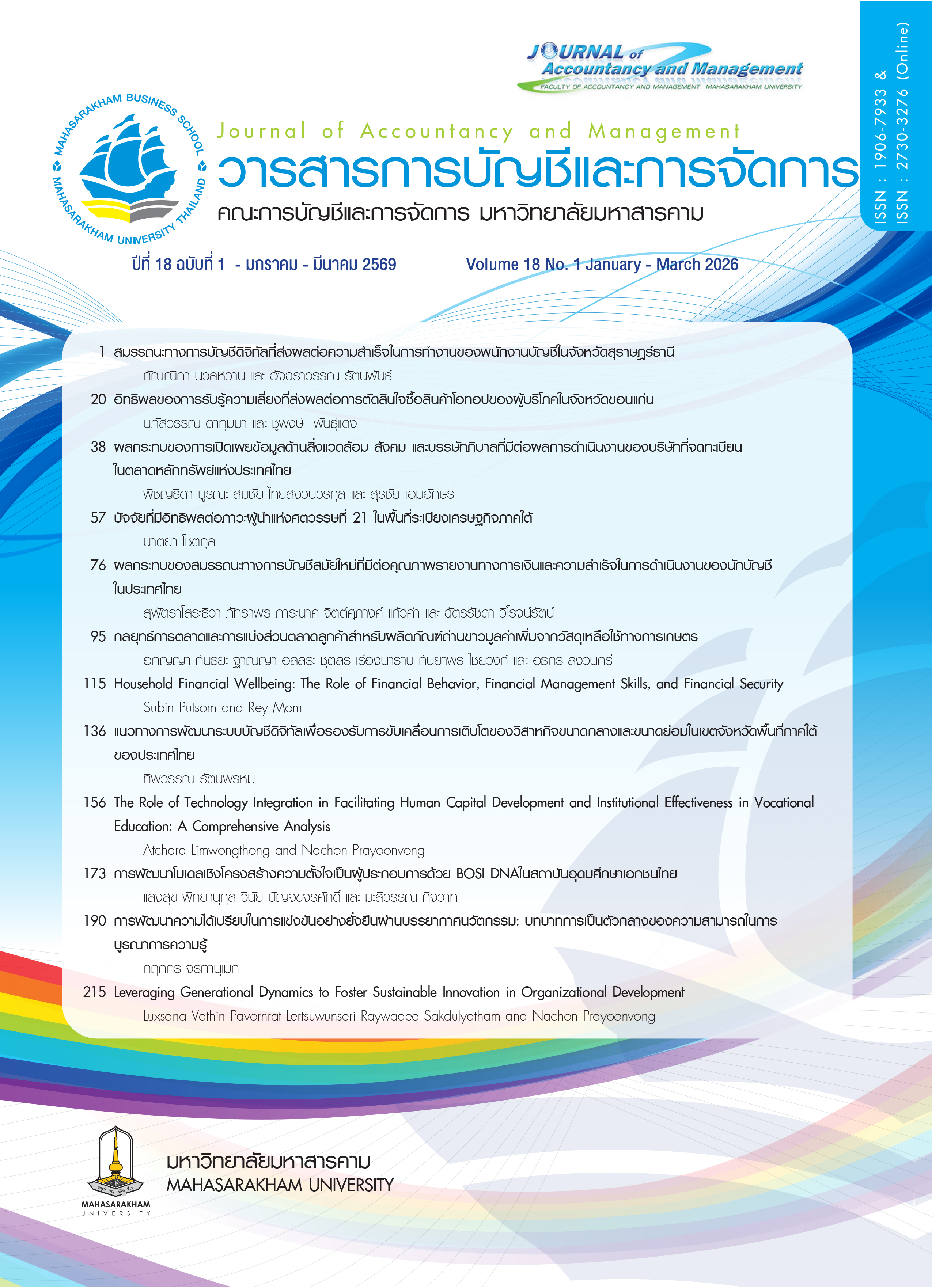
Leveraging Generational Dynamics to Foster Sustainable Innovation in Organizational Development
คำสำคัญ:
Generational Dynamics, Sustainable Innovation, Organizational Developmentบทคัดย่อ
The evolving structure of the twenty-first-century workforce presents significant challenges for organizations due to the increasing presence of employees from multiple generations, each with distinct values, attitudes, and work approaches. Effectively managing generational interactions is essential for enhancing organizational efficiency, innovation, and sustainable development. This article explores the psychological traits and work-related values of Baby Boomers, Generation X, Generation Y, and Generation Z, and how these influence workplace attitudes and cross-generational learning. While existing literature often emphasizes top-down knowledge transfer, this study highlights the underexplored potential of reciprocal intergenerational learning. Drawing on theories of organizational dynamics, generational behavior, innovation, and sustainability, the study proposes a participatory learning model that facilitates creative knowledge exchange and collaboration. It also emphasizes the importance of inclusive leadership and strategic policy in building adaptive organizational cultures. Despite widespread discussion of generational conflict, few studies provide actionable strategies to leverage generational differences as innovation drivers. This study addresses that gap by introducing the Intergenerational Synergy Framework and Innovation through Generational Collaboration, aiming to integrate generational diversity into strategies aligned with environmental, social, and governance (ESG) objectives.
Downloads
เอกสารอ้างอิง
Bennett, R. (2021). The role of participative leadership in shaping positive workplace dynamics. Journal of Organizational Psychology, 21(2), 105–120.
Chen, L., & Sun, R. (2022). Intergenerational learning in digital workplaces: Opportunities and challenges. Journal of Workplace Learning, 34(3), 215–230.
Chen, L., & Zhang, Y. (2021). Green technologies and organizational sustainability: Pathways and challenges. Journal of Cleaner Production, 279, 123456.
Chesbrough, H. W. (2020). Open innovation: The new imperative for creating and profiting from technology. Harvard Business Press.
Garcia, M., & Lee, A. (2023). Generational dynamics in knowledge-based organizations: A Strauss–Howe perspective. Journal of Organizational Behavior, 44(2), 215–232.
Gupta, A., & Kumar, S. (2023). Stakeholder engagement and sustainable organizational practices. Sustainability, 15(4), 1856.
Kim, H., & Davis, C. (2021). Learning preferences and work values of Gen Y and Gen Z: Implications for cross-generational training. Journal of Educational Development, 45(1), 67–83.
Kim, J., & Davis, R. (2021). Millennials in the workplace: Characteristics and implications. International Journal of Business Studies, 12(3), 75–90.
Kwon, H. J. (2020). Diversity and adaptability in workplace teams: A behavioral approach. International Journal of Human Resource Studies, 10(4), 45–62.
Lee, J., & Park, H. (2020). Knowledge transfer across generations in the workplace: A review and future research agenda. Human Resource Development Review, 19(4), 345–365.
Lopez, S., & Zhang, Y. (2023). Cultural agility and cross-generational collaboration in global teams. Journal of International Business Research, 18(1), 78–95.
Lozano, R. (2020). Embedding sustainability into organizational culture. Journal of Business Ethics, 162(4), 757–773.
Martinez, J., Silva, R., & Gomez, P. (2022). Sustainability strategy integration in corporate governance. Corporate Social Responsibility and Environmental Management, 29(2), 412–424.
Morales, D., Kim, E., & Tran, T. (2023). Two-way knowledge sharing between generations: Toward inclusive organizational learning. International Journal of Training and Development, 27(1), 44–61.
Nguyen, M., & Carter, L. (2021). Workplace dynamics in hybrid environments. Journal of Business and Management, 27(3), 132–150.
Nguyen, T., Hoang, M., & Pham, L. (2021). Top-down knowledge transfer in intergenerational teams: Implications for knowledge retention. Journal of Knowledge Management, 25(5), 1189–1205.
O’Reilly, C. A., & Tushman, M. L. (2021). The ambidextrous organization. Harvard Business Review, 82(4), 74–81.
Oliveira, T., & Martins, A. (2020). Understanding generational learning needs: A review of Strauss–Howe generational theory in education. International Review of Education, 66(4), 521–539.
Patel, R. (2020). Designing inclusive HR strategies for multi-generational workforces. Human Resource Development International, 23(1), 85–102.
Prayoonvong, N. (2025). Figures and tables created by the author for the article “Leveraging Generational Dynamics to Foster Sustainable Innovation in Organizational Development.” Unpublished manuscript.
Rogers, E. M. (2003). Diffusion of innovations (5th ed.). Free Press.
Silva, D., Thomas, R., & Ali, H. (2022). Interpersonal communication and trust in multicultural teams: The foundation of dynamic workplaces. International Journal of Intercultural Relations, 89, 30–45.
Smith, D., & Turner, J. (2021). Bridging generational gaps in modern workplaces: Insights from Strauss–Howe generational theory. International Journal of Human Resource Management, 32(6), 1231–1250.
Smith, T., Brown, K., & Johnson, M. (2019). Transparency in sustainability reporting: Enhancing organizational credibility. Journal of Sustainable Business, 14(3), 211–228.
Zhang, Y., Liu, H., & Wang, S. (2022). Adapting leadership for generational diversity: Lessons from Strauss–Howe’s theory. Leadership & Organization Development Journal, 43(3), 412–428.
ดาวน์โหลด
เผยแพร่แล้ว
รูปแบบการอ้างอิง
ฉบับ
ประเภทบทความ
สัญญาอนุญาต
ลิขสิทธิ์ (c) 2025 วารสารการบัญชีและการจัดการ

อนุญาตภายใต้เงื่อนไข Creative Commons Attribution-NonCommercial-NoDerivatives 4.0 International License.
บทความที่ได้รับการตีพิมพ์เป็นลิขสิทธิ์ของวารสารการบัญชีและการจัดการ
ข้อความที่ปรากฏในบทความแต่ละเรื่องในวารสารวิชาการเล่มนี้เป็นความคิดเห็นส่วนตัวของผู้เขียนแต่ละท่านไม่เกี่ยวข้องกับมหาวิทยาลัยมหาสารคาม และคณาจารย์ท่านอื่นๆในมหาวิทยาลัยฯ แต่อย่างใด ความรับผิดชอบองค์ประกอบทั้งหมดของบทความแต่ละเรื่องเป็นของผู้เขียนแต่ละท่าน หากมีความผิดพลาดใดๆ ผู้เขียนแต่ละท่านจะรับผิดชอบบทความของตนเองแต่ผู้เดียว