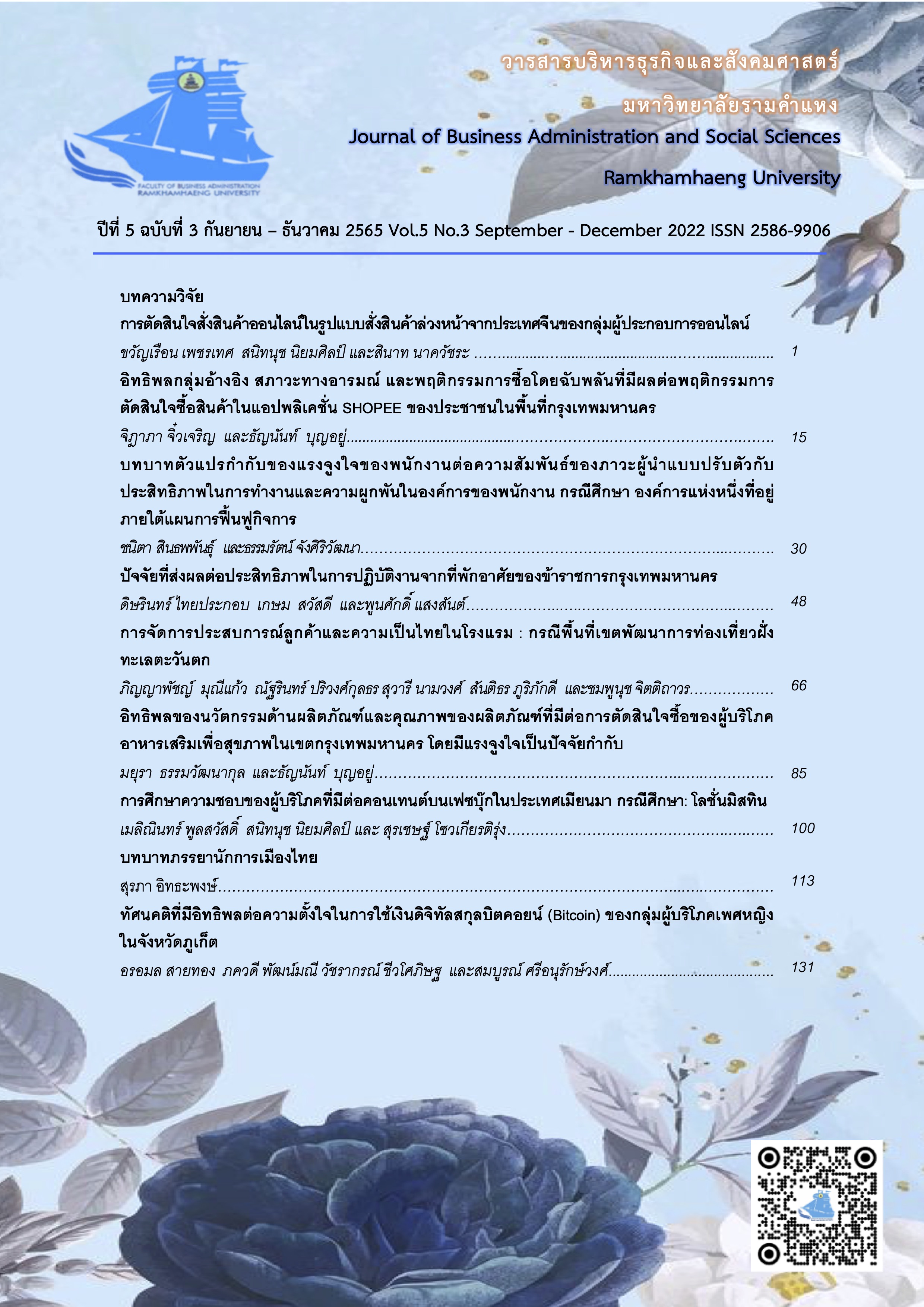
บทบาทตัวแปรกำกับของแรงจูงใจของพนักงานต่อความสัมพันธ์ของภาวะผู้นำแบบปรับตัวกับประสิทธิภาพในการทำงานและความผูกพันในองค์การของพนักงาน กรณีศึกษา องค์การแห่งหนึ่งที่อยู่ภายใต้แผนการฟื้นฟูกิจการ
Article Sidebar
Main Article Content
บทคัดย่อ
การศึกษาเชิงปริมาณนี้มีวัตถุประสงค์เพื่อทดสอบบทบาทตัวแปรกำกับของแรงจูงในการทำงานที่มีต่อความสัมพันธ์ระหว่างภาวะผู้นำแบบปรับตัวกับประสิทธิภาพในการทำงานและความผูกพันต่อองค์การของพนักงานในองค์การที่อยู่ภายใต้แผนฟื้นฟูกิจการเก็บข้อมูลแบบแบ่งชั้นภูมิจากองค์การกรณีศึกษาจำนวน 372 ตัวอย่างและวิเคราะห์ข้อมูลสถิติแบบเส้นทางกำลังสองน้อยที่สุดบางส่วน (Partial Least Square: PLS) ด้วยโปรแกรมสำเร็จรูป PLS-SEM 3.0 เพื่อทดสอบสมมติฐานงานวิจัย ผลการวิจัยพบว่าภาวะผู้นำแบบปรับตัวมีความสัมพันธ์ทางลบกับประสิทธิภาพในการปฏิบัติงานของพนักงาน (β = -0.24;
p < 0.05) และมีความสัมพันธ์ทางบวกกับความผูกพันต่อองค์การของพนักงาน (β = 0.20; p < 0.05)แรงจูงใจในการปฏิบัติงานของพนักงานไม่ส่งผลต่อความสัมพันธ์ระหว่างภาวะผู้นำแบบปรับตัวกับประสิทธิภาพในการปฏิบัติงานและความผูกพันต่อองค์การของพนักงาน ข้อเสนอแนะจากการศึกษานี้สำคัญต่อองค์การที่อยู่ภายใต้แผนฟื้นฟูกิจการต้องเผชิญกับสิ่งแวดล้อมที่มีความเปลี่ยนแปลง ดังนั้นภาวะผู้นำที่ส่งผลลบต่อประสิทธิภาพการทำงานในองค์การที่อยู่ภายใต้แผนฟื้นฟูกิจการเป็นปัจจัยที่องค์การต้องพิจารณาและให้ความสำคัญ องค์การที่อยู่ภายใต้แผนฟื้นฟูจึงควรพัฒนาภาวะผู้นำขององค์การในทุกส่วนให้มีความพร้อมเพื่อเป็นต้นแบบและเป็นผู้นำให้กับพนักงาน เพื่อการทำงานที่มีประสิทธิภาพและเสริมสร้างให้พนักงานมีความผูกพันต่อองค์การ อันจะช่วยให้เกิดความสัมพันธ์ที่ดีในการร่วมฝ่าฟันอุปสรรคต่าง ๆ
Article Details

อนุญาตภายใต้เงื่อนไข Creative Commons Attribution-NonCommercial-NoDerivatives 4.0 International License.
เนื้อหาและข้อมูลในบทความที่ลงตีพิมพ์ในวารสารบริหารธุรกิจและสังคมศาสตร์ มหาวิทยาลัยรามคำแหง ถือเป็นข้อคิดเห็นและความรับผิดชอบของผู้เขียนบทความโดยตรง ซึ่งกองบรรณาธิการไม่จำเป็นต้องเห็นด้วย หรือร่วมรับผิดชอบใดๆ
บทความ ข้อมูล เนื้อหา รูปภาพ ฯลฯ ที่ได้รับการตีพิมพ์ในวารสารบริหารธุรกิจและสังคมศาสตร์ มหาวิทยาลัยรามคำแหง ถือเป็นลิขสิทธิ์ของวารสารบริหารธุรกิจและสังคมศาสตร์ มหาวิทยาลัยรามคำแหง หากบุคคลหรือหน่วยงานใดต้องการนำบทความทั้งหมดหรือส่วนหนึ่งส่วนใดไปเผยแพร่ต่อ หรือเพื่อกระทำการใดๆ จะต้องได้รับอนุญาตเป็นลายลักษณ์อักษรจากวารสารบริหารธุรกิจและสังคมศาสตร์ มหาวิทยาลัยรามคำแหง ก่อนเท่านั้น
เอกสารอ้างอิง
กระทรวงยุติธรรม. (2563). การแก้ไขปัญหาทางธุรกิจของลูกหนี้โดยการฟื้นฟูกิจการ. สืบค้นจาก https://www.led.go.th/brd/file/
สุวัฒน์ จุลสุวรรณ. (2564).ความสัมพันธ์ระหว่างภาวะผู้นำการปรับเปลี่ยนกับประสิทธิผลการบริหารสถานศึกษา สังกัดคณะกรรมการการศึกษาขั้นพื้นฐาน. วารสารวิชาการมหาวิทยาลัยการจัดการและเทคโนโลยีอีสเทิร์น 17(2), 28-40.
Allozi, A. I., Alshurideh, M., Alhamad, A. Q., & Al Kurdi, B. H. (2022). Impact of transformational leadership on the job satisfaction with the moderating role of organizational commitment: Case of UAE and Jordan manufacturing. Academy of Strategic Management Journal, 21(s-2), 1-13. ISSN: 1939-6104-21. S2-001.
Caringal-Go, J. F., Teng-Calleja, M., Franco, E. P., Manaois, J. O., & Zantua R. M. S. (2021). Crisis leadership from the perspective of employees during COVID-19 pandemic. Leadership & Organization Development Journal, 42(4), 630-643. Doi: 10.1108/LODJ-07-2020-0284
Dysvik, A., and Kuvaas, B. (2011). Intrinsic motivation as a moderator on the relationship between perceived job autonomy and work performance. European Journal of Work and Organizational Psychology, 20(3), 367-387. Doi: 10.1080/13594321003590630
Erkutu, H. (2007). The impact of transformational leadership on organizational and leadership effectiveness. Journal of Management Development, 27(7), 708-726. Doi: 10.1108/02621710810883616
Garavaglia, C., Sancino, A., & Trivellato, B. (2020). Italian mayors and the management of COVID-19: Adaptive leadership for organizing local governance. Eurasian Geography and Economic, 62(1), 76-92. Doi: 10.1080/15387216.2020.1845222
Hair J. F., Black, W. C., Babin, B. J., & Anderson, R. E. (2019). Multivariate data analysis (8th ed.). Hamshire, UK: Cengage.
Heifetz, R. A., & Laurie, D. L. (1997). The work of leadership. Harvard business review, 75, 124-134.
Herzberg, F., Mausner, B., & Snyderman, B. B., (1959). The motivation to work. New Yourk: John Wiley & Sons. In Work and the nature of man, F. Herzberg (1973), New York: Menter Book, pp. 91-111.
Jangsiriwattana, T. (2019). The relationship between transformational and transactional leadership: Employee perception of organizational performance and work engagement. Journal of International Academy for Case Studies, 25(3), 1-10. ISSN: 1532-5822-25-3.148
Johansen, B. P. (1990). Situational leadership: A review of the research. Human Resource Development Quarterly, 1(10), 73-85. Doi: 10.1002/hrdq.3920010109
Khalizadeh, J. & Tasci, A.D.A. (2010). Large sample size, significance level, and the effect size: Solutions to perils of using big data for academic research. Tourism Management, 62; 89-96.
Kimberly, J. R. (1975). Environmental constrains and organizational structure: A comparative analysis of rehabilitation organizations. Administrative Science Quarterly, 20(1), 1-9. Retrieved from https://www.jstor.org/stable/2392119
Krejcie, R. V., & Morgan, D. W. (1970). Determining sample size for research activities. Educational and psychological measurement, 30(3), 607-610.
Nebiyu, K. S., & Kassahun, T. (2021). The effects of adaptive leadership on organizational effectiveness at public higher education institutions of Ethiopia. International Journal of Organizational Leadership, 10(s-2021), 141-159. Retrieved from https://www.ijol.cikd.ea
Northouse, P. G. (2016). Leadership: Theory and Practice (7th ed.). London, UK: Sage
Rabiul, M. K., Patwary, A. K., & Panha, I. (2022). The role of servant leadership, self-efficacy, high performance work system, and work engagement in increasing service-oriented behavior. Journal of Hospitality Marketing & Management, 31(4), 504-526. Doi: 10.1080/19368623.2022.1990169
Randall, L. M., & Coakley, L. A. (2006). Applying adaptive leadership to successful change initiatives in academia. Leadership & Organization Development Journal, 28(4), 325-335. Doi: 10.1108/01437730710752201
Santra, S., & Alat , P. (2021). Adaptive leadership of doctors during COVID-19. Leadership in Health Service, 35(2), 246-266. Doi: 101108/LHS-08-2021-0073
Shiva, M. S. A. M., & Suar, D. (2012). Transformational leadership, organizational culture, organizational effectiveness, and program outcomes in non-governmental organizations. International Journal of Voluntary and Nonprofit Organization, 23, 684-710. Doi: 10.1007/s11266-011-9230-4.
Suputra, F. (2021). Leasdership, communication, and work motivation in determining the success of professional organizations. Journal of Law, Politic and Humanities, 1(2), 59 – 70. ISSN: 2747-1985
Trepanier, S. G., Vallerand, R., Menard, J., & Peterson, C. (2020). Job resource and burnout: Work motivation as a moderator. Stress & Health, 36(4), 433-441. Doi: 10.1002/smi.2939
Yukl, G., & Mahsud, R. (2010). Why flexible and adaptive leadership essential. Consulting Psychology Journal: Practice and Research, 62(2), 81-93. Doi: 10.1037/a0019835
