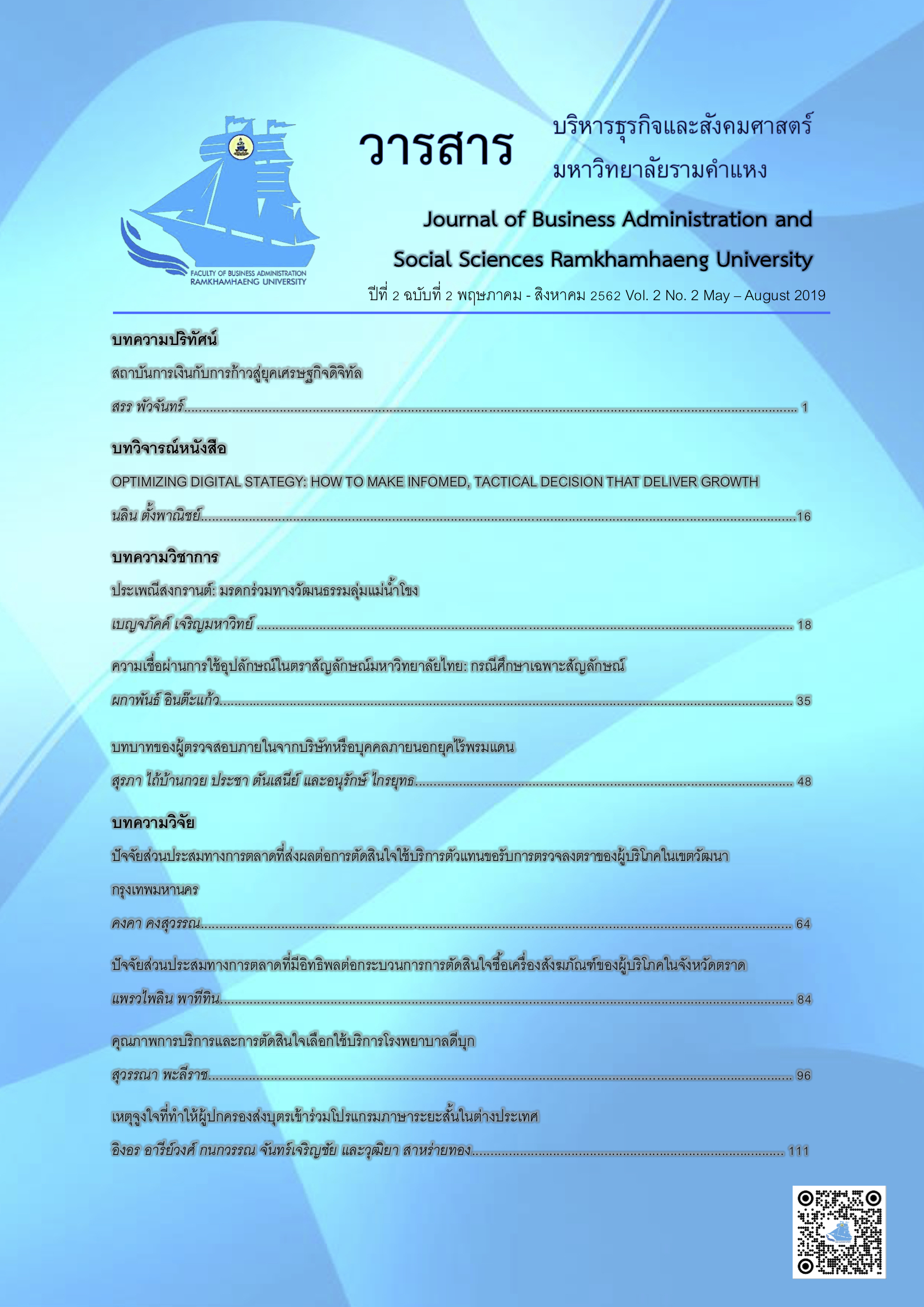
สถาบันการเงินกับการก้าวสู่เศรษฐกิจดิจิทัล
Article Sidebar
Main Article Content
บทคัดย่อ
ปัจจุบัน ธุรกิจมีการนำเทคโนโลยีสมัยใหม่มาใช้เพื่อช่วยในการสนับสนุนการวางแผนและตัดสินใจ สถาบันการเงินเป็นอีกธุรกิจหนึ่งที่นำเทคโนโลยีมาใช้หลากหลายรูปแบบ ส่งผลให้เกิดการเปลี่ยนแปลงในการให้บริการแก่ลูกค้า ทั้งนี้ ปัจจัยที่มีผลต่อความสำเร็จในการนำเทคโนโลยีมาใช้ คือ การพัฒนาทักษะใหม่ให้แก่บุคลากร เช่น การประมวลผล การวิเคราะห์ข้อมูลปริมาณมาก และสามารถทำความเข้าใจข้อมูลเชิงลึก (Insight) เป็นต้น เนื่องจากธุรกิจสถาบันการเงินในยุคเศรษฐกิจดิจิทัลมักจะเกี่ยวข้องกับข้อมูลลูกค้าจำนวนมาก จึงจำเป็นต้องมีการบริหารจัดการ และนำข้อมูลที่เกิดขึ้นมาประมวลวิเคราะห์เพื่อค้นหา Insight และนำไปใช้ในการดำเนินธุรกิจได้ ขณะเดียวกัน ความท้าทายที่สำคัญของการก้าวสู่เศรษฐกิจดิจิทัล คือ ความสามารถในการระบุตัวตนของลูกค้าในโลกดิจิทัล เพื่อให้สถาบันการเงินสามารถเข้าถึง และส่งมอบการให้บริการทางการเงินขั้นพื้นฐานแก่ลูกค้าได้ ดังนั้น การก้าวสู่ยุคเศรษฐกิจดิจิทัลของสถาบันการเงินจึงมีความท้าทายทั้งจากตัวของสถาบันการเงินเอง คู่แข่งในธุรกิจ กฎเกณฑ์ กฎหมายที่เกี่ยวข้อง และรวมถึงผู้ประกอบธุรกิจทางการเงินรายใหม่ที่อาจก่อให้เกิดการเปลี่ยนแปลงรูปแบบธุรกิจ (Disruption) ได้
Article Details
เนื้อหาและข้อมูลในบทความที่ลงตีพิมพ์ในวารสารบริหารธุรกิจและสังคมศาสตร์ มหาวิทยาลัยรามคำแหง ถือเป็นข้อคิดเห็นและความรับผิดชอบของผู้เขียนบทความโดยตรง ซึ่งกองบรรณาธิการไม่จำเป็นต้องเห็นด้วย หรือร่วมรับผิดชอบใดๆ
บทความ ข้อมูล เนื้อหา รูปภาพ ฯลฯ ที่ได้รับการตีพิมพ์ในวารสารบริหารธุรกิจและสังคมศาสตร์ มหาวิทยาลัยรามคำแหง ถือเป็นลิขสิทธิ์ของวารสารบริหารธุรกิจและสังคมศาสตร์ มหาวิทยาลัยรามคำแหง หากบุคคลหรือหน่วยงานใดต้องการนำบทความทั้งหมดหรือส่วนหนึ่งส่วนใดไปเผยแพร่ต่อ หรือเพื่อกระทำการใดๆ จะต้องได้รับอนุญาตเป็นลายลักษณ์อักษรจากวารสารบริหารธุรกิจและสังคมศาสตร์ มหาวิทยาลัยรามคำแหง ก่อนเท่านั้น
เอกสารอ้างอิง
Brynjolfsson, E., & Kahin, B. (2002). Understanding the Digital Economy: Data, Tools, and Research. Cambridge, MA: MIT Press.
Carlsson, B. (2004). The digital economy: What is new and what is not? Structural Change and Economic Dynamics, 15(3), 245-264.
Chiu, I. H-Y. (2016). FinTech and disruptive business models in financial products, intermediation and market: Policy implications for financial regulators. Journal of Technology, Law, and Policy, 21, 55-112.
Dermine, J. (2017). Digital disruption and bank lending. European Economy: Banks, Regulation, and the Real Sector, 2, 63-76.
Durand, A. (2017). Customer Identities Are the Common Denomination in Changing Business Model. Retrieved March 18, 2019, from https//www./pingidentity.com/en/company/blog/posts/2017/customer-identities-are-the-commondenominator-in-changing-business-models.html
Gabor, D., & Brooks, S. (2017). The digital revolution in financial inclusion: International development in fintech era. New Political Economy, 22(4), 423-436.
Gasperini, F. (2018). Are You Shaping Your Bank’s Digital Future or Is It Shaping You?. Retrieved July 12, 2019, from https://www.ey.com/gl/en/industries/financial-services/fso-insights-are-you-shaping-your-banks-digital-future-or-is-it-shaping-you.
Gomber, P., Kauffman, R. J., Parker, C., & Weber, B. W. (2018). On the fintech revolution: Interpreting the forces of innovation, disruption, and transformation in financial services. Journal of Management Information Systems, 35(1), 220-265.
Haltiwanger, J., & Jarmin, R. S. (1999). Measuring the Digital Economy. Retrieved July 12, 2019, from https://pdfs.semanticscholar.org/95fc/71c62cd6f6fc8132e8d5823f7633ce25ca0c.pdf?ga=2.112716547.668655833.1566205168122541315.1561044666.
KPMG. (2018). Emerging Risks and Evolving Responses: Exploring the Challenges Facing Banking and How the Industry can Respond. Retrieved July 25, 2019, from https://home.kpmg/content/dam/kpmg/uk/pdf/2019/02/emerging-risks-and-evolving-responses.pdf
Li, S. (2003). Future trends and challenges of financial risk management in the digital economy. Managerial Finance, 29(5/6), 111-125.
Navaretti, G. B., Calzolari, G., & Pozzolo, A. F. (2017). FinTech and banks: Friends or foes. European Economy: Banks, Regulation, and the Real Sector, 2, 9-30.
Nikolova, I. (2018). What Are the 5 Key Components of IAM in the Digital Transformation Process?. Retrieved August 2, 2019, from https//www.patecco.com/en/blog/ what-are- the-5-key-components-of-iam-in-the-digital-transformation-process.
Sangroya, A., Kumar, S., Dhok, J., & Varma, V. (2010). Towards analyzing data security risks in cloud computing environments. Communications in Computer and Information Science, 54, 255-265.
Scheibach, M. (2019). 2019 Banking Trends: Facing the Challenges and Seizing the Opportunities. Retrieved July 28, 2019, from https://www.fintechamericas.com/
news/2019-banking-trends-facing-the-challenges-and-seizing-the-opportunities/.
Tapscott, D. (1998). Blueprint to the Digital Economy: Creating Wealth in the Era of E-Business. New York: McGraw-Hill.
Vives, X. (2017). The impact of fintech on banking. European Economy: Banks, Regulation, and the Real Sector, 2, 97-105.
Vovchenko, N. G., Andreeva, A. V., Orobinskiy, A. S., & Filippov, Y. M. (2017). Competitive advantages of financial transactions on the basis of the blockchain technology in digital economy. European Research Studies Journal, 20(3B),193-212.
World Bank. (2017). 1.1 Billion ‘Invisible’ People Without ID Are Priority for New High-Level Advisory Council on Identification for Development. Retrieved June 28, 2019, from http://www.worldbank.org/en/news/press-release/2017/10/12/11-billion-invisible-people-without-id-are-priority-for-new-high-level-advisory-council-on-identification-for-development.
World Economic Forum. (2015). The Future of Financial Services: How Disruptive Innovations are Reshaping the Way Financial Services are Structured, Provisioned and Consumed. Retrieved June 20, 2019, from http://globaltrends.thedialogue.org/publication/the-future-of-financial-services-how-disruptive-innovations-are-reshaping-the-way-financial-services-are-structured-provisioned-and-consumed/.
Zimmermann, H. D. (2000). Understanding the digital economy: Challenges for new business models. Paper presented at Association for Information Systems Conference on Understanding the Digital Economy: Challengers for New Business Models. SSRN Electronic Journal, DOI: 10.2139/ssrn.2566095.
