
University staffs’ attitude towards gender in Thai society
Article Sidebar
Main Article Content
Abstract
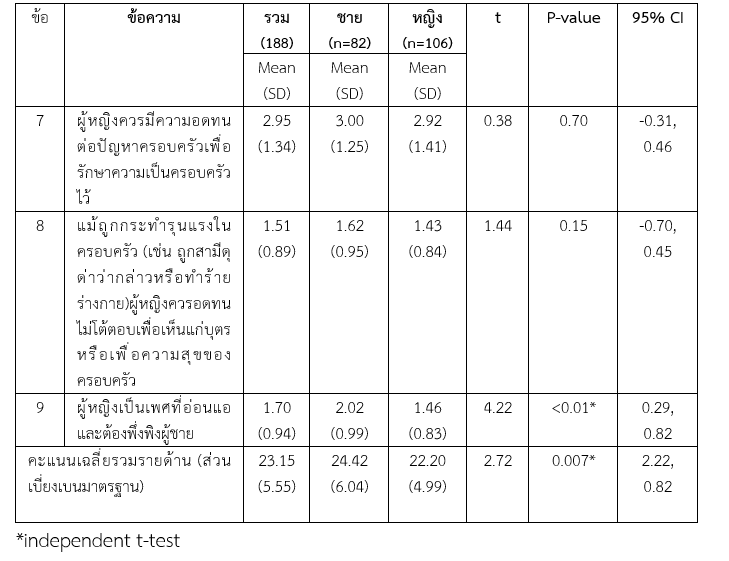
This research aimed to describe attitudes towards gender roles of university staffs. Subjects included 188 staffs at a university in Thailand. Systemic sampling was used. The Attitude towards Gender Scale was used as a study measurement. It contained five dimensions, (norms of Thai women/men, roles of Thai women and men in the family, roles of Thai women and men in the community/workplace, power in relationships, and roles of Thai women and men in a sexual relationship). The item was a 5 - point likert-scale ranging from 1 (disagree) to 5 (completely agree). The results showed that men had significantly higher mean scores, which supporting patriarchy on five dimensions than women (p< 0.05). University should include a mission and strategic plan on promoting and supporting gender equality.
Article Details
บทความที่ได้รับการตีพิมพ์เป็นลิขสิทธิ์ของวารสารมนุษยศาสตร์และสังคมศาสตร์ มหาวิทยาลัยอุบลราชธานี
ข้อความที่ปรากฏในบทความแต่ละเรื่องในวารสารวิชาการเล่มนี้เป็นความคิดเห็นส่วนตัวของผู้เขียนแต่ละท่านไม่เกี่ยวข้องกับมหาวิทยาลัยอุบลราชธานี และคณาจารย์ท่านอื่นๆในมหาวิทยาลัยฯ แต่อย่างใด ความรับผิดชอบองค์ประกอบทั้งหมดของบทความแต่ละเรื่องเป็นของผู้เขียนแต่ละท่าน หากมีความผิดพลาดใดๆ ผู้เขียนแต่ละท่านจะรับผิดชอบบทความของตนเองแต่ผู้เดียว
References
ประหยัด สายวิเชียรและวาณี เอี่ยมศรีทอง. 2538. รายงานการวิจัยเรื่องการดำเนินชีวิตในครอบครัวกับความเครียดในการทำงาน. เชียงใหม่ : คณะศึกษาศาสตร์ มหาวิทยาลัยเชียงใหม่.
วันทนีย์ วาสิกะสิน และ สุนีย์ เหมะประสิทธิ์. 2541. สังคมไทยคาดหวังอย่างไรกับผู้หญิง. กรุงเทพฯ: สำนักพิมพ์มหาวิทยาลัยธรรมศาสตร์.
ศูนย์สาธารณประโยชน์และประชาสังคม สถาบันบัณฑิตพัฒนบริหารศาสตร์. 2555. รายงานผลการสำรวจเจตคติของประชาชนด้านความเสมอภาคหญิงชาย ฉบับสมบูรณ์. http://www.gender.go.th/research/rsdoc/att/content_
attitude_2555.pdf. 5 กุมภาพันธ์ 2557
สมพร รุ่งเรืองกลกิจ, จิราพร เขียวอยู่, วราลักษณ์ กิตติวัฒน์ไพศาล และอิงคฏา โคตรนารา. 2557. “การพัฒนาเครื่องมือประเมินทัศนคติต่อเพศภาวะ”. วารสารพยาบาลศาสตร์และสุขภาพ 37 (4): 1-12.
______________, วราลักษณ์ กิตติวัฒนไพศาล, อิงคฏา โคตนารา และ สุวรรณา อรุณพงศ์ไพศาล. 2555. “โรคซึมเศร้าวิเคราะห์ผ่านมุมมองเพศภาวะ”. วารสารพยาบาลศาสตร์ และ สุขภาพ 35 (4): 21-30.
สำนักงานกิจการสตรีและสถาบันครอบครัว กระทรวงพัฒนาสังคมและความมั่นคงมนุษย์. 2550. คู่มือการวิเคราะห์เชิงมิติหญิงชาย. กรุงเทพฯ: โรงพิมพ์ สกสค.
_________________. 2552. มาตรฐานและตัวชี้วัดความเสมอภาคระหว่างหญิงชาย. กรุงเทพฯ: บิสิเนส อินฟอร์เมชัน พับลิซิตี จำกัด.
____________________และ โตรงการสตรีและเยาวชนศึกษา. มาตรฐานและตัวชี้วัด ความเสมอภาคระหว่างหญิงชาย.
http://www.gender.go.th/publication/book/Standards%20and%20Indicators.pdf. 18 สิงหาคม 2559.
สำนักบริหารการสาธารณสุข สำนักงานปลัดกระทรวงสาธารณสุข. 2556. สถิติผู้มารับบริการในศูนย์พึ่งได้ ในปีพ.ศ. 2547 - พ.ศ. 2554. http://www.phdb.moph.go.th/ewtadmin/ewt/hss_webserv/download/data_centeer56/indexhtml. 1 กันยายน 2556.
สุชีลา ตันชัยนนท์. 2540. สถานการณ์โรคเอดส์: ความหมายของเพศธรรมที่กำลังเปลี่ยนไป. ในเอกสารประกอบการเรียนการสอน วิชาทฤษฎีเฟมินิสต์และทฤษฎีเพศ. นครปฐม: ภาควิชาสังคมศาสตร์การแพทย์และสาธารณสุข คณะสังคมศาสตร์และมนุษยศาสตร์ มหาวิทยาลัยมหิดล.
สุวัฒนา วิบูลย์เศรษฐ์. 2538. การศึกษาความสัมพันธ์ของประชากรต่างวัยในครอบครัว ภาคเหนือและภาคตะวันออกเฉียงเหนือ. สถาบันประชากรศาสตร์ จุฬาลงกรณ์มหาวิทยาลัย.
อวยพร เขื่อนแก้ว. 2555. เส้นทางสู่การเปลี่ยนแปลง: เพศและความเป็นธรรมบนฐานจิตวิญญาณและการเรียนรู้ด้วยหัวใจ. กรุงเทพฯ: โรงพิมพ์เดือนตุลา.
Allanana, G.M. 2013. “Patriarchy and gender inequality in Nigeria: The way forward”. European Scientific Journal 9(17): 115-144.
Astbury, J. Gender and mental health. http://www.globalhealth.harvard.edu/hcpds/wpweb/gender/astbury.pdf, 16 กุมภาพันธ์ 2550.
Chan, J. D. 2009. “Male Gender Role Strain” : A Pastoral Assessment. Doctor of Theology: University of Stellenbosch.
Ickes, W. 1993. “Traditional gender roles: Do they make, and then break, our relationship?”. Journal of Social Issues 49(3): 71-85.
Jakobsson, N. & Kotsadam, A. 2009. “Do attitudes toward gender equality really differ between Norway and Sweden?”. Working paper in economics. No. 352.
Marinova, J. 2003. “Gender stereotypes and the socialization process”. Paper presented for Expert Group Meeting on “the role of men and boys in achieving gender equality.” 21-24 October 2003 Brasilia, Brazil.
O’Sullivan, S. 2012. “All changed, changed utterly? Gender role attitudes and the feminization of the Irish labour force”. Women’s Studies International Forum doi:10.1016/j.wsif.2012.03.020
Robbins, A. 2006. “Biopsychosocial aspects in understanding and treating depression in men: a clinical perspective”. Journal of Men's Health and Gender 3(1), 10-18.
Tu, S. & Chang, Y. 2000. Women ‘s and men’s gender role attitudes in coastal China and Taiwan, Paper presented for East Asain Labor Markets Conference at Yonsei University, Seoul, Korea, February 24, 2000.
World Health Organization. 2009. Gender mainstreaming for health managers: a practical approach. Geneva.
