
Marginalised masculinity in the fiction of Mo Yan and Zhu Wen: Socialist residues, struggles, and resilience
Article Sidebar
Main Article Content
Abstract
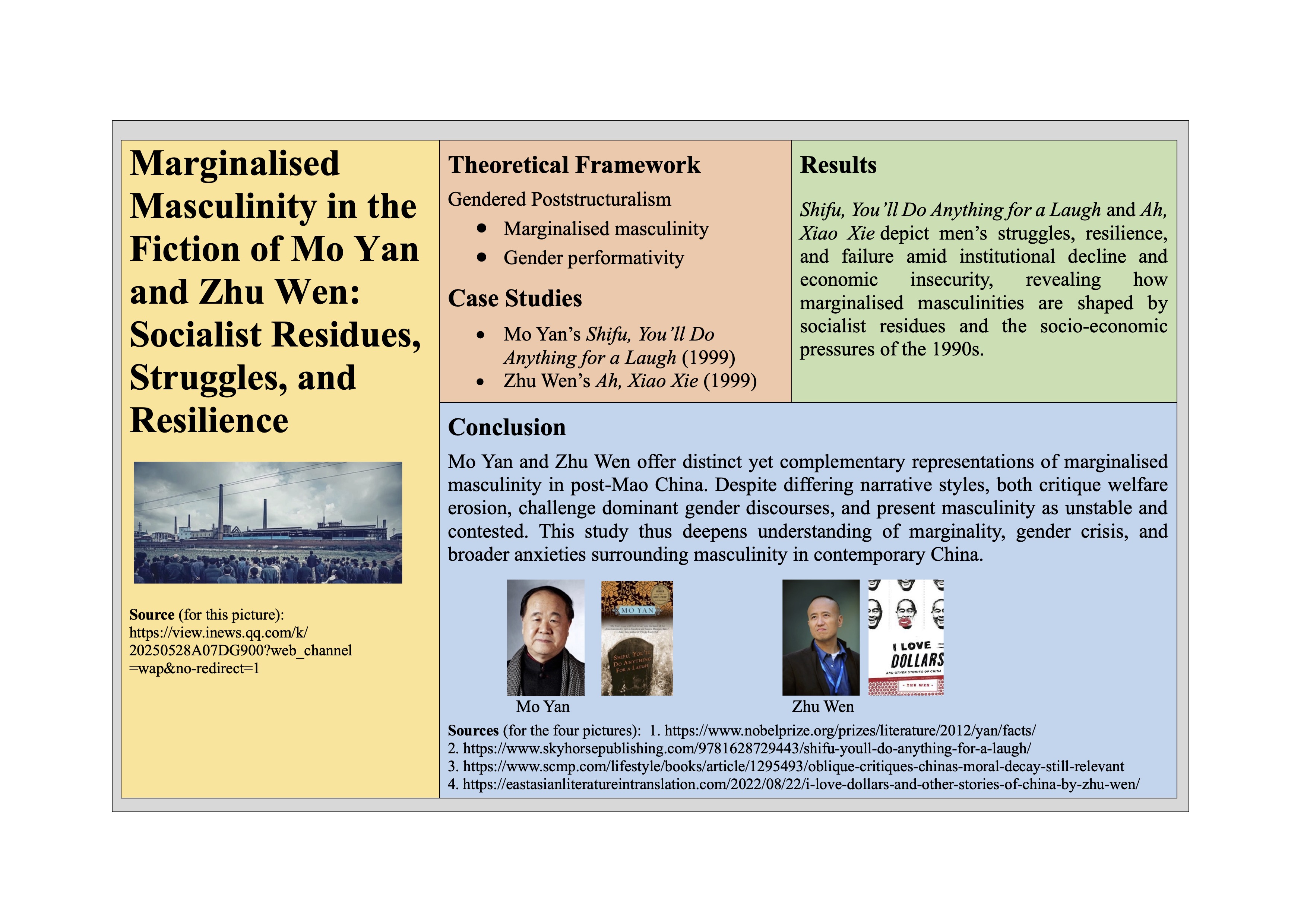
This paper examines representations of marginalised masculinity in the fiction of Mo Yan and Zhu Wen, showing how male subjectivity is reshaped by ideological residues of the socialist past and the socio-economic upheavals of post-Mao China. In the late 1990s, state-owned enterprise (SOE) reform and large-scale layoffs produced a precarious population of displaced workers, with employees in crisis-ridden or shuttered factories—both younger and middle-aged—among the hardest hit. Their lives were shaped simultaneously by the lingering legacies of Maoist collectivism and the disruptive forces of market reform. Post-Mao writers increasingly responded to these transformations through new narrative forms that foreground social insecurity, gender anxiety, and the destabilisation of masculine identity. Focusing on Mo Yan’s Shifu, You’ll Do Anything for a Laugh (1999) and Zhu Wen’s Ah, Xiao Xie (1999), this study addresses a gap in scholarship on Chinese masculinity by offering a gender-focused analysis of marginal male protagonists caught between obsolete socialist certainties and unstable market futures. Approaching these works from a gendered poststructuralist perspective, it explores how they portray men’s struggles, resilience, and failures under conditions of institutional decline and economic insecurity. Through detailed analysis and comparative reading, the paper demonstrates how Mo Yan and Zhu Wen critique the erosion of welfare, challenge dominant gender discourses, and represent masculinity as unstable and contested. In doing so, it contributes to a deeper understanding of marginality, gender crisis, and the broader cultural anxieties surrounding masculinity in post-Mao China.
Downloads
Article Details

This work is licensed under a Creative Commons Attribution-NonCommercial-NoDerivatives 4.0 International License.
All rights reserved. Apart from citations for the purposes of research, private study, or criticism and review,no part of this publication may be reproduced, stored or transmitted in any other form without prior written permission by the publisher.
References
Butler, J. (1990). Gender trouble: Feminism and the subversion of identity. Routledge.
Butler, J. (1993). Bodies that matter: On the discursive limits of “sex”. Routledge.
Cheng, Z., & Beresford, M. (2012). Layoffs in China’s city of textiles: Adaptation to change. Journal of Contemporary Asia, 42(2), 155–181. https://doi.org/10.1080/00472336.2012.668347
Connell, R. W. (2005). Masculinities (2nd ed.). Polity.
Connell, R. W., & Messerschmidt, J. W. (2005). Hegemonic masculinity: Rethinking the concept. Gender & Society, 19(6), 829–859. https://doi.org/10.1177/0891243205278639
Edwards, L. P. (1994). Men and women in Qing China: Gender in The Red Chamber Dream. Brill.
Han, J. (2019). Renxing yu yuwang de zhanshi chang—jiedu Mo Yan xiaoshuo “Shifu yuelaiyue youmo” [A showcase of humanity and desire: Reading Mo Yan’s Shifu, You’ll Do Anything for a Laugh]. Journal of Weifang University, 19(1), 1–4. [in Chinese]
Hird, D., & Song, G. (Eds.). (2018). The cosmopolitan dream: Transnational Chinese masculinities in a global age. Hong Kong University Press. https://doi.org/10.1515/9789888455478
Huang, A. C. Y., & Goldblatt, H. (2009). Mo Yan as humorist. World Literature Today, 83(4), 32–37. https://doi.org/10.1353/wlt.2009.0315
Huang, J., & Mo, Y. (2020). Mo Yan zuopin Yingyi zhong “du” de bawo—yi “Shifu yuelaiyue youmo” zi Ge Haowen yiben wei li [The “degree” in English translation of Mo Yan’s works: The case study of Howard Goldblatt’s translation of Shifu, You’ll Do Anything for a Laugh]. Journal of Huizhou University, 40(5), 78–82. [in Chinese]
Hunt, P. (2022). Rebel men: Masculinity and attitude in postsocialist Chinese literature. Hong Kong University Press. https://doi.org/10.2307/j.ctv2rcndzm
Kong, N., Osberg, L., & Zhou, W. (2019). The shattered “Iron Rice Bowl”: Intergenerational effects of Chinese state-owned enterprise reform. Journal of Health Economics, 67, Article 102220. https://doi.org/10.1016/j.jhealeco.2019.06.007
Kong, S. (2005). Consuming literature: Best sellers and the commercialization of literary production in contemporary China. Stanford University Press. https://doi.org/10.1515/9780804767378
Larson, W. (2017). Zhang Yimou: Globalization and the subject of culture. Cambria Press.
Li, Q. (2000). Shehui fenceng yu pinfu chaju [Social stratification and the poor-rich disparity]. Lujiang Press. [in Chinese]
Louie, K. (2002). Theorising Chinese masculinity: Society and gender in China. Cambridge University Press.
Louie, K. (2014). Chinese masculinities in a globalizing world. Routledge. https://doi.org/10.4324/9781315884646
Lovell, J. (2007). Translator’s preface to I Love Dollars and Other Stories of China. In W. Zhu (Ed.), I Love Dollars and Other Stories of China (pp. vii–xviii). Columbia University Press.
Lovell, J. (2009, August 5). Filthy fiction: The writings of Zhu Wen. The China Beat. https://digitalcommons.unl.edu/cgi/viewcontent.cgi?article=1362&context=chinabeatarchive
Lu, T. (1995). Misogyny, cultural nihilism and oppositional politics: Contemporary Chinese experimental fiction. Stanford University Press.
McDougall, B. S. (2003). Literary decorum or carnivalistic grotesque: Literature in the People’s Republic of China after fifty years. In B. S. McDougall (Ed.), Fictional authors, imaginary audiences: Modern Chinese literature in the twentieth century (pp. 241–274). The Chinese University Press.
McMahon, K. (1995). Misers, shrews, and polygamists: Sexuality and male-female relations in eighteenth-century Chinese fiction. Duke University Press. https://doi.org/10.1515/9780822397298
Mo, Y. (2000). Shifu yuelaiyue youmo [Shifu, you’ll do anything for a laugh]. Jiefangjun Wenyi Chubanshe. [in Chinese]
Mo, Y. (2001a). Shifu, You’ll Do Anything for a Laugh (H. Goldblatt, Trans.). In Y. Mo (Ed.), Shifu, You’ll Do Anything for a Laugh (pp. 1–58). Arcade Publishing. (Original work published 1999)
Mo, Y. (2001b). Preface (Hunger and loneliness: My muses) (H. Goldblatt, Trans.). In Y. Mo (Ed.), Shifu, You’ll Do Anything for a Laugh, (pp. vii–xix). Arcade Publishing. (Original work published 2001)
Song, G. (2004). The fragile scholar: Power and masculinity in Chinese culture. Hong Kong University Press.
Swanpitak, R. (2025). Subjectivity and sexuality in contemporary Chinese feminist writing: Representations of transgressive women. Springer. https://doi.org/10.1007/978-981-97-9152-1
Visser, R. (2010). Cities surround the countryside: Urban aesthetics in postsocialist China. Duke University Press. https://doi.org/10.2307/j.ctv11smvxk
Xiong, L. (2020). Zhu Wen chuangzuo de geren lichang ji yiyi [Zhu Wen’s authorial stance and the significance of his writing]. Masterpieces Review, 7, 117–119.
Zhang, X. (2008). Postsocialism and cultural politics: China in the last decade of the twentieth century. Duke University Press. https://doi.org/10.1515/9780822388937
Zhao, B. (2018). Zhu Wen xiaoshuo yu Ben Yaming yuyan guan de qihe [The correspondence between Zhu Wen’s novels and Ben Yaming’s conception of allegory]. Jiangsu Social Sciences, 6, 170–174. https://doi.org/10.13858/j.cnki.cn32-1312/c.2008.06.009 [in Chinese]
Zhao, D., Zhang, J., & Tang, J. (2024). Job insecurity and fertility: Evidence from massive lay-offs in urban China. Journal of Asian Economics, 94, Article 101789. https://doi.org/10.1016/j.asieco.2024.101789
Zhong, X. (1994). Male suffering and male desire: The politics of reading Half of Man Is Woman by Zhang Xianliang. In C. K. Gilmartin, G. Hershatter, L. Rofel, & T. White (Eds.), Engendering China: Women, culture, and the state (pp. 175–192). Harvard University Press.
Zhong, X. (2000). Masculinity besieged?: Issues of modernity and male subjectivity in Chinese literature of the late twentieth century. Duke University Press. https://doi.org/10.1515/9780822397267
Zhu, W. (2006). Dama de yuqi: Zhu Wen duanpian xiaoshuo xuan [Dama’s tone: Selected short stories of Zhu Wen]. Shanghai Renmin Chubanshe. [in Chinese]
Zhu, W. (2007). Ah, Xiao Xie (J. Lovell, Trans.). In W. Zhu (Ed.), I Love Dollars and Other Stories of China (pp. 185–214). Columbia University Press. (Original work published 1999)
