
Realization and unrealization of off-record indirectness in intercultural communication
Article Sidebar
Main Article Content
Abstract
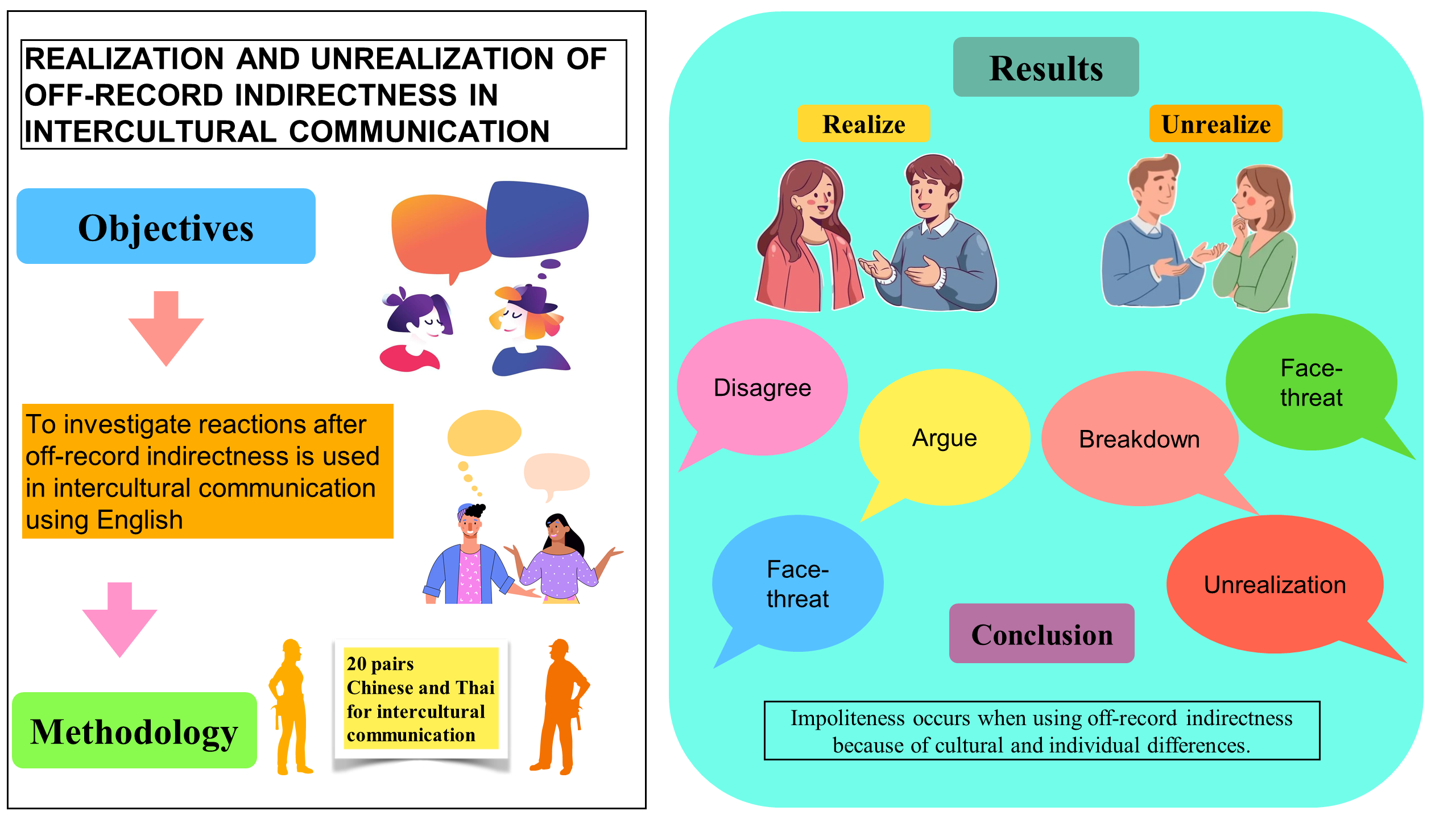
Since little research has examined the reactions after off-record indirectness is used, the realization and unrealization, or lack of understanding, of off-record indirectness in intercultural communication using English as a lingua franca (ELF) was investigated in this study. In total, 40 participants were involved. The 20 Chinese and 20 Thai participants were divided into 20 pairs to engage in dyadic intercultural ELF conversations. Conversation analysis (CA) was used for the data analysis. A qualitative method and quantitative analyses were used. Overall, the use of off-record indirectness mainly pertained to one’s face according to the perspectives of politeness and impoliteness. Three situations occurred when off-record indirectness was realized: the conversations continued although certain disagreements emerged. These arguments occurred due to face-threatening acts (FTAs), and off-record indirectness was used as a response FTA. Three situations occurred when off-record indirectness was unrealized: communication broke down, FTAs were perpetrated by either the hearer or the speaker of off-record indirectness, and the intersection of a series of unrealized examples of off-record indirectness was observed. This research further contributes to the study of off-record indirectness in intercultural communication, and a model for the realization and unrealization of off-record indirectness in intercultural ELF communication is proposed.
Downloads
Article Details

This work is licensed under a Creative Commons Attribution-NonCommercial-NoDerivatives 4.0 International License.
All rights reserved. Apart from citations for the purposes of research, private study, or criticism and review,no part of this publication may be reproduced, stored or transmitted in any other form without prior written permission by the publisher.
References
Al-Adaileh, B. A. (2024). Off-record indirectness in Jordanian Arabic. Journal of Politeness Research, 20(2), 507–531. https://doi.org/10.1515/pr-2022-0047
Baker, W. (2024). Intercultural communication. ELT Journal, 78(2), 212–215. https://doi.org/10.1093/elt/ccad040
Blum-Kulka, S. (1987). Indirectness and politeness in requests: Same or different? Journal of Pragmatics, 11(2), 131–146. https://doi.org/10.1016/0378-2166(87)90192-5
Bousfield, D. (2008). Impoliteness in interaction. John Benjamins.
Bregasi, M. (2020). Saving face and atrocities: Sequence expansions and indirectness in television interviews. Human Studies, 43(1), 89–106. https://doi.org/10.1007/s10746-019-09519-1
Byram, M. (2021). Teaching and assessing intercultural communicative competence: Revisited. Multilingual Matters.
Chen, X., & Wang, J. (2021). First order and second order indirectness in Korean and Chinese. Journal of Pragmatics, 178, 315–328. https://doi.org/10.1016/j.pragma.2021.03.022
Culpeper, J., & Tantucci, V. (2021). The principle of (im)politeness reciprocity. Journal of Pragmatics, 175, 146–164. https://doi.org/10.1016/j.pragma.2021.01.008
Daar, G. F., Beratha, N. L. S., Suastra, I. M., & Sukarini, N. W. (2023). The off-record politeness strategy and cultural values of the Belis negotiation speech event: A sociopragmatic study. Indonesian Journal of Applied Linguistics, 12(3), 612–622. https://doi.org/10.17509/ijal.v12i3.48746
Ehmer, O., & Rosemeyer, M. (2018). Inferences in interaction and language change. Open Linguistics, 4(1), 536–551. https://doi.org/10.1515/opli-2018-0026
Fang, X. (2024). Making refusals via English as a lingua franca: Chinese English speakers’ strategies and sequences. Journal of Pragmatics, 230, 1–14. https://doi.org/10.1016/j.pragma.2024.06.011
Haselow, A. (2021). Dealing with trouble in conversation in English-speaking cultures: Conversational repair in global varieties of English. English World-Wide, 42(3), 324–349. https://doi.org/10.1075/eww.00075.has
Haugh, M. (2024). (Im)politeness as object, (im)politeness as perspective. Journal of Politeness Research, 20(1), 201–226. https://doi.org/10.1515/pr-2023-0082
Jefferson, G. (2004). Glossary of transcript symbols with an introduction. In G. H. Lerner (Ed.), Conversation analysis: Studies from the first generation (pp. 13–31). John Benjamins.
Jenks, C. J. (2025). Intercultural communication, world Englishes, and interculturality. World Englishes, 44(4), 518–524. https://doi.org/10.1111/weng.12718
Kecskes, I. (Ed.). (2022). The Cambridge handbook of intercultural pragmatics. Cambridge University Press.
McConachy, T., & Spencer-Oatey, H. (2021). Cross-cultural and intercultural pragmatics. In M. Haugh, D. Z. Kádár, & M. Terkourafi (Eds.), The Cambridge handbook of sociopragmatics (pp. 733–757). Cambridge University Press.
Merino, A. (2023). Co-constructing emergent common ground: The role of the intercultural mediator. In I. Kecskes (Ed.), Common ground in first language and intercultural interaction (pp. 135–162). De Gruyter Mouton.
Nam, B. H., Yang, Y., & Draeger, R., Jr. (2023). Intercultural communication between Chinese college students and foreign teachers through the English corner at an elite language university in Shanghai. International Journal of Intercultural Relations, 93, Article 101776. https://doi.org/10.1016/j.ijintrel.2023.101776
Ogiermann, E. (2015). Direct off-record requests? – ‘Hinting’ in family interactions. Journal of Pragmatics, 86, 31–35. http://dx.doi.org/10.1016/j.pragma.2015.06.006
Pan, Z. (2022). A corpus-based study on politeness used by L1 Thai EFL learners. International Journal of Linguistics, 14(6), 28–47. https://doi.org/10.5296/ijl.v14i6.20436
Pan, Z. (2023). Examination of data collection methods for pragmatic competence assessment of EFL learners. International Journal of English Language and Literature Studies, 12(2), 159–171. https://doi.org/10.55493/5019.v12i2.4798
Pan, Z. (2024). Impoliteness in polylogal intercultural communication among Asian EFL learners. Intercultural Pragmatics, 21(2), 227–254. https://doi.org/10.1515/ip-2024-2003
Pan, Z. (2025). Ritual frame indicating expressions used in requests in intercultural communication. Journal of Politeness Research, 21(2), 407–426. https://doi.org/10.1515/pr-2024-0007
Spencer-Oatey, H., & Kádár, D. Z. (2021). Intercultural politeness: Managing relations across cultures. Cambridge University Press.
Su, H.-Y., & Lee, W.-H. (2022). Metadiscourse of impoliteness, language ideology, and identity: Offense-taking as social action. Journal of Politeness Research, 18(2), 227–255. https://doi.org/10.1515/pr-2019-0013
Tantucci, V., Wang, A., & Culpeper, J. (2022). Reciprocity and epistemicity: On the (proto)social and cross-cultural ‘value’ of information transmission. Journal of Pragmatics, 194, 54–70. https://doi.org/10.1016/j.pragma.2022.04.012
Tawilapakul, U. (2022). Face threatening and speaker presuppositions: The case of feminine polite particles in Thai. Journal of Pragmatics, 195, 69–90. https://doi.org/10.1016/j.pragma.2022.04.016
Terkourafi, M. (2019). Indirectness in the age of globalization: A social network analysis. Russian Journal of Linguistics, 23(4), 930–949. https://doi.org/10.22363/2687-0088-2019-23-4-930-949
Zhao, L., & Ran, Y. (2022). Rationalizing impoliteness: Taking offence and providing vicarious accounts in mother-in-law/daughter-in-law conflict mediation. Journal of Pragmatics, 197, 69–80. https://doi.org/10.1016/j.pragma.2022.05.015
Zhou, L., & Zhang, S. (2022). A multifunctional analysis of off-record indirectness in Chinese interactions. Language Sciences, 90, Article 101459. https://doi.org/10.1016/j.langsci.2021.101459
