
Tempo interpretation and symbolic motives in opening movement of Haydn’s The Creation
Article Sidebar
Main Article Content
Abstract
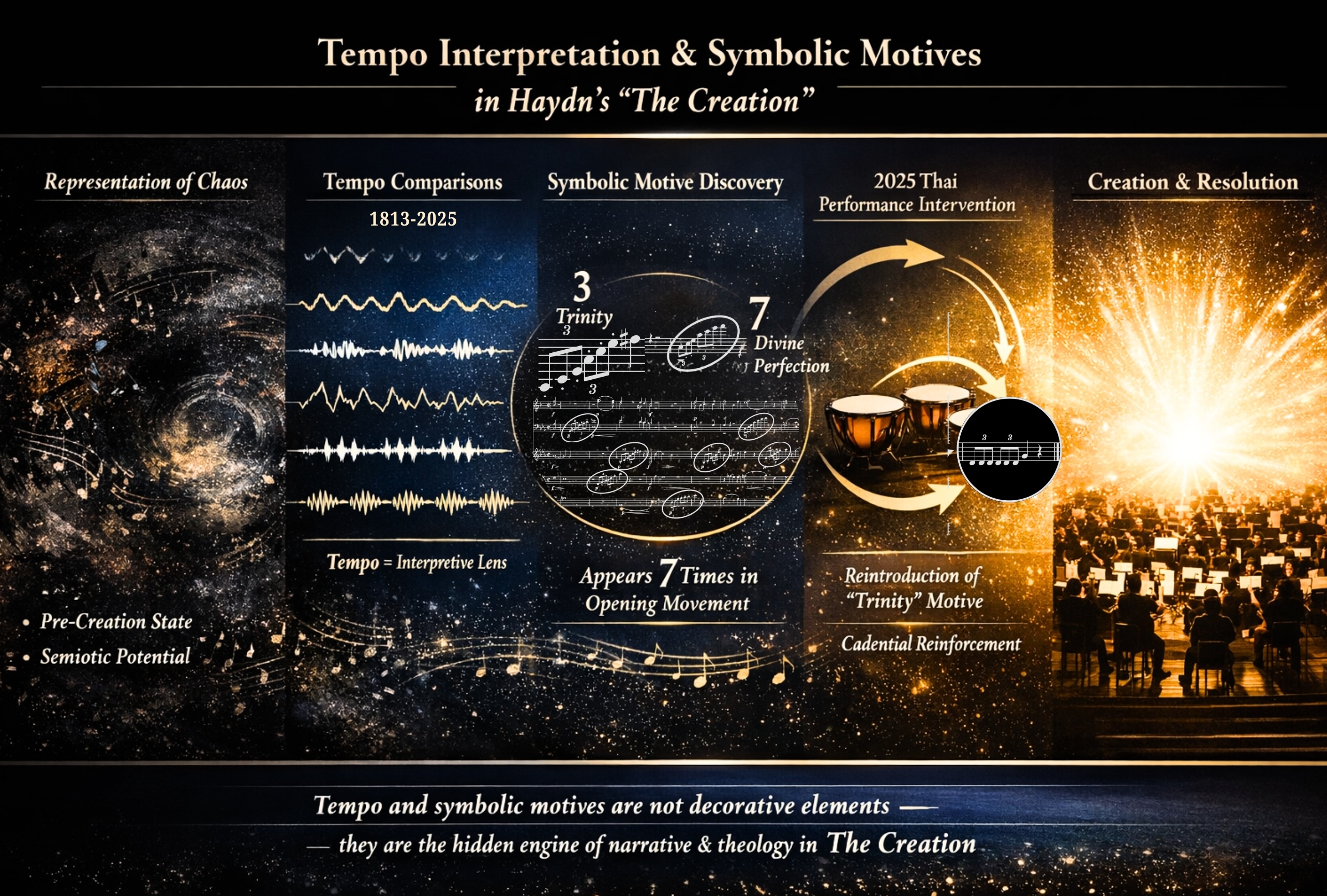
This study investigates two interrelated aspects of Franz Joseph Haydn’s seminal oratorio, “The Creation” (Hob. XXI:2): tempo interpretation and symbolic motives. It compares historical and contemporary performance practices by analyzing tempo choices, from the composer’s era to a 2025 performance in Thailand. The research utilizes Temperley’s (1991) comparative tempo data from four distinct conducting traditions—Historic, Austrian, British, and Early Music— alongside an analysis of the contemporary Thai performance. The central focus is a semiotic analysis of the opening movement, “Representation of Chaos,” which identifies seven key symbolic motives that reflect theological concepts. The most significant new finding is a recurrent 7-note motive, internally structured as a double triplet plus a final note (3+3+1), which appears seven times. The number seven symbolizes divine perfection (the seven days of creation), while the triplet motive signifies the Holy Trinity in Christianity. This discovery led to a creative application in the 2025 performance, where the researcher reintroduced this “Trinity” motive in the final measure of the oratorio by adding a specific ornamentation for the timpani as a cadential final. This act of cyclical return not only links the narrative’s conclusion back to its beginning but also reinforces the work’s core message with this divine symbol. This research, therefore, posits that tempo and symbolic motives are not mere aesthetic choices, but are fundamental to the narrative and theological structure of Haydn’s masterpiece.
Downloads
Article Details

This work is licensed under a Creative Commons Attribution-NonCommercial-NoDerivatives 4.0 International License.
All rights reserved. Apart from citations for the purposes of research, private study, or criticism and review,no part of this publication may be reproduced, stored or transmitted in any other form without prior written permission by the publisher.
References
Agawu, V. K. (2025). Playing with signs: A semiotic interpretation of classic music. Princeton University Press.
Bangkok Combined Choir and Orchestra. (2025, June 24). Program book for Haydn’s The Creation [Program book]. Thailand Cultural Centre, Bangkok, Thailand.
Bennett, R. (1995). Music dictionary. Cambridge University Press.
Bratby, R. (2025, February 26). Program notes for Haydn’s The Creation [Program notes]. City of Birmingham Symphony Orchestra, England.
Eaton, S. (2017). How the composer’s worldview shapes musical meaning: Haydn’s Creation and the Enlightenment. Artistic Theologian, 5, 17–57. https://www.academia.edu/71140932
Haydn, F. J. (1957). The Creation (R. Shaw & A. Parker, Eds.) [Choral score]. Lawson-Gould Music.
Haydn, F. J. (n.d.-a). The Creation “Die Schöpfung” [Conductor score]. Breitkopf & Härtel Edition.
Haydn, F. J. (n.d.-b). The Creation “Die Schöpfung” [Conductor score]. Edwin F. Kalmus Edition.
Holy Bible. (n.d.). New International Version Edition. http://www.biblica.com
Hongcharu, C. (2025). Haydn’s The Creation [Video recording]. Bangkok Combined Choir and Orchestra.
Indiana University Bloomington. (n.d.). The Bible through music: Joseph Haydn - The Creation. https://collections.libraries.indiana.edu/lilly/exhibitions/exhibits/show/the-bible-through-music/old-testament--pentateuch/the-creation
Jacobs, J., & Ochser, S. (2021). Symbol. In Jewish Encyclopedia. https://www.jewishencyclopedia.com/articles/14155-symbol
Leonard, D. (2021, August 23). The meaning of the number 7 in the Bible explained. Grunge. https://www.grunge.com/494512/the-meaning-of-the-number-7-in-the-bible-explained/
Mozart, L. (1951). A treatise on the fundamental principles of violin playing. Oxford University Press.
Rosen, C. (1980). The classical style: Haydn, Mozart, Beethoven. Faber and Faber.
Rosen, C. (1997). The classical style: Haydn, Mozart, Beethoven. W.W. Norton.
Temperley, N. (1991). Haydn’s Tempos in “The Creation.” Early Music, 19(2), 235–245. http://www.jstor.org/stable/3127638
Temperley, N. (1999). Haydn: The Creation. Cambridge University Press.
Waruwu, S., Terasa, D., Damanik, D., & Sitopu, E. (2025). Theological study of the doctrine of the Trinity of God. Socio-Economic and Humanistic Aspects for Township and Industry, 3(1), 66–82. https://doi.org/10.59535/sehati.v3i1.388
