
The effects of a PLC model using lesson study with mentoring to develop assistant teachers’ competency in active learning management for fostering students’ creative innovation ability
Article Sidebar
Main Article Content
Abstract
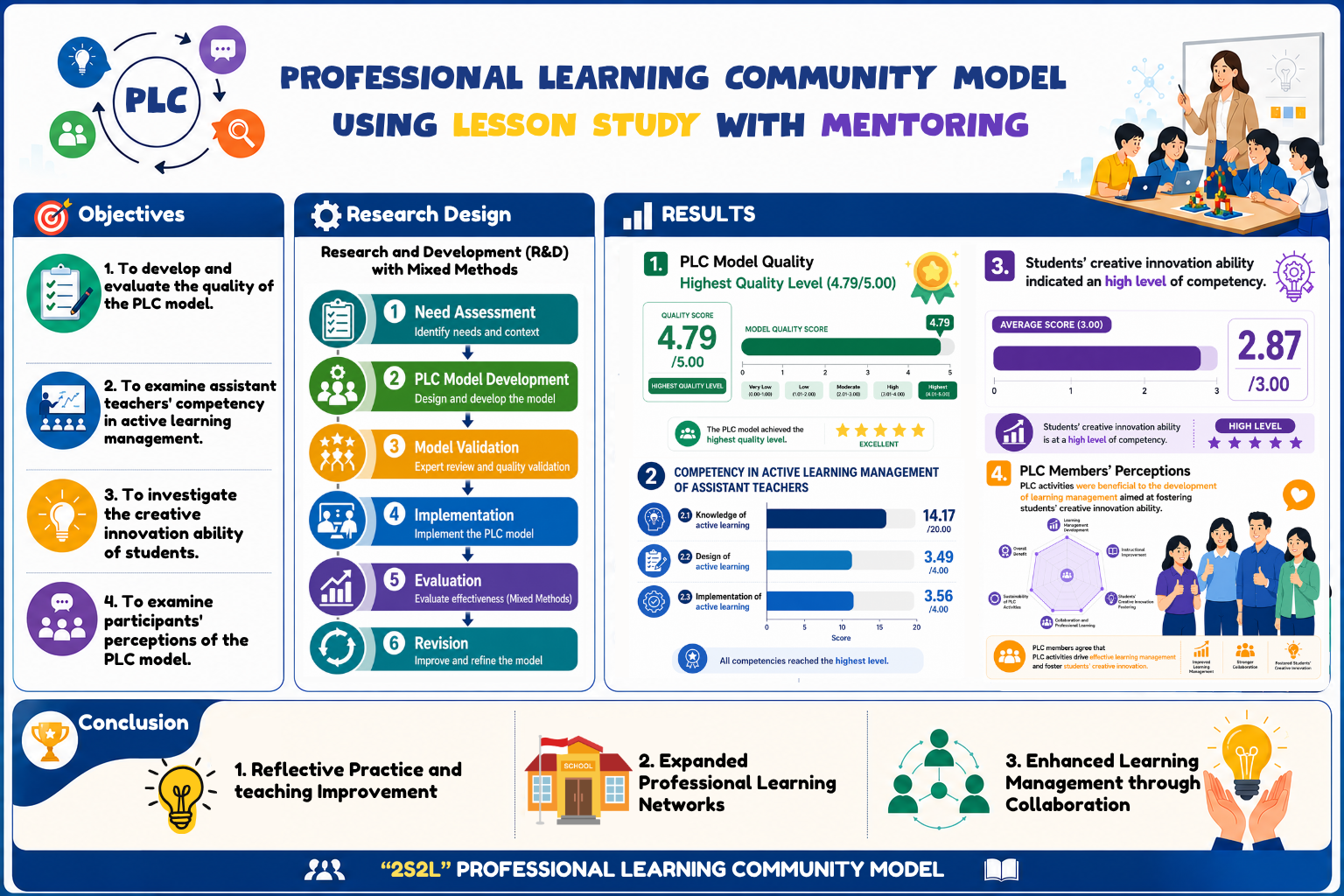
This research aimed to 1) develop and evaluate the quality of a professional learning community model integrating lesson study and coaching and mentoring to enhance assistant teachers’ competency in active learning management that fosters students’ creative innovation ability; 2) examine assistant teachers’ competency in active learning management; 3) investigate students’ creative innovation ability; and 4) explore professional learning community members’ opinions on the professional learning community model. The research sample included six assistant teachers, six mentor teachers, three educational supervisors, four school administrators, and seventy-six students from six classrooms. The study was conducted during the second semester of the academic year 2024. Statistics used for data analysis included mean, standard deviation, and content analysis. The findings revealed that 1) the professional learning community model consisted of six components: principles, objectives, process, evaluation, implementation conditions, and supporting factors. Specifically, the process component involves a four-step cycle, highlighting a lesson study method that integrates five sub-steps: analyzing and arranging, instructional design, teaching and observation, reflection, and refinement. The model’s overall quality was rated at the highest level (M = 4.79, SD = 0.15). 2) Assistant teachers showed improvement in three areas: knowledge and understanding of active learning management was higher than before (M = 4.17, SD = 0.41), development of instructional design ability was at the highest level (M = 3.49, SD = 0.38), and development of learning management ability was at the highest level (M = 3.36, SD = 0.34). 3) Students’ creative innovation ability was also rated at a high level (M = 2.62, SD = 0.19). 4) The professional learning community members’ opinions indicated that the model was effective and beneficial for professional development.
Downloads
Article Details

This work is licensed under a Creative Commons Attribution-NonCommercial-NoDerivatives 4.0 International License.
All rights reserved. Apart from citations for the purposes of research, private study, or criticism and review,no part of this publication may be reproduced, stored or transmitted in any other form without prior written permission by the publisher.
References
Ban Zong School. (2024). Self-assessment report (SAR), academic year 2023: School performance report. Office of the Basic Education Commission, Ministry of Education.
Chansanong, S., & Sithsungnoen, C. (2023). Development of a blended professional learning community model integrated with coaching to enhance teachers’ competency in STEM education learning management and secondary students’ innovation creation. Journal of Roi Kaensarn Academi, 8(10), 327–348. https://so02.tci-thaijo.org/index.php/JRKSA/article/view/263205 [in Thai]
Chartered Institute of Personnel Development. (2025, August 11). Coaching and mentoring. https://www.cipd.co.uk/knowledge/fundamentals/people/development/coaching-mentoring-factsheet#gref
Chularut, P. (2018). Learning management for students in the Thailand 4.0 era. Veridian E-Journal, Silpakorn University, 11(2), 2363–2380. [in Thai]
Csikszentmihalyi, M. (1997). Creativity: Flow and the psychology of discovery and invention. Harper Collins.
Dan, C. (2012). Professional learning community’s impact on science teacher classroom practice in a midwestern urban school district [Doctoral dissertation, University of Nebraska-Lincoln]. DigitalCommons@University of Nebraska-Lincoln.
Dechakupt, P. (2019). Creating innovation based on PLC & Logbook research. Chulalongkorn University Press. [in Thai]
Fernandez, C., & Yoshida, M. (2004). Lesson study: A Japanese approach to improving mathematics teaching and learning. Routledge. https://doi.org/10.4324/9781410610867
Ketsing, W. (1995). Mean and interpretation: A simple matter that is sometimes misinterpreted. Journal of Educational Research News, 18(3), 8–10. [in Thai]
Laoriandee, W., Kijrungruang, P., & Sirisamphan, O. (2017). Active learning management strategies for developing thinking and enhancing educational quality for the 21st century (12th ed.). Phetkasem Printing Group. [in Thai]
Mavuso, M. A. (2007). Mentoring as a knowledge management tool in organisations [Master’s thesis, Stellenbosch University]. Stellenbosch University Repository.
Nilapun, M. (2015). Educational research methods. Department of Curriculum and Instruction, Faculty of Education, Silpakorn University. [in Thai]
Notification of the Ministry of Education Re: Education policy of the fiscal year 2025–2026. (2024, November 13). Royal Thai Government Gazette. No. 141 Special Section 309 D. pp. 11–13. https://ratchakitcha.soc.go.th/documents/49252.pdf [in Thai]
Office of the Basic Education Commission. (2019). Guidelines for supervision to promote active learning under the “less teaching, more learning” policy. Ministry of Education. https://url-shortener.me/NVYK [in Thai]
Office of the Education Council. (2017). National education plan B.E. 2560–2579 (2017–2036). Prikwan Graphic. [in Thai]
Office of the Education Council. (2023). Annual report 2023: Office of the Education Council. Ministry of Education. [in Thai]
Office of the National Economic and Social Development Council. (2018). National strategy 2018–2037. Secretariat Office of the National Strategy Committee. https://url-shortener.me/NVZ8
Po Ngern, W., Sithsungnoen, C., Nilapun, M., & Poomraruen, E. (2021). The effect of using the model to enhance the quality of teaching based on learning according to GPAS 5 steps to enhance students’ learning skills in Thailand 4.0 of the elementary education. Journal of Research and Curriculum Development, 11(1), 22–35. https://so03.tci-thaijo.org/index.php/jrcd/article/view/243540 [in Thai]
Sittijan, W. (2017, January 15) Problem–based Learning : PBL. Institute for Research on Education System Foundation. http://www.ires.or.th/?p=801 [in Thai]
Sonsalee, P. (2018). Professional learning community (PLC). Kamphaeng Phet Primary Educational Service Area Office 1. https://url-shortener.me/NW93 [in Thai]
Srisa-ard, B. (2002). Introduction to research (7th ed.). Suviriyasarn. [in Thai]
Srisaipattanakun, A., Jutiphon, A., & Chanchum, S. (2017). Roles of assistant teachers in academic administration in schools under Chumphon Primary Educational Service Area Office 2. Nakkhabut Paritat Journal, 9(1), 194–202. [in Thai]
Thipnet, K. (2018). Development of teaching and learning management innovation using the professional learning community process (Research report). Office of the Basic Education Commission, Ministry of Education. [in Thai]
Uamphrom, S. (2017). Guidelines for building a professional learning community. Chomromdek. [in Thai]
Wongsapan, W., Muenjaem, S., & Wichaakarawit, C. (2019). The lesson study of Ban Mae Jong school teachers, Amphoe Doi Saket, Chiang Mai. Lampang Rajabhat University Journal, 8(1), 124–138. https://so04.tci-thaijo.org/index.php/JLPRU/article/view/153027 [in Thai]
Wongyai, V., & Patthaphon, M. (2019). Innovation skill development. Leadership Center for Curriculum Innovation. [in Thai]
Woranetsudathip, N. (2021). Building a professional learning community (PLC) through lesson study. Northeastern University Academic and Research Journal, 11(3), 347–358. [in Thai]
