
Effects of metaphors on thinking: The case of the drug addiction problem in Thai society
Article Sidebar
Main Article Content
Abstract
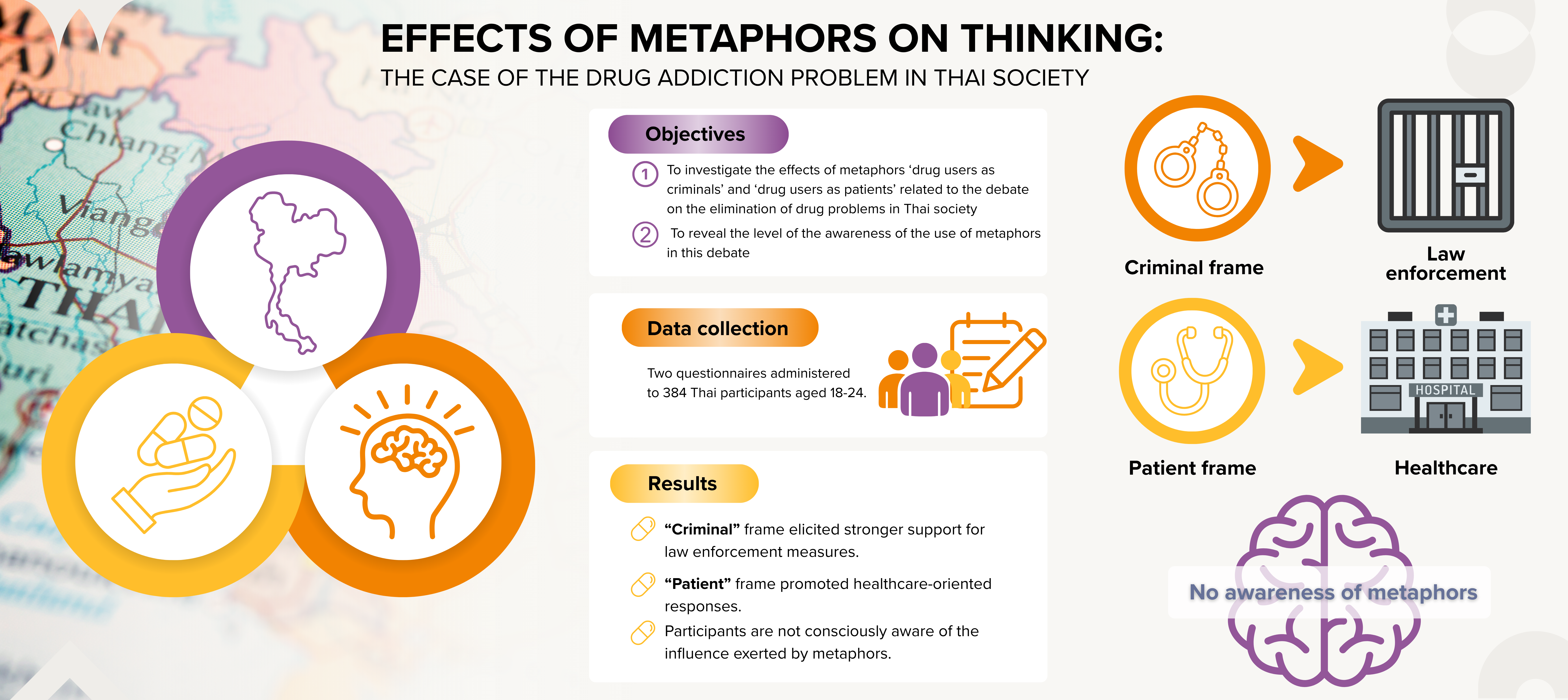
This study investigates how metaphorical framing shapes public reasoning about drug addiction in Thai society. Specifically, it examines how presenting drug users as criminals versus patients influences perceptions of responsibility and preferred solutions. The research objectives are 1) to assess the impact of different metaphors related to the debate on the elimination of drug problems in Thai society, and; 2) to elucidate the degree of conscious awareness of the use of metaphors in this debate. Data were collected from two questionnaires administered to 384 Thai participants aged 18–24. Each questionnaire consisted of three parts: general information; a passage about drug consisting of metaphors ‘drug users as criminals’ or ‘drug users as patients’; and open-ended questions on opinions about drug problems. The findings reveal that the “criminal” frame elicited stronger support for law enforcement measures, while the “patient” frame promoted healthcare-oriented responses. These results highlight the subtle yet powerful effects of metaphorical framing, even when participants are not consciously aware of its influence. This study underscores context sensitivity and cultural resistance, which lend support to Kövecses’s (2020) cultural extensions of Conceptual Metaphor Theory (CMT) and suggesting dynamic mappings between the conceptual domains of criminals and patients. By demonstrating how figurative language directs social attitudes and proposed policies, this research contributes to understanding the role of metaphor in shaping public discourse and advancing social equity, while offering insights relevant to health communication and social policy debates.
Downloads
Article Details

This work is licensed under a Creative Commons Attribution-NonCommercial-NoDerivatives 4.0 International License.
All rights reserved. Apart from citations for the purposes of research, private study, or criticism and review,no part of this publication may be reproduced, stored or transmitted in any other form without prior written permission by the publisher.
References
Brugman, B. C., Burgers, C., & Vis, B. (2019). Metaphorical framing in political discourse through words vs. concepts: A meta-analysis. Language and Cognition, 11(1), 41–65. https://doi.org/10.1017/langcog.2019.5
Brugman, B. C., Droog, E., Reijnierse, W. G., Leymann, S., Frezza, G., & Renardel de Lavalette, K. Y. (2022). Audience perceptions of COVID-19 metaphors: The role of source domain and country context. Metaphor and Symbol, 37(2), 101–113. http://doi.org/10.1080/10926488.2021.1948332
Chatti, S. (2022). Military framing of health threats: The COVID-19 pandemic as a case study. In F. M. Federici (Ed.), Language as a social determinant of health (pp. 39–61). Palgrave Macmillan. https://doi.org/10.1007/978-3-030-87817-7_2
Chkhaidze, A., Buyruk, P., & Boroditsky, L. (2021). Linguistic metaphors shape attitudes towards immigration. Proceedings of the Annual Meeting of the Cognitive Science Society, 43, 2863–2868. https://scholarship.org/uc/item/1xf1t3vv
Cotter, C., Samos, D., & Swinglehurst, D. (2021). Framing obesity in public discourse: Representation through metaphor across text type. Journal of Pragmatics, 174, 14–27. https://doi.org/10.1016/j.pragma.2020.12.015
Doquin de Saint Preux, A., & Masid Blanco, O. (2021). The power of conceptual metaphors in the age of pandemic: The influence of the WAR and SPORT domains on emotions and thoughts. Language & Communication, 81, 37–47. https://doi.org/10.1016/j.langcom.2021.08.003
Entman, R. M. (1993). Framing: Toward clarification of a fractured paradigm. Journal of Communication, 43(4), 51–58. https://doi.org/10.1111/j.1460-2466.1993.tb01304.x
Fisher, C. (2020). The flood of refugees in our heads: Metaphorical framing of refugees in German newspaper discourse: A qualitative content analysis. Journalism Research, 3(1), 29–45. https://journalistik.online/en/paper-en/the-flood-of-refugees-in-our-heads-metaphorical-framing-of-refugees-in-german-newspaper-discourse/
Hendricks, R. K., Demjén, Z., Semino E., & Boroditsky, L. (2018) Emotional implications of metaphor: Consequences of metaphor framing for mindset about cancer. Metaphor and Symbol, 33(4), 267–279. https://doi.org/10.1080/10926488.2018.1549835
Institute for Population and Social Research, Mahidol University. (2023). Thai health 2023. https://www.thaihealth.or.th/wp-content/uploads/2023/11/Thai-Health-2023.pdf
Kövecses, Z. (2010). Metaphor: A practical introduction (2nd ed.). Oxford University Press.
Kövecses, Z. (2020). Extended conceptual metaphor theory. Cambridge University Press.
Lakoff, G., & Johnson, M. (1980). Metaphors we live by. University of Chicago Press.
Lecheler, S., & de Vreese, C. H. (2012). News framing and public opinion: A mediation analysis of framing effects on political attitudes. Journalism & Mass Communication Quarterly, 89(2), 185–204. https://doi.org/10.1177/1077699011430064
Likitdecharoj, N. (2025, August 13). Drug war: Over 2,000 deaths in three months with no convictions. Cross Cultural Foundation. https://crcfthailand.org/2025/08/13/60394/ [in Thai]
Office of the Narcotics Control Board. (2024). Annual drug data. Ministry of Justice. https://data.oncb.go.th/year [in Thai]
Ottatti, V., Renstrom, R., & Price, E. (2014). The metaphorical framing model: Political communication and public opinion. In M. Landau, M. D. Robinson, & B. P. Meier (Eds.), The power of metaphor: Examining its influence on social life (pp. 179–202). American Psychological Association. https://doi.org/10.1037/14278-009
Paoaree, S. (2023). Thailand drug policy reform [Survey report]. National Institute of Development Administration. https://nidapoll.nida.ac.th/polls/thailand-drug-policy-reform-public-opinion-2024/ [in Thai]
Reijnierse, W. G., Burgers, C., Krennmayr, T., & Steen, G. J. (2015). How viruses and beasts affect our opinions (or not): The role of extendedness in metaphorical framing. Metaphor and the Social World, 5(2), 245–263. https://doi.org/10.1075/msw.5.2.04rei
Roscoe, J. T. (1989). Research methods in business (2nd ed.). McGraw-Hill.
Semino, E., Demjén, Z., & Demmen, J. (2018). An integrated approach to metaphor and framing in cognition, discourse, and practice, with an application to metaphors for cancer. Applied Linguistics, 39(5), 625–645. https://doi.org/10.1093/applin/amw028
The Government Public Relations Department. (2025, February 1). Anti-drug operations under the “Seal Stop Safe” campaign. Office of the Prime Minister. https://thailand.prd.go.th/en/content/category/detail/id/48/iid/361013
Thibodeau, P. H., & Boroditsky, L. (2011). Metaphors we think with: The role of metaphor in reasoning. PLoS ONE, 6(2), Article e16782. https://doi.org/10.1371/journal.pone.0016782
Thibodeau, P. H., & Boroditsky, L. (2013). Natural language metaphors covertly influence reasoning. PLoS ONE, 8(1), Article e52961. https://doi.org/10.1371/journal.pone.0052961
Thibodeau, P. H., & Boroditsky, L. (2015). Measuring effects of metaphor in a dynamic opinion landscape. PLoS ONE, 10(7), Article e0133939. https://doi.org/10.1371/journal.pone.0133939
UNAIDS. (2023, June 26). Compassionate care for people who use drugs in Thailand. https://www.unaids.org/en/resources/presscentre/featurestories/2023/june/20230626_people-who-use-drugs-thailand
United Nations Office on Drugs and Crime. (2018, April). People at center: UNODC support for UNGASS 2016 on the world drug problem. United Nations. https://www.unodc.org/documents/postungass2016//follow-up/18-01924_UNGASS_eBook_002.pdf
