
Conceptualizing lesbians across cultures: Exploring lesbian terms in English and Thai
Article Sidebar
Main Article Content
Abstract
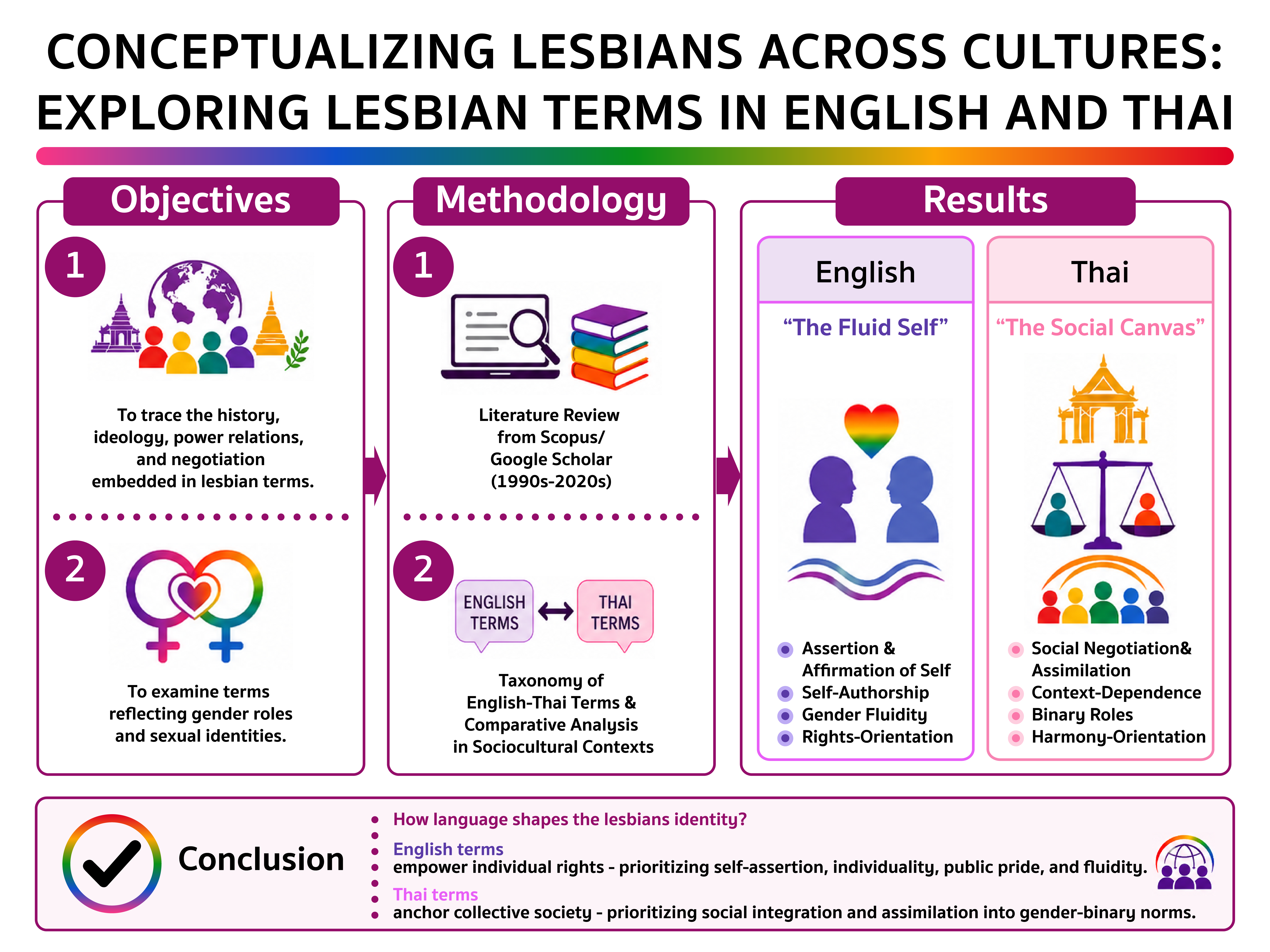
This review article examines the conceptualization of lesbian identities in English and Thai contexts through a comparative analysis of their respective terminologies. The primary objectives are twofold: first, to trace the historical development, power relations, and modes of resistance underpinning these lesbian terms within their cultural contexts; and second, to discuss how these terminologies reflect divergent constructions of gender roles and sexual identity. Synthesized from existing academic studies from the 1900s onward, the insights presented in this article are organized into three major sections: the first section introduces English terms and definitions associated with lesbian identities from English-dominant Western societies; the second traces the historical development and evolution of Thai lesbian terms; and the third examines the ideologies and perceptions underlying the coinage of these terminologies in both cultures. Findings reveal that English terms prioritize self-identification and gender fluidity, while Thai terms are discursively constructed through contextually dependent, binary role structure, and social harmony. This distinction highlights the cultural and linguistic differences in conceptualizing lesbian identities. By examining these terminologies across two distinct linguistic and cultural contexts, this study contributes to the fields of LGBTQ+ studies, sociolinguistics, and cross-cultural discourse, offering insights into how language reflects and shapes understandings of sexual and gender identities in different societies.
Downloads
Article Details

This work is licensed under a Creative Commons Attribution-NonCommercial-NoDerivatives 4.0 International License.
All rights reserved. Apart from citations for the purposes of research, private study, or criticism and review,no part of this publication may be reproduced, stored or transmitted in any other form without prior written permission by the publisher.
References
Barnes, R., & Eicher, J. (1992). Dress and gender: Making and meaning in cultural context. Berg Publishing.
Barrett, R. (2017). From drag queens to leathermen: Language, gender, and gay male subcultures. Oxford University Press. https://doi.org/10.1093/acprof:oso/9780195390179.001.0001
Bell, D., Binnie, J., Cream, J., & Valentine, G. (1994). All hyped up and no place to go. Gender, Place & Culture, 1(1), 31–47. https://doi.org/10.1080/09663699408721199
Bergman, S. B. (2010). Butch is a noun. Arsenal Pulp Press.
Boonyapisomparn, N., Manojai, N., Srikummoon, P., Bunyatisai, W., Traisathit, P., & Homkham, N. (2023). Healthcare discrimination and factors associated with gender-affirming healthcare avoidance by transgender women and transgender men in Thailand: Findings from a cross-sectional online-survey study. International Journal for Equity in Health, 22(1), Article 31. https://doi.org/10.1186/s12939-023-01843-4
Butler, J. (1990). Gender trouble: Feminism and the subversion of identity. Routledge.
Callahan, C. J., & McGuire, J. K. (2022). Sexual orientation labelling: Relational processes of trans identity development. Culture, Health & Sexuality, 24(12), 1634–1649. https://doi.org/10.1080/13691058.2021.1992014
Carpenter, K., & McKenzie, M. (2011). Love on a continuum. Social and Economic Studies, 60(1), 111–136.
Cavendish, M. (2010). Sex and society (Vol. 2). Marshall Cavendish Reference.
Cerezo, A., Cummings, M., Holmes, M., & Williams, C. (2020). Identity as resistance: Identity formation at the intersection of race, gender identity, and sexual orientation. Psychology of Women Quarterly, 44(1), 67–83. https://doi.org/10.1177/0361684319875977
Cheng, F.-T. (2021). Theorizing TL esthetics: Forming a femme gaze through yes or no 2.5. Journal of Lesbian Studies, 25(1), 71–87. https://doi.org/10.1080/10894160.2019.1689477
Chonwilai, S. (2009). Ying Rak Ying (women who love women). In S. Chonwilai & P. Boonmongkon (Eds.), Sexual language in Thai society: Power, rights and sexual well-being (pp. 165–174). The Southeast Asian Consortium on Gender, Sexuality and Health & National Human Rights Commission of Thailand. [in Thai]
Choomgrant, K. (2014). Out of the closet: An understanding of ‘queer heritage’ in the context of Southeast Asia [Doctoral dissertation, Silpakorn University]. Academia. https://www.academia.edu/75413450/OUT_OF_THE_CLOSET_AN_UNDERSTANDING_OF_QUEER_HERITAGE_IN_THE_CONTEXT_OF_SOUTHEAST_ASIA
Ciasullo, A. M. (2001). Making her (in) visible: Cultural representations of lesbianism and the lesbian body in the 1990s. Feminist Studies, 27(3), 577–608. https://doi.org/10.2307/3178806
Coleman-Fountain, E. (2014). Lesbian and gay youth and the question of labels. Sexualities, 17(7), 802–817. https://doi.org/10.1177/1363460714531432
Cook, M., & McHenry, R. (2013). Sexual attraction. Pergamon.
Diamond, L. M., & Butterworth, M. (2008). Questioning gender and sexual identity: Dynamic links over time. Sex Roles, 59, 365–376. https://doi.org/10.1007/s11199-008-9425-3
Duggan, E. (2025). Lesbian vs. Dyke: An examination of the differences in social meaning between two queer identity terms [Master’s thesis, Michigan State University]. MSU Libraries Digital Collections. https://doi.org/doi:10.25335/mwhb-yr69
Eliason, M. J., & Morgan, K. S. (1998). Lesbians define themselves: Diversity in lesbian identification. International Journal of Sexuality and Gender Studies, 3, 47–63. https://doi.org/10.1023/A:1026204208243
Expósito-Barea, M. (2012). From the Iron to the Lady: The “kathoey” phenomenon in Thai cinema. Sesión no numerada: Revista de letras y ficción audiovisual, 2, 190–202.
Fongkaew, K., Khruataeng, A., Unsathit, S., Khamphiirathasana, M., Jongwisan, N., Arlunaek, O., & Byrne, J. (2019). “Gay guys are shit-lovers” and “Lesbians are obsessed with fingers”: The (mis)representation of LGBTIQ people in Thai news media. Journal of Homosexuality, 66(2), 260–273. https://doi.org/10.1080/00918369.2017.1398026
Geczy, A., & Karaminas, V. (2020). Lesbian style: From mannish women to lipstick dykes. In M. Barnard (Ed.), Fashion theory (2nd ed., pp. 307–327). Routledge.
Geiger, W., Harwood, J., & Hummert, M. L. (2006). College students’ multiple stereotypes of lesbians. Journal of Homosexuality, 51(3), 165–182. https://doi.org/10.1300/J082v51n03_08
Gil-Berrozpe, J. C., & Faber, P. (2017). The role of terminological knowledge bases in specialized translation: The use of umbrella concepts. In M. A. Candel-Mora & C. Vargas-Sierra (Eds.), Temas actuales de terminología y estudios sobre el léxico (pp. 1–26). Comares.
Gunn, A., Hoskin, R. A., & Blair, K. L. (2021). The new lesbian aesthetic? Exploring gender style among femme, butch and androgynous sexual minority women. Women’s Studies International Forum, 88, Article 102504. https://doi.org/10.1016/j.wsif.2021.102504
Hagai, E. B., & Seymour, N. (2022). Is lesbian identity obsolete? Journal of Lesbian Studies, 26(1), 1–11. https://doi.org/10.1080/10894160.2021.2005231
Halberstam, J. (1998). Transgender butch: Butch/FTM border wars and the masculine continuum. GLQ: A Journal of Lesbian and Gay Studies, 4(2), 287–310. https://doi.org/10.1215/10642684-4-2-287
Halberstam, J. (2017). Trans: A quick and quirky account of gender variability. University of California Press. https://doi.org/10.1525/9780520966109
Hanneder, H., & Best, S. (2023). Did dykes die out or where have they gone? An interdisciplinary analysis of a key term in queer archives. Tijdschrift voor Genderstudies, 26(3/4), 313–334. https://doi.org/10.5117/TVGN2023.3/4.007.HANN
Hart, L. (2002). Living under the sign of the cross: Some speculations on femme femininity. Women & Performance: A Journal of Feminist Theory, 13(1), 44–60. https://doi.org/10.1080/07407700208571393
Henrichs-Beck, C. L., & Szymanski, D. M. (2017). Gender expression, body–gender identity incongruence, thin ideal internalization, and lesbian body dissatisfaction. Psychology of Sexual Orientation and Gender Diversity, 4(1), 23–33. https://doi.org/10.1037/sgd0000214
Hoskin, R. A. (2021). Can femme be theory? Exploring the epistemological and methodological possibilities of femme. Journal of Lesbian Studies, 25(1), 1–17. https://doi.org/10.1080/10894160.2019.1702288
Jackson, P. A. (2000). An explosion of Thai identities: Global queering and re-imagining queer theory. Culture, Health & Sexuality, 2(4), 405–424. https://doi.org/10.1080/13691050050174422
Jackson, P. A. (2004). Gay adaptation, tom-dee resistance, and kathoey indifference: Thailands gender/sex minorities and the episodic allure of queer English. In W. L. Leap & B. Tom (Eds.), Speaking in queer tongues: Globalization and gay language (pp. 202–230). University of Illinois Press.
Jackson, P. A. (2009). Global queering and global queer theory: Thai [trans]genders and [homo]sexualities in world history. Autrepart, 49, 15–30. https://doi.org/10.3917/autr.049.0015
Jackson, P. A. (Ed.). (2011). Queer Bangkok: 21st century markets, media, and rights (Vol. 1). Hong Kong University Press.
Jackson, P. A., & Duangwises, N. (2017, July 15–18). Review of studies of gender and sexual diversity in Thailand in Thai and international academic publications [Conference session]. The 13th International Conference of Thai Studies, Chiang Mai, Thailand
Kauth, M. R. (2000). True nature: A theory of sexual attraction. Springer.
Keeler, W. (2023). Comparative queer Southeast Asian studies. Southeast Asian Studies, 12(3), 529–554. https://doi.org/10.20495/seas.12.3_529
Kerr, D. (2013). Butch, femme, dyke, or lipstick, aren’t all lesbians the same? An exploration of labels and “looks” among lesbians in the U.S. South [Master’s thesis, University of Mississippi]. eGROVE. https://egrove.olemiss.edu/etd/1153
Kositsawat, P. (2019). Modalities of sexual agency among Thai lesbians [Master’s thesis, Chiang Mai University]. CMU Intellectual Repository (CMU IR).
Krantz, S. (1995). Reconsidering the etymology of bulldike. American Speech, 70(2), 217–221. https://doi.org/10.2307/455819
Laalo, C. M. (2012). Beyond lipstick: Expressions of queer femme identity in dress & new media [Master’s thesis, Toronto Metropolitan University]. RShare Digital Repository. https://doi.org/10.32920/ryerson.14649141.v1
Lane-Steele, L. (2011). Studs and protest-hypermasculinity: The tomboyism within black lesbian female masculinity. Journal of Lesbian Studies, 15(4), 480–492. https://doi.org/10.1080/10894160.2011.532033
Macias, S. I. (2022). “Somos contra la ‘queer-ificacíon’”/ “We reject the queer-ification of lesbianism”: Lesbian political identity and anti-queer politics among Mexican lesbians and queer Chicanas-Latinas. Journal of Lesbian Studies, 26(1), 73–88. https://doi.org/10.1080/10894160.2021.1959886
Mackay, F. (2019). Always endangered, never extinct: Exploring contemporary butch lesbian identity in the UK. Women’s Studies International Forum, 75, Article 102241. https://doi.org/10.1016/j.wsif.2019.102241
Magliozzi, D., Saperstein, A., & Westbrook, L. (2016). Scaling up: Representing gender diversity in survey research. Socius: Sociological Research for a Dynamic World, 2. https://doi.org/10.1177/2378023116664352
Maltz, R. (1998). Real butch: The performance/performativity of male impersonation, drag kings, passing as male, and stone butch realness. Journal of Gender Studies, 7(3), 273–286. https://doi.org/10.1080/09589236.1998.9960721
Maltz, R. (1999). Toward a dyke discourse: The essentially constructed stonebutch identity. Journal of Lesbian Studies, 3(3), 83–92. https://doi.org/10.1300/J155v03n03_08
Manion, J. (2014). Transbutch. TSQ: Transgender Studies Quarterly, 1(1–2), 230–232. https://doi.org/10.1215/23289252-2400127
Martin, C. L., Cook, R. E., & Andrews, N. C. Z. (2017). Reviving androgyny: A modern day perspective on flexibility of gender identity and behavior. Sex Roles, 76, 592–603. https://doi.org/10.1007/s11199-016-0602-5
Monjagapate, J., & Rungkittanasan, N. (2019). The study of acceptance Thai LGBTQs in Bangkok: Analysis of attitudes from Gen-Z people. International Journal of Information Privacy, Security and Integrity, 4(2), 102–114. https://doi.org/10.1504/IJIPSI.2019.106582
Moore, M. (2023). Conversations with the “Queens of Lez,” “ChapStick Lesbians,” and fellow femmes; A qualitative exploration of queer femmeness, femme sex, and femme relationships [Master’s thesis, James Madison University]. JMU Libraries. https://commons.lib.jmu.edu/masters202029/232
Moore, M. R. (2006). Lipstick or timberlands? Meanings of gender presentation in black lesbian communities. Signs: Journal of Women in Culture and Society, 32(1), 113–139.
Newton, E. (1984). The mythic mannish lesbian: Radclyffe hall and the new woman. Signs: Journal of Women in Culture and Society, 9(4), 557–575. http://www.jstor.org/stable/3173611
Ojanen, T. T. (2009). Sexual/gender minorities in Thailand: Identities, challenges, and voluntary-sector counseling. Sexuality Research & Social Policy, 6(2), 4–34. https://doi.org/10.1525/srsp.2009.6.2.4
Perkins, K. J. (2022). Willful lives: Self-determination in lesbian and trans feminisms. Journal of Lesbian Studies, 26(2), 194–198. https://doi.org/10.1080/10894160.2021.1997073
Pliensak, N., Suwan, A., Panyakhamlerd, K., Bumphenkiatikul, T., & Wainipitapong, S. (2023). Mental health of transmasculine adults receiving gender-affirming hormone therapy in Thailand. Transgender Health, 8(6), 509–515. https://doi.org/10.1089/trgh.2021.0160
Pongpanit, A., & Murtagh, B. (2022). Emergent queer identities in 20th century films from Southeast Asia. In S. Tang & H. Y. Wijaya (Eds.), Queer Southeast Asia (pp. 83–102). Routledge.
Prado-Castro, D. M., & Graham, T. (2017). Constructing our identities: Identity expression amongst lesbian women attending university. South African Journal of Higher Education, 31(4), 94–111. https://journals.co.za/doi/epdf/10.20853/31-4-914
Prasannam, N., & Chan, Y.-K. (2023). Thai Boys Love (BL)/Y (aoi) in literary and media industries. Intersections: Gender and Sexuality in Asia and the Pacific, 49. https://doi.org/10.25911/FC44-RB16
Prokati, K. (1993). Tamnarn rak-ruam-pheet (The legends of homosexuality). Thammasat Law Journal, 13(2), 85–95. [in Thai]
Rose, D. (2009). Yusuf come home: Parashat Miketz (Genesis 41:1–44:17). In G. Drinkwater, J. Lesser, & D. Shneer (Eds.), Torah queeries: Weekly commentaries on the Hebrew Bible (pp. 60–63). New York University Press.
Rubin, G. (2006). Of catamites and kings: Reflections on butch, gender, and boundaries. In S. Stryker & S. Whittle (Eds.), The transgender studies reader (pp. 471–481). Routledge.
Rust, P. C. (1992). The politics of sexual identity: Sexual attraction and behavior among lesbian and bisexual women. Social Problems, 39(4), 366–386. https://doi.org/10.2307/3097016
Samborska, M. (2012). Citing gender: The relationship between dress and gender identity. Art Inquiry, 14, 269–281.
Sanmongkol, N., & Tinnam, C. (2024). Historical discourse analysis of lesbian in Thai media from 1996 to 2020. Journal of Communication Arts, 42(3), 99–125. https://so02.tci-thaijo.org/index.php/jcomm/article/view/268895 [in Thai]
Shi, Y., & Lei, L. (2020). The evolution of LGBT labelling words: Tracking 150 years of the interaction of semantics with social and cultural changes. English Today, 36(4), 33–39. https://doi.org/10.1017/S0266078419000270
Shuttleworth, C. (2023). Talking sex: Thai Phet and its connection to Thai drag performance as reflected by the language of kathoey performers in Chiang Mai. Humanities, Arts and Social Sciences Studies, 23(3), 618–632. https://doi.org/10.14456/hasss.2023.52
Sinnott, M. (2000). Masculinity and tom identity in Thailand. In P. A. Jackson & G. Sullivan (Eds.), Lady boy, tom boys, rent boys: Male and female homosexualities in contemporary Thailand (pp. 94–116). Silkworm Books.
Sinnott, M. (2004). Toms and Dees: Transgender identity and female same-sex relationships in Thailand. University of Hawaii Press.
Sinnott, M. (2011). The language of rights, deviance, and pleasure: Organizational responses to discourses of same-sex sexuality and transgenderism in Thailand. In P. A. Jackson (Ed.), Queer Bangkok: 21st century markets, media, and rights (pp. 205–228). Hong Kong University Press. https://doi.org/10.5790/hongkong/9789888083046.003.0012
Sinnott, M. (2012). Korean-pop, tom gay kings, les queens and the capitalist transformation of sex/gender categories in Thailand. Asian Studies Review, 36(4), 453–474. https://doi.org/10.1080/10357823.2012.739995
Smith, C. A., Konik, J. A., & Tuve, M. V. (2011). In search of looks, status, or something else? Partner preferences among butch and femme lesbians and heterosexual men and women. Sex Roles, 64, 658–668.
Supawantanakul, N. (2018). Queer glocalisation and intersectionality: In the cases of Thailand and Japan [Doctoral dissertation, University of Auckland]. ResearchSpace@Auckland. https://hdl.handle.net/2292/46440
Tate, C. C. (2012). Considering lesbian identity from a social–psychological perspective: Two different models of “being a lesbian”. Journal of Lesbian Studies, 16(1), 17–29. https://doi.org/10.1080/10894160.2011.557639
Vecchio, N. L. (2021). Borrowing and the historical LGBTQ lexicon: Profile of a pragmatically marked field. Pragmatics & Cognition, 28(1), 167–192. https://doi.org/10.1075/pc.00022.vec
Vilhjalmsson, T. (2015). The tribadic tradition: The reception of an ancient discourse on female homosexuality [Master’s thesis, University of Bristol]. Skemman. http://hdl.handle.net/1946/23126
