
Green supplier selection using the analytic hierarchy process: Evidence from the paper food packaging industry in Bangkok and surrounding provinces
Article Sidebar
Main Article Content
Abstract
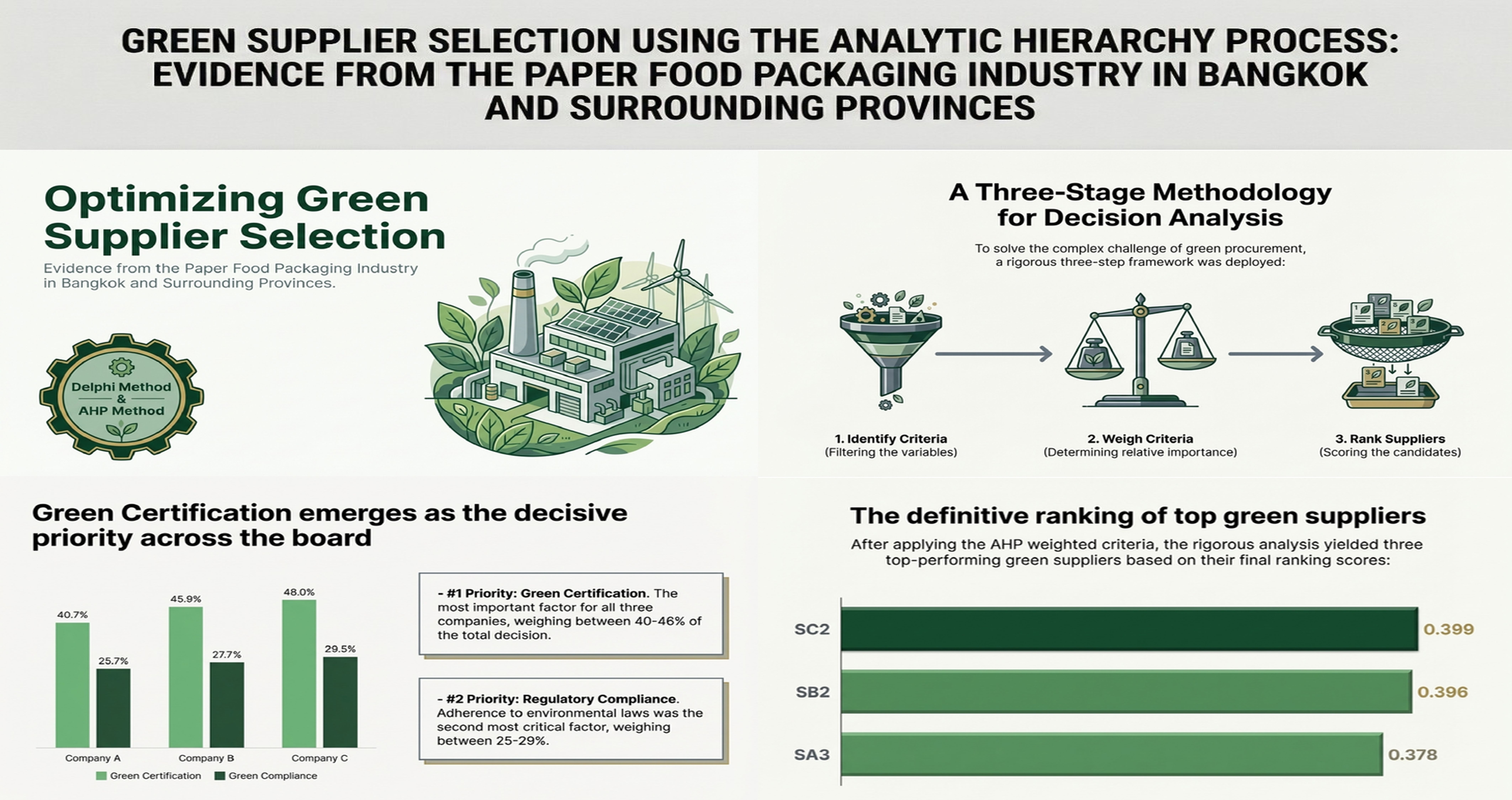
This study develops a systematic decision-making framework for green supplier selection in the food packaging industry by using the analytic hierarchy process (AHP). Growing environmental awareness and increasingly stringent regulatory requirements have intensified the need for structured approaches to evaluating suppliers based on sustainability criteria. However, industry-specific green supplier selection frameworks remain limited. To address this gap, a two-phase methodology is employed. First, the Delphi method is used to identify and validate supplier selection criteria through expert consensus. Second, the AHP is applied to conduct a multicriteria decision analysis. Eight industry experts from three food packaging companies participated in both the criteria identification and supplier evaluation processes. The Delphi analysis yielded six validated green supplier selection criteria: green raw materials usage (C1), green products (C2), green service quality (C3), green image (C4), green certification (C5), and green compliance (C6). The AHP findings revealed that green certification (C5) is the most influential criterion across all three companies, with importance weights of 0.407, 0.459, and 0.460, respectively, followed by green compliance (C6) as the second-highest priority. The supplier evaluation results identified the optimal suppliers for each company as SA3 (0.378), SB2 (0.396), and SC2 (0.399), with SC2 achieving the highest overall performance score. Consistency ratio (CR) testing confirmed the reliability of the decision-making process, with all CR values below 0.10, thereby validating the methodological rigor of the proposed framework. Overall, the findings demonstrate that formal environmental standards and regulatory compliance are the primary drivers of supplier selection in the food packaging sector. This framework provides practitioners with an evidence-based tool to support sustainable supplier selection decisions and contributes to the sustainable supply chain management literature by offering an industry-specific approach that balances environmental objectives with operational requirements.
Downloads
Article Details

This work is licensed under a Creative Commons Attribution-NonCommercial-NoDerivatives 4.0 International License.
All rights reserved. Apart from citations for the purposes of research, private study, or criticism and review,no part of this publication may be reproduced, stored or transmitted in any other form without prior written permission by the publisher.
References
Afif, K., Rebolledo, C., & Roy, J. (2022). Drivers, barriers and performance outcomes of sustainable packaging: A systematic literature review. British Food Journal, 124(3), 915–935. https://doi.org/10.1108/bfj-02-2021-0150
Agyabeng-Mensah, Y., Ahenkorah, E., Afum, E., Nana Agyemang, A., Agnikpe, C., & Rogers, F. (2020). Examining the influence of internal green supply chain practices, green human resource management and supply chain environmental cooperation on firm performance. Supply Chain Management: An International Journal, 25(5), 585–599. https://doi.org/10.1108/scm-11-2019-0405
Ahmad, T., Boit, J., & Aakula, A. (2023). The role of cross-functional collaboration in digital transformation. Journal of Computational Intelligence and Robotics, 3(1), 205–242. https://www.researchgate.net/profile/Tanzeem-Ahmad-3/publication/389744145_The_Role_of_Cross-Functional_Collaboration_in_Digital_Transformation/links/67d098b3d7597000650803c2/The-Role-of-Cross-Functional-Collaboration-in-Digital-Transformation.pdf
Alamsyah, D. P., Othman, N. A., & Mohammed, H. A. A. (2020). The awareness of environmentally friendly products: The impact of green advertising and green brand image. Management Science Letters, 10(9), 1961–1968. https://doi.org/10.5267/j.msl.2020.2.017
Althabatah, A., Yaqot, M., Menezes, B., & Kerbache, L. (2023). Transformative procurement trends: Integrating industry 4.0 technologies for enhanced procurement processes. Logistics, 7(3), Article 63. https://doi.org/10.3390/logistics7030063
Appannan, J. S., Mohd Said, R., Ong, T. S., & Senik, R. (2023). Promoting sustainable development through strategies, environmental management accounting and environmental performance. Business Strategy and the Environment, 32(4), 1914–1930. https://doi.org/10.1002/bse.3227
Awewomom, J., Dzeble, F., Takyi, Y. D., Ashie, W. B., Ettey, E. N. Y. O., Afua, P. E., Sackey, L. N. A., Opoku, F., & Akoto, O. (2024). Addressing global environmental pollution using environmental control techniques: A focus on environmental policy and preventive environmental management. Discover Environment, 2(1), Article 8. https://doi.org/10.1007/s44274-024-00033-5
Banaeian, N., Mobli, H., Nielsen, I. E., & Omid, M. (2015). Criteria definition and approaches in green supplier selection–a case study for raw material and packaging of food industry. Production & Manufacturing Research, 3(1), 149–168. https://doi.org/10.1080/21693277.2015.1016632
Boesen, S., Bey, N., & Niero, M. (2019). Environmental sustainability of liquid food packaging: Is there a gap between Danish consumers’ perception and learnings from life cycle assessment? Journal of Cleaner Production, 210, 1193–1206. https://doi.org/10.1016/j.jclepro.2018.11.055
Brunelli, M. (2014). Introduction to the analytic hierarchy process. Springer. https://doi.org/10.1007/978-3-319-12502-2
Carter, C. R., & Liane Easton, P. (2011). Sustainable supply chain management: Evolution and future directions. International Journal of Physical Distribution & Logistics Management, 41(1), 46–62. https://doi.org/10.1108/09600031111101420
Cheng, H., Xu, H., McClements, D. J., Chen, L., Jiao, A., Tian, Y., Miao, M., & Jin, Z. (2022). Recent advances in intelligent food packaging materials: Principles, preparation and applications. Food Chemistry, 375, Article 131738. https://doi.org/10.1016/j.foodchem.2021.131738
Cui, L., Wu, H., & Dai, J. (2023). Modelling flexible decisions about sustainable supplier selection in multitier sustainable supply chain management. International Journal of Production Research, 61(14), 4603–4624. https://doi.org/10.1080/00207543.2021.1924412
de Boer, L., Labro, E., & Morlacchi, P. (2001). A review of methods supporting supplier selection. European Journal of Purchasing & Supply Management, 7(2), 75–89. https://doi.org/10.1016/S0969-7012(00)00028-9
Deshmukh, A. J., & Vasudevan, H. (2014). Emerging supplier selection criteria in the context of traditional vs green supply chain management. International Journal of Managing Value and Supply Chains, 5(1), 19–33. https://doi.org/10.5121/ijmvsc.2014.5103
DiMarket. (2025). Paper packaging industry in Thailand unlocking growth potential: Analysis and forecasts 2026–2034.https://www.datainsightsmarket.com/reports/paper-packaging-industry-in-thailand-17033?tab=summary
Du, Y., Wang, X., Brombal, D., Moriggi, A., Sharpley, A., & Pang, S. (2018). Changes in environmental awareness and its connection to local environmental management in water conservation zones: The case of Beijing, China. Sustainability, 10(6), Article 2087. https://doi.org/10.3390/su10062087
Ecer, F. (2022). Multi-criteria decision making for green supplier selection using interval type-2 fuzzy AHP: A case study of a home appliance manufacturer. Operational Research, 22(1), 199–233. https://doi.org/10.1007/s12351-020-00552-y
Fish, L. S., & Busby, D. M. (2005). The Delphi method. In D. H. Sprenkle & F. P. Piercy (Eds.), Research methods in family therapy (2nd ed., pp. 238–253). The Guilford Press. https://scholarsarchive.byu.edu/facpub/4584/
Garg, A., & Vemaraju, S. (2025). Green logistics management effect on sustainable logistics performance. Journal of Environmental & Earth Sciences, 7(2), 175–186. https://doi.org/10.30564/jees.v7i2.7685
Govindan, K., Rajendran, S., Sarkis, J., & Murugesan, P. (2015). Multi criteria decision making approaches for green supplier evaluation and selection: A literature review. Journal of Cleaner Production, 98, 66–83. https://doi.org/10.1016/j.jclepro.2013.06.046
Grime, M. M., & Wright, G. (2016). Delphi method. In N. Balakrishnan, T. Colton, B. Everitt, W. Piegorsch, F. Ruggeri, & J. L. Teugels (Eds.), Wiley statsref: Statistics reference online (pp. 1–6). John Wiley & Sons. https://doi.org/10.1002/9781118445112.stat07879
Guo, Z., Bai, L., & Gong, S. (2019). Government regulations and voluntary certifications in food safety in China: A review. Trends in Food Science & Technology, 90, 160–165. https://doi.org/10.1016/j.tifs.2019.04.014
Han, J.-W., Ruiz-Garcia, L., Qian, J.-P., & Yang, X.-T. (2018). Food packaging: A comprehensive review and future trends. Comprehensive Reviews in Food Science and Food Safety, 17(4), 860–877. https://doi.org/10.1111/1541-4337.12343
Herbes, C., Beuthner, C., & Ramme, I. (2020). How green is your packaging—A comparative international study of cues consumers use to recognize environmentally friendly packaging. International journal of Consumer Studies, 44(3), 258–271. https://doi.org/10.1111/ijcs.12560
Hossain, M. K., & Thakur, V. (2020). Benchmarking health-care supply chain by implementing Industry 4.0: A fuzzy-AHP-DEMATEL approach. Benchmarking: An International Journal, 28(2), 556–581. https://doi.org/10.1108/BIJ-05-2020-0268
Hruška, R., Průša, P., & Babić, D. (2014). The use of AHP method for selection of supplier. Transport, 29(2), 195–203. https://doi.org/10.3846/16484142.2014.930928
Humphrey-Murto, S., Wood, T. J., Gonsalves, C., Mascioli, K., & Varpio, L. (2020). The Delphi method. Academic Medicine, 95(1), 168. https://www.sap2.org.ar/i2/archivos/1365.pdf
Jabbarzadeh, A. (2018). Application of the AHP and TOPSIS in project management. Journal of Project Management, 3(2), 125–130. https://doi.org/10.5267/j.jpm.2018.1.001
Jiang, P., Hu, Y.-C., Yen, G.-F., & Tsao, S.-J. (2018). Green supplier selection for sustainable development of the automotive industry using grey decision‐making. Sustainable Development, 26(6), 890–903. https://doi.org/10.1002/sd.1860
Kim, D., Na, J., & Ha, H.-K. (2024). Exploring the impact of green logistics practices and relevant government policy on the financial efficiency of logistics companies. Heliyon, 10(10), Article e30916. https://doi.org/10.1016/j.heliyon.2024.e30916
Konys, A. (2019). Green supplier selection criteria: From a literature review to a comprehensive knowledge base. Sustainability, 11(15), Article 4208. https://doi.org/10.3390/su11154208
Lo, H.-W. (2023). A data-driven decision support system for sustainable supplier evaluation in the Industry 5.0 era: A case study for medical equipment manufacturing. Advanced Engineering Informatics, 56, Article 101998. https://doi.org/10.1016/j.aei.2023.101998
Mabrouk, N. B. (2021). Green supplier selection using fuzzy Delphi method for developing sustainable supply chain. Decision Science Letters, 10(1), 63–70. https://doi.org/10.5267/j.dsl.2020.10.003
MacArthur, E. (2013). Towards the circular economy. https://emf.s3.amazonaws.com/downloads/Towards_A_Circular_Economy.pdf
Majid, I., Nayik, G. A., Dar, S. M., & Nanda, V. (2018). Novel food packaging technologies: Innovations and future prospective. Journal of the Saudi Society of Agricultural Sciences, 17(4), 454–462. https://doi.org/10.1016/j.jssas.2016.11.003
Martins, V. G., & Romani, V. P. (2022). Food packaging industry: An introduction. In A. K. Shukla (Ed.), Food packaging: The smarter way (pp. 1–9). Springer. https://doi.org/10.1007/978-981-16-7196-8_1
Moktadir, M. A., Rahman, T., & Sultana, R. (2017). Selection of best supplier by using AHP approach for managing risk factors in logistics: A case of leather products industry. Industrial Engineering & Management, 6(4), Article 1000232. https://doi.org/10.4172/2169-0316.1000232
Molina-Besch, K., Wikström, F., & Williams, H. (2019). The environmental impact of packaging in food supply chains—does life cycle assessment of food provide the full picture? The International Journal of Life Cycle Assessment, 24(1), 37–50. https://doi.org/10.1007/s11367-018-1500-6
Mordor Intelligence. (2024). Thailand packaging market size & share analysis - growth trends and forecast (2025–2030). https://www.mordorintelligence.com/industry-reports/thailand-packaging-market
Mousakhani, S., Nazari-Shirkouhi, S., & Bozorgi-Amiri, A. (2017). A novel interval type-2 fuzzy evaluation model based group decision analysis for green supplier selection problems: A case study of battery industry. Journal of Cleaner Production, 168, 205–218. https://doi.org/10.1016/j.jclepro.2017.08.154
Mukherjee, K. (2016). Supplier selection criteria and methods: Past, present and future. International Journal of Operational Research, 27(1–2), 356–373. https://doi.org/10.1504/IJOR.2016.078470
Noori-Daryan, M., Taleizadeh, A. A., & Jolai, F. (2019). Analyzing pricing, promised delivery lead time, supplier-selection, and ordering decisions of a multi-national supply chain under uncertain environment. International Journal of Production Economics, 209, 236–248. https://doi.org/10.1016/j.ijpe.2017.12.019
Okoli, C., & Pawlowski, S. D. (2004). The Delphi method as a research tool: An example, design considerations and applications. Information & Management, 42(1), 15–29. https://doi.org/10.1016/j.im.2003.11.002
Ortiz-Barrios, M., Miranda-De la Hoz, C., López-Meza, P., Petrillo, A., & De Felice, F. (2020). A case of food supply chain management with AHP, DEMATEL, and TOPSIS. Journal of Multi‐Criteria Decision Analysis, 27(1–2), 104–128. https://doi.org/10.1002/mcda.1693
Pålsson, H., & Sandberg, E. (2022). Adoption barriers for sustainable packaging practices: A comparative study of food supply chains in South Africa and Sweden. Journal of Cleaner Production, 374, Article 133811. https://doi.org/10.1016/j.jclepro.2022.133811
Paula, I. C. D., Campos, E. A. R. D., Pagani, R. N., Guarnieri, P., & Kaviani, M. A. (2020). Are collaboration and trust sources for innovation in the reverse logistics? Insights from a systematic literature review. Supply Chain Management: An International Journal, 25(2), 176–222. https://doi.org/10.1108/scm-03-2018-0129
Perçin, S. (2006). An application of the integrated AHP‐PGP model in supplier selection. Measuring Business Excellence, 10(4), 34–49. https://doi.org/10.1108/13683040610719263
Petkoska, A. T., Daniloski, D., D’Cunha, N. M., Naumovski, N., & Broach, A. T. (2021). Edible packaging: Sustainable solutions and novel trends in food packaging. Food Research International, 140, Article 109981. https://doi.org/10.1016/j.foodres.2020.109981
Primasari, C. H., Wardoyo, R., & Sari, A. K. (2018). Integrated AHP, profile matching, and TOPSIS for selecting type of goats based on environmental and financial criteria. International Journal of Advances in Intelligent Informatics, 4(1), 28–39. https://doi.org/10.26555/ijain.v4i1.105
Puška, A., & Stojanović, I. (2022). Fuzzy multi-criteria analyses on green supplier selection in an agri-food company. Journal of Intelligent Management Decision, 1(1), 2–16. https://doi.org/10.56578/jimd010102
Qian, L. (2014). Market-based supplier selection with price, delivery time, and service level dependent demand. International Journal of Production Economics, 147(Part C), 697–706. https://doi.org/10.1016/j.ijpe.2013.07.015
Rashidi, K., Noorizadeh, A., Kannan, D., & Cullinane, K. (2020). Applying the triple bottom line in sustainable supplier selection: A meta-review of the state-of-the-art. Journal of Cleaner Production, 269, Article 122001. https://doi.org/10.1016/j.jclepro.2020.122001
Ren, R., Hu, W., Dong, J., Sun, B., Chen, Y., & Chen, Z. (2020). A systematic literature review of green and sustainable logistics: Bibliometric analysis, research trend and knowledge taxonomy. International Journal of Environmental Research and Public Health, 17(1), Article 261. https://doi.org/10.3390/ijerph17010261
Rezaei, J., Papakonstantinou, A., Tavasszy, L., Pesch, U., & Kana, A. (2019). Sustainable product‐package design in a food supply chain: A multi‐criteria life cycle approach. Packaging Technology and Science, 32(2), 85–101. https://doi.org/10.1002/pts.2418
Saaty, R. W. (1987). The analytic hierarchy process—what it is and how it is used. Mathematical Modelling, 9(3–5), 161–176. https://doi.org/10.1016/0270-0255(87)90473-8
Saaty, T. L. (1990). How to make a decision: The analytic hierarchy process. European Journal of Operational Research, 48(1), 9–26. https://doi.org/10.1016/0377-2217(90)90057-I
Saaty, T. L. (2001). Fundamentals of the analytic hierarchy process. In D. L. Schmoldt, J. Kangas, G. A. Mendoza, & M. Pesonen (Eds.), The analytic hierarchy process in natural resource and environmental decision making (pp. 15–35). Springer. https://doi.org/10.1007/978-94-015-9799-9_2
Saaty, T. L. (2008). Decision making with the analytic hierarchy process. International Journal of Services Sciences, 1(1), 83–98. https://doi.org/10.1504/IJSSCI.2008.017590
Saaty, T. L., & Ergu, D. (2015). When is a decision-making method trustworthy? Criteria for evaluating multi-criteria decision-making methods. International Journal of Information Technology & Decision Making, 14(06), 1171–1187. https://doi.org/10.1142/S021962201550025X
Seier, M., Archodoulaki, V.-M., & Koch, T. (2024). The morphology and properties of recycled plastics made from multi-layered packages and the consequences for the circular economy. Resources, Conservation and Recycling, 202, Article 107388. https://doi.org/10.1016/j.resconrec.2023.107388
Seuring, S., & Müller, M. (2008). From a literature review to a conceptual framework for sustainable supply chain management. Journal of Cleaner Production, 16(15), 1699–1710. https://doi.org/10.1016/j.jclepro.2008.04.020
Silvestri, C., Silvestri, L., Piccarozzi, M., & Ruggieri, A. (2024). Toward a framework for selecting indicators of measuring sustainability and circular economy in the agri-food sector: A systematic literature review. The International Journal of Life Cycle Assessment, 29(8), 1446–1484. https://doi.org/10.1007/s11367-022-02032-1
Song, W., Chen, Z., Liu, A., Zhu, Q., Zhao, W., Tsai, S.-B., & Lu, H. (2018). A study on green supplier selection in dynamic environment. Sustainability, 10(4), Article 1226. https://doi.org/10.3390/su10041226
Utama, D. M. (2021). AHP and TOPSIS integration for green supplier selection: A case study in Indonesia. Journal of Physics: Conference Series, 1845, Article 012015. https://doi.org/10.1088/1742-6596/1845/1/012015
Wandosell, G., Parra-Meroño, M. C., Alcayde, A., & Baños, R. (2021). Green packaging from consumer and business perspectives. Sustainability, 13(3), Article 1356. https://doi.org/10.3390/su13031356
Wang, Y., & Wang, Y. (2021). Research on the application of environmentally friendly packaging materials in the sustainable development of logistics. IOP Conference Series: Earth and Environmental Science, 781(3), Article 032025. https://doi.org/10.1088/1755-1315/781/3/032025
Wei, C., Wu, J., Guo, Y., & Wei, G. (2021). Green supplier selection based on CODAS method in probabilistic uncertain linguistic environment. Technological and Economic Development of Economy, 27(3), 530–549. https://doi.org/10.3846/tede.2021.14078
Yazdani, M., Chatterjee, P., Zavadskas, E. K., & Zolfani, S. H. (2017). Integrated QFD-MCDM framework for green supplier selection. Journal of Cleaner Production, 142(Part 4), 3728–3740. https://doi.org/10.1016/j.jclepro.2016.10.095
Yu, Q., & Hou, F. (2016). An approach for green supplier selection in the automobile manufacturing industry. Kybernetes, 45(4), 571–588. https://doi.org/10.1108/K-01-2015-0034
Zhang, L.-J., Liu, R., Liu, H.-C., & Shi, H. (2020). Green supplier evaluation and selections: A state-of-the-art literature review of models, methods, and applications. Mathematical Problems in Engineering, 2020(1), Article 1783421. https://doi.org/10.1155/2020/1783421
Zhang, W., Wu, Y., Luo, R., & Wang, Y. (2023). Sustainable strategies for green supply chain within the platform economy consider subsidies and marketing efforts. PLoS ONE, 18(11), Article e0292349. https://doi.org/10.1371/journal.pone.0292349
