
Developing a caregiver training curriculum to enhance early childhood safety skills in Thai child development centers in Nakhon Pathom Province
Article Sidebar
Main Article Content
Abstract
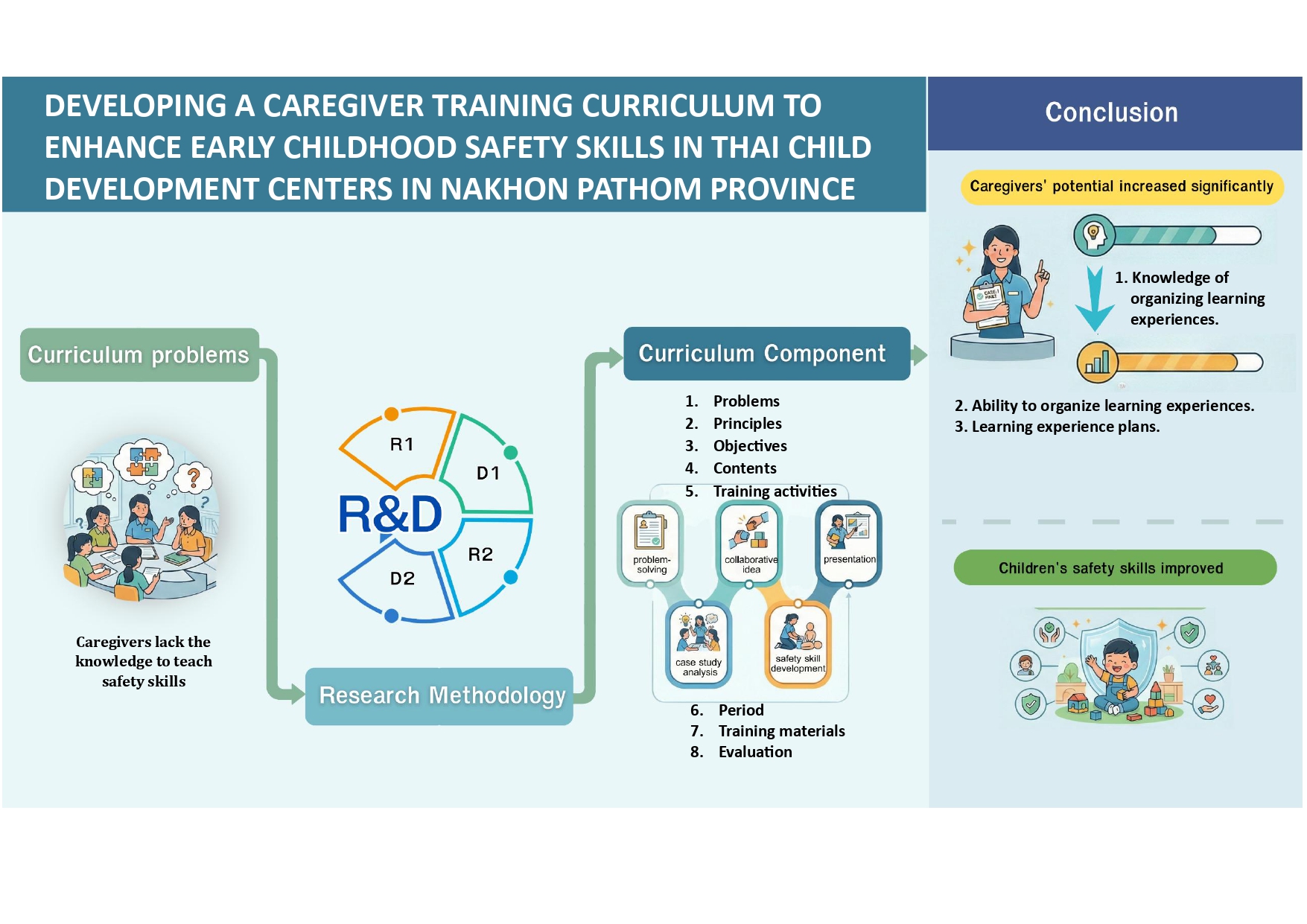
The study responded to the need to strengthen caregivers’ competency in providing learning experiences to promote early childhood safety skills (ECSSs) in child development centers affiliated with local administrative organizations in Nakhon Pathom Province, Thailand. It aimed 1) to develop a competency-based training curriculum for caregivers, 2) to verify the curriculum’s effectiveness in enhancing caregivers’ knowledge, ability, and experience provision plans, and 3) to investigate the possibility of expanding the curriculum for use in other centers. The study adopted four R&D stages of research, namely, baseline study (R1), curriculum drafting and verification (D1), effectiveness verification (R2), and curriculum revision (D2). Mean scores, standard deviations, and t-tests were employed in analyzing the quantitative data. It was found that the developed curriculum consisted of eight essential components: curriculum problems and importance, principles, objectives, contents, training activities, period, training materials, and evaluation. The training followed a structured five-stage model involving case study analysis, collaborative idea exploration, problem-solving, safety skill development, and presentation. After the training, the caregivers participating in the training program gained statistically higher knowledge and understanding of learning experience organization for child safety (p < .01), and their ability to prepare and carry out the learning plans was rated at a high to a very high level. The children in the centers also developed significantly improved safety skills to a high level after their caregivers’ learning application of the training. The curriculum was successfully applied in two other child development centers, confirming its potential for adaptation and relevancy. The findings indicate that the curriculum effectively enhanced the caregivers’ competencies and contributed to the promotion of ECSSs in child development centers.
Downloads
Article Details

This work is licensed under a Creative Commons Attribution-NonCommercial-NoDerivatives 4.0 International License.
All rights reserved. Apart from citations for the purposes of research, private study, or criticism and review,no part of this publication may be reproduced, stored or transmitted in any other form without prior written permission by the publisher.
References
Ahun, M. N., Aboud, F., Wamboldt, C., & Yousafzai, A. K. (2023). Implementation of UNICEF and WHO’s care for child development package: Lessons from a global review and key informant interviews. Frontiers in Public Health, 11, 1–14. https://doi.org/10.3389/fpubh.2023.1140843
Arroyo, E. A., Prieto, E. B., Cordero, L. F., Marín, M. L., Franco, L. C. L., Gómez, A. L., Benedetti, F., & Díaz-Veiga, P. (2023, August). Toward the professionalization of caregivers: Training and skills needed for long-term. Social Protection and Health Division, Inter-American Development Bank Group (IDB). https://dx.doi.org/10.18235/0005055
Baruni, R. R., & Miltenberger, R. G. (2022). Teaching safety skills to children: A discussion of critical features and practice recommendations. Behavior Analysis in Practice, 15(3), 938–950. https://doi.org/10.1007/s40617-021-00667-4
Bautista, A., Bull, R., Ng, E. L., & Lee, K. (2021). “That’s just impossible in my kindergarten.” Advocating for ‘glocal’ early childhood curriculum frameworks. Policy Futures in Education, 19(2), 155–174. https://doi.org/10.1177/1478210320956500
Benayoune, A. (2024). Competency-based framework development and implementation: Current and future perspectives. Information Management and Business Review, 16(3), 606–615. https://doi.org/10.22610/imbr.v16i3(I).4013
Bright, M. A., Sayedul Huq, M., Patel, S., Miller, M. D., & Finkelhor, D. (2022). Child safety matters: Randomized control trial of a school-based, child victimization prevention curriculum. Journal of Interpersonal Violence, 37(1–2), 538–556. https://doi.org/10.1177/0886260520909185
Chaemchoy, S. (2023). Development of a model for early childhood teacher and caregiver preparation and development to enhance desired qualities of young children in Thailand. Kasetsart Journal of Social Sciences, 44, 215–222. https://so04.tci-thaijo.org/index.php/kjss/article/view/264467/179640
Chatakan, W., Boonpob, P., Chairueang, N., Sutra, J., Thitipraserth, N., & Nilsook, P. (2024). Coordination mechanisms and systems to enhance Thai early childhood development management efficiency. Asia-Pacific Journal of Research in Early Childhood Education, 18(3), 61–85. https://dx.doi.org/10.17206/apjrece.2024.18.3.61
Childress, D. C., Raver, S. A., Eckhoff, A., & Gear, S. B. (2023). Technology-mediated professional development for early intervention service providers: Connecting adult learning with caregiver support. Professional Development in Education, 49(5), 899–913. https://doi.org/10.1080/19415257.2021.1879222
Harvath, T., Mongoven, J., Sexson, K., & Bettega, K. (2023). Development of competencies to strengthen support for caregivers and enhance their capacity to provide care. Gerontology & Geriatrics Education, 44(4), 523–527. https://doi.org/10.1080/02701960.2022.2083117
Joo, J. H., Bone, L., Forte, J., Kirley, E., Lynch, T., & Aboumatar, H. (2022). The benefits and challenges of established peer support programmes for patients, informal caregivers, and healthcare providers. Family Practice, 39(5), 903–912. https://doi.org/10.1093/fampra/cmac004
Jullien, S. (2021). Prevention of unintentional injuries in children under five years. BMC Pediatrics, 21, Article 311. https://doi.org/10.1186/s12887-021-02517-2
Juntawong, N., Boonyamalik, P., & Lagampan, S. (2021). The effects of knowledge and skill promotion program on accident prevention behaviors in preschool children. Journal of Public Health Nursing, 35(1), 21–36. https://he01.tci-thaijo.org/index.php/phn/article/view/248729/169239 [in Thai]
Kawee, L., Napatpittayatorn, P., & Ponrachom, C. (2024). Drowning of children under 5 years old: Problem, causal factors, and solutions. Journal of Health and Nursing Research, 40(2), 226–236. https://he01.tci-thaijo.org/index.php/bcnbangkok/article/view/268264/183939 [in Thai]
Lenning, O. T., Hill, D. M., Saunders, K. P., Stokes, A., & Solan, A. (2023). Powerful learning communities: A guide to developing student, faculty, and professional learning communities to improve student success and organizational effectiveness. Routledge. https://doi.org/10.4324/9781003446385
Lindholm, M., Reiman, A., & Keväjärvi, M. (2022). Safety and health challenges affecting the informal caregivers of children. Nordic Social Work Research, 12(4), 506–522. https://doi.org/10.1080/2156857X.2020.1838941
Morrongiello, B. A., & Dawber, T. (2004). Identifying factors that relate to children’s risk-taking decisions. Canadian Journal of Behavioural Science/Revue canadienne des sciences du comportement, 36(4), 255–266. https://doi.org/10.1037/h0087235
Narintarangkul Na Ayutthaya, S. (2018). Paradigm, model and mechanism for area-based teacher development. Educational Management and Innovation Journal, 1(3), 82–100. https://so01.tci-thaijo.org/index.php/emi/article/view/146190 [in Thai]
Office of the Education Council. (2017). National Education Plan B.E. 2560–2579. Prikwarn Graphic. https://planipolis.iiep.unesco.org/sites/default/files/ressources/thailand_educationplan.pdf [in Thai]
Office of the National Economic and Social Development Council (NESDC). (2025, July 23). The thirteenth national economic and social development plan. Office of the Prime Minister. https://www.nesdc.go.th/wp-content/themes/plant3-child/assets/pdf/13/article_file_20230615134223.pdf
Price, K., Lee, K. C., Woolley, K. E., Falk, H., Peck, M., Lilford, R., & Moiemen, N. (2021). Burn injury prevention in low-and middle-income countries: Scoping systematic review. Burns & Trauma, 9, Article tkab037. https://doi.org/10.1093/burnst/tkab037
Rodriguez, A. M., & Chua, P. G. (2021). Growing steady and strong: Early childhood development regional guidance in East Asia and the Pacific. UNICEF East Asia and Pacific Regional Office. https://www.unicef.org/eap/media/10121/file/Growing%20Steady%20and%20Strong%20report%20.pdf
Sangngam, S. (2021). The development of early childhood students’ creative thinking problem solving abilities through STEM education learning activities. Journal of Physics: Conference Series, 1835, Article 012008. http://doi.org/10.1088/1742-6596/1835/1/012008
Schnitzer, P. G. (2006). Prevention of unintentional childhood injuries. American Family Physician, 74(11), 1864–1869. https://www.aafp.org/pubs/afp/issues/2006/1201/p1864.html
Schwebel, D. C., & Gaines, J. (2007). Pediatric unintentional injury: Behavioral risk factors and implications for prevention. Journal of Developmental & Behavioral Pediatrics, 28(3), 245–254. https://doi.org/10.1097/01.DBP.0000268561.80204.2a
Sultan, M. A., Miller, E., Tikkanen, R. S., Singh, S., Kullu, A., Cometto, G., Fitzpatrick, S., Ajuebor, O., Gillon, N., Edward, A., Moleman, Y. P., Pandya, S., Park, I., Shen, J. Y., Yu, Y., Perry, H., Scott, K., & Closser, S. (2025). Competency-based education and training for community health workers: A scoping review. BMC Health Services Research, 25, Article 263. https://doi.org/10.1186/s12913-025-12217-7
Topping, K., & Wolfendale, S. (2017). Parental involvement in children’s reading. Routledge. https://doi.org/10.4324/9781351236102
Wang, X., Ratanaolarn, T., & Sitthiworachart, J. (2025). Integrating project-based blended learning and design thinking to enhance creativity and openness to experience. Cogent Education, 12(1), Article 2500760. https://doi.org/10.1080/2331186X.2025.2500760
Watanabe, O., Chompikul, J., Kawamori, M., Pimpisan, N., & Visanuyothin, S. (2019). Predictors of family caregiver burden in caring for older people in the urban district of Nakhon Ratchasima Province, Thailand. Kokusai Hoken Iryo (Journal of International Health), 34(4), 217–228. https://doi.org/10.11197/jaih.34.217
World Health Organization. (2018). Nurturing care for early childhood development: A framework for helping children survive and thrive to transform health and human potential. https://iris.who.int/server/api/core/bitstreams/781de51d-4cef-482e-bb3b-c2b3becf3c9f/content
Yang, L., Nong, Q. Q., Li, C. L., Feng, Q. M., & Lo, S. K. (2007). Risk factors for childhood drowning in rural regions of a developing country: A case–control study. Injury Prevention, 13(3), 178–182. https://injuryprevention.bmj.com/content/13/3/178.short
