
FC-STEAM as participatory identity design model in graphic design education: A visual communication strategy for higher education
Article Sidebar
Main Article Content
Abstract
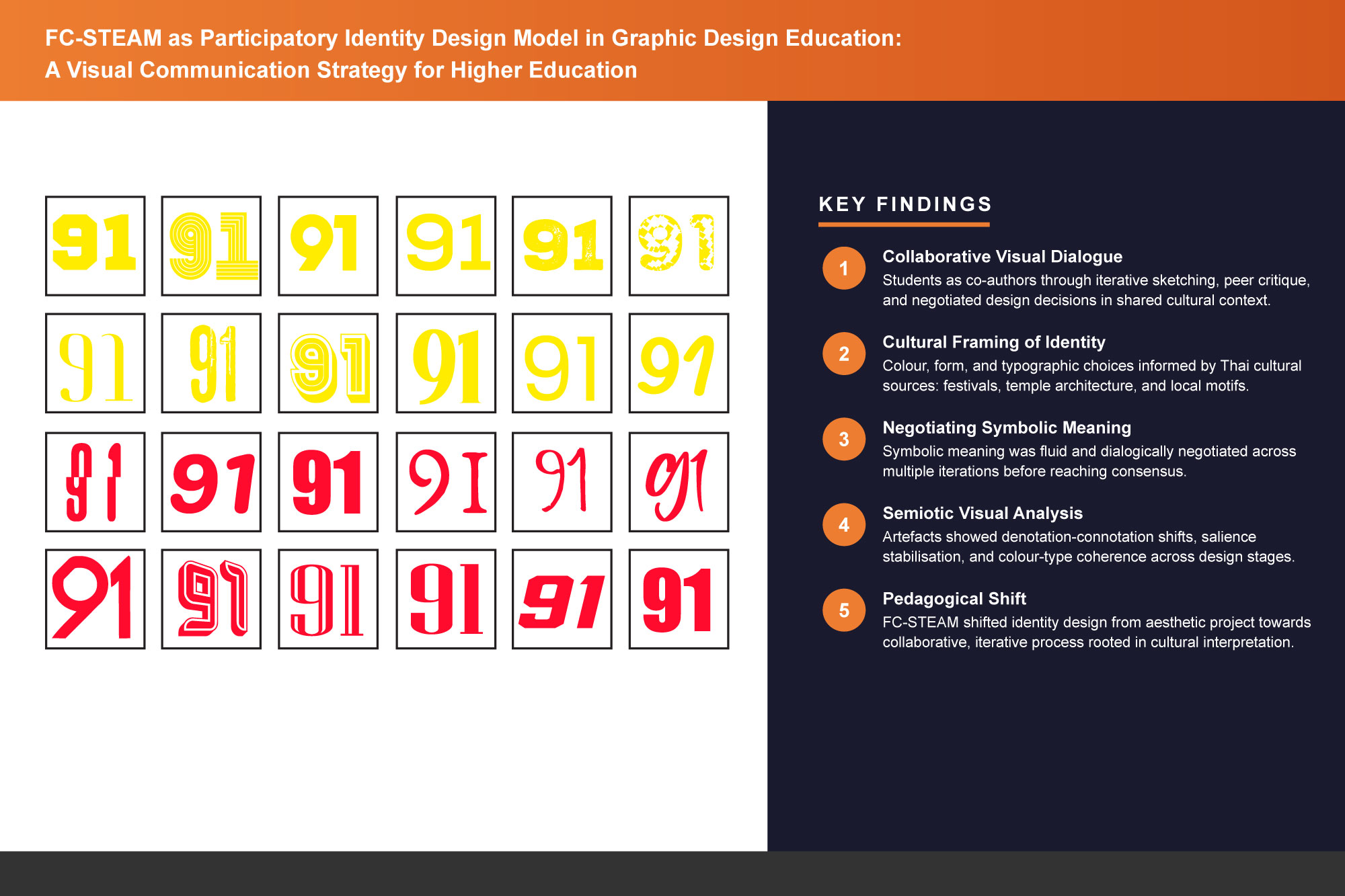
This research examines how participatory design frameworks can support identity construction in the context of undergraduate visual communication education. It proposes an evolved FC-STEAM model that integrates form storming, creative exploration, and STEAM-based inquiry to help students develop culturally resonant visual identities. The study was conducted in a third-year design course at Thammasat University, Thailand using a design-based research approach. Data were collected through participatory observation, in-depth interviews, and focus groups, with quantitative elements used to examine the impact of large-scale events on decision-making. The analysis combined thematic and semiotic visual analysis, represented by visual artefacts, logo sketches, logo systems, and branding applications at a consistent scale. The results reveal that the FC-STEAM model shifted identity design—previously treated as a purely aesthetic project—towards a collaborative, iterative process rooted in cultural interpretation. The most promising outcomes were achieved through partial implementation of the process, which significantly enhanced visual literacy, collaborative decision-making, and awareness of symbolic meaning within branding contexts. The study contributes a scalable pedagogical model for participatory identity design that aligns strategic design education with semiotic understanding and interdisciplinary creativity.
Downloads
Article Details

This work is licensed under a Creative Commons Attribution-NonCommercial-NoDerivatives 4.0 International License.
All rights reserved. Apart from citations for the purposes of research, private study, or criticism and review,no part of this publication may be reproduced, stored or transmitted in any other form without prior written permission by the publisher.
References
Akama, Y. (2015). Being awake to Ma: Designing in between-ness as a way of becoming with. CoDesign, 11(3–4), 262–274. https://doi.org/10.1080/15710882.2015.1081243
Bannon, L. J., & Ehn, P. (2012). Design: Design matters in participatory design. In J. Simonsen & T. Robertson (Eds.), Routledge international handbook of participatory design (pp. 37–63). Routledge.
Bateman, J. A. (2014). Text and image: A critical introduction to the visual/verbal divide. Routledge.
Bestley, R., & Noble, I. (2016). Visual research: An introduction to research methods in graphic design (3rd ed.). Bloomsbury Visual Arts.
Bovill, C., Cook-Sather, A., & Felten, P. (2011). Students as co-creators of teaching approaches, course design, and curricula: Implications for academic developers. International Journal for Academic Development, 16(2), 133–145. https://doi.org/10.1080/1360144X.2011.568690
Braun, V., & Clarke, V. (2022). Thematic analysis: A practical guide. Sage.
British Educational Research Association. (2018). Ethical guidelines for educational research (4th ed.). British Educational Research Association (BERA). https://www.bera.ac.uk/publication/ethical-guidelines-for-educational-research-2018
Byrne, D. (2022). A worked example of Braun and Clarke’s approach to reflexive thematic analysis. Quality & Quantity, 56, 1391–1412. https://doi.org/10.1007/s11135-021-01182-y
Carter, S., & Laurs, D. (Eds.). (2018). Developing research writing: A handbook for supervisors and advisors. Routledge.
Cornelissen, J., Thøger Christensen, L., & Kinuthia, K. (2012). Corporate brands and identity: Developing stronger theory and a call for shifting the debate. European Journal of Marketing, 46(7–8), 1093–1102. https://doi.org/10.1108/03090561211230214
Cover, R. (2015). Digital identities: Creating and communicating the online self. Academic Press.
Creswell, J. W., & Poth, C. N. (2018). Qualitative inquiry and research design: Choosing among five approaches (4th ed.). Sage.
Dörnyei, Z. (2009). Individual differences: Interplay of learner characteristics and learning environment. Language Learning, 59(s1), 230–248. https://doi.org/10.1111/j.1467-9922.2009.00542.x
Flick, U. (2023). An introduction to qualitative research (7th ed.). Sage.
Frascara, J. (2004). Communication design: Principles, methods, and practice. Allworth Press.
Gaver, B., Dunne, T., & Pacenti, E. (1999). Design: Cultural probes. Interactions, 6(1), 21–29. https://doi.org/10.1145/291224.291235
Grimsgaard, W. (2022). Design and strategy: A step-by-step guide. Laurence King.
Hnit, H., & Almanna, A. (2025). Constructing identity through narratives: Personal, social, and digital dimensions. Social Sciences & Humanities Open, 12, Article 101692. https://doi.org/10.1016/j.ssaho.2025.101692
Iivari, N., Tervo, E., Käsmä, M., & Heikkinen, M. (2023). Participatory design meets gender equality at European higher education institutions. CoDesign, 19(4), 304–326. https://doi.org/10.1080/15710882.2023.2215742
Irwin, T. (2015). Transition design: A proposal for a new area of design practice, study, and research. Design and Culture, 7(2), 229–246. https://doi.org/10.1080/17547075.2015.1051829
Israel, M. (2015). Research ethics and integrity for social scientists: Beyond regulatory compliance (2nd ed.). Sage.
Jewitt, C., Bezemer, J., & O’Halloran, K. (2016). Introducing multimodality. Routledge. https://doi.org/10.4324/9781315638027
Kalantzis, M., & Cope, B. (2010). The teacher as designer: Pedagogy in the new media age. E-Learning and Digital Media, 7(3), 200–222. https://doi.org/10.2304/elea.2010.7.3.200
Kinnula, M., Iivari, N., Kuure, L., & Molin-Juustila, T. (2023). Educational participatory design in the crossroads of histories and practices–Aiming for digital transformation in language pedagogy. Computer Supported Cooperative Work (CSCW), 32, 745–780. https://doi.org/10.1007/s10606-023-09473-8
Laurillard, D. (2013). Teaching as a design science: Building pedagogical patterns for learning and technology. Routledge.
Lave, J., & Wenger, E. (1991). Situated learning: Legitimate peripheral participation. Cambridge University Press.
Lawson, B. (2006). How designers think: The design process demystified (4th ed.). Architectural Press.
Lupton, E., & Phillips, J. C. (2015). Graphic design: The new basics (2nd ed.). Princeton Architectural Press.
Manzini, E. (2015). Design, when everybody designs: An introduction to design for social innovation. MIT Press.
Matthes, J. (2009). What’s in a frame? A content analysis of media framing studies in the world’s leading communication journals, 1990–2005. Journalism & Mass Communication Quarterly, 86(2), 349–367. https://doi.org/10.1177/107769900908600206
Mengoni, A. (2021). Visual semiotics. In K. Purgar (Ed.), The Palgrave handbook of image studies (pp. 641–654). Palgrave Macmillan. https://doi.org/10.1007/978-3-030-71830-5_39
Montt-Blanchard, D., Najmi, S., & Spinillo, C. G. (2023). Considerations for community engagement in design education. She Ji: The Journal of Design, Economics, and Innovation, 9(2), 234–263. https://doi.org/10.1016/j.sheji.2023.05.004
Nowell, L. S., Norris, J. M., White, D. E., & Moules, N. J. (2017). Thematic analysis: Striving to meet the trustworthiness criteria. International Journal of Qualitative Methods, 16(1). https://doi.org/10.1177/1609406917733847
Palinkas, L. A., Horwitz, S. M., Green, C. A., Wisdom, J. P., Duan, N., & Hoagwood, K. (2015). Purposeful sampling for qualitative data collection and analysis in mixed method implementation research. Administration and Policy in Mental Health and Mental Health Services Research, 42, 533–544. https://doi.org/10.1007/s10488-013-0528-y
Patton, M. Q. (2015). Qualitative research & evaluation methods (4th ed.). Sage.
Perignat, E., & Katz-Buonincontro, J. (2019). STEAM in practice and research: An integrative literature review. Thinking Skills and Creativity, 31, 31–43. https://doi.org/10.1016/j.tsc.2018.10.002
Roberts, S., & Philip, R. (2006). The grammar of visual design. Australasian Journal of Educational Technology, 22(2), 209–228. https://doi.org/10.14742/ajet.1299
Sanders, E. B.-N., & Stappers, P. J. (2008). Co-creation and the new landscapes of design. CoDesign, 4(1), 5–18. https://doi.org/10.1080/15710880701875068
Simonsen, J., & Robertson, T. (Eds.). (2012). Routledge international handbook of participatory design. Routledge.
Smits, M., Ludden, G., Peters, R., Bredie, S. J. H., van Goor, H., & Verbeek, P.-P. (2022). Values that matter: A new method to design and assess moral mediation of technology. Design Issues, 38(1), 39–54. https://doi.org/10.1162/desi_a_00669
Stebbing, P. D. (2004). A universal grammar for visual composition? Leonardo, 37(1), 63–70. https://doi.org/10.1162/002409404772828157
Tracy, S. J. (2020). Qualitative research methods: Collecting evidence, crafting analysis, communicating impact (2nd ed.). Wiley-Blackwell.
World Medical Association. (2013). World medical association declaration of Helsinki: Ethical principles for medical research involving human subjects. JAMA, 310(20), 2191–2194. https://doi.org/10.1001/jama.2013.281053
Yakman, G., & Lee, H. (2012). Exploring the exemplary STEAM education in the U.S. as a practical educational framework for Korea. Journal of the Korean Association for Science Education, 32(6), 1072–1086. https://doi.org/10.14697/jkase.2012.32.6.1072
