
Education for disaster risk reduction in the seismic landscape: Co-creating resilience through university-school networks in Northern Thailand
Article Sidebar
Main Article Content
Abstract
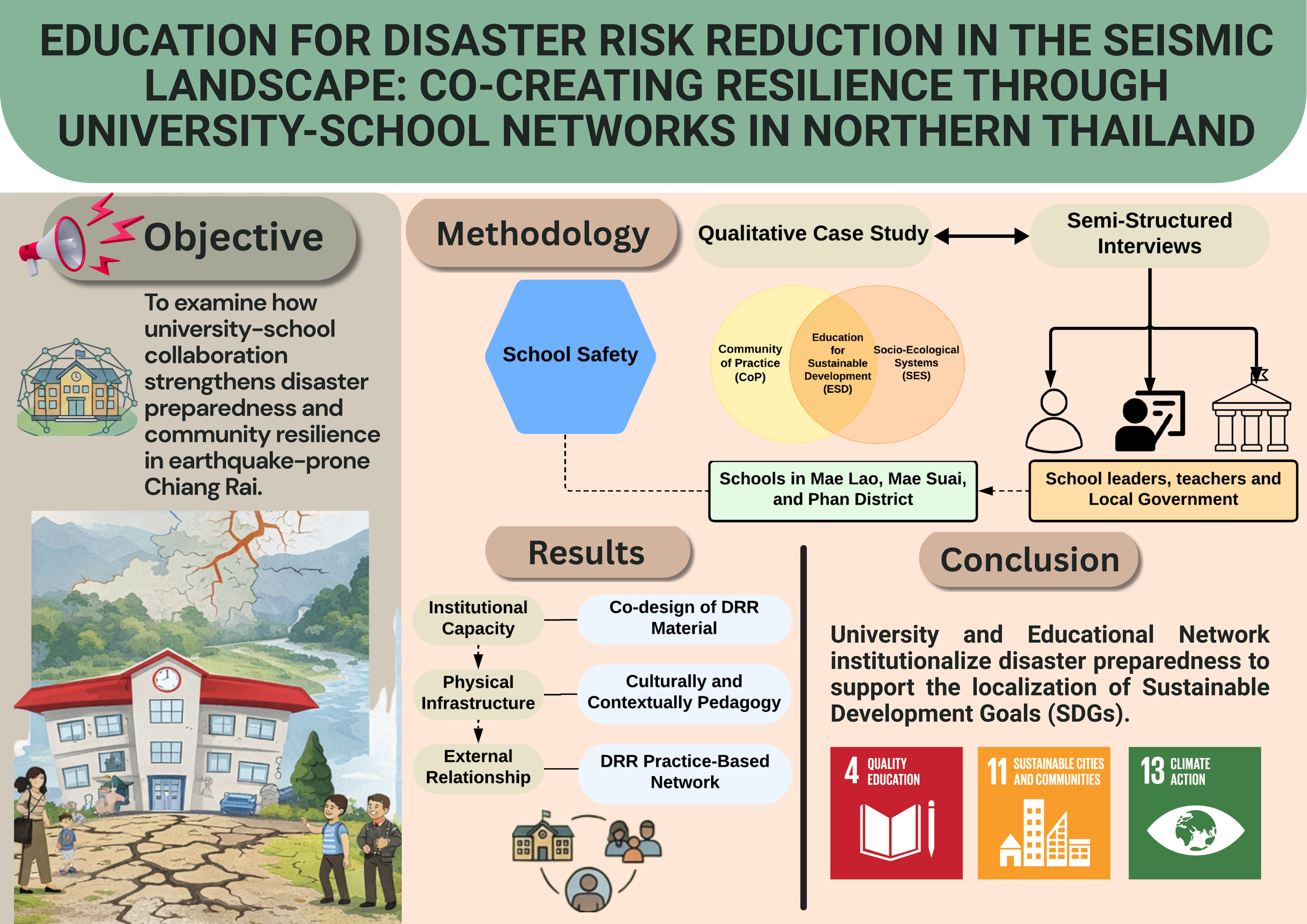
This study examined how university-school collaborations can serve as transformative platforms for building community resilience and promoting sustainable development in Chiang Rai Province, Northern Thailand, which was affected by the 2014 earthquake and is exposed to transboundary seismic risks from the 2025 Myanmar earthquake. The research investigated the role of educational partnerships in fostering long-term adaptive capacity. Adopting a qualitative exploratory design, the study was guided by a composite conceptual framework that integrates the Community of Practice, Social-Ecological System, and Education for Sustainable Development (ESD) perspectives. Data was gathered through in-depth interviews and content analysis involving purposively selected informants, including government officials, school principals, and educators. The study analyzed three core dimensions of school safety: institutional capacity, physical infrastructure, and external relationships. The findings revealed that resilience is not merely a product of engineering solutions or administrative mandates but emerges from deeply rooted knowledge and collaborative practices among diverse educational and community actors. The university-school network operates as a dynamic community of practice, facilitating mutual learning, cross-generational engagement, and participatory knowledge production. These networks strengthen the schools’ roles as integral centers within a broader social-ecological risk governance system, fostering iterative adaptation and context-sensitive responses to disaster threats. Furthermore, the research demonstrates how such partnerships contribute to the realization of global sustainability goals, particularly SDG 4 (Quality Education), SDG 11 (Sustainable Cities and Communities), and SDG 13 (Climate Action), by integrating disaster preparedness, ecological thinking, and civic responsibility into the educational system.
Downloads
Article Details

This work is licensed under a Creative Commons Attribution-NonCommercial-NoDerivatives 4.0 International License.
All rights reserved. Apart from citations for the purposes of research, private study, or criticism and review,no part of this publication may be reproduced, stored or transmitted in any other form without prior written permission by the publisher.
References
Akkerman, S. F., & Bakker, A. (2011). Boundary crossing and boundary objects. Review of Educational Research, 81(2), 132–169. https://doi.org/10.3102/0034654311404435
Baškarada, S. (2014). Qualitative case study guidelines. The Qualitative Report, 19(40), Article 24. https://doi.org/10.46743/2160-3715/2014.1008
Choi, J., & Choi, C. (2018). The application of Hyangyak based on communities of practice for disaster prevention education and its implications. Journal of the Korean Society of Hazard Mitigation, 18(6), 69–78. https://doi.org/10.9798/KOSHAM.2018.18.6.69 [in Korean]
Cutter, S. L., Barnes, L., Berry, M., Burton, C., Evans, E., Tate, E., & Webb, J. (2008). A place-based model for understanding community resilience to natural disasters. Global Environmental Change, 18(4), 598–606. https://doi.org/10.1016/j.gloenvcha.2008.07.013
Dania, M., Inpin, W., Juwitasari, R., Miyake, Y., Takeuchi, Y., & Maki, T. (2022). The production of safety school space from climate disasters in Doi Mae Salong forest, upland Northern Thailand. Forest and Society, 6(2), 763–788. https://doi.org/10.24259/fs.v6i2.20739
de Oliveira, M. P. P., Valdanha Neto, D., & de Figueiredo, R. A. (2024). (Re)constructing socio-ecological resilience from school education: A proposal for an indicator system. Ambiente & Sociedade, 27, Article e00183. https://www.scielo.br/j/asoc/a/h6YyhQdthyKHrmSXL96mQKS/?format=pdf&lang=en
Fadli, M. K., Waramlah, R., Puganeswary, T., Navindrakumar, K., Juni, M. H., & Rosliza, A. M. (2018). Public health impact of natural disaster: Socio-ecological perspective. International Journal of Public Health and Clinical Sciences, 5(2), 56–67. https://publichealthmy.org/ejournal/ojs2/index.php/ijphcs/article/download/609/447
Farley, D. M. (2020). Crisis as a constant: Understanding the communicative enactment of communities of practice within the Extension Disaster Education Network (EDEN) [Master’s thesis, University of Montana]. ScholarWorks at University of Montana. https://scholarworks.umt.edu/etd/11655
Franco, I. B., & Tracey, J. (2019). Community capacity-building for sustainable development: Effectively striving towards achieving local community sustainability targets. International Journal of Sustainability in Higher Education, 20(4), 691–725. https://doi.org/10.1108/IJSHE-02-2019-0052
Fu, Q., & Zhang, X. (2024). Promoting community resilience through disaster education: Review of community-based interventions with a focus on teacher resilience and well-being. PLoS ONE, 19(1), Article e0296393. https://doi.org/10.1371/journal.pone.0296393
Galdames, I. S., & Saracostti, M. (2024). Educational alliances for climate action: Analysis of partnerships between universities and schools in education for sustainability. In A. Abreu, J. V. Carvalho, A. Mesquita, A. Sousa Pinto, & M. Mendonça Teixeira (Eds.), Perspectives and trends in education and technology (pp. 75–86). Springer. https://doi.org/10.1007/978-3-031-78155-1_8
Laosunthara, A., Thongthip, R., & Krutphong, K. (2025). Navigating legal frameworks for national resilience: A comparative analysis of key disaster management laws in Thailand and Japan. In 2025 Fourth International Symposium on Instrumentation, Control, Artificial Intelligence, and Robotics (ICA-SYMP) (pp. 76–79). IEEE. https://doi.org/10.1109/ICA-SYMP63674.2025.10876468
Lave, J., & Wenger, E. (1991). Situated learning: Legitimate peripheral participation. Cambridge University Press.
Lin, Y., Kelemen, M., & Kiyomiya, T. (2021). Bridging community resilience and sustainable tourism development via post-disaster education tourism in rural Japan. The Journal of Organization and Discourse, 2(1), 32–44. https://doi.org/10.36605/jscos.2.1_32
Liu, F., Dai, E., & Yin, J. (2023). A review of social-ecological system research and geographical applications. Sustainability, 15(8), Article 6930. https://doi.org/10.3390/su15086930
Miles, S. B., Burton, H. V., & Kang, H. (2019). Community of practice for modeling disaster recovery. Natural Hazards Review, 20(1), Article 04018023. https://doi.org/10.1061/(ASCE)NH.1527-6996.0000313
Modica, M., & Zoboli, R. (2016). Vulnerability, resilience, hazard, risk, damage, and loss: A socio-ecological framework for natural disaster analysis. Web Ecology, 16(1), 59–62. https://doi.org/10.5194/we-16-59-2016
Neuendorf, K. A. (2018). Content analysis and thematic analysis. In P. Brough (Ed.), Advanced research methods for applied psychology: Design, analysis and reporting (pp. 211–223). Routledge.
Norris, F. H., Stevens, S. P., Pfefferbaum, B., Wyche, K. F., & Pfefferbaum, R. L. (2008). Community resilience as a metaphor, theory, set of capacities, and strategy for disaster readiness. American Journal of Community Psychology, 41(1–2), 127–150. https://doi.org/10.1007/s10464-007-9156-6
Oktari, R. S., Shiwaku, K., Munadi, K., Syamsidik, & Shaw, R. (2015). A conceptual model of a school-community collaborative network in enhancing coastal community resilience in Banda Aceh, Indonesia. International Journal of Disaster Risk Reduction, 12, 300–310. https://doi.org/10.1016/j.ijdrr.2015.02.006
Oktari, R. S., Shiwaku, K., Munadi, K., Syamsidik, & Shaw, R. (2018). Enhancing community resilience towards disaster: The contributing factors of school-community collaborative network in the tsunami affected area in Aceh. International Journal of Disaster Risk Reduction, 29, 3–12. https://doi.org/10.1016/j.ijdrr.2017.07.009
Ornthammarath, T., Chua, C. T., Suppasri, A., & Foytong, P. (2023). Seismic damage and comparison of fragility functions of public and residential buildings damaged by the 2014 Mae Lao (Northern Thailand) earthquake. Earthquake Spectra, 39(1), 126–147. https://doi.org/10.1177/87552930221131830
Pananont, P., Herman, M. W., Pornsopin, P., Furlong, K. P., Habangkaem, S., Waldhauser, F., Wongwai, W., Limpisawad, S., Warnitchai, P., Kosuwan, S., & Wechbunthung, B. (2017). Seismotectonics of the 2014 Chiang Rai, Thailand, earthquake sequence. Journal of Geophysical Research: Solid Earth, 122(8), 6367–6388. https://doi.org/10.1002/2017JB014085
Paton, D. (2013). Disaster resilient communities: Developing and testing an all-hazards theory. Journal of Integrated Disaster Risk Management, 3(1), 1–17. https://doi.org/10.5595/idrim.2013.0050
Rahman, A.-U., & Shaw, R. (2015). Disaster resilience: Generic overview and Pakistan context. In A.-U. Rahman, A. Khan, & R. Shaw (Eds.), Disaster risk reduction approaches in Pakistan (pp. 53–73). Springer.
Ross, H., & Berkes, F. (2014). Research approaches for understanding, enhancing, and monitoring community resilience. Society & Natural Resources, 27(8), 787–804. https://doi.org/10.1080/08941920.2014.905668
Servant-Miklos, V. (2022). Environmental education and socio-ecological resilience in the COVID-19 pandemic: Lessons from educational action research. Environmental Education Research, 28(1), 18–39. https://doi.org/10.1080/13504622.2021.2022101
Shiel, C., Filho, W. L., Finisterra do Paço, A. M., & Brandli, L. L. (2016). Evaluating the engagement of universities in capacity building for sustainable development in local communities. Evaluation and Program Planning, 54, 123–134. https://doi.org/10.1016/j.evalprogplan.2015.07.006
Songlar, T., Panjaphothiwat, N., La-or, P., Chomchoe, C., & Khunthason, S. (2019). Knowledge, attitude and practice (KAP) of earthquake preparedness amongst the elderly in risk areas, Chiang Rai, Thailand. Journal of Health Research, 33(1), 2–13. https://doi.org/10.1108/JHR-12-2018-0167
Stake, R. E. (2005). Qualitative case studies. In N. K. Denzin & Y. S. Lincoln (Eds.), The Sage handbook of qualitative research (3rd ed., pp. 443–466). Sage.
Stephens, J. C., Hernández, M. E., Román, M., Graham, A. C., & Scholz, R. W. (2008). Higher education as a change agent for sustainability in different cultures and contexts. International Journal of Sustainability in Higher Education, 9(3), 317–338. https://doi.org/10.1108/14676370810885916
Sun, Y., Yamori, K., & Kondo, S. (2013). Disaster education based on community of practice—A case study in Okitsu, Kochi prefecture. Journal of Integrated Disaster Risk Management, 3(1), 92–106. https://doi.org/10.5595/idrim.2013.0056
Thomas, L. (2022). University-community collaboration for a sustainable school-based program for the holistic education and wellness of adolescents. ECS Transactions, 107(1), Article 14855. https://doi.org/10.1149/10701.14855ecst
Tong, T. M. T., Shaw, R., & Takeuchi, Y. (2012). Climate disaster resilience of the education sector in Thua Thien Hue province, Central Vietnam. Natural Hazards, 63, 685–709. https://doi.org/10.1007/s11069-012-0178-5
Trencher, G., Yarime, M., McCormick, K. B., Doll, C. N. H., & Kraines, S. B. (2014). Beyond the third mission: Exploring the emerging university function of co-creation for sustainability. Science and Public Policy, 41(2), 151–179. https://doi.org/10.1093/scipol/sct044
Twigg, J. (2009). Characteristics of a disaster-resilient community: A guidance note (version 2). DFID Disaster Risk Reduction NGO Interagency Group. https://discovery.ucl.ac.uk/id/eprint/1346086/
UNESCO. (2017). Education for sustainable development goals: Learning objectives. https://unesdoc.unesco.org/ark:/48223/pf0000247444
Wenger, E. (1998). Communities of practice: Learning, meaning, and identity. Cambridge University Press.
Yamori, K. (2009). Action research on disaster reduction education: Building a “community of practice” through a gaming approach. Journal of Natural Disaster Science, 30(2), 83–96. https://doi.org/10.2328/jnds.30.83?
Yin, R. K. (2018). Case study research and applications: Design and methods (6th ed.). Sage.
